


1. Abstract
For many, penetration into RWA has represented a benchmark of mainstream cryptocurrency adoption: only when we’re able to bridge the onchain world with traditional finance, will crypto be able to establish itself as an appealing mainstream asset.
What was once speculation is slowly turning into a reality, with US Treasuries, bonds, and even real estate being tokenised and brought onchain.
Driven by regulatory clarity and technological maturity, RWA are gaining meaningful traction.
In particular, this report focuses on the Arbitrum ecosystem, a Layer 2 (L2), which has successfully bootstrapped several RWA-focused programs and now has a total value locked (TVL) of over $350m in RWA assets.
This report will provide an overview of RWA on Arbitrum, the programs and initiatives that contributed to this growth, the main assets and providers with case studies, as well as some risk considerations and future outlook.

2. Overview of RWA on Arbitrum
RWA is a booming market. Many early cryptocurrency adopters have fantasised about the day when Wall Street suits would use crypto.
Well, that day has arrived, as RWA are finally onchain and starting to get widely adopted.
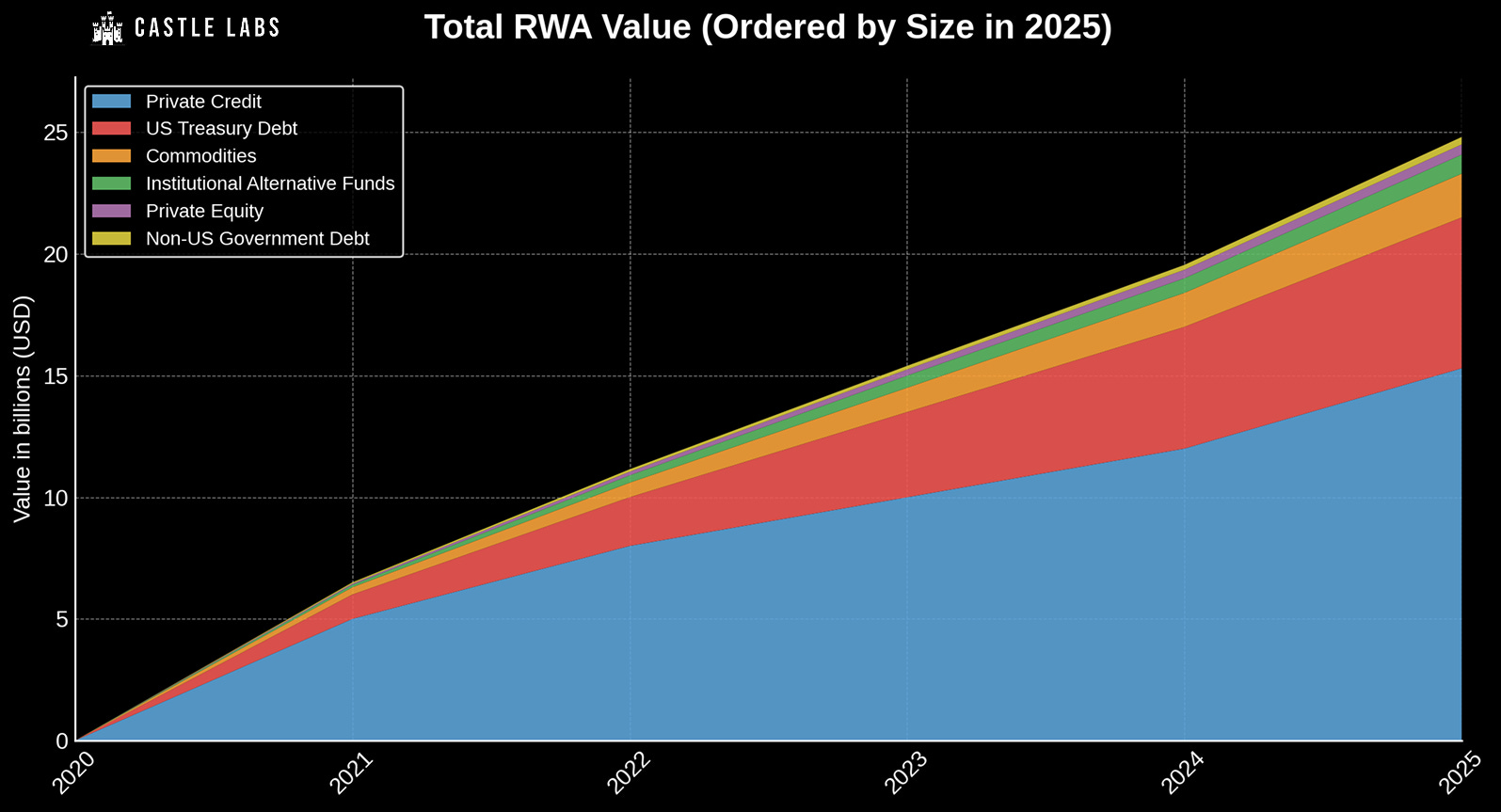
Currently, the total RWA value onchain hovers at over $25b, divided as follows:
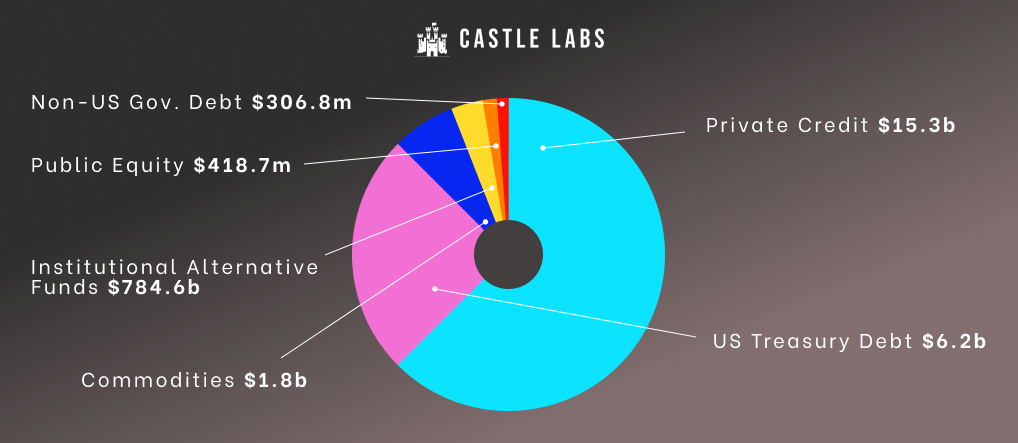
15.3b (60%) in Private Credit
$6.2b (26.9%) in US Treasury Debt
$1.8b (7.2%) in commodities
$784m (3.26%) in Institutional Alternative Funds
$418.7m (1.71%) in Private Equity
$306m (about 1.2%) in Non-US Government Debt
The emergence of RWAs onchain is driven by a convergence of factors:
Regulatory frameworks for digital assets are maturing
Technological infrastructure has reached production-grade reliability
Institutional interest is rapidly accelerating
The gradual acceptance and regulation of cryptocurrencies, including the MiCA in Europe, and the GENIUS Act recently approved in the US, means this category of assets is being slowly legitimised within the broader financial environment.
At the same time, networks like Bitcoin and Ethereum have been up and running for over 10 years now, demonstrating their security guarantees, liveliness and decentralisation.
However, due to their nature, RWA assets require higher guarantees before they can be implemented onchain. For this reason, the emergence of L2s has proven to be particularly appealing for institutional investors, as they reduce the costs of operating onchain by orders of magnitude compared to the Ethereum mainnet.
Among those, Arbitrum is one of the L2s which has experienced the biggest growth within the RWA category.
Why Arbitrum?
Proven tech stack
Credible blockspace neutrality
One of the biggest treasuries in crypto
Arbitrum has demonstrated a solid tech stack: its focus on technology-driven expansion, with developments such as Stylus and Timeboost, has proven itself as a valid alternative to the Ethereum mainnet.
Furthermore, Arbitrum has been leveraged by others in the backend, such as Hyperliquid, as a bridge for USDC, beyond the functionalities of the ecosystem. This is a testament to Arbitrum’s credible neutrality as blockspace. Credible neutrality refers to a blockchain network that operates impartially and treats everyone under the same rules, without favouring any user, application or outcome.
Credible neutrality is essential for:
Trust: Users and institutions are more willing to rely on a platform that won’t change rules arbitrarily or show favouritism.
Security: Neutral systems are more resilient against capture or centralisation.
Composability: DeFi thrives when developers know that no protocol gets special treatment.
Institutional Confidence: For RWAs, neutrality gives assurance that tokenised assets aren’t subject to hidden risks (e.g. censorship, biased governance).
Last but not least, Arbitrum boasts the 6th biggest treasury in the space, with over $1.17b in assets, and one of the most developed stablecoin ecosystems,
With the ability to represent tangible and yield-bearing instruments while guaranteeing the programmability and transparency of blockchain systems, RWAs present new opportunities for diversification, stable yield, and greater capital efficiency for both institutional investors and DAOs.
2.2 Which proposals gave rise to this?
This section provides a short history of RWA within Arbitrum. The initial development of RWAs within Arbitrum has been driven both by the foundation and the Arbitrum DAO.
The initial push of the Arbitrum DAO within RWA assets was led by the Stable Treasury Endowment Proposal, known as STEP, followed by the RWA innovation grants, the treasury management proposal, and last but not least, STEP 2.
STEP (April 2024)
This proposal committed over $85m (35m ARB) within RWA assets to tokenised US treasuries, through institutional issuers.
While the program was intended as a pilot, after an in-depth analysis of the applicants, it successfully selected several providers:
Securitize BUIDL
Ondo’s USDY
Superstate USTB
Mountain Protocol USDM
OpenEden TBill
Backed Finance bIB01
Applicants were selected based on:
Lack of investment restrictions
Companies that have a clear organisational structure and are not segregated from one another
Significant AUM, multiple ISIN exposure, experienced team
Using public or decentralised tools and networks (not only proprietary ones)
The desire to avoid companies with extra decentralised governance layers
The presence of sufficient and detailed documentation
Additionally, to ensure the scope extended beyond this list, STEP also included an annual investment of 1% of the DAO treasury in tokenised RWAs for the next five years. Furthermore, it served as a training ground for a better understanding of the RWA landscape and the tradeoffs between ecosystem growth and principal protection. Future iterations will ideally focus on one of these objectives.
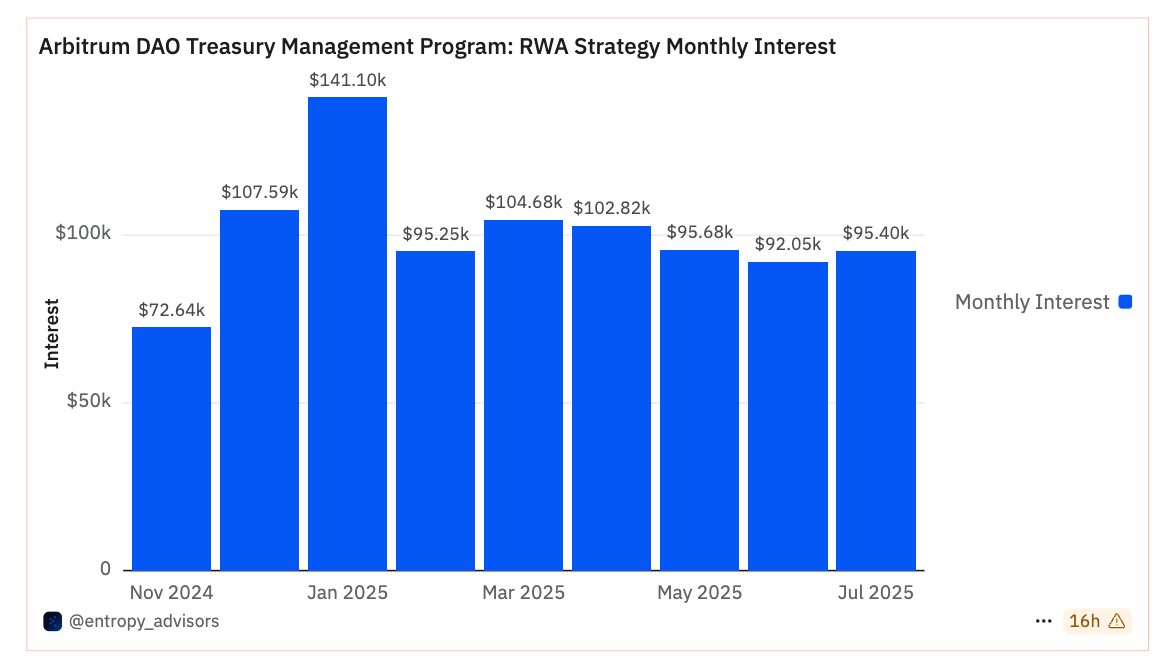
The STEP program was extremely successful, contributing to generating $600k in interest for the Arbitrum DAO in less than a year.
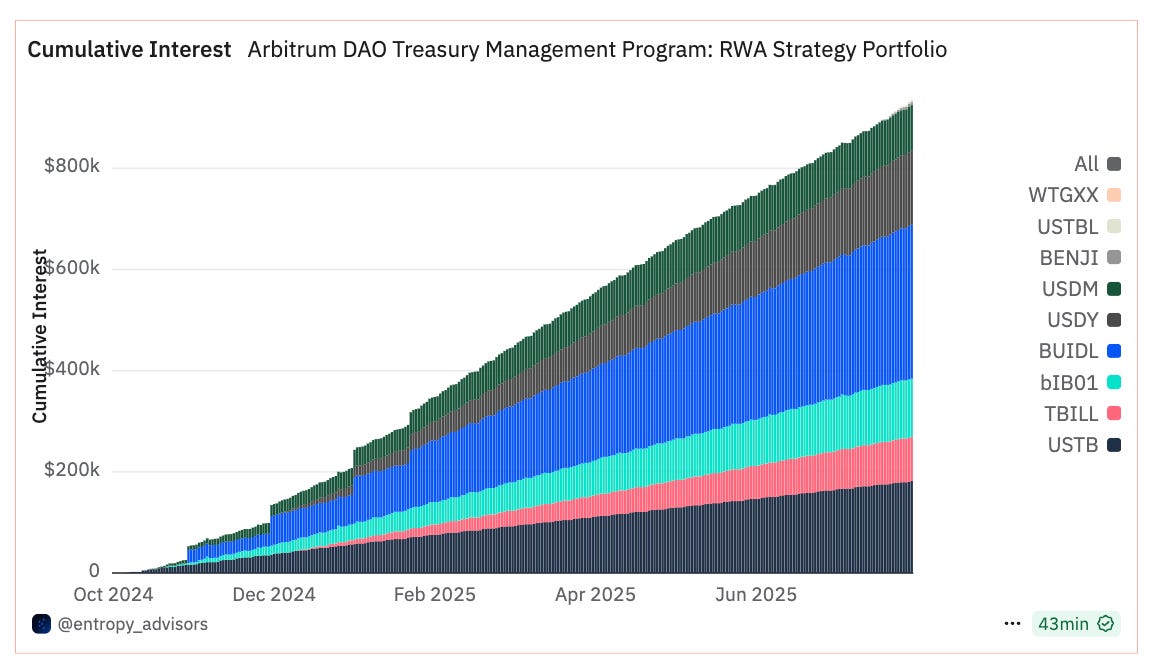
Here’s the cumulative amount divided by month:
What’s special about STEP is that it follows clear principles to deal with institutional service providers:
It directly assesses and selects yield-bearing stable assets, without intermediaries
It is designed as an RFP when protocols can apply with their product and get reviewed
Institutional players are applying directly in a decentralised forum, and the program aims to generate sustainable yield for the DAO.
RWAIG Grants (June 2024)
The Arbitrum Foundation has financed a series of innovation grants (RWAIG), a 2-month pilot initiative running from June to August 2024, to support integration, analytics, and RWA research within Arbitrum, with a budget of 300k ARB.
The main objective of these grants was to:
Critically raise the activity of RWA within Arbitrum, to take the lead and “future-proof platform growth” against competitors.
Explore how to deploy the DAO treasury into RWAs and how to launch onchain tokenisation on Arbitrum
Broader integration of RWA assets and tools within existing ecosystem apps such as GMX, Aave and Pendle.
The program ended up funding 8 different projects:
RWA Research: educating users on the sector
PYOR: an analytics dashboard for RWA
Mystic Finance: a lending market where users can borrow stablecoins using RWA assets
Jia: turning small medium enterprise receivables into tokenised assets.
Truflation: providing real-time data on inflation
Backed Finance: creating structure products tracking securities
Infinfty: creating a ERC-6651 RWA token which tracks the lifecycle of products sourcing, performance, ownership and environmental impact.
Treasury Management (December 2024)
At the end of 2024, a treasury management proposal was brought forward to complement the initial work done by STEP and focus on passive yields via onchain strategies leveraging the ARB token, instead of having idle tokens in the treasury.
Its objectives included:
Asset management: managing 25m ARB tokens to generate yield onchain
Convert stablecoins: simplify conversion of ARB assets into stablecoins, minimising slippage and market impact
Deploy Stablecoins for Liquidity: 15m ARB will be converted into stablecoins and allocated to very low-risk yield-bearing strategies to cover DAO’s expenses or hiring service providers.
Diversification and stability: the focus should be on risk-adjusted returns while preserving capital from risk.
It divided this strategy into two tracks:
Treasury: setting aside 10m ARB for an ARB-only strategy and 15m ARB to be converted into stable and become the DAO’s “checking account”
Growth: 7500 ETH to allocate in DeFi.
STEP 2 (January 2025)
The success of the initial STEP was replicated with the STEP 2 proposal, approving an additional 35m ARB (about $15.7m).
After carefully reviewing over 50 applications, the STEP committee decided to deploy assets according to the following allocations:
WisdomTree WTGXX: 30%
Spiko USTBL: 35%
Franklin Templeton FOBXX (BENJI): 35%
The importance of this program was also reflected in how the DAO perceived it. STEP 2 was approved with a substantial majority, with almost 89% of participants in favour, 11% abstaining and only 0.01% against.
Combined, these programs and initiatives contributed significantly to bootstrapping the presence of RWA onchain assets on Arbitrum, leading to a rise from basically $0 in TVL to over $70m in the space of less than a year.
So where does this leave us?
What’s the RWA landscape on Arbitrum?
The following section will delve deeper into RWA assets, asset providers and RWA growth on Arbitrum, leveraging onchain data.
3. RWA Growth on Arbitrum
With its low-cost, high-throughput architecture and credible neutrality, Arbitrum is rapidly building out an ecosystem of issuers, infrastructure providers, and incentive programs that are bringing RWAs onchain at scale.
While Arbitrum's early focus was on DeFi primitives, DEXs, lending protocols, and yield aggregators, the idea of bringing off-chain assets onchain began gaining traction following the early experiment with tokenised US Treasuries happening on Ethereum in 2022.
Currently, Arbitrum boasts almost $350m in RWA market capitalisation, with over 129 assets tokenised. While this number is impressive, it only represents about 1.39% of the total market capitalisation of RWA assets, suggesting strong potential for future growth.
While widely different, several projections estimate the growth of the onchain RWA sector at:
In the first scenario, the sector is projected to grow by 40x over the next five years.
Being already positioned as one of the most established networks for onchain RWA will translate into a significant competitive advantage for Arbitrum.
Growth of RWA on Arbitrum
In 2024 only, Arbitrum has grown from almost $0 in TVL to almost $85m by the end of the year.
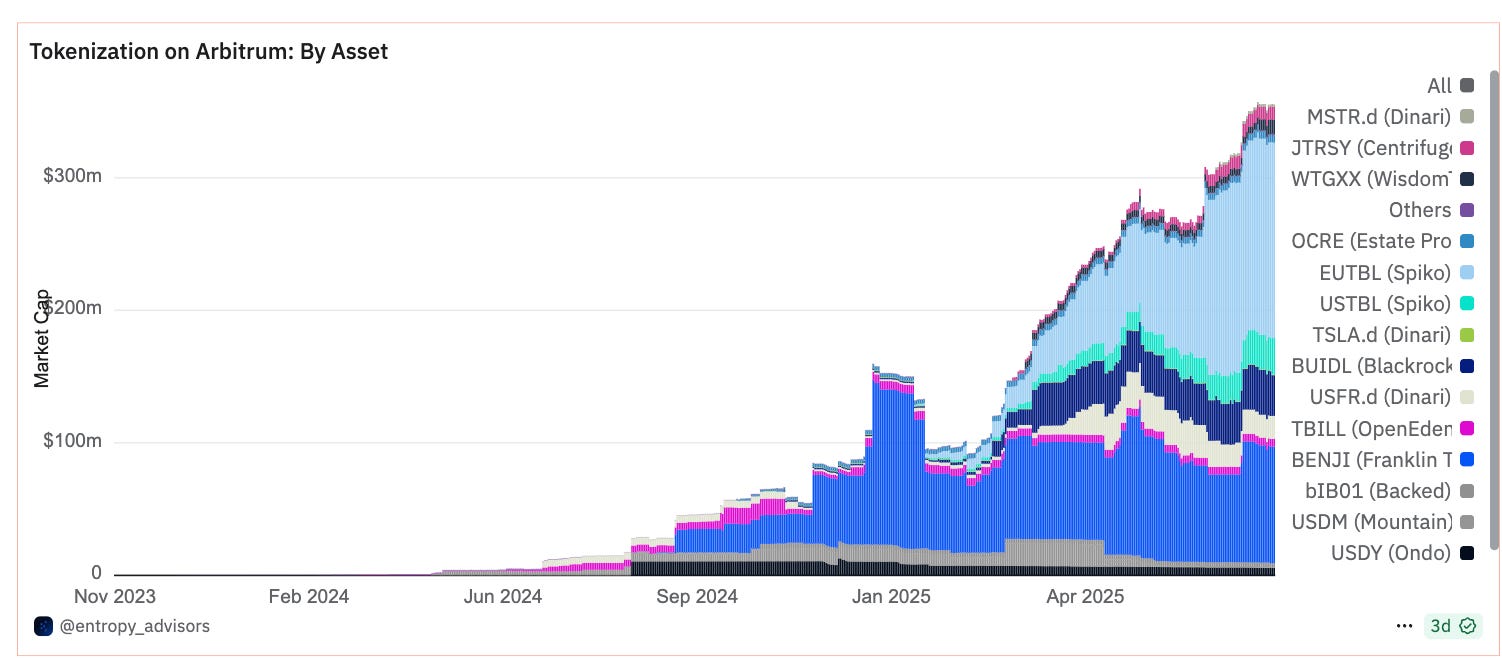
This growth has been characterised by three phases, closely linked to the initiatives highlighted above:
Early Growth: From near-zero, Arbitrum RWA TVL surged past $5M by Q1 2024, indicating early traction.
Major Spike (Q2 2024): In the first half of 2024, TVL rose from ~$20M to ~$70M, coinciding with STEP 1 allocations.
Sustained Expansion: Consistent growth through 2025 as DAO treasury allocations increased (STEP 2), with new RWA issuers joining (e.g., Spiko, WisdomTree, BlackRock).
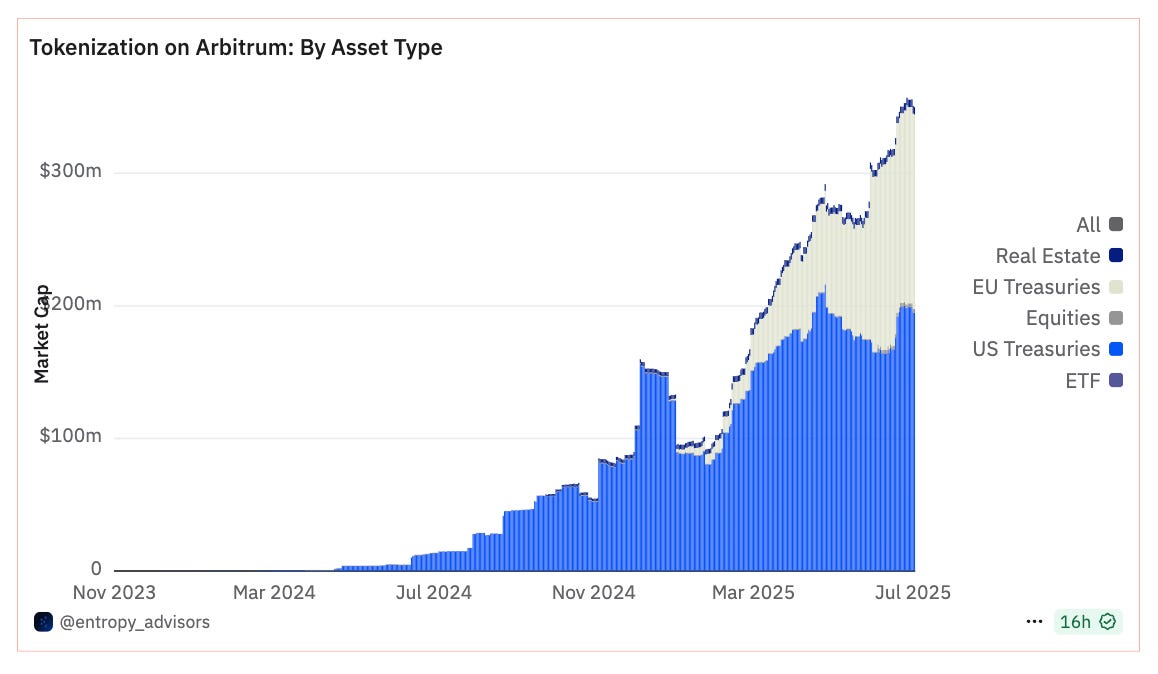
This evolution has also been reflected in the type of assets supported onchain. By 2024, most RWAs were US treasuries. Over time, this has evolved and included new assets.
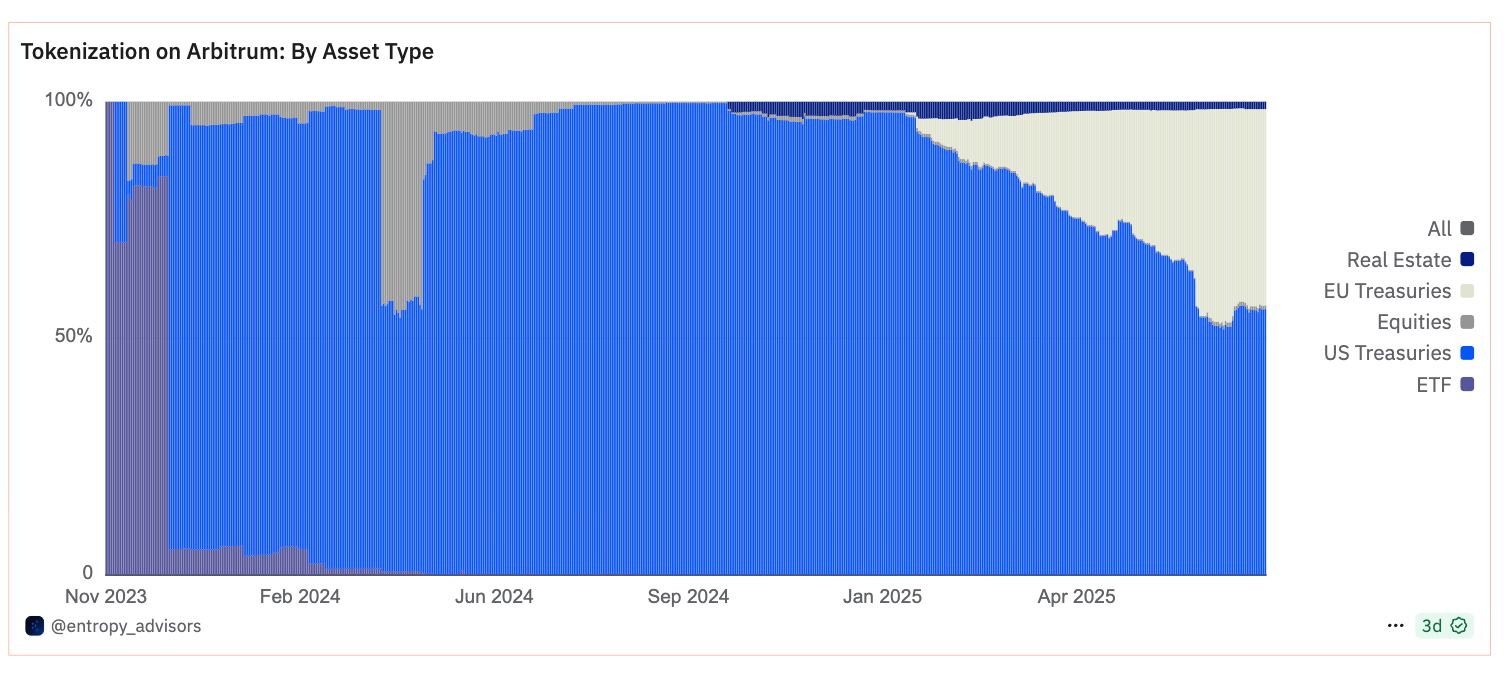
While US treasuries still represent the majority of asset type ($197m), EU treasuries have caught up with them ($150m). Slowly but surely, alternative assets such as Real Estate, Equities and ETFs are also gaining traction.
4. RWA Assets and Providers
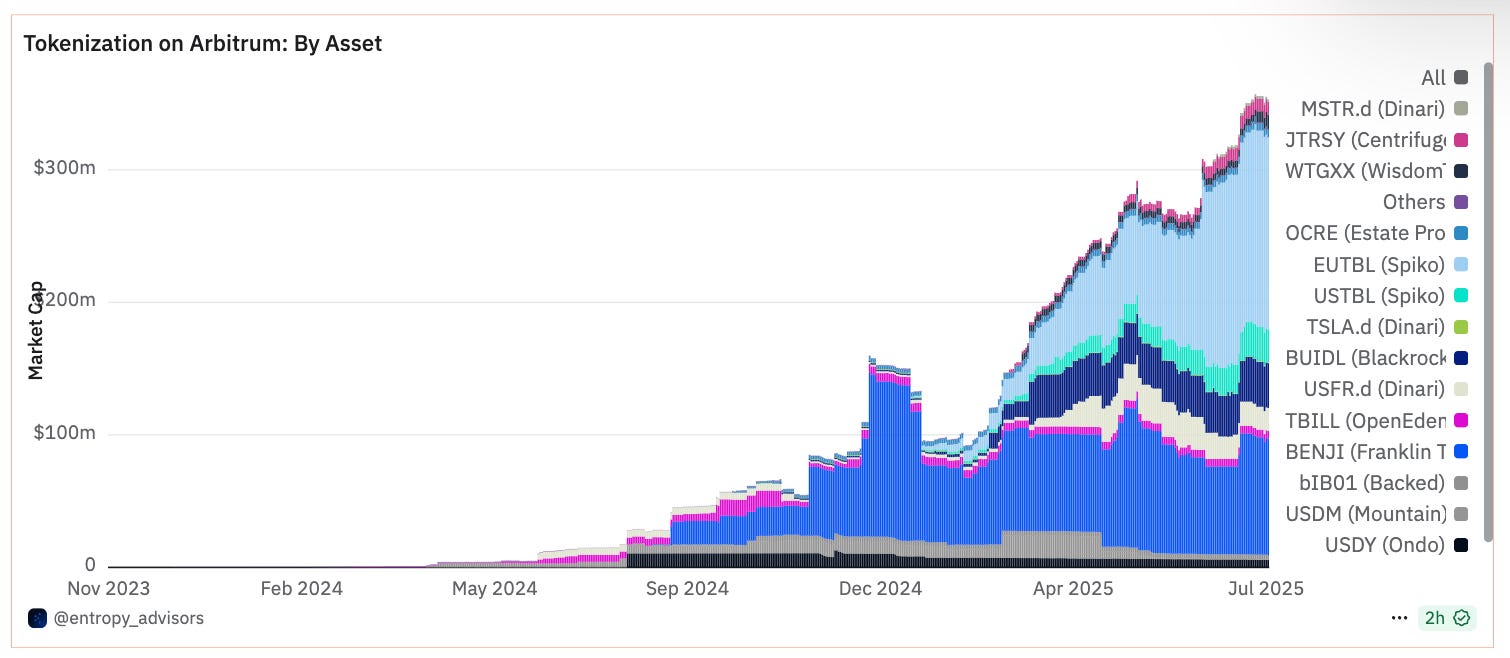
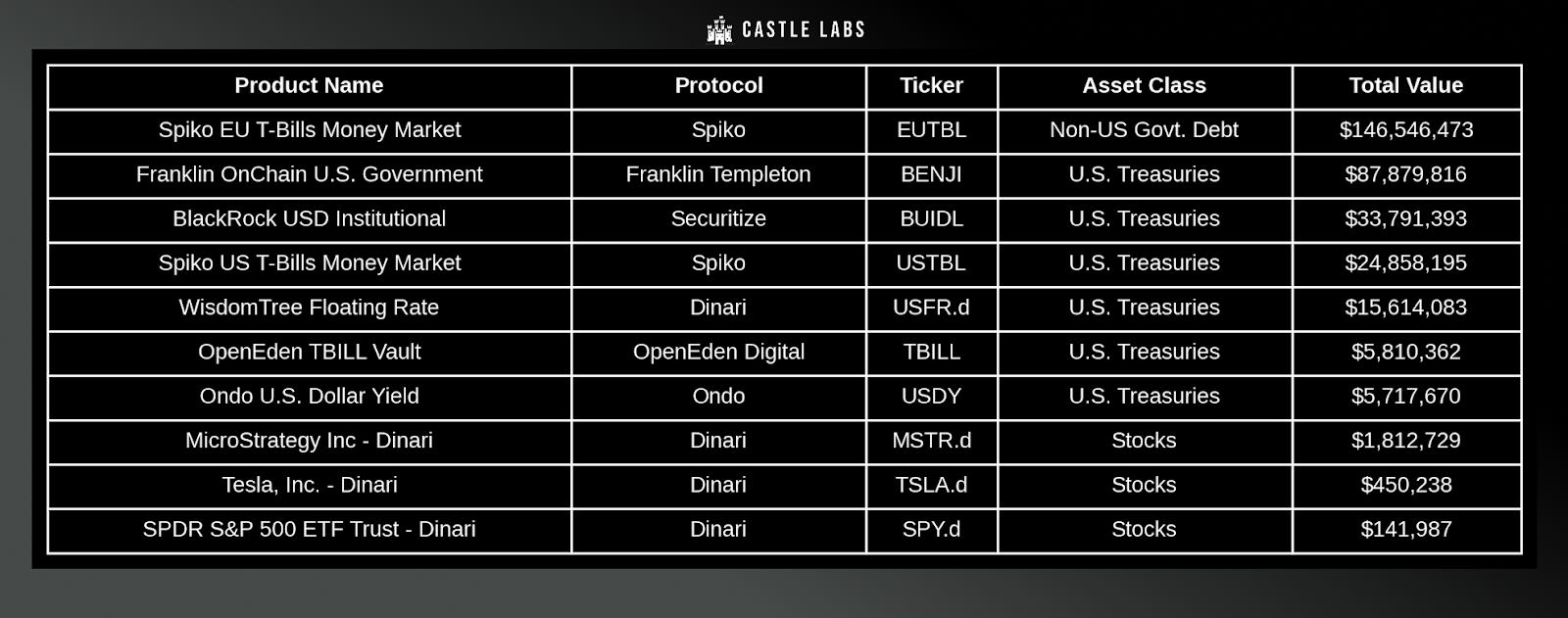
This section dives further into these asset categories, focusing on the top 10 RWA products by total value, divided according to their issuers.
4.1 Spiko
Spiko has built a platform to issue and distribute securities tokenised onchain.
They are licensed by the French Financial Markets Authority (AMF) and have created two money market funds:
Spiko Euro (EUTBL)
Spiko Dollar (USTBL)
These funds are backed by a portfolio of Treasury Bills (T-bills), with returns similar to risk-free rates from central banks. They are currently among the most utilised products with EUTBL ranking first, with $146m in total value, and USTBL ranking fourth, with $24.8m, another proof of how T-bills are the most widely adopted asset onchain.
4.2 Franklin Templeton
Franklin Templeton is an established investment management firm listed on the NYSE (BEN).
To bring tokenised mutual funds onchain, they have launched BENJI, a mobile app with their proprietary recordkeeping system supporting tokenised securities and cryptocurrencies.
Each BENJI token represents a share of their Franklin OnChain U.S. Government Money Fund (FOBXX). Currently, BENJI is the second biggest RWA product on Arbitrum, with over $87m.
4.3 Securitize
Securitize is a platform providing access to tokenised securities to institutional investors.
On Arbitrum specifically, they offer BUIDL, BlackRock’s USD Institutional Digital Liquidity Fund.
It consists of a short-term treasury tokenised product, focused on providing USD yield onchain, which has accrued over $33m in total value.
4.4 Dinari
Dinary allows the creation of tokenised stocks, ETFs, indexes and more, which are referred to as “dShares” and backed 1:1 with the underlying assets.
Dinari features several products within Arbitrum:
WisdomTree Floating Rate Treasury Fund (USFR.d), which provides cost-effective access to US government floating rate notes, with over $15m in total value.
Tokenised MicroStrategy Shares (MSTR.d), with $1.8m in value.
Tokenised Tesla Shares (TSLA.d), $450k in total value.
Tokenised SPDR S&P 500 ETF Trust (SPY.d), an index composed of S&P 500 companies, with about $141k committed.
These assets highlight the potential of stocks and indexes, which are, however, still underrepresented within Arbitrum.
4.5 OpenEden
OpenEden offers access to tokenised US securities and more. The Bermuda Monetary Authority licenses them, operates them with a Digital Asset Business License, and has received an "Investment Grade" by Moody.
Currently, they are the most significant tokenised US treasury issuer in both Europe and Asia. In particular, OpenEden offers a TBILL vault, where users can invest in short-dated US T-bills.
Currently, it has over $5.8m deposited.
4.6 Ondo
Ondo makes institutional financial products available to investors.
In particular, on Arbitrum, they have found good initial traction with USDY, which currently has $5.7m in total value.
USDY is a yield-bearing stablecoin backed by US treasuries, providing a yield of about 4.29% APY.
While Arbitrum features a strong lineup of products and assets, the RWA ecosystem is still nascent.
How this will play out in time will depend on:
Asset expansion at a chain level, servicing broader demand
Strategic focus on RWA as one of the winning niches of Arbitrum
Alignment between Arbitrum Aligned Entities (AAE)
Institutional push at a Business Development level
Future outlook
The initial providers set up by STEP 1 have been reinforced with a new wave of providers during STEP 2, broadening the assets and products available on Arbitrum.
The pace at which Arbitrum has been able to accrue its current total value in RWA allows us to forecast:
A billion-dollar RWA ecosystem
The inclusion of more categories of assets (private credit, real estate, yield-bearing stablecoins)
Deeper interoperability of these assets across networks.
Notwithstanding the current progress, there is significant room for growth for Arbitrum if it wants to strengthen its positioning within this niche. In fact, Arbitrum only ranks 7th among networks for RWA total value. As it stands, Arbitrum’s $350m RWA TVL is a measly 1.39% of the total market capitalisation of RWA onchain assets.
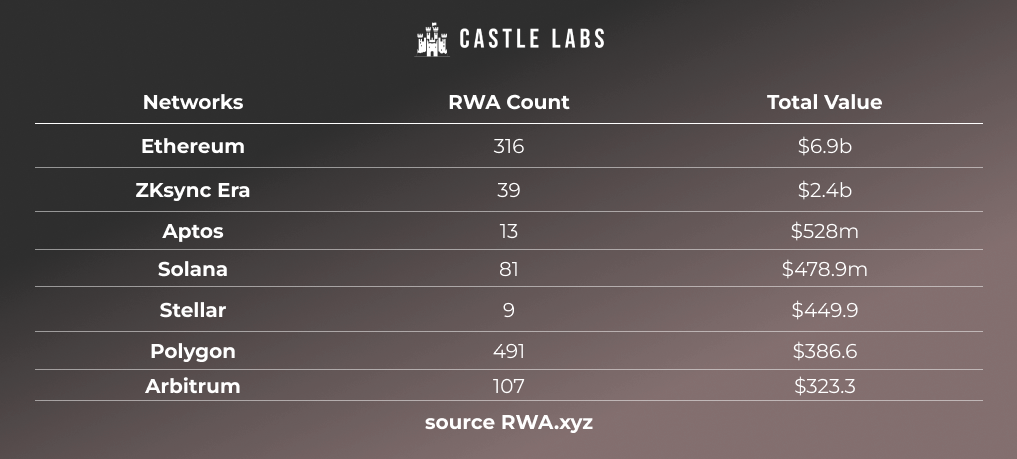
To compete with these networks, more opportunities must be explored concerning private credit issuers, bonds, hard metals such as gold or silver, and stocks.
Due to Entropy’s deep involvement in Treasury Management and RWAs on Arbitrum, we asked their CEO, Matt Fiebach, for his opinion on the future of RWAs on Arbitrum - here’s what he had to say:
“Many RWA issuers today are mainly focused on reducing OpEx related to issuance and transfer, and there is still a way to go to prove that out at scale. That said, the single biggest next unlock for RWAs on Arbitrum will be furthering composability.
It is not just about listing more asset categories or bringing in new providers, that's just step 1. The real unlock is making sure these assets plug into the more efficient onchain primitives the industry has built over the last decade: exchanges, lending, Io’s and Po’s, vault optimization, and whatever comes next. The holy grail is open, permissionless transferability that lets RWAs be as freely composable as native crypto assets. We are not there yet (and it is a moon shot given today’s regulatory realities), but that is the north star.
It is encouraging to see giants like Franklin and WisdomTree actually issuing tokens themselves. That is real institutional involvement, and something I hope to see continue to grow. If we get to a place where user activity with RWAs, such as trading and lending, can actually happen onchain, even if abstracted away and running on permissioned Arbitrum-based rails, the floodgates will open.”
We completely agree with Matt, especially on the aspects of composability and accessibility of these assets. We are at the very beginning of what these assets are capable of onchain. We hope to soon see a world where treasury bills, bonds, stocks, and commodities are not only tokenised onchain, but are spread throughout the range of primitives we can experience in DeFi today.
From a methodological point of view, it’s important to mention that we have excluded stablecoins within this specific report about RWA, as the main focus is to highlight the different assets that are currently available on Arbitrum.
Last but not least, it’s important to mention some risks and considerations following this analysis.
5.1 Risks & Forward-Looking Considerations
Token‑Ecosystem Disconnect: RWA growth does not translate directly into ARB token value accrual.
Asset Concentration: T-bills still comprise a very high % of RWA TVL, highlighting the need for diversification into different asset categories such as private credit, corporate bonds and real estate.
Regulatory Dynamics: While regulation is improving and legitimising cryptocurrency, compliance frameworks for tokenised securities are still evolving, while institutional issuance demands clarity and jurisdictional alignment.
The expansion of asset providers and RWA categories like private credit and real estate onchain could push Arbitrum’s ecosystem TVL toward $1 billion by the end of the year.
With the treasury management program and STEP 2 in full swing, we expect additional information and insights, which will provide further insight into the results of these programs as well as future decisions and initiatives.
Conclusion
Arbitrum has grown its RWA TVL from near-zero to $350m in just over a year.
The STEP programs and DAO-driven initiatives were pivotal in bootstrapping early growth. As part of this, a diverse set of institutional-grade products is now live on Arbitrum (e.g., T-bills, money market funds, tokenised equities).
The increasing institutional presence (e.g., Franklin Templeton, WisdomTree) reinforces the role of Arbitrum as a credible, neutral and cost-effective network for institutional DeFi.
But the job is far from done.
Aside from the risks and issues highlighted above, Arbitrum faced several strategic opportunities in the upcoming months.
These involve the expansion into underrepresented RWA categories such as private credit, real estate and commodities, but even more importantly, enhancing the composability of these new offerings, unlocking integrations with core Arbitrum primitives (DEXs, lending protocols, vaults, etc.).
As the ongoing STEP 2 and treasury programs will provide further momentum and learning,
continued alignment between the DAO, aligned entities, and institutional players is critical to long-term leadership in the RWA vertical by Arbitrum.