


BTC has continued to grind higher over the week, whilst ETF inflows top $750M for the third week in a row, logging their first eight-day inflow streak since October. Then, on Friday, BlackRock’s IBIT options open interest ($27.6B) overtook Deribit’s ($26.9B) for the first time, indicating growing institutional appetite for accessing regulated crypto derivatives directly in the U.S.
Life onchain has not been the same story. DeFi fought back after a month of exploits that culminated in the $292M Kelp hack last weekend, leaving Aave with $200M+ of bad debt. In just five days, DeFi United, led by Aave, raised more than 132,000 ETH to backstop the hole. 14 core ecosystem participants got involved, donating or lending large sums, with a sea of smaller donors, too. The relief fund can easily cover the bad debt with defiunited.eth sitting at over $300 million. DeFi will survive. This time, at least.
In this week’s edition, we’ll look more closely at DeFi United, its contributors and their own exposure, along with what would have happened had this not come together. Then we’re on to big growth figures on Solana across ETF flows, and its onchain RWAs. We’ll dive into three major centralised exchanges forging towards an agentic future and what we at Castle see playing out here, before preparing for one of the most anticipated events of the year: the MegaETH TGE, due in two days. All this and lots more, with our analyst also highlighting what Polygon might look like if Polymarket were to depart.
DeFi United crosses $300M
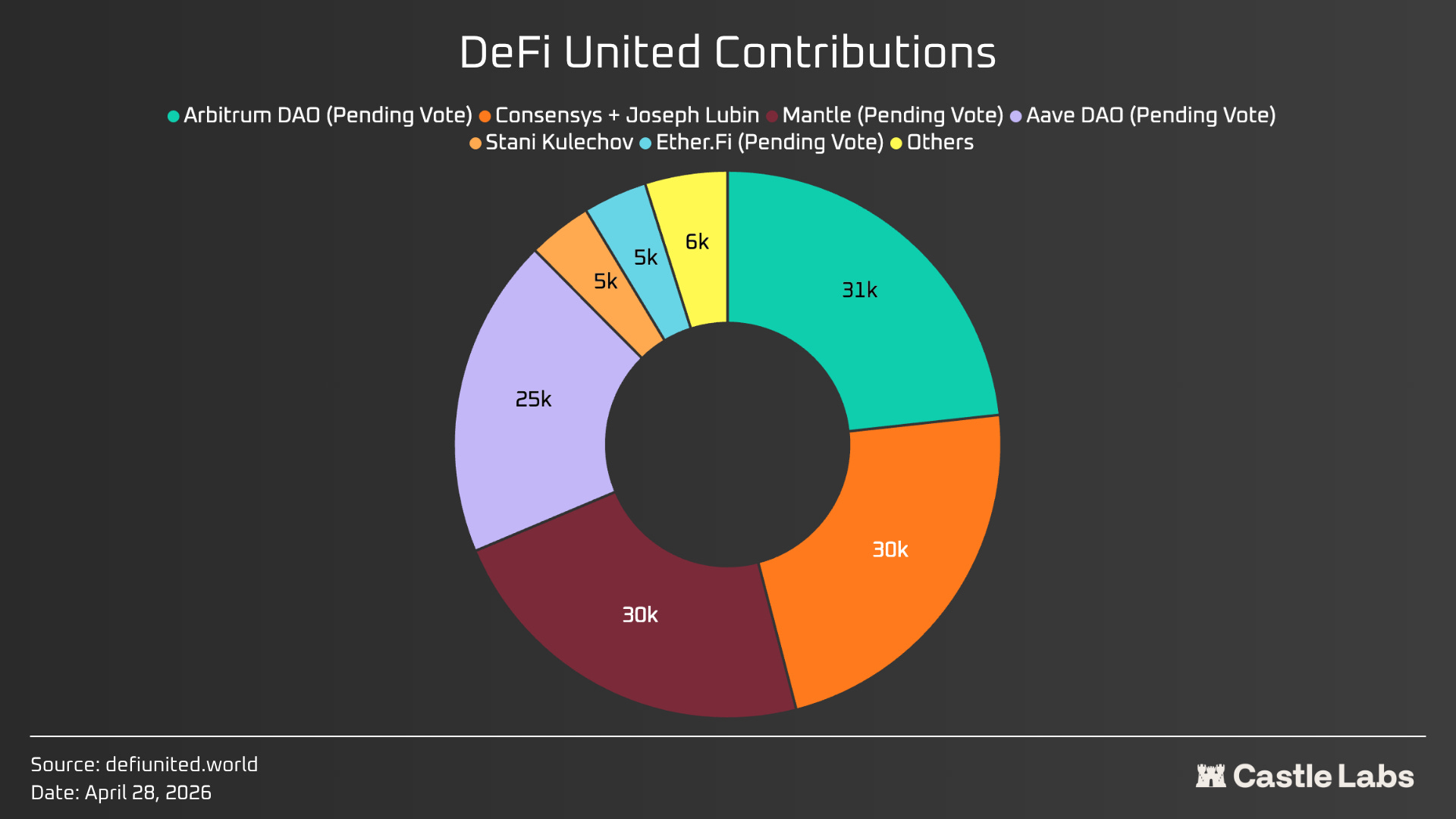
On Sunday, Consensys and Joseph Lubin pledged up to 30,000 ETH, pushing the total relief over 300 million. Contributors surfaced from across DeFi, with Aave DAO (25k ETH), Ether.fi (5k ETH), Stani personally (5k ETH), Lido (2.5k ETH), Kelp DAO (2k ETH), and Golem Foundation (1k ETH) all contributing alongside a 30k ETH 3-year loan from Mantle. These, combined with the 30,000+ ETH held by the Arbitrum DAO after the Security Council’s freezing last week, along with personal donations from Emilio Frangella (500 ETH), VP of Engineering at Aave and Ernesto & BGD Labs (350 ETH). We even saw the Ethereum Foundation cooperating in such a moment, swapping 21,269 aWETH for wstETH as part of Lido’s deleveraging work.
The real question to ask is: How did this happen? How did such a Herculean effort of recovery succeed? The awkward answer is that Aave is too big to fail. It’s too important to too many people that market participants do not lose faith and trust in Aave. This is highlighted by Aave’s Umbrella module, which, while sitting at $54 million in WETH, will not be activated in this recovery effort. In fact, throughout its history, Aave’s insurance protocol has never been used, and, most likely, in order for Aave to remain a beacon of safety and trust, it never will be.
The contributor map also provides some flavour. Below, we look at each contributor, whether they donated or loaned ETH, and what general exposure or alignment they might have to this bad debt.
From top to bottom:
Consensys and Joe Lubin (30k ETH): whilst Linea and MetaMask were not directly affected. Consensys is deeply rooted within Ethereum, and allowing this contagion and cascade to play out would have hit the ETH market cap heavily and negatively impacted onchain activity for some time
Mantle (30,000 ETH, 36-month loan): mETH sits in the LRT category on Aave, and Mantle was facing a 71.45% WETH shortfall under the scenario where losses were confined to L2s. In this set-up, they’ve managed to engineer a commercial outcome. The loan interest is Lido APR + 1%, with $11M of AAVE tokens and 5% of Aave revenue as collateral, and 130k AAVE delegated to the ecosystem for participation in governance.
Aave DAO Treasury (25,000 ETH, pending vote): obviously, Aave is the protocol with the bad debt, and as such, would be expected to be one of the largest contributors. It has chosen to backstop itself, whilst leaving Aave’s Umbrella module intact. In addition to this, Aave now has an active proposal to pause token buybacks, after only just implementing them last year.
EtherFi (5,000 ETH, pending vote): weETH alone accounts for 57.9% of Aave’s WETH borrowing. If the LRT loop trade on Aave dies, EtherFi’s central venue falls with it.
Stani Kulechov (5,000 ETH, personal): As the face of Aave Labs, Stani’s reputation depends on a positive outcome here.
Lido (2,500 stETH conditional + up to $3M EarnETH vault burn): Lido’s EarnETH vault held 9% rsETH exposure, and EarnETH depositors faced up to 9,000 ETH in losses if the relief vehicle didn’t close. The 2,500 stETH is conditional on the full deficit being covered.
Kelp DAO (2,000 ETH): The protocol central to the exploit and that minted the unbacked token.
Golem Foundation & Project (1,000 ETH): No direct LRT exposure. The closest thing to a true ecosystem-solidarity donor on the list.
Emilio Frangella (500 ETH, personal): Aave Labs’ VP of Engineering. Personal donation. Team-aligned, reputational.
Ernesto Boado & BGD Labs (350 ETH): Ernesto is CEO of BGD Labs, the protocol’s previous service provider. Despite BGD Labs leaving Aave, they still showed up to donate here.
LayerZero (amount TBD): The compromised bridge.
Ethena (amount TBD): USDe and sUSDe loopers on Aave were directly affected by the WETH liquidity freeze, and USDe’s collateral basket holds LSTs and LRTs.
Ink Foundation & Tydro (amount TBD): Tydro is a friendly Aave fork on Ink.
Solana captures both ETF and RWA flows
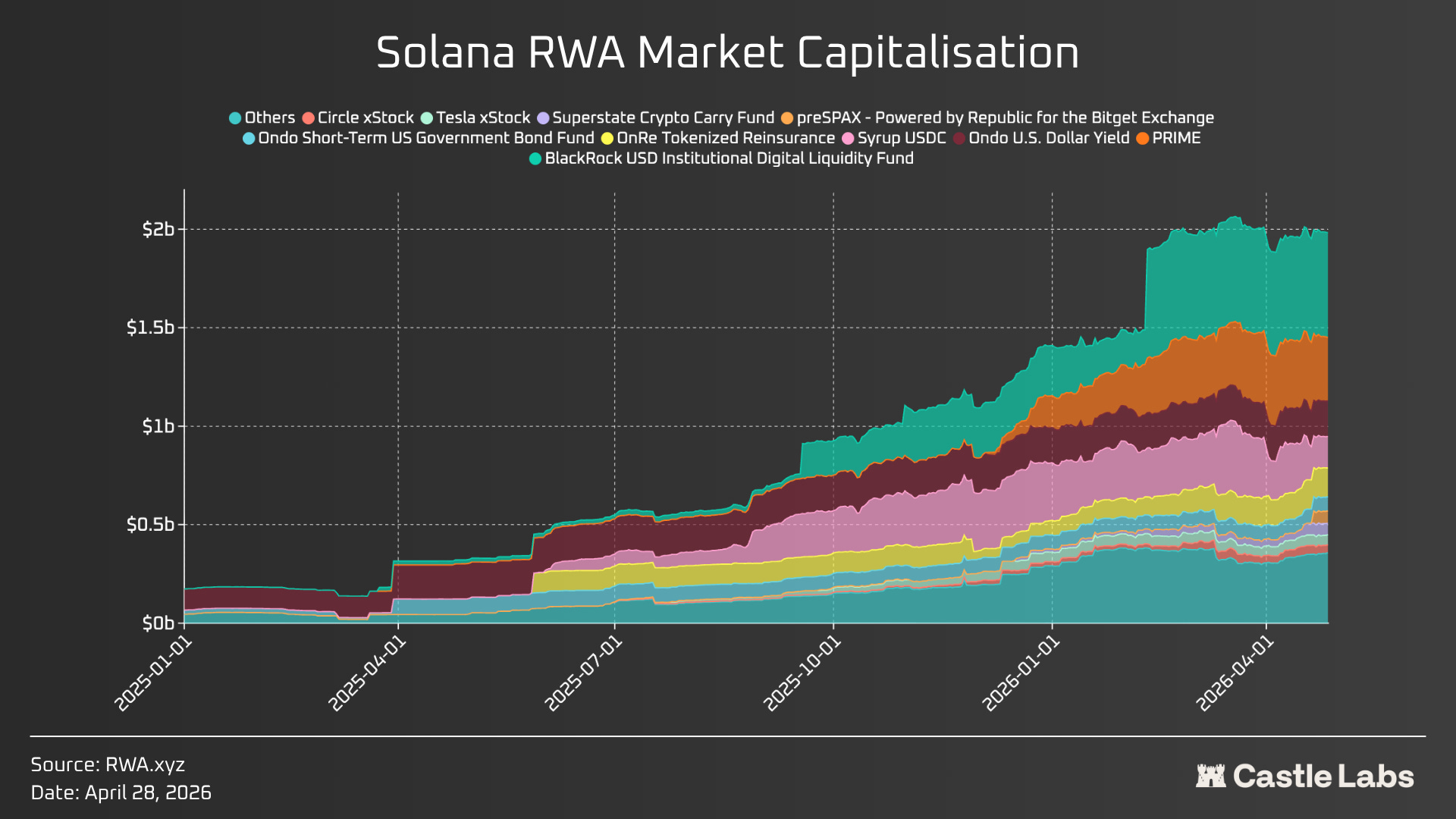
Whilst Ethereum was scrambling to save its DeFi ecosystem from catastrophe, Solana has been hitting positive headlines since the Drift exploit earlier in the month. In the past 12 months, RWAs on Solana have grown from $170M to $2B (excl. stablecoins) as holders on the chain crossed 192,000. Meanwhile, SOL ETFs cleared $1B in cumulative total net inflow in the last two weeks, with large positions held by Goldman Sachs, Morgan Stanley, VanEck, and market makers such as Jane Street.
Despite Solana being on top this week, the Solana Foundation showed its class by lending USDT into Aave for the first time ever in support of the recovery efforts and brought $AAVE onto Solana for trading.
DeFi United.
CEXs going Agentic
Three major exchanges last week deployed products that enable agents to access their platforms, signalling a clear trend towards a change in the user experience on trading platforms. Coinbase shipped Agentic Market on Monday, April 20; Bybit MCP followed on Wednesday, and Binance Agentic Wallet shipped on Friday. Whilst each enables a different level of access for agents and payments, the direction is clear. Agentic Market in particular embraces x402 to provide live pricing, volume data, and integration guides for thousands of services, completely without API keys, accounts, or logins.
We unpacked the broader thesis and why this is just the beginning of agentic finance in a report last week.

MegaETH TGE in 2 days
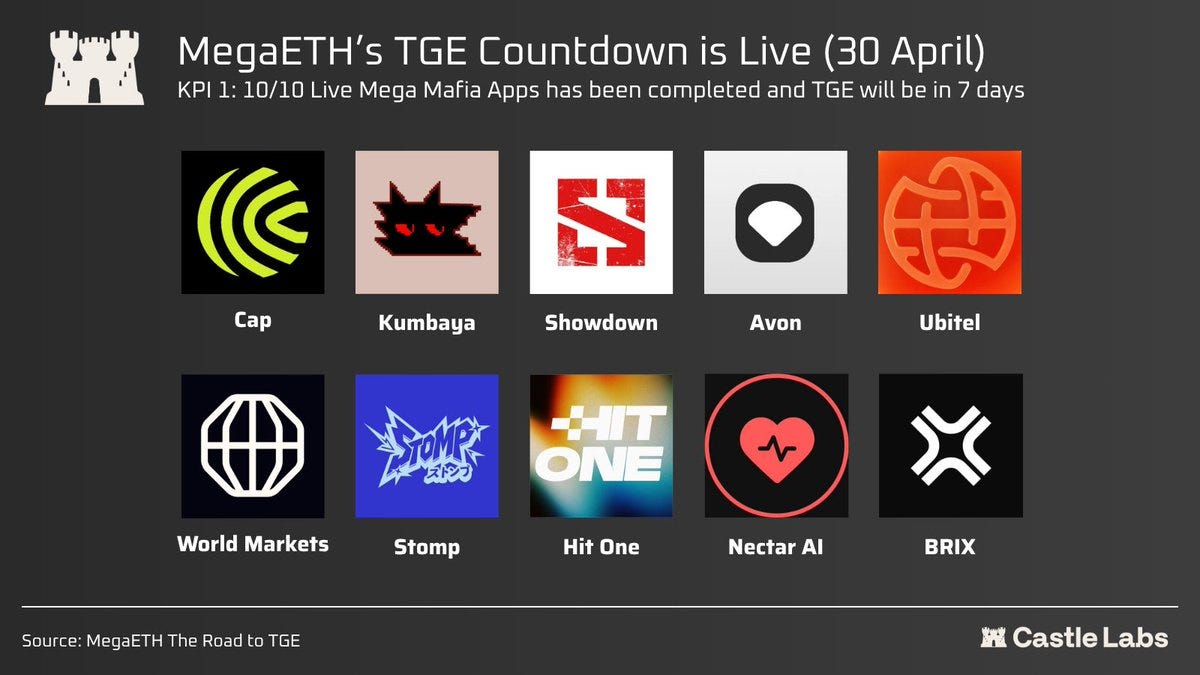
With the launch of Brix last week, KPI 1 on the road to TGE was completed, requiring 10 apps from the Mega Mafia incubator programme to go live.
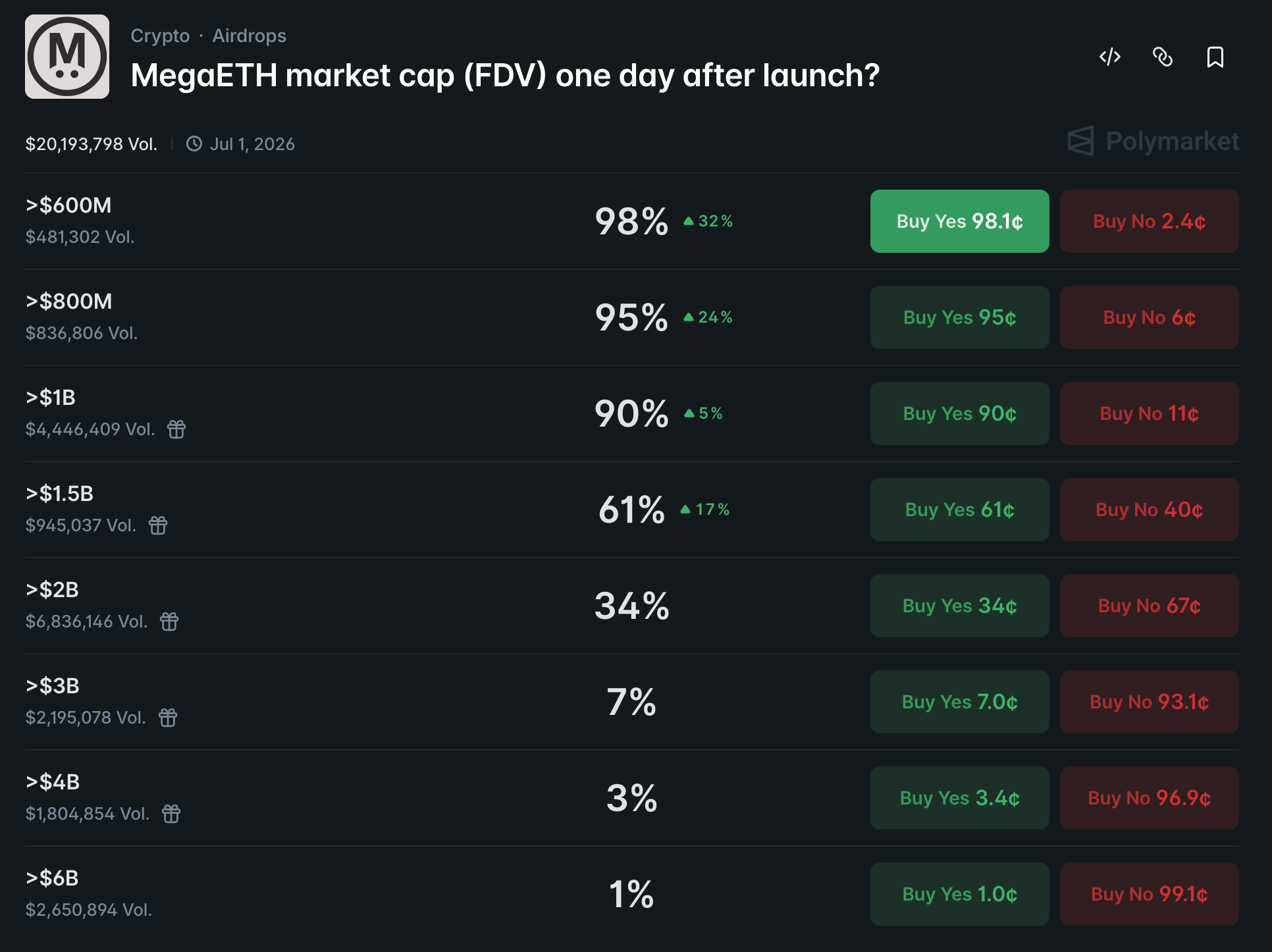
TGE is now just two days away, with speculation rife around opening valuations. The circulating supply is reported to be 6-7%. 1% from the Echo round, 1.25% from Fluffles, around 2% from the public ICO, plus whatever market makers and exchanges may receive. At pre-market, $MEGA is trading around $0.18, putting it at roughly a $1.8B FDV; meanwhile, Polymarket is pricing a 90% chance of launching with an FDV over $1B, matching the ICO price.

Polygon without Polymarket
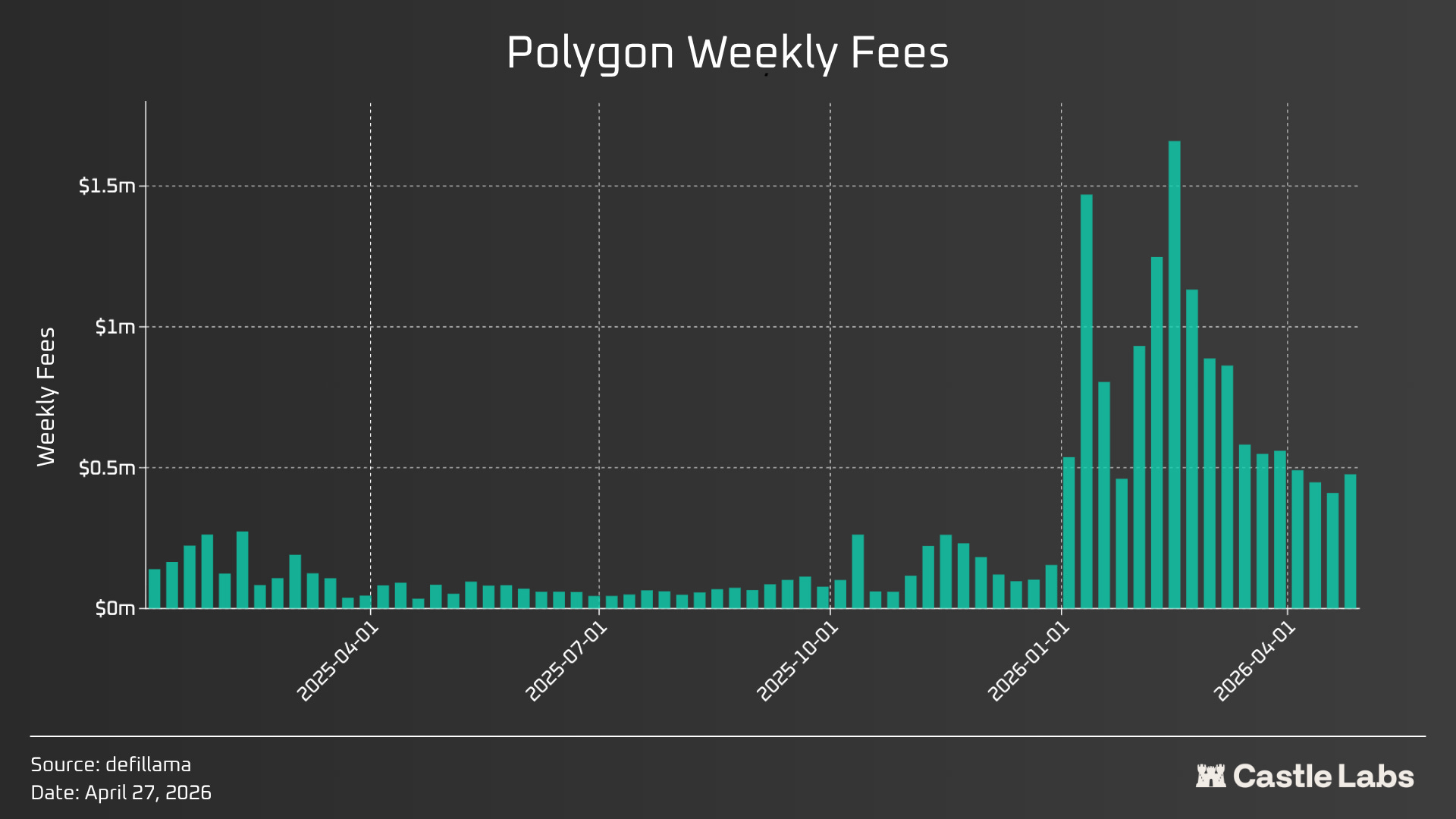
Polygon made $5.65 million in chain fees in 2025. In 2026, they have already surpassed this number, making $13.5 million since the beginning of the year. A large share of the fees comes from Polymarket after they enabled fees through additional contracts on their platform in early January, clubbed with their rising volumes. This is also reflected in the fee spike below in the first week of the year.
To manage this spike in gas usage on the chain, Polygon went live with the Dandeli hard fork on January 9th, 2026, increasing the chain’s throughput to 20 mgas/s. This managed the sudden surge, and fees stabilised for users across the network.
But recently, Josh, VP of Engineering at Polymarket, highlighted that they are considering a chain migration, which could enable cheaper block space, faster transactions, and lower block times for instant settlement. This has sparked a long-overdue conversation around Polygon’s overdependence on the app.
Over the last 30 days, apps on Polygon generated ~$30M in revenue, with Polymarket accounting for 71% of that total. The top three apps account for ~95% of total app revenue, indicating a high concentration of revenue among a few apps. Additionally, this concentration has increased over time.
In comparison, the top three apps account for 42% on Ethereum, 57% on Base, and 46% on Arbitrum, indicating a more distributed revenue profile across those ecosystems. While app revenue concentration alone isn’t sufficient to evaluate a chain’s performance, it provides useful context for understanding where economic activity originates and how dependent the ecosystem is on a small set of applications.
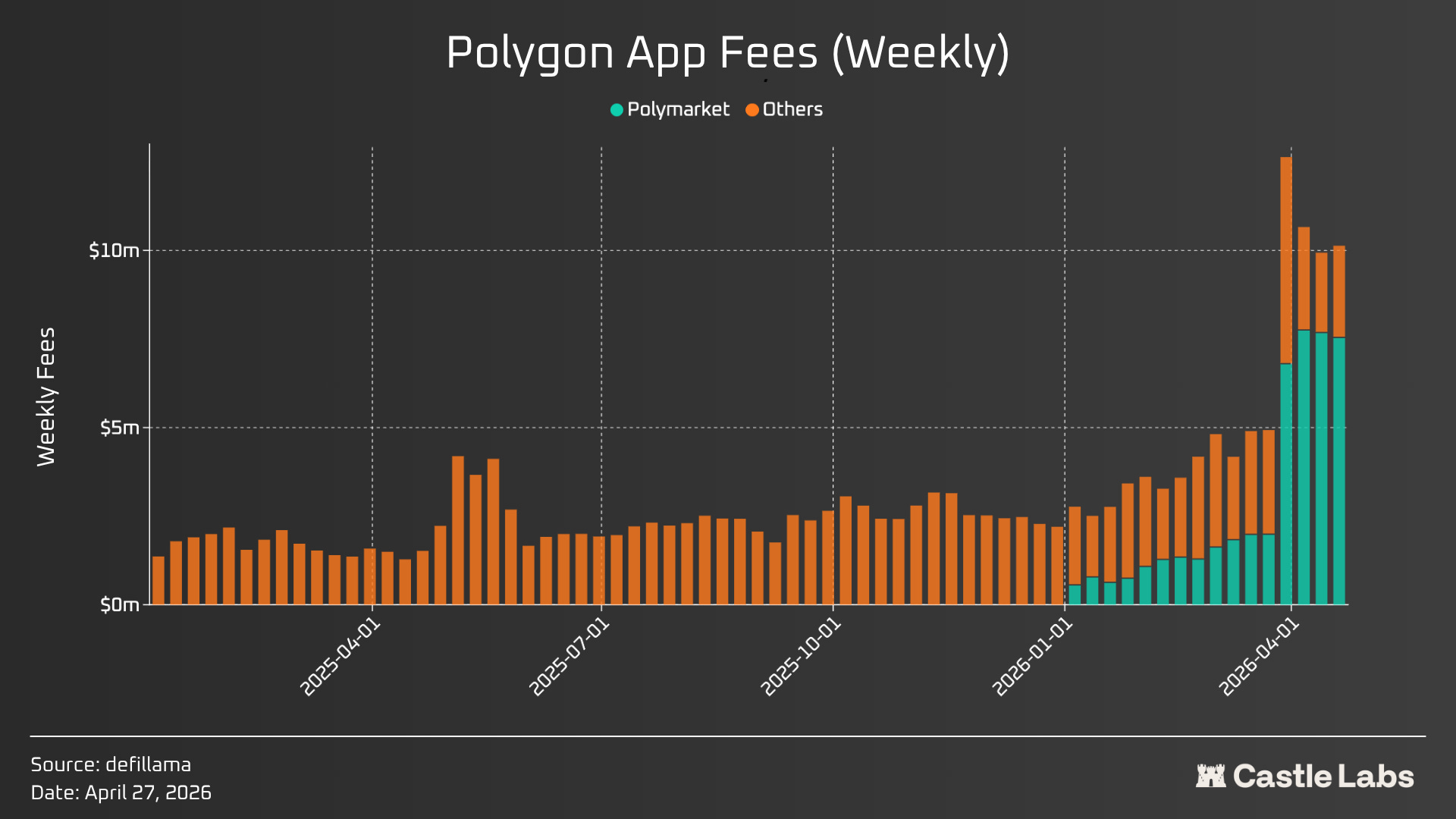
In terms of gas usage, over the last 24 hours, two of the largest gas spenders on the chain were the Polymarket fee contracts, followed by Quickswap, reflecting the activity concentration.
If Polymarket leaves, this revenue leaves Polygon.
The estimated decline in fees is around 60-70% and would leave Polygon with ~$40k in daily fee losses. In the last 30 days, the chain made ~$2m. Removing Polymarket, this number comes down to around $800k, bringing the annualised fees generated to ~$10 million instead of ~$25 million with Polymarket.
On the other hand, Polygon is positioning itself more as a payment network, with a current stablecoin supply of $3.57 billion. Last month, payment apps on Polygon did $2 billion in volume, led by Tazapay, Paxos, Coinflow, and others. Polygon also has a great representation in P2P transfers for micro, small, and medium-sized payments, often competing with Ethereum and Solana.
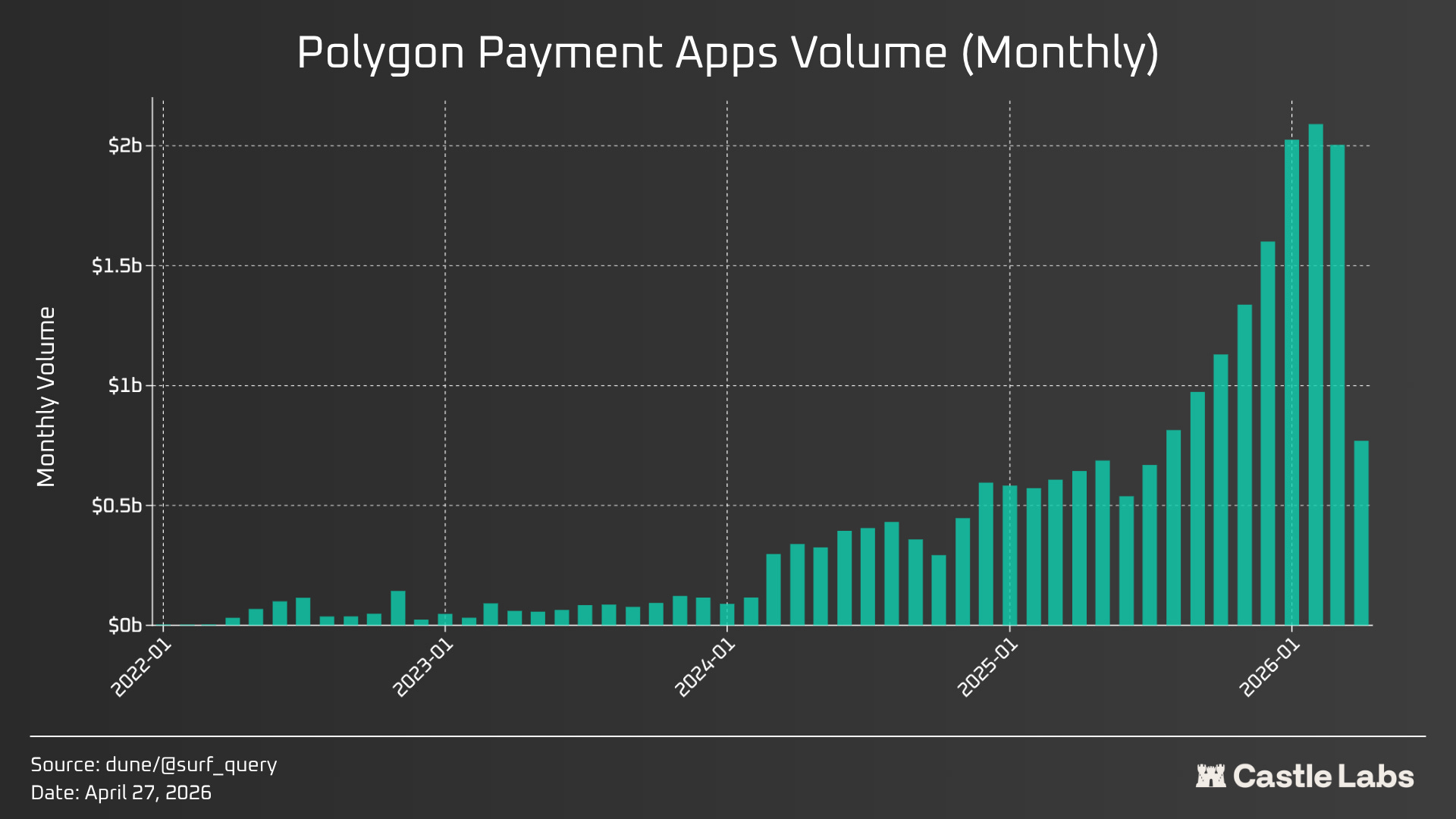
Given these numbers and the different sources of activity and revenue on the chain, Polygon is performing well. But nonetheless, losing the most revenue-generating app on the chain has a significant impact.
What we can speculate on next is where Polymarket may move to, and whether they want their own sovereign chain to control, such as through the Arbitrum, Elastic (ZkSync), Polygon CDK stacks, or simply migrate to a faster chain like MegaETH or Monad. If they’re going to move, they’ll move to their own stack, in our opinion.

MegaETH TGE on Thursday, April 30, the first real test of KPI-gated tokenomics at launch
Aave DAO, Mantle, EtherFi, Arbitrum DAO, and others have governance votes, confirming whether DeFi United’s pledges deploy as expected
Consensus Miami opens May 5, where crypto, finance, tech, and policy announcements are to be expected
This time DeFi was united, next time it won’t be so easy. See you next Tuesday.
Don’t forget to join our Telegram channel for the latest updates from Castle and all our research: Link here
In our newsletter, we may discuss projects or tokens in which we hold positions. While we aim to provide informative content, our views are not financial advice. Please conduct your research and consult professionals before making investment decisions. Crypto markets are volatile, and past performance doesn’t guarantee future results. Invest responsibly, and be aware of the risks. Your capital is at risk, and we do not accept liability for any losses.