

Robotics. Crypto. AI.
This is the Technological Trinity of our generation.
These are the three most disruptive technologies, and some may argue, the last significant technological disruption. That’s why it was super interesting that Virtuals has incorporated a robotics vertical into its stack.
Why would they need to do that?
AI builders have quickly realized that crypto and blockchain are the most effective ways for agents to transact and operate on the Internet. At the same time, robotics builders know that integrating AI into their machines creates an actual autonomous machine capable of following directions and completing IRL tasks.
This creates a symbiosis in which each piece of technology enhances the other. They can obviously live without each other, as not all robots need crypto and not all agents need robots, but when the 3 of them come together, they form a complete loop.
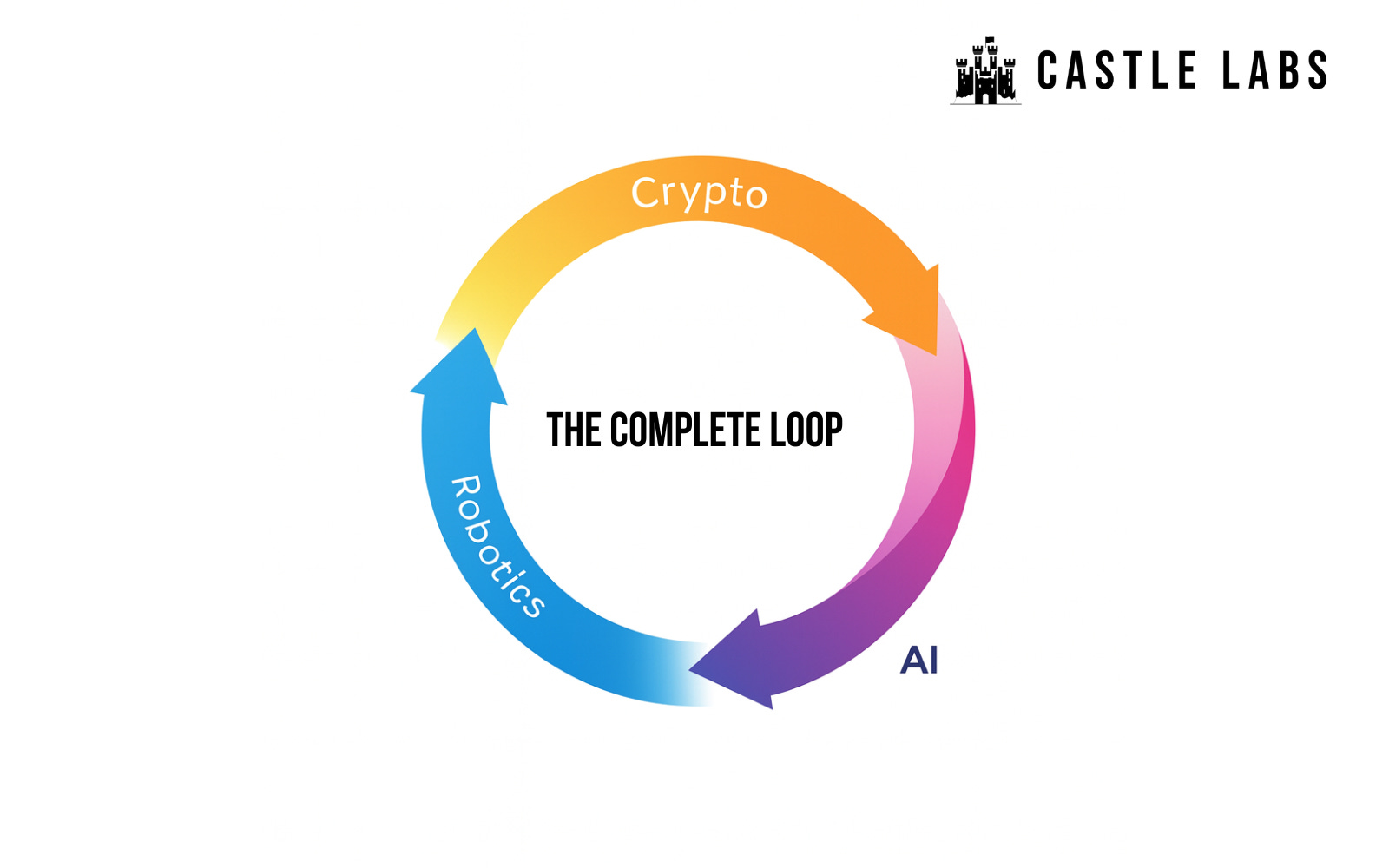
Blockchain enables the coordination of agents/robots at scale, while providing the rails for paying for things, paying each other for services rendered, or even allowing a DAO to control a swarm of autonomous delivery drones.
AI gives robots reasoning and decision-making skills without the need for human handholding, and robots provide a physical execution component, enabling agents to interact with the human world.
This is the perfect symbiosis between technologies, and Virtuals realizes this through the launch of what they refer to as aGDP or agentic GDP.
It is described as “the aggregate output of humans, agents, and machines cooperating across both digital and physical domains.”
This turns digital productivity into something tangible when combined with robots that can operate in physical domains previously untouched by agents.
Virtuals has three main products as its foundation: ACP, Butler, and Unicorn.
The following sections will outline each of them, whilst showcasing how robotics can be integrated into these pillars.
ACP
ACP, or Agent Commerce Protocol, is what the name implies. It enables agent-to-agent transactions, typically involving things like trading, analysis, and research.
But now, with robotics included, ACP can evolve into something more.
Imagine this scenario:
You’re a property developer and need a construction task completed.
You use a research agent that hires a design agent to draft plans.
The research agent then hires a construction robot agent to lay the foundation for the property.
The construction agent hires supply chain agents to order materials for the property.
All transactions settle through ACP.
While this may seem almost too futuristic, the possibilities are endless here. There are numerous use cases available, such as delivery drone swarms hired by a manufacturing agent to deliver products directly to consumers’ homes, or even a farm agent that analyzes weather data in order to hire a robot agent that performs seeding or irrigation tasks.
For those interested in diving deeper, here’s what ACP look like in the backend:•
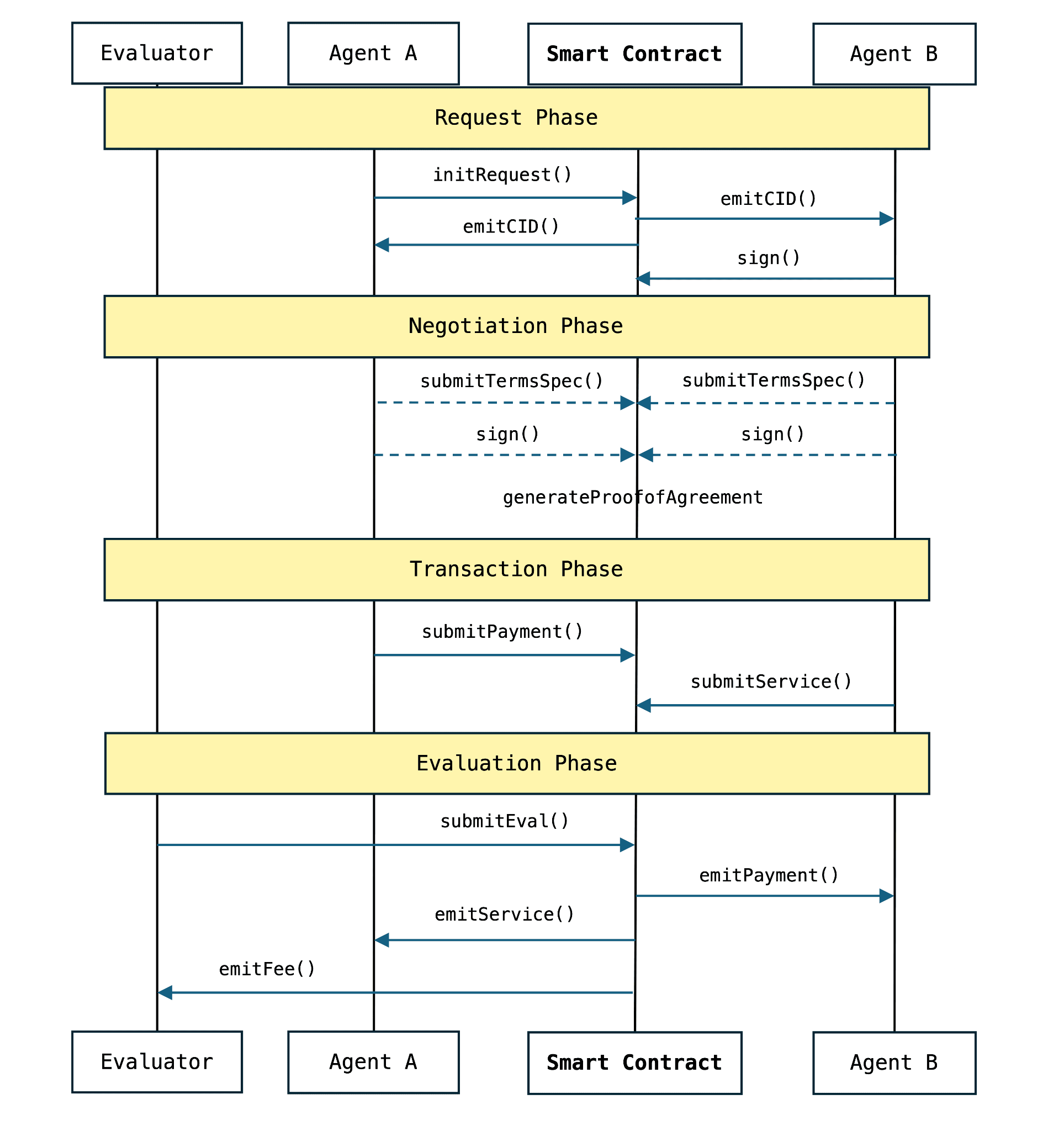
More details can be found here.
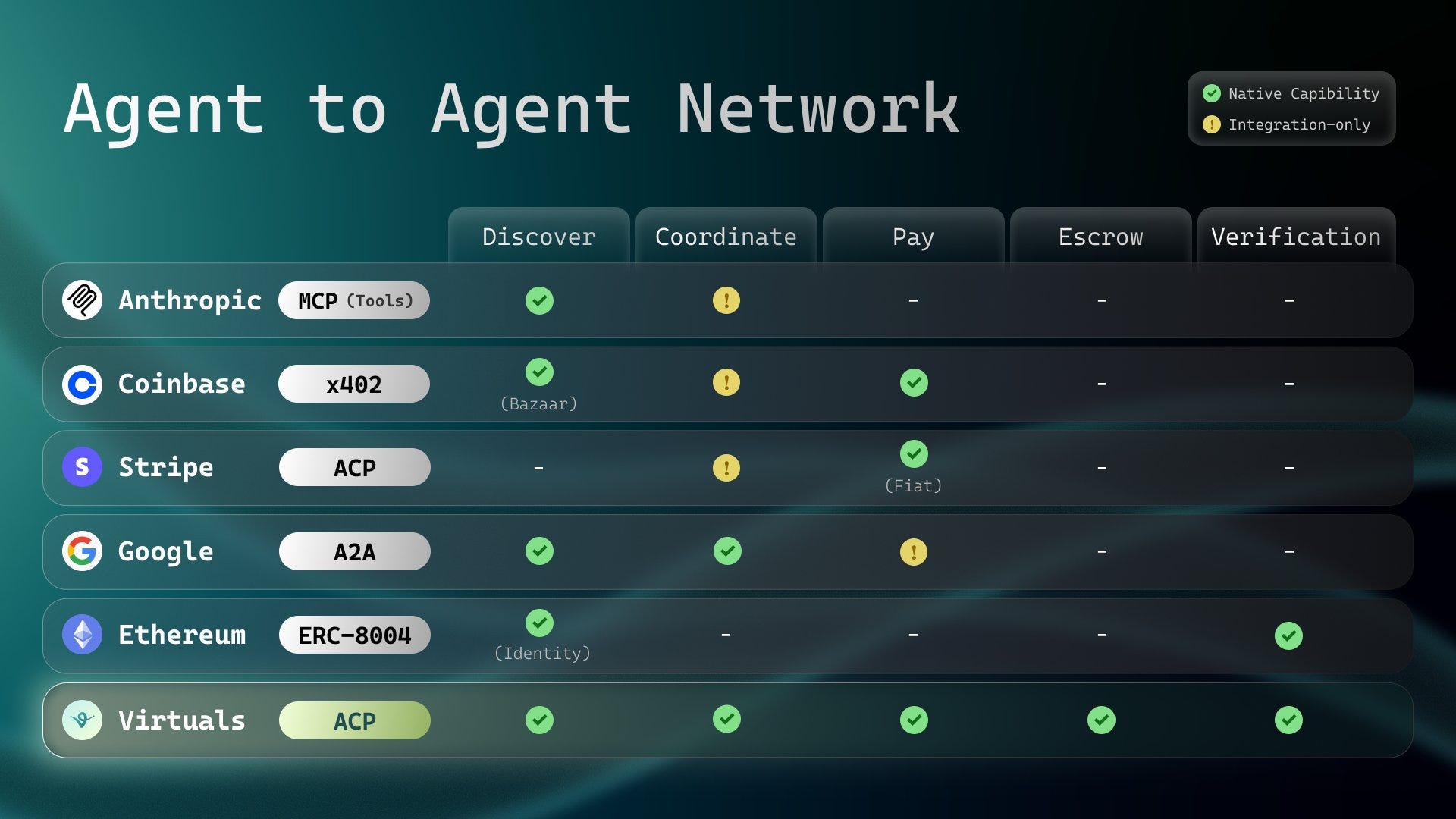
These days, we have seen the emergence of hype around x402. Here’s how ACP compares against it and why Virtuals is well-positioned to benefit from this growth of agentic capabilities:
Butler
Butler is Virtual’s front end to its agentic economy, allowing users to interact with autonomous agents built on the protocol.

Users enter their requests into a chat on X, and Butler suggests the appropriate agent (or cluster of agents) to complete the task. After collecting the inputs, it confirms the cost and deliverables of the job with the user and then routes the job.
Once you add in robotics, this becomes a whole new dynamic. Users can route commands to agents via Butler, and agents can then execute them in the real world via the robots.
Users could then pilot and control an entire business enterprise solely through agents.
Need to design t-shirts and clothing? There’s an agent for that.
Need to package and deliver those items to real people? There’s a robot for that.
The floodgates open for business management: anyone can submit a request or task for agents/robots to accomplish, and watch it get done without getting their human hands dirty.
Unicorn
Unicorn is Virtual’s upgraded launchpad for projects within the ecosystem, enabling builders/founders to raise capital for their startups. The old Genesis model eventually turned into more of a farming fiasco, as users cared more about collecting points than they did backing real founders.
Virtuals has stated that they were already investing in robotics projects through their venture arm and noticed how slow and fragmented innovation becomes without scalable financing. Now that incentives are more aligned with the Unicorn model, robotics and agent builders can more easily fund their ambitious ideas, such as:
Agents managing a swarm of agricultural agents that autonomously plant, monitor, and harvest crops using predictive analytics for optimizing crop yield.
A smart network of delivery drones that bid for delivery tasks and deliver via ground or air.
Autonomous construction robots that are coordinated by design and site-planning agents
The list of ideas can go on and on.
There is still a piece missing, however. Today’s robots don’t come out of the box knowing how to do anything and everything.
They need to be taught and trained.
This is where SeeSaw comes in.
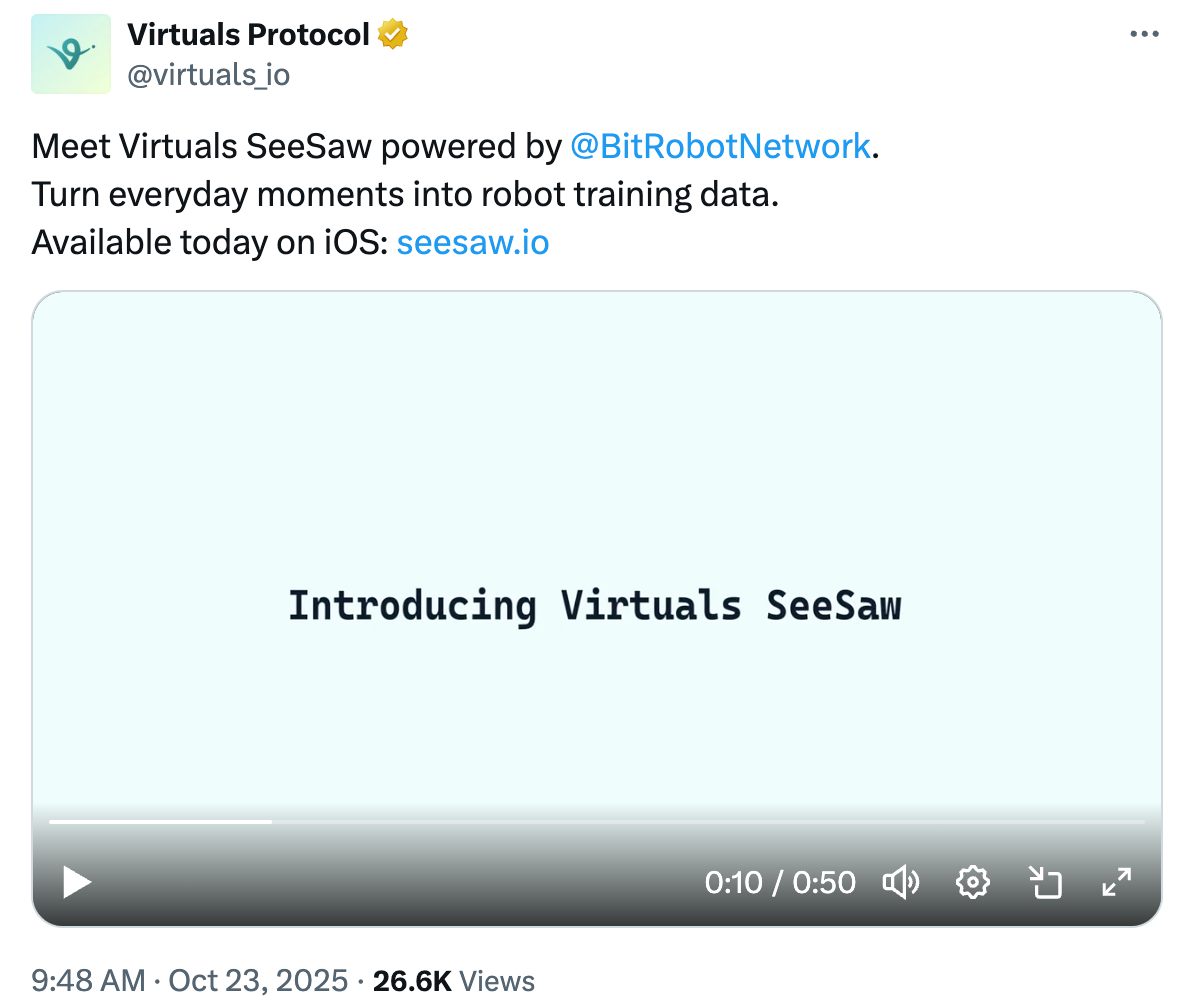
SeeSaw
For these robotic agents to work effectively in the real world, they need large-scale spatial datasets. This can include anything from distinguishing various types of sirens and alarms to navigating construction sites to something as simple as properly folding a shirt.
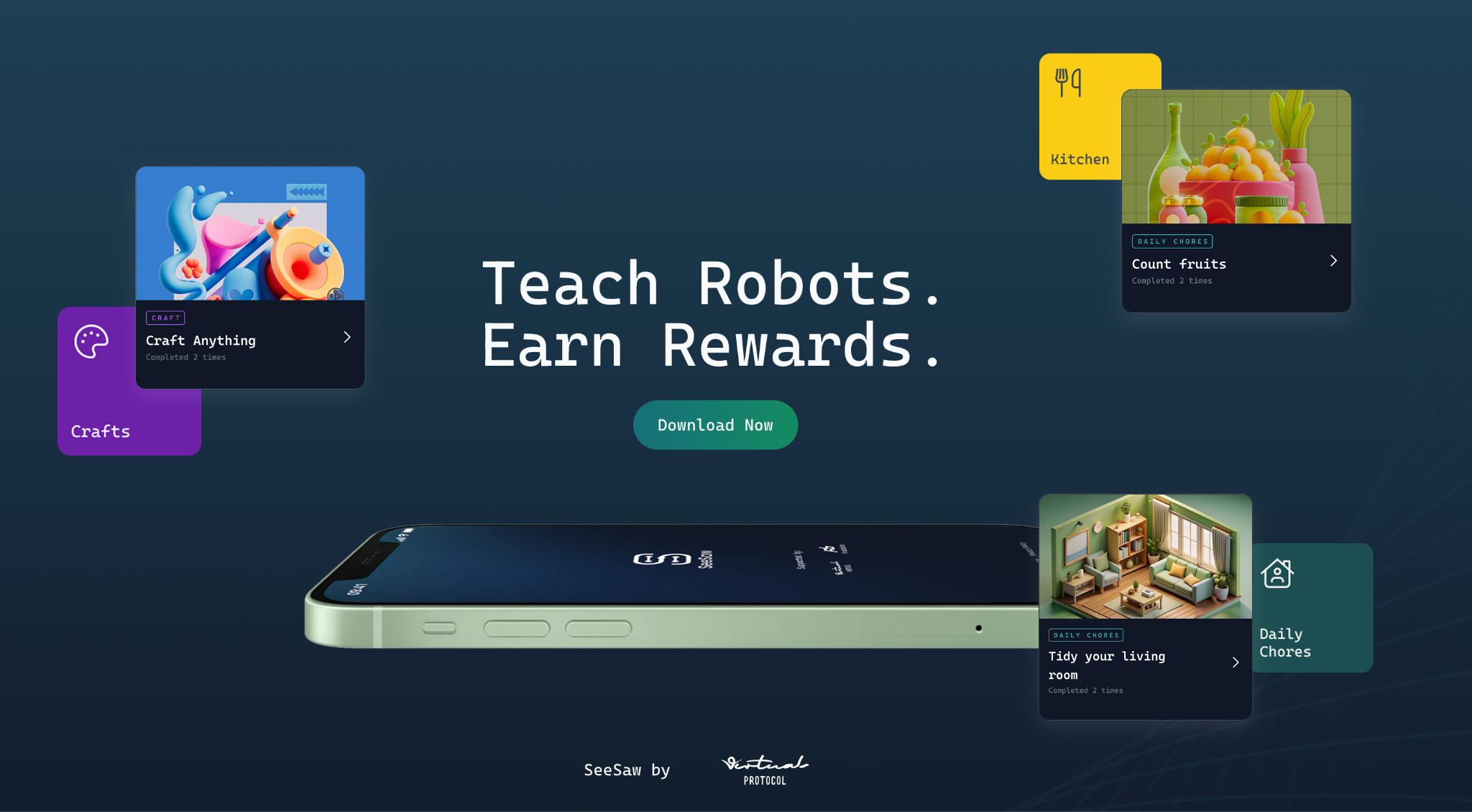
SeeSaw allows robots to better understand the world around them by having humans record daily activities and desired tasks. These daily actions become data for the robots to learn from.
Robots will inherently struggle to learn how objects and people move in a 3-dimensional world. This is why it is so important for robots to acquire a dataset of all these actions, no matter how small or nuanced.
This is exactly why SeeSaw was created, as Virtuals know how important this data collection is.
SeeSaw is an iOS mobile video-collection app that crowdsources videos of hand-object interactions. They’ve gamified the process so users can complete quests and earn rewards.
As long as the rewards match the output from the users, this should scale fairly quickly, giving Virtuals a huge database of visual interactions to provide as a service to any robotics team in need.
SeeSaw is built in conjunction with BitRobot to ensure the data acquired is up to snuff and useful for training robots at scale.
Just The Beginning
While this is the end of this paper, it’s just the beginning for the Technological Trinity.
These three sectors are only starting to show what they’re capable of, and, by the very nature of crypto, we get to see these developments at the ground level.
It’s not wild to assume that we will see fully robotic agencies and companies in the near future. The prospect of seeing robots walking around completing tasks automatically should be fascinating (and terrifying) for the sci-fi nerd in us all.
The future is coming sooner than any of us probably anticipated. It will be interesting to see what can come from Virtuals’ foray into the Technological Trinity.
Thanks for writing this, it clarifies a lot. The whole aGDP concept is super cool, but how do we even begin to, like, quantifie that?