


Bitcoin is the undisputed king of crypto, a reserve asset acknowledged by corporations, sovereign States, billionaires, and average investors alike.
While it was once hailed as a mere hedge against inflation, it is now described as a less cumbersome digital gold. It currently commands a market capitalisation of ~$2 trillion, an order of magnitude above that of many successful public companies.
Originally, the face of a countermovement born of the 2008 Great Financial Crisis, Bitcoin has matured into a contender for gold’s role as a reserve asset. It is so important that its cultists are waging a war against the quantum risk, the latest threat in a long line of antagonists. Be that as it may, human and financial resources are being deployed to safeguard this unique asset. If privacy was not part of the original plan, it has now become one of the core selling points in the age of surveillance capitalism. Aside from this feature, Bitcoin has several use-cases, some of which are severely ignored.
Bitcoin is the most underutilised asset in human history. Gold has been used for commerce or jewellery, silver for electronic components and cutlery, land for cattle or real estate, but Bitcoin remains an almost entirely non-productive asset.
For years, the consensus has been that Bitcoin is for holding, and everything else (yield, lending, borrowing, complex derivatives) is for Ethereum. Today, less than 0.5% of the total Bitcoin supply participates in DeFi. Six million coins (nearly 30% of the total supply) have sat dormant for over 5 years, while other assets freely flow between protocols, users, and institutions.
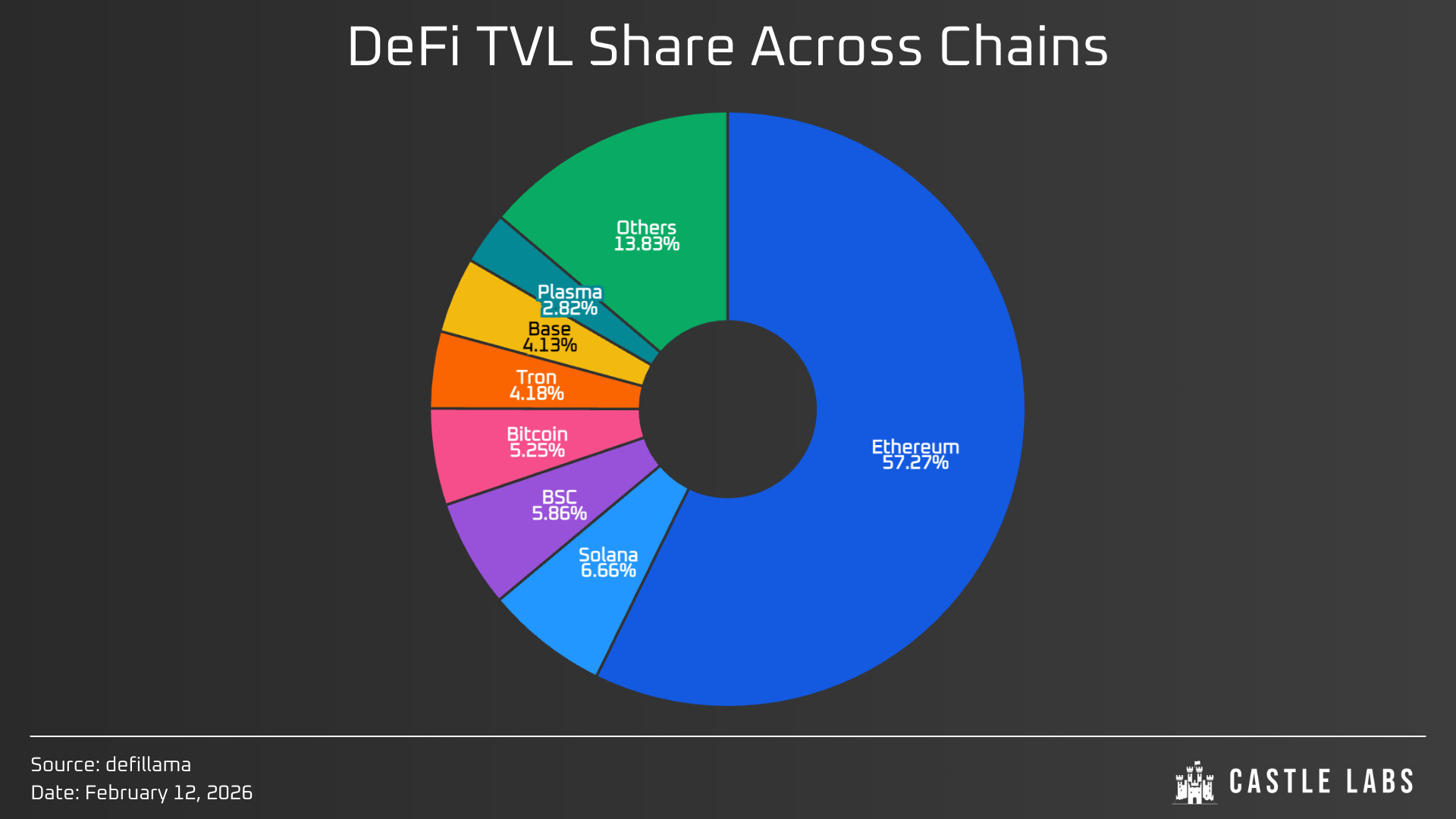
Bitcoiners are often described as apathetic, displaying behaviour different from that of the DeFi trader. Bitcoiners are risk-averse, also as a response to the fact that existing infrastructure has not been able to support Bitcoin utilisation without compromising security and decentralisation through custodial bridges and opaque rehypothecation. Unlike Ethereum, which relies on a network of node operators, DeFi protocols, audit firms, neo-banks and stablecoins, Bitcoin has remained a marginalised asset.
This reliance on blind trust effectively walls off Bitcoin liquidity, crippling a potentially formidable source of income for its holders.
There have been attempts to bridge the chasm between what holders want and what they can achieve without risk. Nonetheless, only a fully comprehensive, trustless stack that integrates both legal and structural guarantees could foster this appetite within the Bitcoin community.
Among those, Starknet’s BTCFi initiative aims to fix this lack of both safety and transparency as a definitive solution to the underutilization of Bitcoin holders in DeFi infrastructure.
This reticence is twofold:
A lack of safety in existing Bitcoin infrastructure automatically repels large holders from participating in DeFi, thus sequestering billions in liquid assets. As Bitcoin currently relies on custodians, the trust factor poses a risk to asset holders; the industry’s standard relies on cryptography, which streamlines transactions and substantially reduces human intervention. In doing so, holders rely on agnostic, neutral processes.
An opaque series of protocols, wrappers and bridges, entirely unconvincing for a public whose very financial wealth depends on clear, transparent and regulated infrastructure. Bitcoin currently relies on centralised structures, whose lack of transparency deters large inflow of capital from escaping the “holding” approach. Because holders cannot ascertain the outcome of their transactions in a blind ecosystem, they choose not to trust custodians and miss out on the yield opportunity of a well-designed infrastructure.
To finally onboard Bitcoin to crypto, although this may seem counterintuitive, we need to build infrastructure worthy of the most discussed asset since the internet.
The Trust Deficit
To understand why Starknet’s approach is long overdue, we must grasp the explosive growth of Bitcoin’s “DeFi” ecosystem. It is true that holding BTC remains the safer bet and, for most, the only viable way to avoid catastrophic losses.
For a high-net-worth individual, family office, or institutional allocator holding 100 BTC, the “DeFi opportunity“ typically appears to be a poor trade with limited upside. If a bridge is hacked, the entire principal is lost. It is thus justified to wonder if holders are not right to hold their assets.
The industry still bears the scars of Celsius and FTX, which demonstrated that “trusted custodians“ are often untrustworthy. Onchain, the record is equally bleak. We have seen bridge hacks demonstrate that the risk is real and, more often than not, catastrophic, as affected assets are almost always irretrievable.
Most existing “Bitcoin Layer 2“ solutions are effectively multisig federations. A holder is depositing their Bitcoin into a box controlled by 5, 9, or perhaps 20 signers. They trust that the majority of those individuals will not collude, be coerced by governments, or be hacked.
Until the infrastructure is trustless and allows users to verify rather than rely on trust, the liquidity problem will remain unresolved. It is precisely after the Great Financial Crisis that Satoshi devised Bitcoin, to allow taxpayers, investors and trailblazers alike to protect themselves from Wall Street and the State.
How, then, can one justify the lack of confidence in the very ecosystem we built to challenge a system we don’t trust?
The current paradigm is threefold:
Asset holders can rely on a custodian, a highly centralised model with a single point of failure.
Another possibility is to delegate asset control to a decentralised network, whose reliability depends on the number of signers.
Finally, the trustless model, which is purely mathematical, has yet to be perfected, but it is the Holy Grail of a monetary system based on self-agency.
Why Trust Fails: Every Bridge Asks You to Trust Someone
To advance from Level 2 to Level 3, Starknet is re-architecting the interaction between Layer 2s and Bitcoin. In a way, this is the first experiment to structurally accommodate both sophisticated, casual users and hardcore Bitcoin maxis, offering a suite of tools for privacy, security, and yield.
This development is visible in four pillars:
Level 1: Custodial Wrappers (WBTC)
To obtain WBTC, asset holders transfer their Bitcoin to a custodian (e.g., BitGo), which mints an ERC-20 token on a different chain. Starknet has adopted a welcoming approach to top Bitcoin wrappers through unified routing and a wrapper ecosystem. Starknet integrates WBTC, tBTC, or newer yield-bearing variants such as LBTC. The ecosystem pushes for Unified WBTC Routing. By concentrating liquidity into core pools (via AMMs such as Ekubo), Starknet ensures oracle reliability, thereby preventing the fragmentation that affects other chains.
Trust Model: Centralised, reliant on trusting third parties (a custodian in particular).
Risk: Corporate failure or regulatory seizure. For example, in late 2024, BitGo entered a joint venture with BiT Global, effectively handing partial control of the underlying BTC custody to entities affiliated with Justin Sun. This posed a clear risk, prompting MakerDAO to vote on offboarding WBTC due to concerns about misappropriation. Coinbase followed suit in November 2024.
Level 2: Threshold Bridges (tBTC)
This is a similar design to WBTC, with the difference that, instead of a single provider, there is a decentralised network of signers that controls the bridge to Bitcoin. This configuration is superior to a single company because it requires a collusion of many unrelated parties to steal funds.
Trust Model: Trust in a distributed set. Despite its decentralised narrative, Harmony Horizon relied on a fragile 2-of-5 multisig scheme. The Lazarus Group compromised just two private keys, bypassing the rest of the network to drain $100 million.
Status: Starknet is currently optimising this tier. While Level 1 bridges rely on a single company, tBTC relies on a rotating network of 100 independent node operators. To move funds, 51 of them must agree. This removes the single point of failure Justin Sun represented in the case cited above.
Level 3: Trust-Minimised Bridges (BitVM)
Trust-minimised bridges require only one honest participant to detect and prove fraud. Unlike threshold bridges that need a majority consensus, these systems operate on a 1-of-n assumption. Security holds as long as at least one party in the network remains honest.
Trust Model: One of the operators is honest. Any single honest party can challenge invalid state transitions and halt malicious activity. BitVM is a construction where any operator can challenge an invalid Bitcoin state. The attack surface shrinks dramatically because instead of compromising 51 of 100 operators, an attacker must compromise every single participant.
Status: Intermediate step between federated trust and pure cryptographic verification. Starknet is developing ColliderVM as a trust-minimised fallback if OP_CAT activation is delayed. Even without a Bitcoin soft fork, ColliderVM would leverage STARK proofs and advanced cryptoeconomics to unlock Bitcoin’s liquidity while maintaining 1-of-n security assumptions.
Level 4: Trustless (ideal scenario)
In this scenario, the bridge is governed by math, not people. Zero-Knowledge proofs on the destination chain (Starknet) are cryptographically verified by the source chain (Bitcoin). Every other “Bitcoin L2” is stuck at federation (multisig) with no realistic path forward. The Starknet community has approved SNIP-31, a proposal to allow Bitcoin to serve as an accepted token for staking within Starknet’s consensus mechanism. This means Bitcoin will eventually account for up to 25% of the staking power securing Starknet. This way, Bitcoin will be effectively integrated into the network’s security budget, generating a sustainable yield from existing network inflation rather than a new pool of mercenary incentives.
Starknet is the only L2 architecturally designed for trustless BTC from the ground up.
Fourth-generation Bitcoin bridges eliminate operators and disputes by making Bitcoin enforce correctness directly:
Model: Trust in math (OP_CAT).
Status: Using maths and pure engineering, Starknet aims to leverage Bitcoin’s existing technology to upgrade it, accommodating the practical needs of today’s holders, with the final vision to entirely eliminate the human factor in complex transactions. This proposed Bitcoin opcode would let Bitcoin natively verify STARK proofs. If activated, Bitcoin itself could validate Starknet state transitions.
Unlike EVM-compatible chains that are largely stuck at the federation stage, Starknet’s native architecture (built on STARK proofs) is designed for the cryptographic verification that Bitcoin’s roadmap badly needs.
Starknet’s Bet: What Would Trustless Actually Look Like?
Currently, Starknet’s focus is to enable “covenants” on Bitcoin, scripts that allow Bitcoin to verify events on other chains. The leading proposal is OP_CAT, a code change that would allow Bitcoin to verify STARK proofs natively.
The team behind Starknet (StarkWare) includes Eli Ben-Sasson, a pioneer in ZK cryptography who co-invented STARK proofs and was involved in co-founding Zcash. Across the industry, they are known for their early work and implementation of ZK proofs, as evidenced by their position as the network with the most research grants dedicated to this topic and a strong lead over competitors.
Even if OP_CAT is delayed, Starknet is developing ColliderVM, a backup solution leveraging the massive computational power of STARKs to simulate these trustless environments via advanced cryptoeconomics. In the context of Starknet’s infrastructure, it would act as a trust-minimised bridge using ZK-proofs to unlock Bitcoin’s massive liquidity. Essentially, this upgrade enables Bitcoin to interact with complex, high-speed smart contracts typically reserved for Ethereum’s EVM. This scenario does not require a Bitcoin soft fork.
The vision is Dual Settlement: STARK proofs verified on both Ethereum and Bitcoin.
The Real Unlock: The Missing Piece: Institutional Rails
To move trillions of dollars’ worth of Bitcoin, developing the right tech is only one part of the equation, for it is also necessary to add a regulatory layer on top of the underlying infrastructure. Banks, despite their unintelligible quant strategies, remain regulated businesses defended by legions of white-shoe firms on retainer. DeFi seeks to extricate itself from the “frontier finance” straightjacket it has evolved into, to serve both retail and institutional investors who remain cautious about emerging assets.
Institutional capital, in particular, cannot interact with anonymous smart contracts; it requires know-your-customer compliance and regulated counterparties. To legitimise its lineup, Starknet has onboarded Re7, a UK-regulated digital asset manager with nearly $1B in AUM. As a core infrastructure partner, they pre-seeded BTCFi liquidity to ensure markets were usable from Day 1.
For the first time, Bitcoin has found its fit within the highly-regulated, controlled environment of traditional finance. Not only does Re7 provide a trust-minimised infrastructure, but it also respects the privacy inherent to a better Bitcoin.
This new yield layer bridges different categories of investors. Although Bitcoin is traditionally associated with institutional investors, the public has also moved to digital assets. Bitcoin is entering pension funds, significantly altering the risk profile of such investments; a larger allocation ensures a more resilient network, reducing node risk.
Starknet’s BTCFi Architecture: Building the Infrastructure
To move from Level 2 to Level 3, Starknet is re-architecting the interaction between Layer 2s and Bitcoin. In a way, this is the first experiment to structurally accommodate both sophisticated, casual users and hardcore Bitcoin maxis, offering a suite of tools for privacy, security, and yield.
This development is visible in three pillars:
SNIP-31: Staking at the Consensus Level
The Starknet community has approved SNIP-31, a proposal to allow Bitcoin to serve as an accepted token for staking within Starknet’s consensus mechanism. This means Bitcoin will eventually account for up to 25% of the staking power securing Starknet. This way, Bitcoin will be effectively integrated into the network’s security budget, generating a sustainable yield from existing network inflation rather than a new pool of mercenary incentives.
Wrapper Ecosystem & Unified Routing
Starknet has adopted a welcoming approach to top Bitcoin wrappers. Starknet integrates WBTC, tBTC, or newer yield-bearing variants such as LBTC. The ecosystem pushes for Unified WBTC Routing. By concentrating liquidity into core pools (via AMMs such as Ekubo), Starknet ensures oracle reliability, thereby preventing the fragmentation that affects other chains.
Borrower-First Incentives
Starknet has allocated 100 million STRK to its liquidity campaign, with a focus on BTCFi. However, unlike previous cycles that subsidised passive deposits, Starknet incentivises activity. Rewards are heavily weighted toward borrowers, creating a healthy market rate for lenders and supporting yield from real, organic demand.
What This Enables: The Flywheel Is Already Spinning
The infrastructure Starknet is building is animated by a series of applications, each designed to implement a specific use case. For the first time, a Bitcoin holder benefits from a suite of sophisticated financial tools available on a low-fee, high-throughput ZK-Rollup. Starknet has designed a yield layer specifically for Bitcoin; although other L2s have gravitated toward it, there is no other existing ecosystem-wide suite.
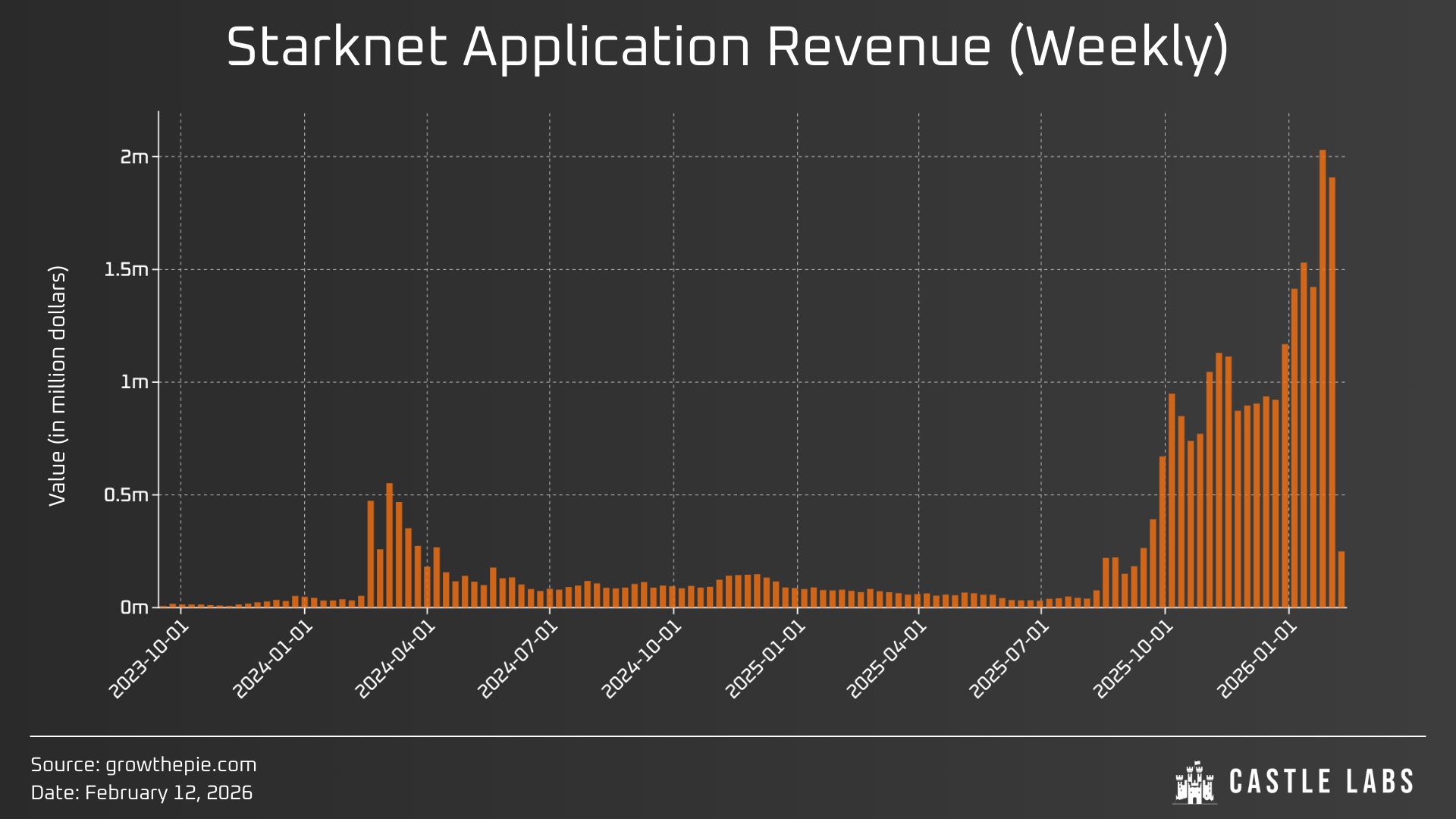
In terms of hard data, capital is both flowing and growing on Starknet. If other L2s like Arbitrum or Optimism saw their revenue decrease by almost -50% YoY, Starknet’s yearly revenue is up above 3000%.
Staking: Users can earn STRK simply by staking their BTC wrapper. Current projections sit at ~6-7% APR in STRK on Endur, offering a low-risk baseline yield. Approximately 1080 Bitcoins are currently staked, representing close to $90M generating yield. The amount of staked STRK is even more telling: 1.15B STRK, 22% of the available supply, is currently on Endur.
Lending & Borrowing: Starknet has allocated 100 million STRK to its liquidity campaign, with a focus on BTCFi. However, unlike previous cycles that subsidised passive deposits, Starknet incentivises activity. Rewards are heavily weighted toward borrowers, creating a healthy market rate for lenders and supporting yield from real, organic demand. Protocols like Vesu, for example, are the engine of this ecosystem. Due to the “DeFi Spring” incentives, borrowers currently receive massive rebates, often refunding up to 40% of their borrowing costs in STRK. This effectively subsidises leverage.
Capital-Efficient LPing: Ekubo is arguably the most advanced AMM in crypto today, being compared to a Uniswap v4.5 analogue, featuring 1/100th-basis-point ticks. Bitcoin holders can provide liquidity in tighter ranges (e.g., WBTC/USDC), earning trading fees with significantly less capital than required on Uniswap V2-style forks.
Structured Products: For those who want “set and forget” yield, Re7 Capital and 0D offer vaults. These execute delta-neutral strategies (e.g., long spot BTC + short perp) to capture funding rates without price exposure.
Perps & Trading: Protocols like Extended (which also offers XVS) allow users to trade perps while earning yield on their collateral. Depositors receive XVS tokens equal to 90% of their USDC deposit, which serve as margin for leveraged trading. While XVS backs trades, it simultaneously earns a base yield (around 15% APR from the vault’s AMM) plus activity-based extra yield that scales with trading volume.
Notably, 3 of the 10 largest perp DEXs are Starknet-adjacent or built on the chain, such as Extended or Paradex. Combined, they represent almost $200B in monthly trading, comparable to Hyperliquid.The Loop: The most common active strategy involves staking BTC to mint an LST, using that as collateral to borrow stablecoins (capturing the rebate), and redeploying into the ecosystem.
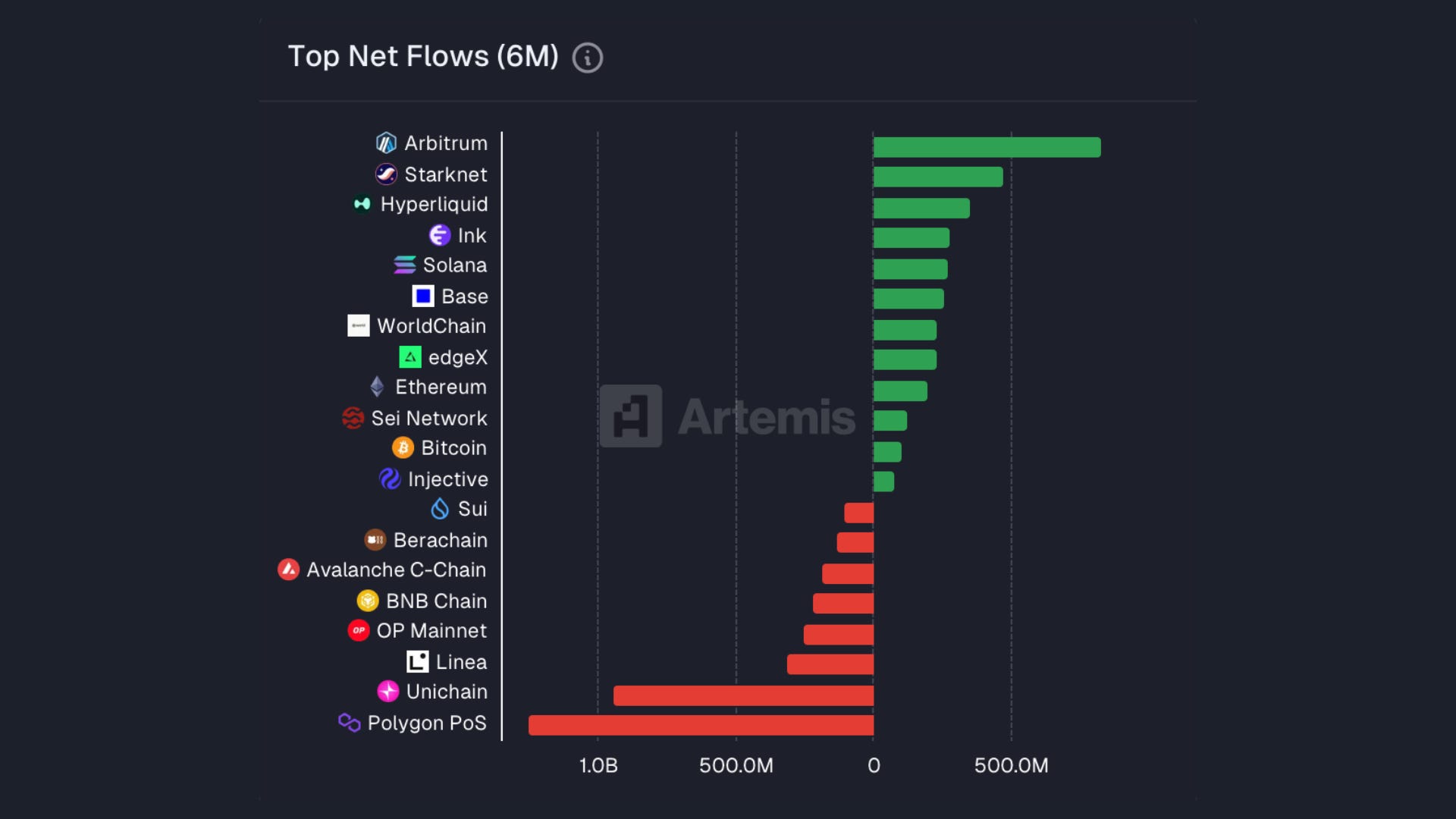
Despite a difficult year, money is flowing into Starknet. If other well-known L2 ecosystems are struggling with an industry-wide slump, Bitcoin found a safe haven in the first L2 build specifically for its unique profile. As Vitalik put out in a post last week, L2s are required to move from general-purpose to provide specific value, now that blockspace is cheap and Ethereum is scaling mainnet.
What’s Next: What Comes After Infrastructure
Bitcoin is the world’s greatest store of value, but it is unproductive. Due to its scarcity, mobility, and ability to evade physical hindrances, such as gold or other commodities, Bitcoin is a valuable asset for those looking to “fence” their wealth. Unlike bonds, stocks, or land, it is currently very difficult to justify exploiting this asset class because the downside is much greater. If a stock can recover, a lost Bitcoin is more often than not gone forever.
The owners of that value currently refuse to move it because the existing bridges are wobbly at best, unreliable at worst. The incentives to use Bitcoin are unconvincing. We have mentioned before the risk profile of a Bitcoin-centred investment strategy: a modest annual yield versus the potential for a cataclysmic loss. Starknet is the only L2 with a credible path to trustless BTC. No other protocol offers the same level of security and a comparable DeFi ecosystem. Starknet is the only L2 that has built an entire ecosystem from the ground up for Bitcoin.
This creates a powerful capital flywheel. As BTC TVL grows on Starknet, the network’s value accrues via sequencer fees and staking demand. This correlation between TVL and STRK creates a feedback loop: higher security attracts more capital, which in turn drives higher fees.
Truly trustless BTCFi is the answer to those wary investors looking to protect their wealth. We have already seen TVL double in recent months, and momentum is building. From a low of $80M in July 2025, the current TVL peaked at almost $325M at the end of January 2026.
In the long term, Starknet is positioned to capture more TVL than Ethereum simply because the Bitcoin addressable market is much larger. It just needed a nudge to find its niche. There are currently more than a thousand Bitcoins staked only on Ekubo: the volume on Starknet perp DEXs is comparable to that of Hyperliquid, one of the largest trading venues.
With OP_CAT and ColliderVM, Starknet’s intent to transform Bitcoin into a programmable asset is magnified by Re7’s institutional weight. Bitcoin can therefore become the privacy asset it was always meant to be, while also meeting the requirements of institutional holding, which cannot merely escape all forms of legal scrutiny.
Making Bitcoin a productive asset is one of the largest TVL opportunities in the upcoming year. As the StarkNet infrastructure develops, the network is well-positioned to lead this narrative, encouraging more and more large holders to put their assets to work.
Finally, after almost two decades of experimentation, we are witnessing Bitcoin’s coming of age as a macro asset that can now be used as collateral across several capital markets, with a clear path toward a trustless process.
written by Vincent ✍️
Every week for the last 3 years, we have shared our research for free, directly in your email. Not a subscriber yet? Let’s fix it:
If you are more of a Telegram guy, you can read all of our research without the noise on our TG channel:
Disclaimer: This article was produced in collaboration with Starknet. Castle Labs applies the same standard to sponsored content as in our independent research. We strive to be accurate, unbiased and educational. Commissioned partnerships provide resourcing and distribution, not editorial control.