

Crypto has spent years using blockchain activity metrics as benchmarks for success: TVL, trading volume, users, transactions, and active addresses.
The more important question that is fast becoming consensus this cycle is whether these businesses are sustainable, whether activity turns into actual revenue, and who gets to keep it.
That is the focus of this weekly Chronicle:
Maple’s new rules-based buybacks
Uniswap’s fee switch for v4 pools
Sky’s strong revenue numbers but complex accounts
Theo adding Fidelity’s FILQ inside thBILL
OndoPerps turning tokenised equities into collateral
Revenue is not enough on its own: it needs a clear route of value accrual.
Does it go to tokenholders, stakers, LPs, reserves? Or does it get captured somewhere else in the stack before holders ever see it?
We are revisiting a similar question in our Castle x Kaiko report later this week: how blockchains make money. It’s quickly becoming clear that, despite raising vast amounts of capital and commanding huge valuations, very few are running sustainable, profitable businesses.

Maple’s Revenue-Linked Buybacks
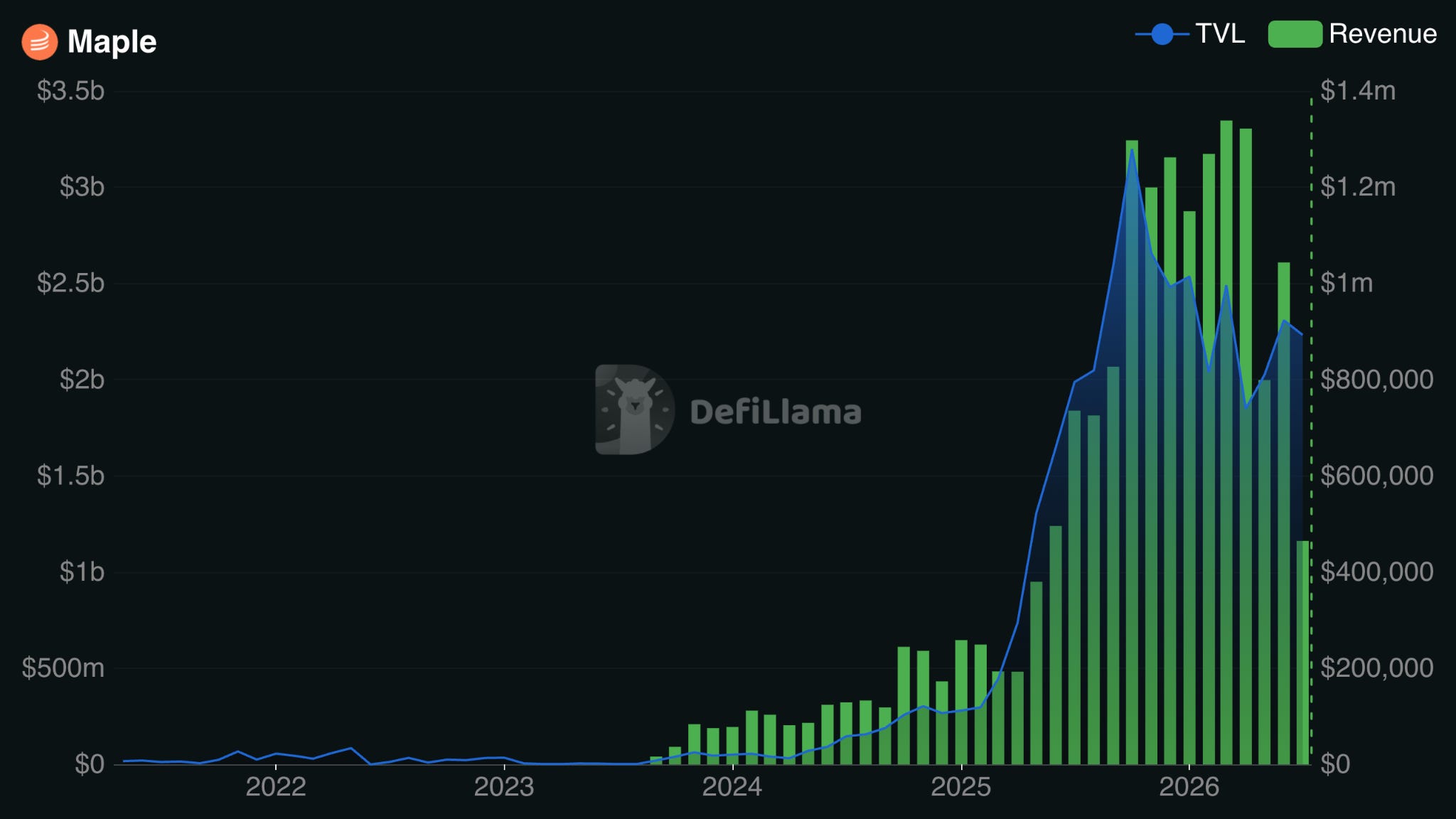
Maple has been a great success story in crypto recently, offering professionally managed, permissioned, and secure lending for sophisticated allocators. They just closed out a record H1 with $4.6B in AUM (+81% YoY) and $4.4M in Q2 revenue (+47% YoY), while their business grew 22% even as DeFi lending contracted 31%.
That was swiftly followed by a strong start to Q3 with the launch of syrupUSDG, Maple’s first new Syrup asset in two years. syrupUSDG brings Maple’s onchain credit engine to Global Dollar (USDG) and Robinhood Chain, giving holders exposure to Maple-originated lending strategies
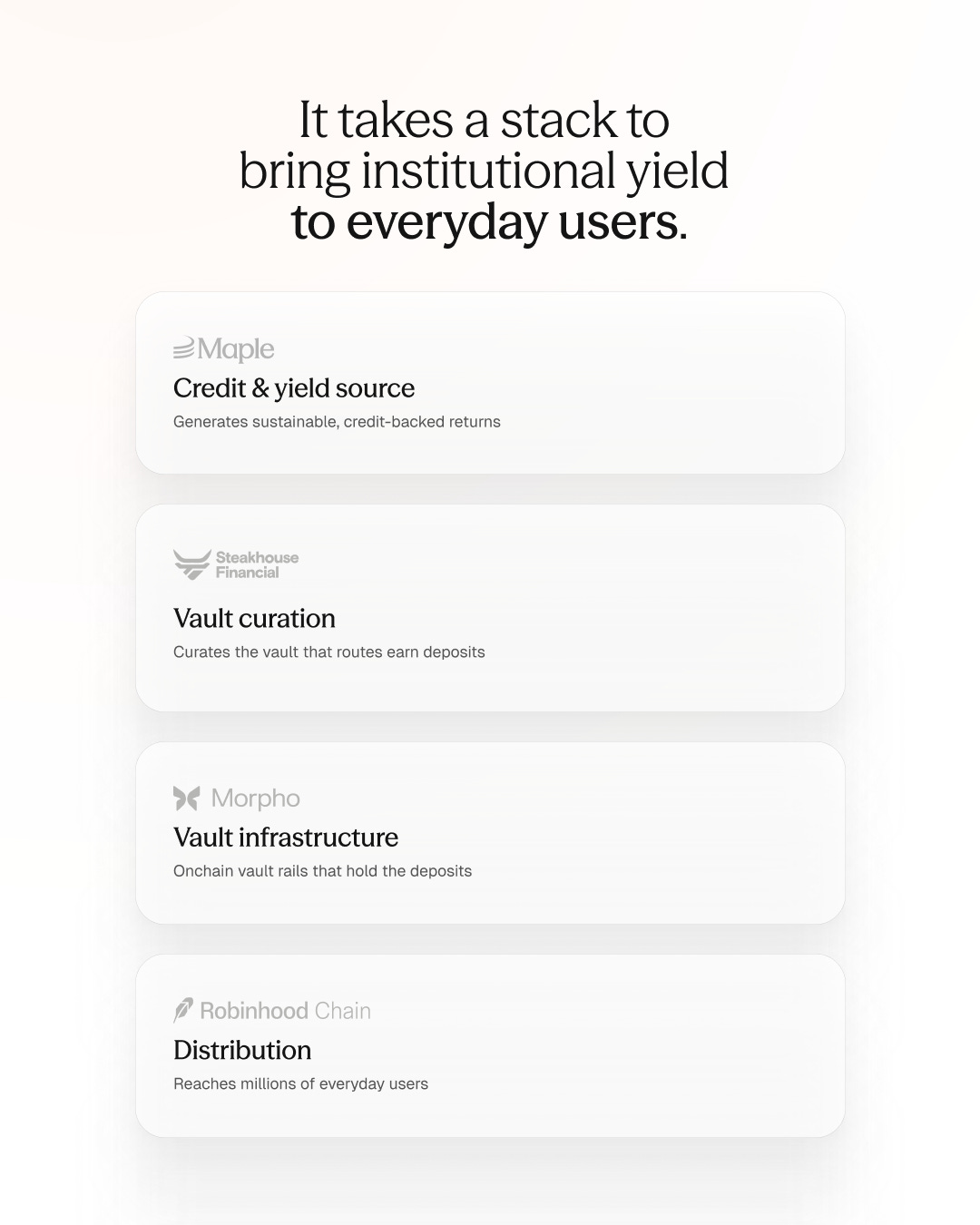
syrupUSDG can sit inside Robinhood Earn, which offers up to 7% APY. This APY packages Robinhood’s distribution, Morpho’s vault infrastructure, Steakhouse Financial’s curation, and Maple’s institutional credit as the yield source.
So how do SYRUP holders benefit from all of this?
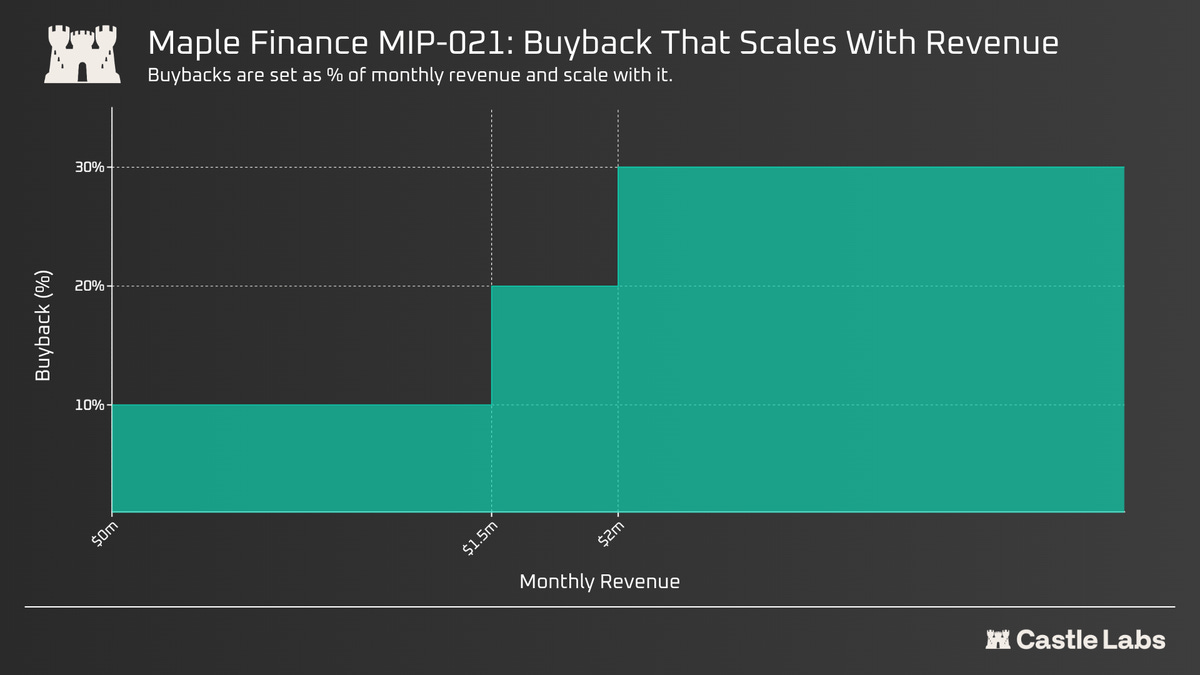
Recently, Maple implemented discretionary buybacks (MIP-019), but is now set to replace them with a rules-based framework (MIP-021). This will scale the proportion of buybacks directly with the gross monthly revenue:
Below $1.5M: 10% allocated to SYRUP buybacks
From $1.5M to $2.0M: 20% allocated to buybacks
Above $2.0M: 30% allocated to buybacks
Buybacks occur at the end of each month once revenue is finalised, with purchased SYRUP allocated to the SYRUP Strategic Fund (SSF), which Maple defines as working capital for strategic growth, token liquidity, capital reserves, and buybacks.
Most buybacks aim to distribute profits (dividends), retire shares (burn supply), or reduce float (lock-up supply). Maple’s route doesn’t really do any of these things, which makes it look more like a treasury management strategy.
This has been raised in the forums, with community members requesting that bought SYRUP be held in a public reserve address and treated as non-circulating, non-voting, and non-transferable unless a new governance proposal is raised. However, those safeguards do not appear to be included in the current proposal.
Therefore, the definition and use of this strategically reclaimed SYRUP remain up in the air, which may well impact public perception of this buyback framework, leading to it being viewed more as a treasury management play and less as any real value accrual for SYRUP holders.
Follow the snapshot vote here.
Uniswap Brings Fees To v4
Yesterday, Hayden from Uniswap shared that the protocol is now raking in over $5 million in daily fees, second only to USDT and USDC.
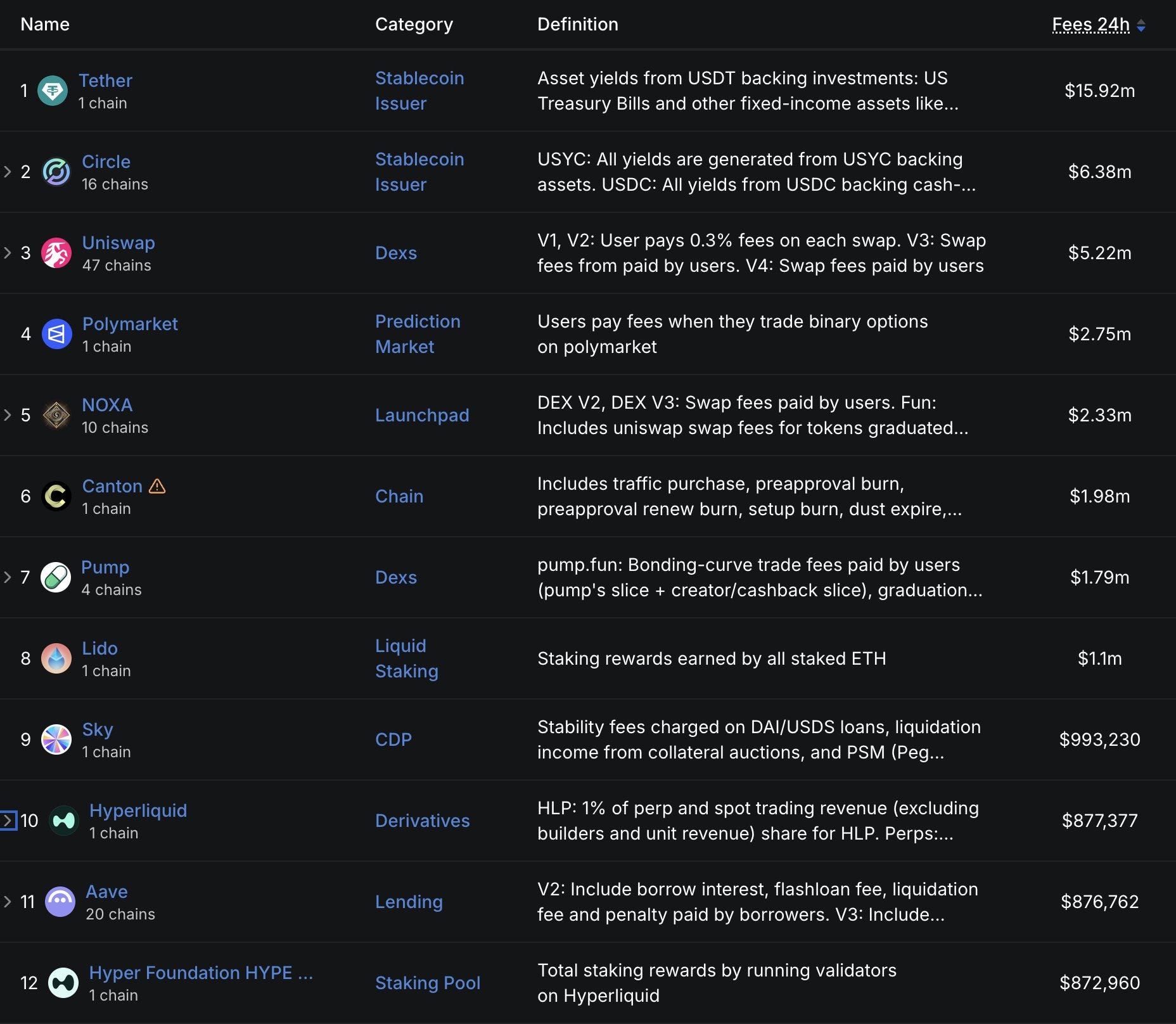
Most of this revenue increase is deriving from the launch of Robinhood Chain. However, while very much welcome, these stats are neither annualised nor expected to last long. In fact, we expect Robinhood to internalise these fees as soon as possible.
In recent years, there has been considerable debate about the utility of UNI, its revenues, and fee distribution.
Finally, Uniswap has activated protocol fees on V4 as well.
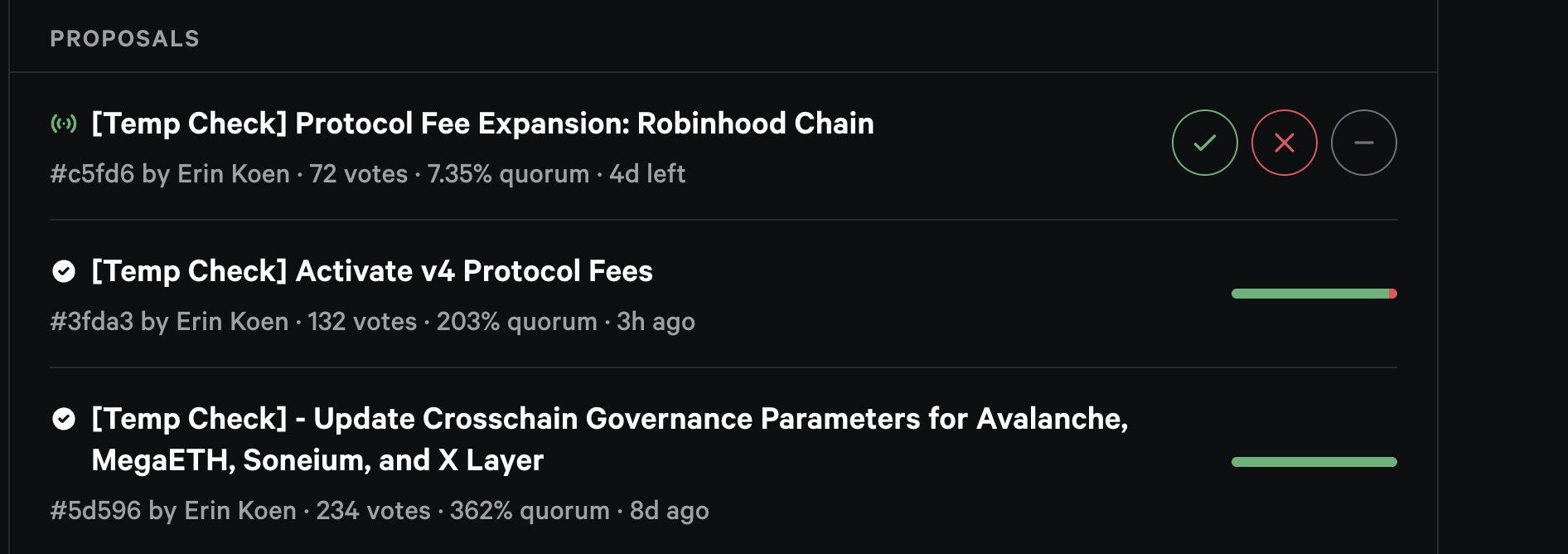
The previous fee switch activation on V2/V3 led many LPs to move to V4 as an incentive to encourage capital migration. How will this change affect LPs now? Will it improve capital efficiency for Uniswap as a whole, helping deprecate V2 and V3 in favour of V4?
Due to its architecture, V4 requires a more flexible and customisable approach to the fee switch. This is mainly due to the Hook architecture and dynamic fees, which can create multiple fee tiers.
As a consequence, governance rules in V4 will be defined by a “fee controller system”, a practical way to ensure governance can set rules for different “pool families” (V4FeePolicy) while still retaining enough flexibility to override or adjust these policies in time (V4FeeAdapter).
The question remains: how will this change affect LPs?
The previous fee switch on V2 and V3 resulted in a 25% cut for LPs, prompting them to move to V4.
Now that V4 fees are activated, will Uniswap manage to retain LPs or will they move to other fee-less trading venues?
These concerns have been expressed by governance participants.
A proposed solution is to conditionally enable the fee switch for V4. That is, only if LPs are profitable.
A user proposes as follows: “If a pool’s implied volatility is consistently above realised volatility, then governance can take a cut without breaking the LP trade.
Instead, if RV > IV, then LPs are already undercompensated. Taking 25% of their fees does not monetise the protocol. It pushes LPs further into negative EV”
We will monitor flows from V4 closely to answer this question.
Fees from V4 will be used for LP rewards/buyback allocations, with a split closer to a 5-25% / 75%-95%. Here is how this compares to the Hyperliquid buybacks:
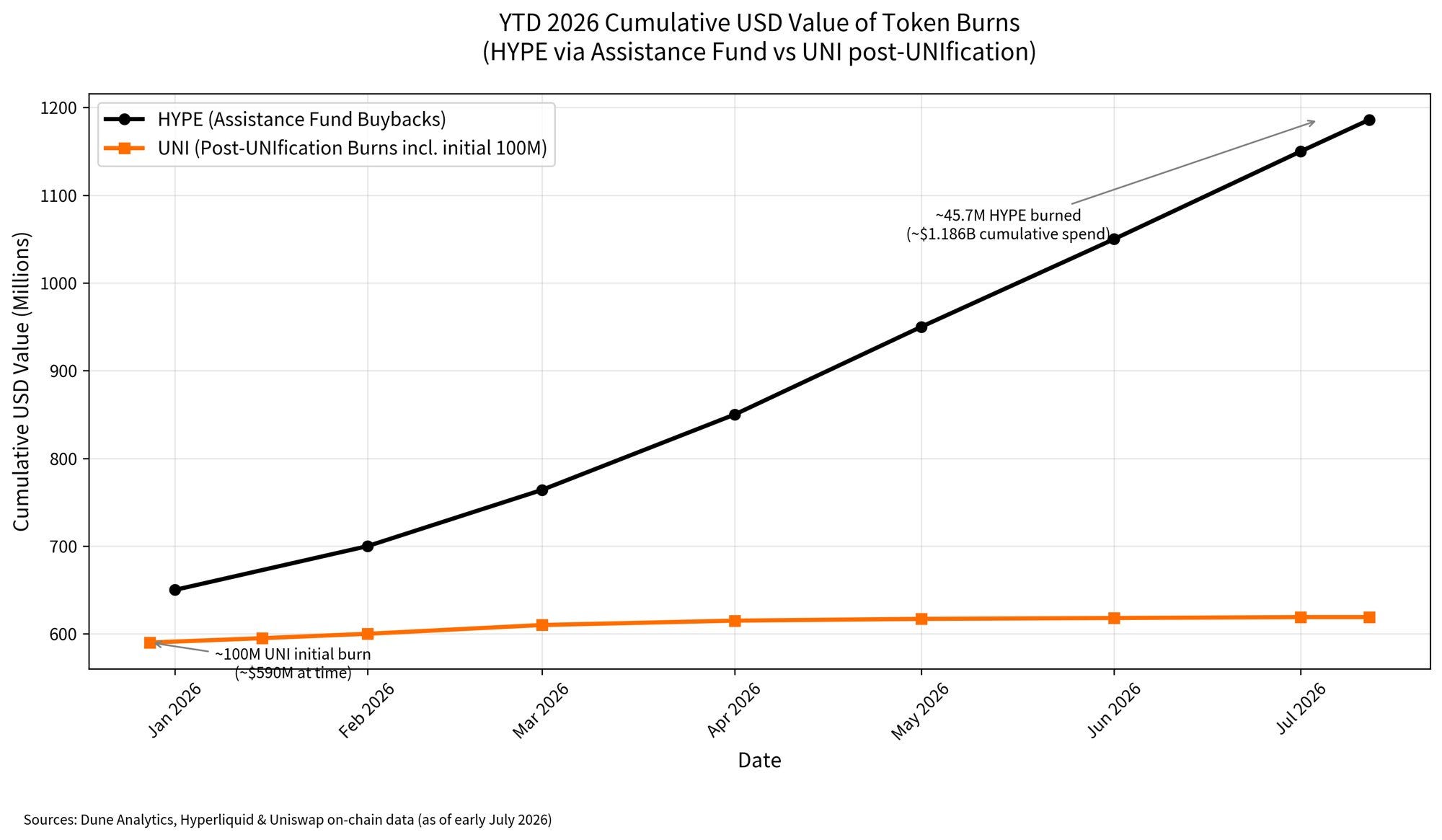
To date, Uniswap has already burned over 6 million UNI tokens.
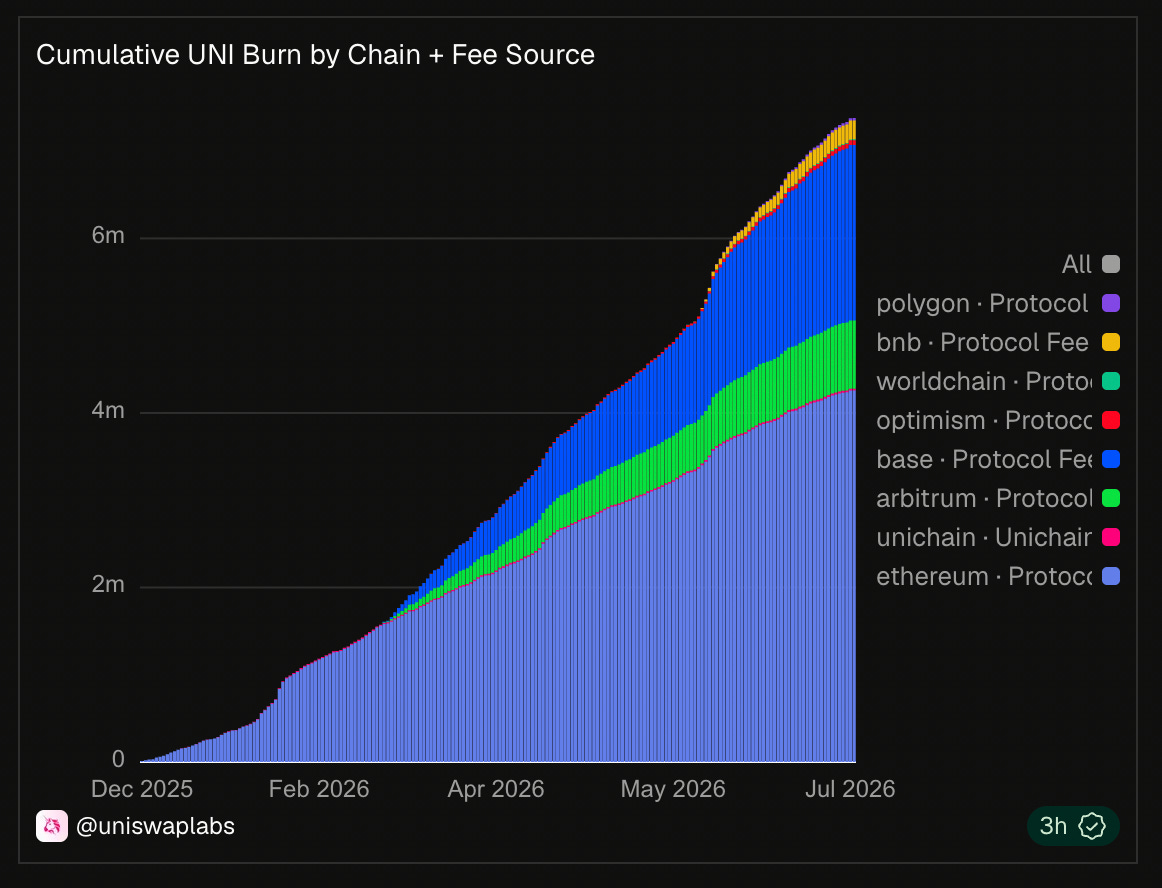
More stats on UNI burns are available here.
Something else worth mentioning is the impact of these buybacks and the overall revenues and fees for token holders.
Projects distribute these very differently.
Stay tuned as we are writing a report on this.
Sky Posts Record Revenue
June was a record month for Sky! In case you missed it:
Record revenue run-rates of $419M
USDS yield distributions exceed $250M
Sustained growth in Sky Reserves
Increased activity across the Sky Agent Network.
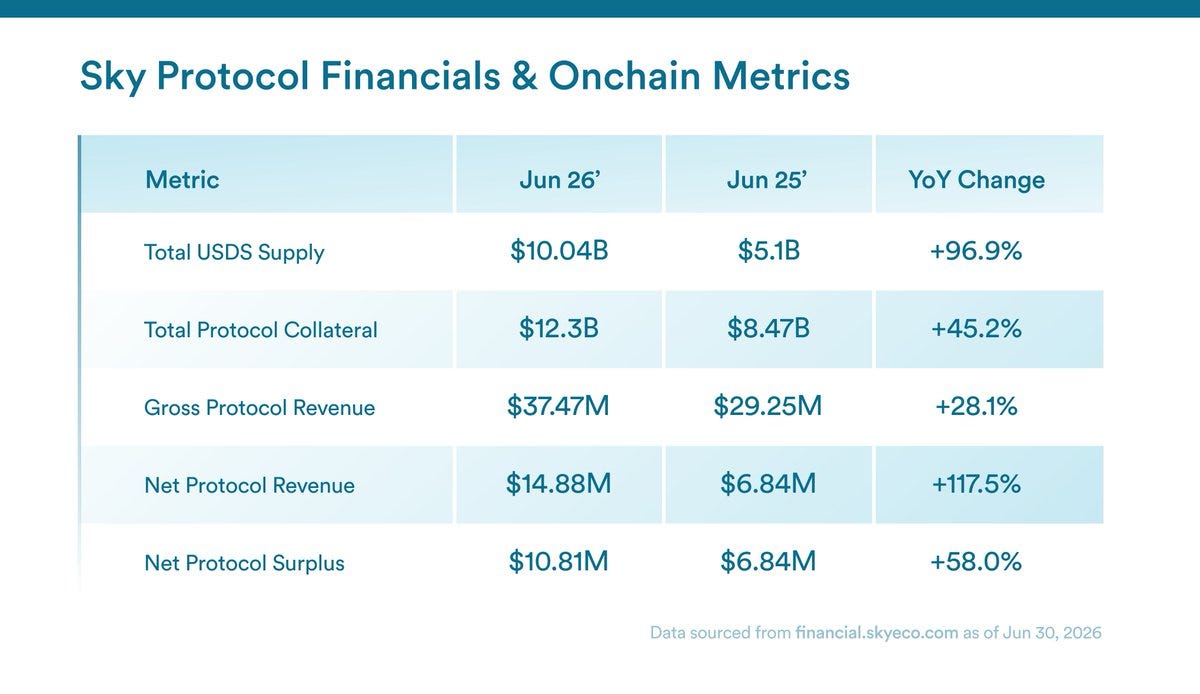
No doubt Sky is generating revenue, building new products, and pushing more activity through Spark, Grove and the wider Prime Agent structure.
But what do these record numbers mean for SKY holders?
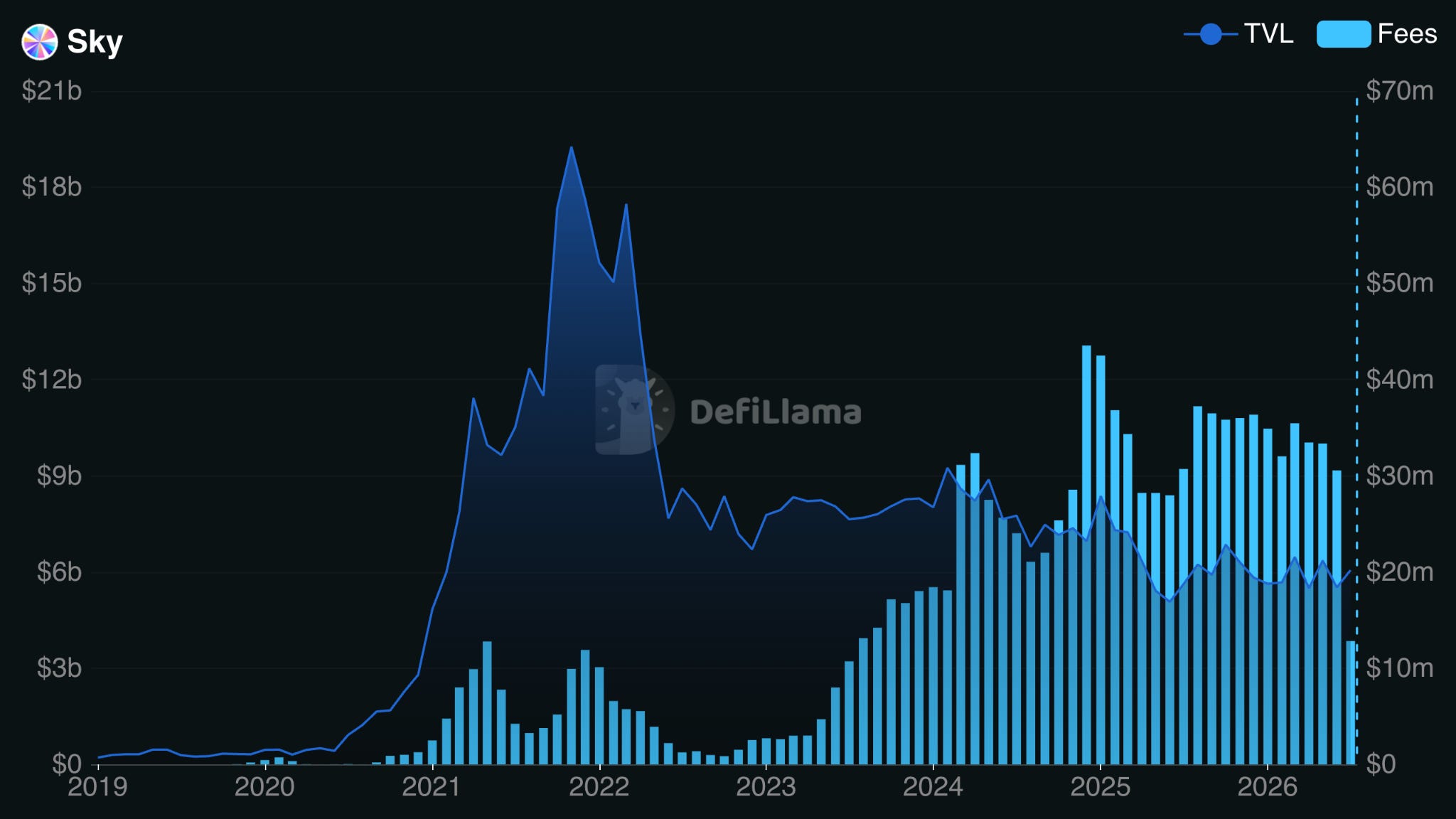
SKY does have an accrual mechanism. Protocol revenues from stability fees and Sky Agent performance are used to buy back SKY on the open market, with those tokens distributed to participants in the SKY Staking Engine. However, Sky is not a simple one-token, one-balance-sheet story. Prime Agents have their own roles, tokens, holders, and economics. For context, Prime Agents are specialist capital allocators inside the Sky ecosystem. Sky can fund or back them, they can owe money back to Sky, and their performance can feed into protocol profits. Those profits are then supposed to support the SKY buyback and staking reward mechanism.
That makes the token-holder question harder to answer cleanly. You can look at protocol revenue, cost of revenue, reserves, staking rewards and token-holder income. But once Prime Agents sit around the core protocol, the balance sheet becomes harder to read. Some value may accrue to SKY. Some may sit with agents. Some may flow through sUSDS or Ecosystem Rewards. Some may accrue to SPK, GROVE or future agent tokens.
PaperImperium wrote a useful thread this week on exactly this, arguing that Sky’s financials are hard to interpret because Prime Agents are not treated consistently across the accounts. If determining what a token holder has a claim to is too complicated, the value proposition itself can be undermined.
OndoPerps Launches with Tokenised Stocks as Collateral
Ondo just launched OndoPerps, its perpetual offering for trading equity perps with up to 20x leverage.
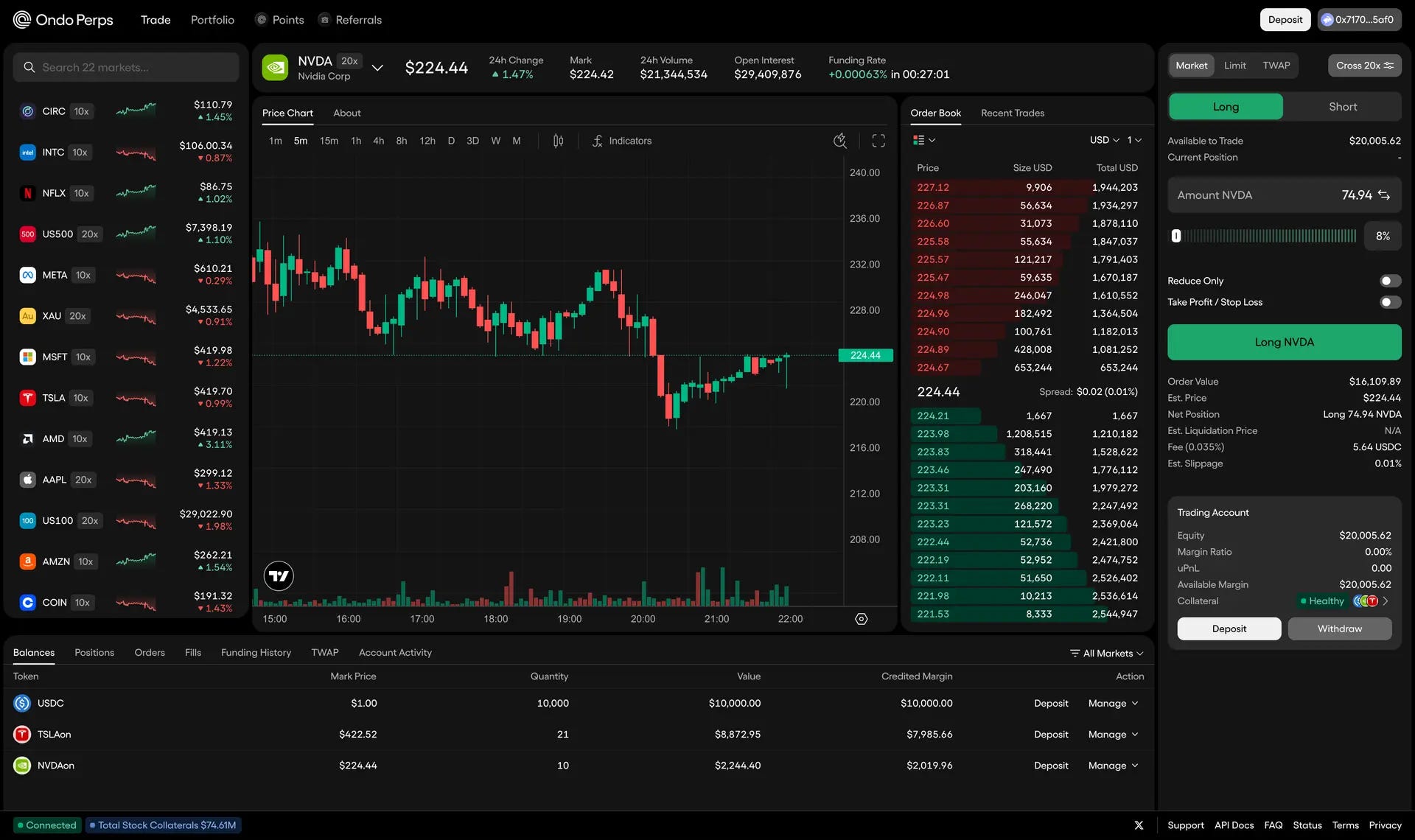
This complements Ondo’s spot equities offering and allows it to compete with venues such as Tradexyz, which has captured most of the perpetual open interest in RWAs.
The listed markets include commodities such as oil, gold, silver, stocks like Apple, Tesla, Nvidia, Microsoft, Amazon, Alphabet, Meta, Netflix, Intel, AMD, Oracle, Micron, Palantir, SpaceX, Strategy, Coinbase, Circle, Robinhood, and indices such as the US100 and US500.
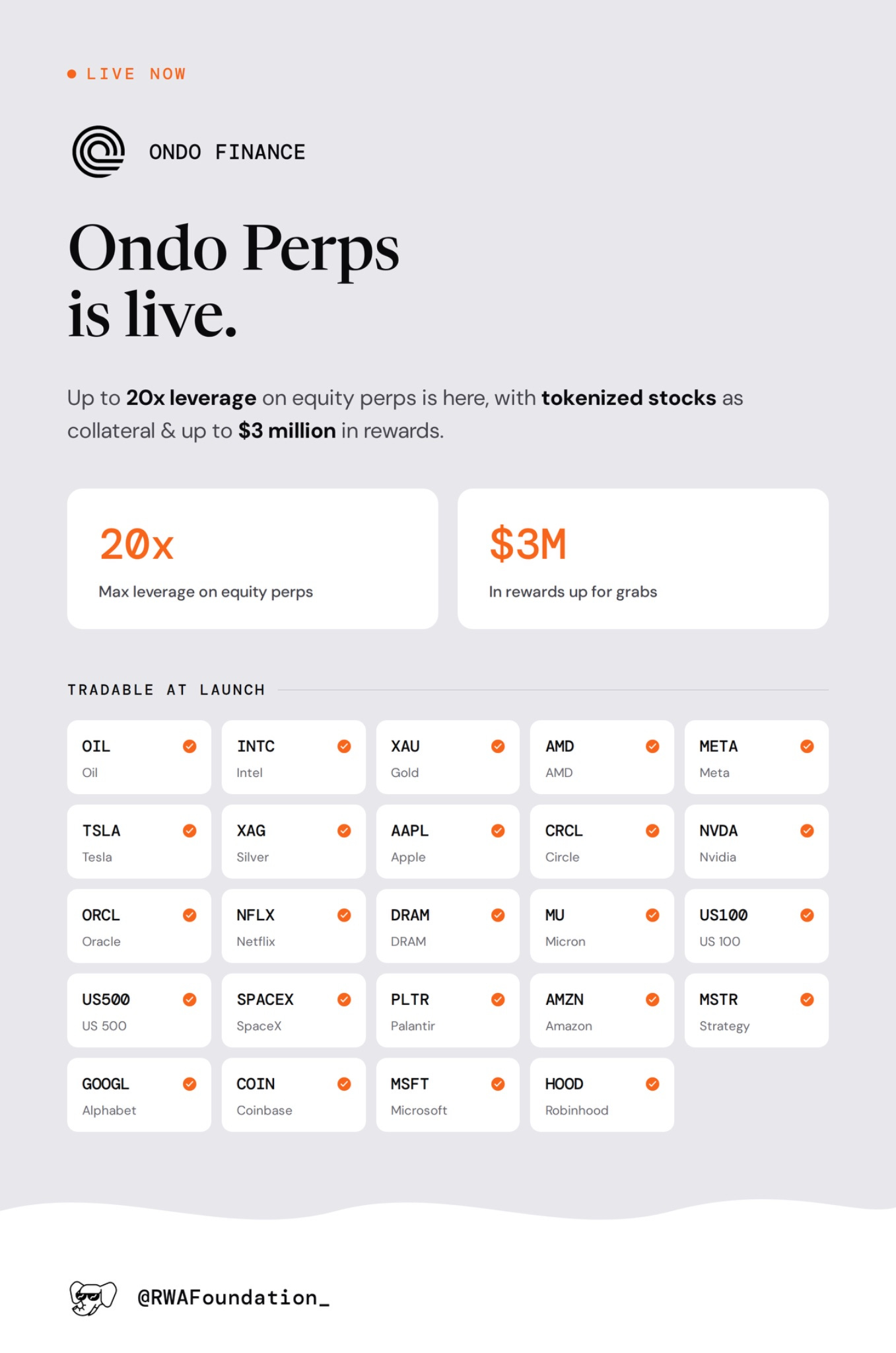
The particularity of this launch is that it complements Ondo’s existing offering, allowing tokenised stocks to serve as collateral for 24/7 perpetual exposure to commodities, equities, or indices. This is the key differentiator that sets Hyperliquid apart from other trading platforms: a unified margin across all products, enabling a broader range of strategies, including hedging, delta-neutral, and more.
Now Ondo spot equity holders will be able to use these as collateral and hedge or leverage their current exposure.
The perps market still has a long way to go, and we can expect RWA perp trading to become one of the fastest-growing areas in the near future. The trend is clear.
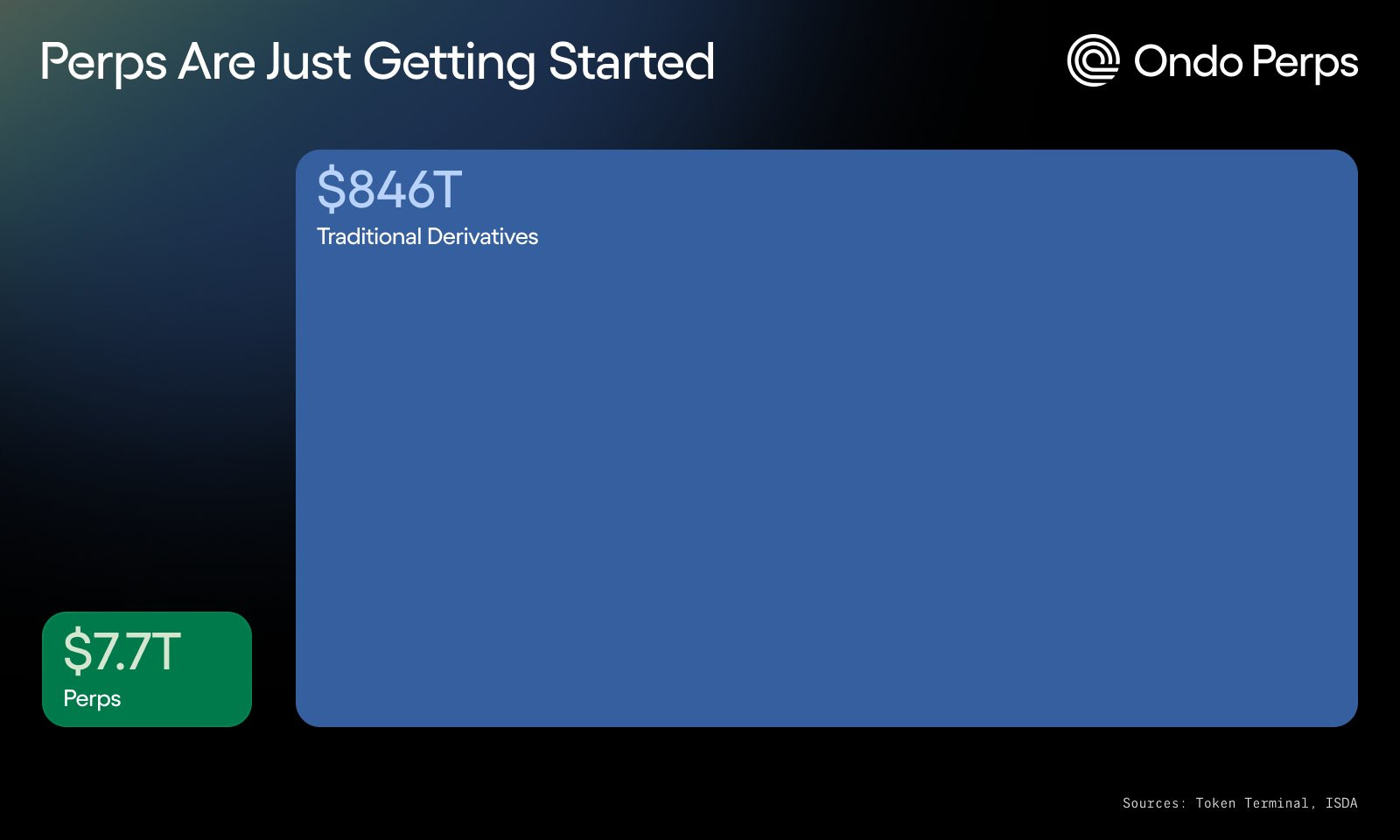
In the backend, liquidity is ensured by a combination of institutional market makers and user flows.
If you already hold Ondo spot equities and want to try Ondo Perps, there’s over $175k in USDC rewards available in the first week (this is not a sponsored post for Ondo).

Tokenised Funds are Moving From Issuance To Utility
For the last two years, the RWA market has mostly measured progress by what got issued onchain.
Another fund tokenised, another asset manager onboarded, another chain supported.
The next phase is about what those assets are used for.
That is why today we’re sitting down with Theo to discuss their FILQ integration.
Theo invested $20M into Fidelity International’s tokenised USD digital liquidity fund (FILQ) through Sygnum, adding FILQ as a second institutional underlying asset within their existing product, thBILL.
Whilst direct holding is the familiar starting point, once a fund is onchain, the more interesting question is where else it can sit: inside a stablecoin, a Treasury product, a collateral system, a lending market, a vault, or a settlement workflow.
“Most investors don’t want a money-market fund. They want the yield, in a form they can actually use.”
Evan, GTM & Chief of Staff at Theo, said, “holding the fund directly gets you the return and nothing else. Wrapping it into a composable product lets the same dollar earn and move at once... The tokenised fund makes it institutional-grade. The onchain product makes it useful.”
thBILL already had exposure to Wellington’s tokenised Treasury fund. The addition of FILQ now brings Fidelity International as a second institutional manager. That gives thBILL a broader base, but it also shows that the structure can add new managers without rebuilding the whole product each time.
If tokenised funds remain standalone wrappers, the market will simply compete on issuer brand, AUM, and chain support. However, if they become inputs for more customisable onchain products, competition moves to what additional value can be built around them.
Fidelity International’s own framing follows a similar line. Emma Pecenicic, Head of Digital Assets Distribution at Fidelity International, said the firm sees tokenisation as “a foundational shift in how global financial markets will function,” and that combining investment expertise with digital-native infrastructure can bring “regulated, institutional-grade liquidity onchain for markets that operate around the clock.”
So what is this shift we are expecting?
Theo’s view is that “direct holding is the first step because it’s the familiar one. It maps to how funds work today. But the value of putting an asset onchain is what you can do with it next: use it as collateral, route it into strategies, settle against it instantly.”
The target destination for these assets is clearly utility.
Can they sit inside a Treasury product? Can they back a stablecoin? Can they be used as collateral? Can they move through lending markets, vaults, or structured products without being a compliance headache?
The addition of FILQ inside thBILL is a small but useful example of that shift. The fund is not the final product. It is a balance-sheet item for Theo, strengthening their product and readying it for growth and expansion into places Fidelity cannot easily reach.
The next wave of tokenised fund adoption will be driven less by direct holders of these institutional assets, and more by their embedded use in onchain products.

On Our Radar
Circle and agent payments: Jeremy Allaire has published an essay on Circle’s Agent Stack, stating that if agents take on more of the firm’s work and value moves natively across programmable networks, the agentic and onchain economies begin to overlap. What should be watched is whether this becomes real payment flow. Do agents actually hold balances, pay for services, rebalance wallets, settle invoices or trigger transactions in USDC? Do developers build around Circle’s stack rather than generic wallets and APIs?
Castle x Kaiko revenue report: We are publishing with Kaiko later this week on the changing business of running a blockchain. Chains used to rely mostly on blockspace fees, but they are now forced to diversify into other vertical revenue streams, MEV, sequencer economics, app capture, and making sure they are positioned to capture value where it actually accrues.
Robinhood Chain durability: Robinhood Chain’s first week has caused quite the disruption in the onchain landscape. We flagged it as the fifth-largest chain by 24h DEX volume shortly after launch, with more than $370M in daily volume and $1.35B cumulative volume, mostly driven by CASHCAT. It later rose to second in 24h DEX volume, only behind Solana. Whilst Robinhood has everything set up to be a serious consumer distribution channel for onchain finance, they are leaning into the meme world and, as a result, are seeing great early metrics on their chain. We’ll be watching how these two worlds find better equilibrium over the coming months.
SEC public-market access roundtable for IPOs: Clearly, crypto is having an impact on traditional finance markets, with several large tradex trading platforms opening their doors to 2,747 trading more and more assets being tokenised, and even IPOs coming onchain. Now, here, the SEC is hosting a virtual roundtable on modernising IPOs and expanding their access to public markets.
Every week for the last 3 years, we have shared our research for free, directly in your email. Not a subscriber yet? Let’s fix it:
PLUS, don’t forget to join our Telegram channel for the latest updates from Castle and all our research: Link here

In our newsletter, we may discuss projects or tokens in which we hold positions. While we aim to provide informative content, our views are not financial advice. Please conduct your research and consult professionals before making investment decisions. Crypto markets are volatile, and past performance doesn’t guarantee future results. Invest responsibly, and be aware of the risks. Your capital is at risk, and we do not accept liability for any losses.