


Options are picking up again.
Brought back to virality following a couple of viral posts with big payoffs and the growth of $DRV, is this the time for options to go mainstream?
Turns out they just needed a little push.
We already covered options earlier this year in our report with Block Scholes.
In this short article, we take our research a step further by addressing the market’s main misconceptions, which still see one word used interchangeably for several different option products.
We split the category into at least three live product families:
1. Exchange-style options venues: Derive and Paradex.
2. Binary and prediction-style venues: Polymarket, Kalshi and Hyperliquid HIP-4.
3. Structured products and yield strategies: Rysk and Hegic.
A trader buying defined-risk calls on Derive is not doing the same thing as a HYPE holder selling covered calls through Rysk. A user betting on an election or a BTC level on Polymarket is not using the same product as a trader pricing skew on Paradex.
This distinction matters because it helps users understand each platform’s value proposition and which one fits their strategy or use case.
Options Exchanges
This category includes protocols resembling more traditional options exchanges. Think of them as the Uniswaps for options. Anyone can use these platforms to find the right option strategy for the required exposure. This category has made massive progress.
Initially, these venues operated through passive liquidity-provision pools, which greatly limited liquidity and scalability.
Today, they have moved toward a hybrid of central limit order books (CLOB) and request-for-quote (RFQ), complementing orderbook liquidity with professional market-maker liquidity.
Examples include Derive and Paradex.
User fit: pro traders, market makers, funds, active retail options traders.
Less ideal for: passive holders, users who want one-click yield, prediction-market users who want yes/no outcomes.
Derive
Derive evolved from Lyra, one of the earliest options AMMs.
Today Derive runs its own L2 on the Optimism stack, offering cross-margined options through an orderbook interface.
Its volumes have been consistently growing throughout the year, representing over 90% of total option volume traded daily.
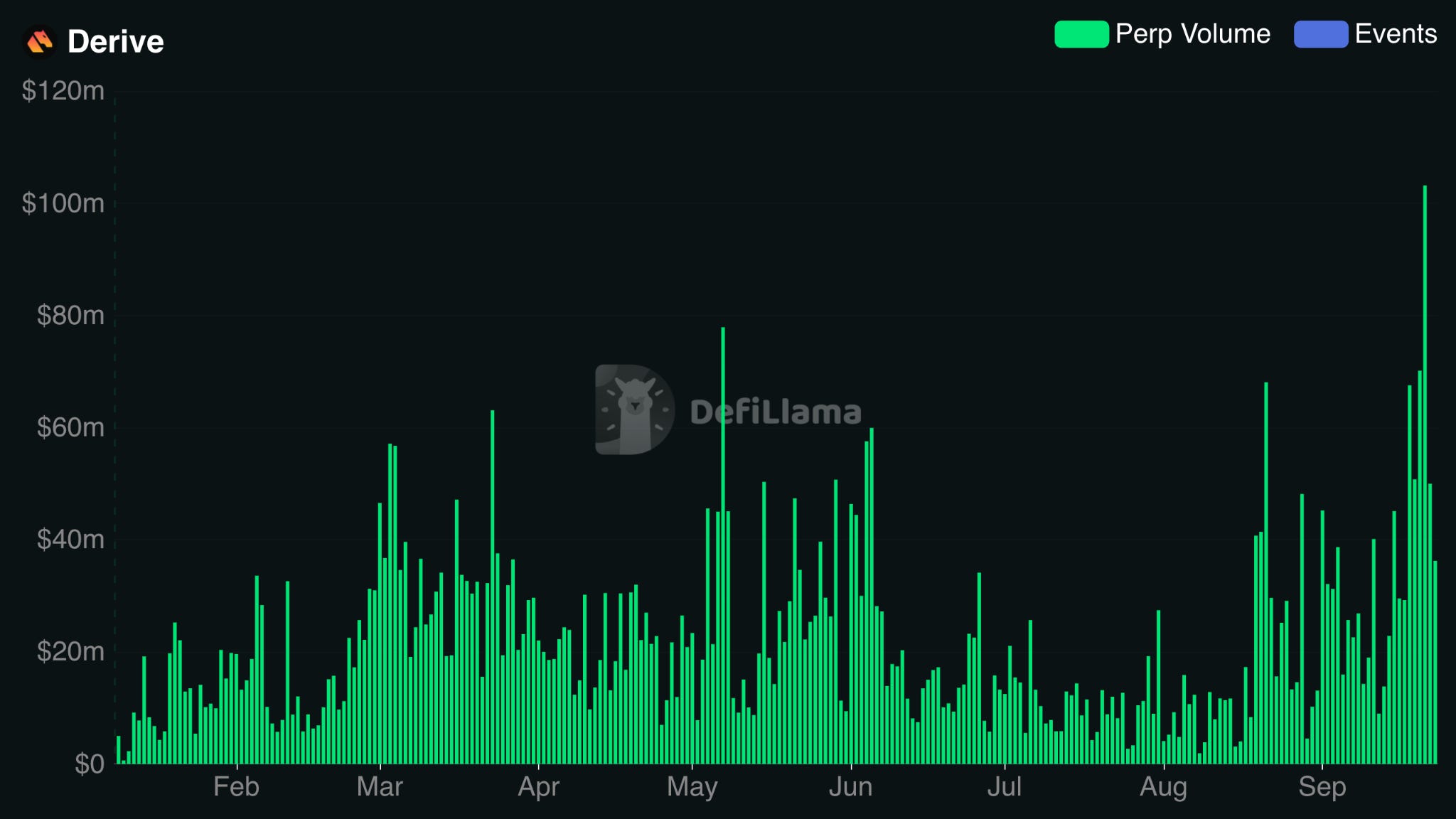
A quick look at the user interface (UI) makes their target clear: they don’t hide options complexity and target sophisticated volatility traders.
Rather than simplifying the experience, Derive wants to offer the full power of options to those who understand them, positioning itself as exchange infrastructure.
Users can pick between assets, strikes, and expiries, then combine them to create custom payoff structures.
One such example, shared by KoolAid, went viral recently:
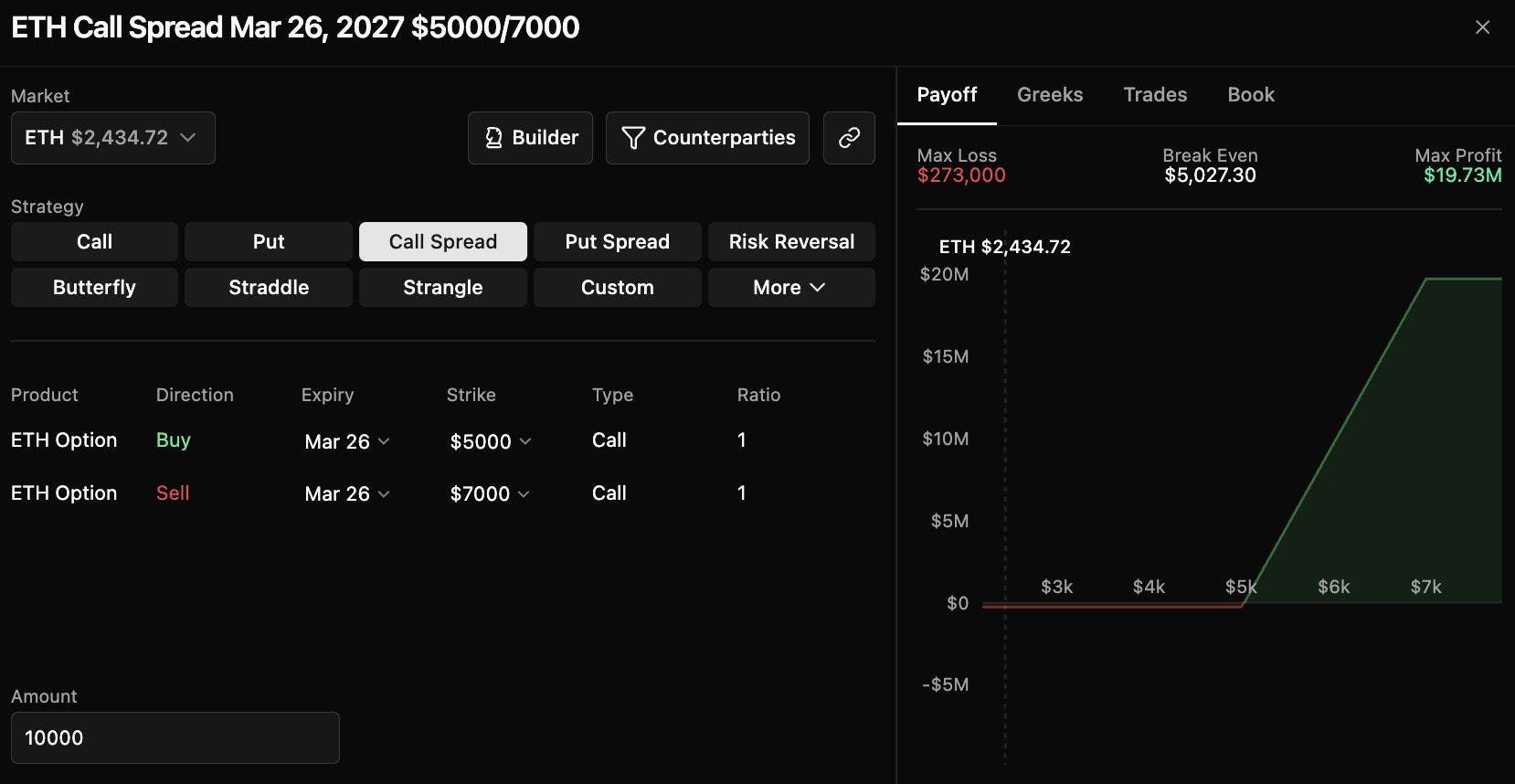
This user opened a call spread trade on ETH.
He bought ETH calls at a $5k strike for March 26, 2027, and sold ETH calls at a $7k strike.
For those unfamiliar with options, this means he’s betting ETH will be between $5k and $7k by March 2027. And you thought you were bullish on ETH?
Beyond the dreamy target, this post went viral because of a massive payout: the user invested $300k to win up to $20 million if ETH hits $7k. He will only make money if the price is between $5k and $7k; otherwise, the option will expire worthless.
This shows Derive’s power: a plug-and-play interface that lets sophisticated users build their own option strategies.
Derive just recorded its biggest-ever day in volume, with over $500m notional volume.
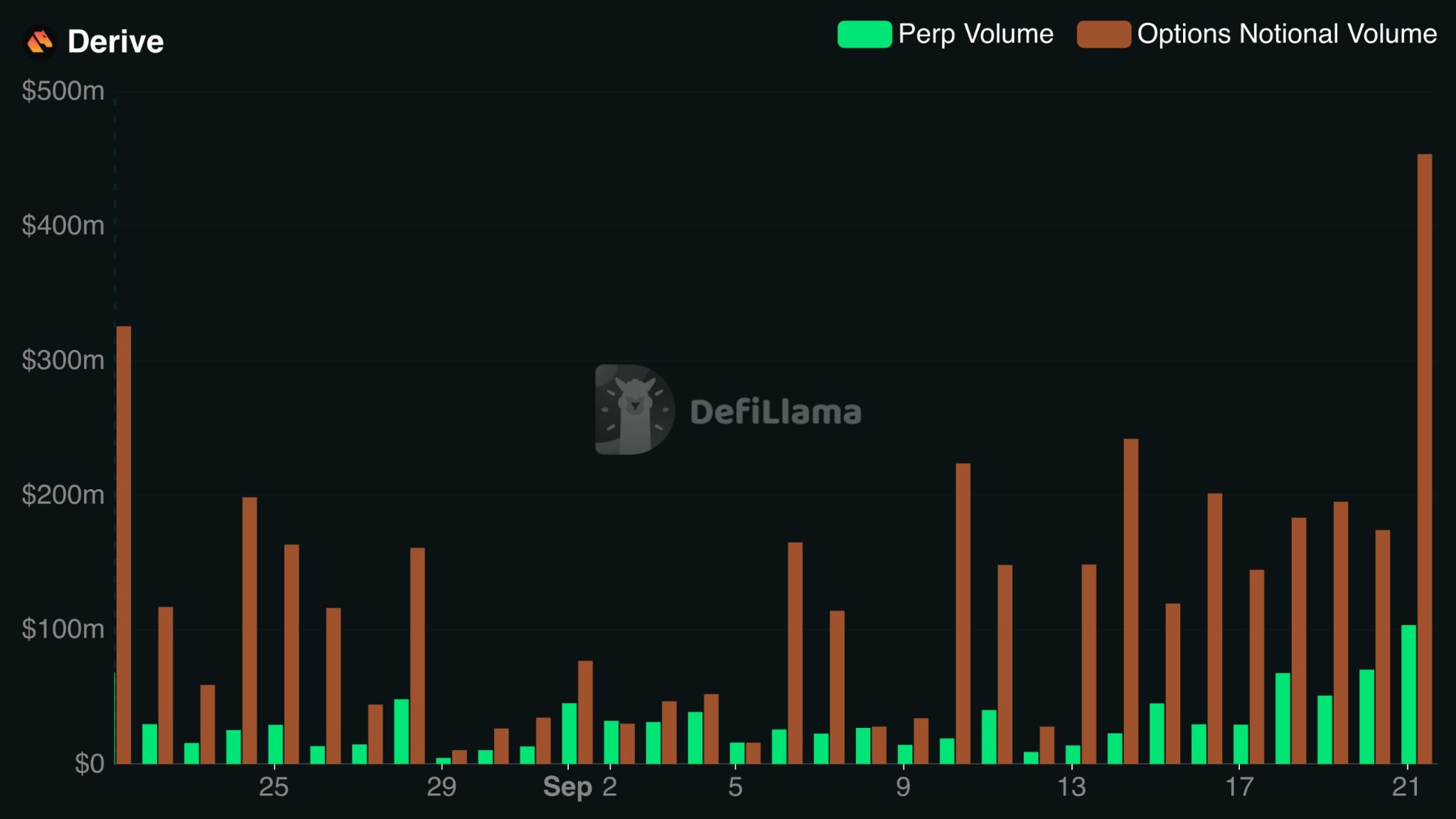
In the backend, it uses an offchain matching engine to guarantee instant execution and its onchain L2 for settlement.
Derive is launching V3 soon, turning the protocol into a zkVM on Ethereum mainnet, with all the benefits that come with it.
In addition to this:
Improved throughput
Cross-margin across portfolio
Faster RWA and long-tail listing
Native vaults
Borrowing of additional non-cash assets
Derive will be able to offer options on a much broader range of assets, including equities, commodities, etc. Native vault deployment means third parties can create strategies, effectively acting as curators for structured products.
Derive is therefore the best fit for users who want real options infrastructure rather than simplified yield: its weaknesses are the same as its strengths.
Paradex
Paradex announced the integration of the Paradigm RFQ for its options platform in mid-September 2026.
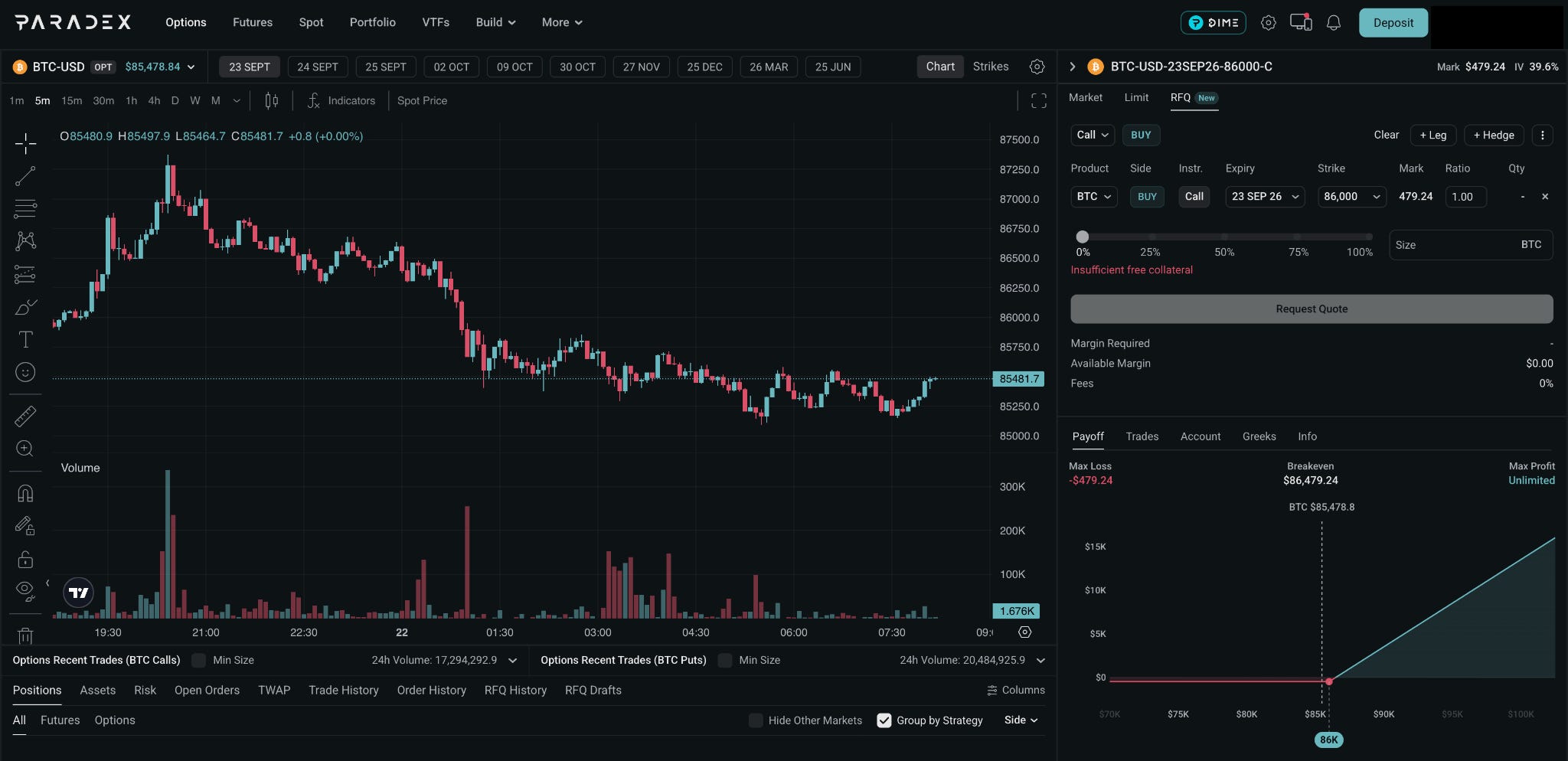
Users can select from a simple strategy to a multi-leg strategy, and build their own payoff structure. The quote is then sent to the RFQ, with market makers and institutional liquidity providers providing their best quotes for execution.
Leveraging an RFQ avoids bootstrapping orderbook liquidity for each market, which was a major obstacle for early option protocols.
Furthermore, Paradex can leverage Paradigm’s RFQ, one of the deepest and most liquid implementations, with years of track record. Since its inception in 2019, it has processed over $1 trillion in volume.
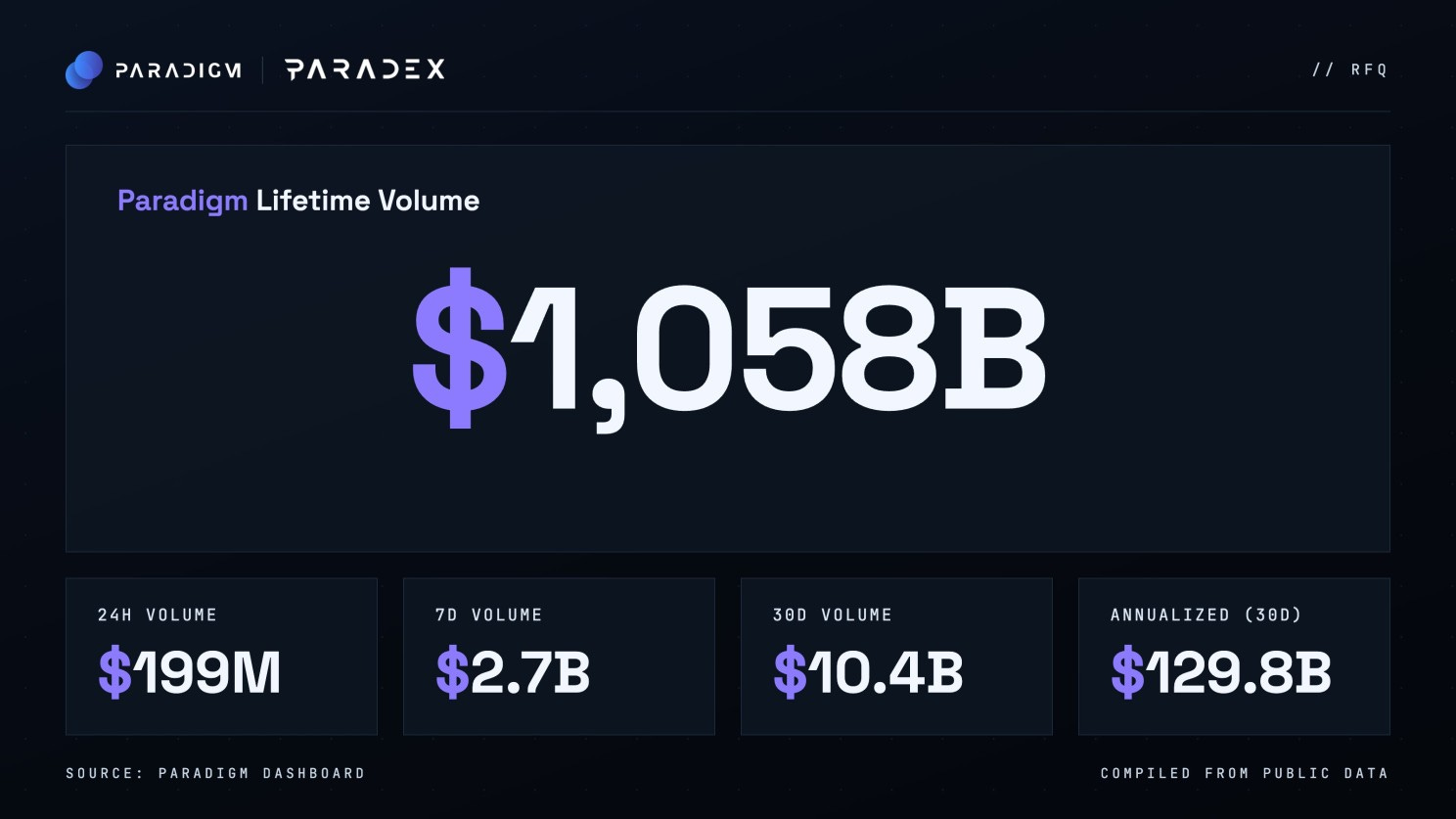
For context, this is the same RFQ that Deribit, the leading options trading platform, uses and, on average, is responsible for 27% of its volume.
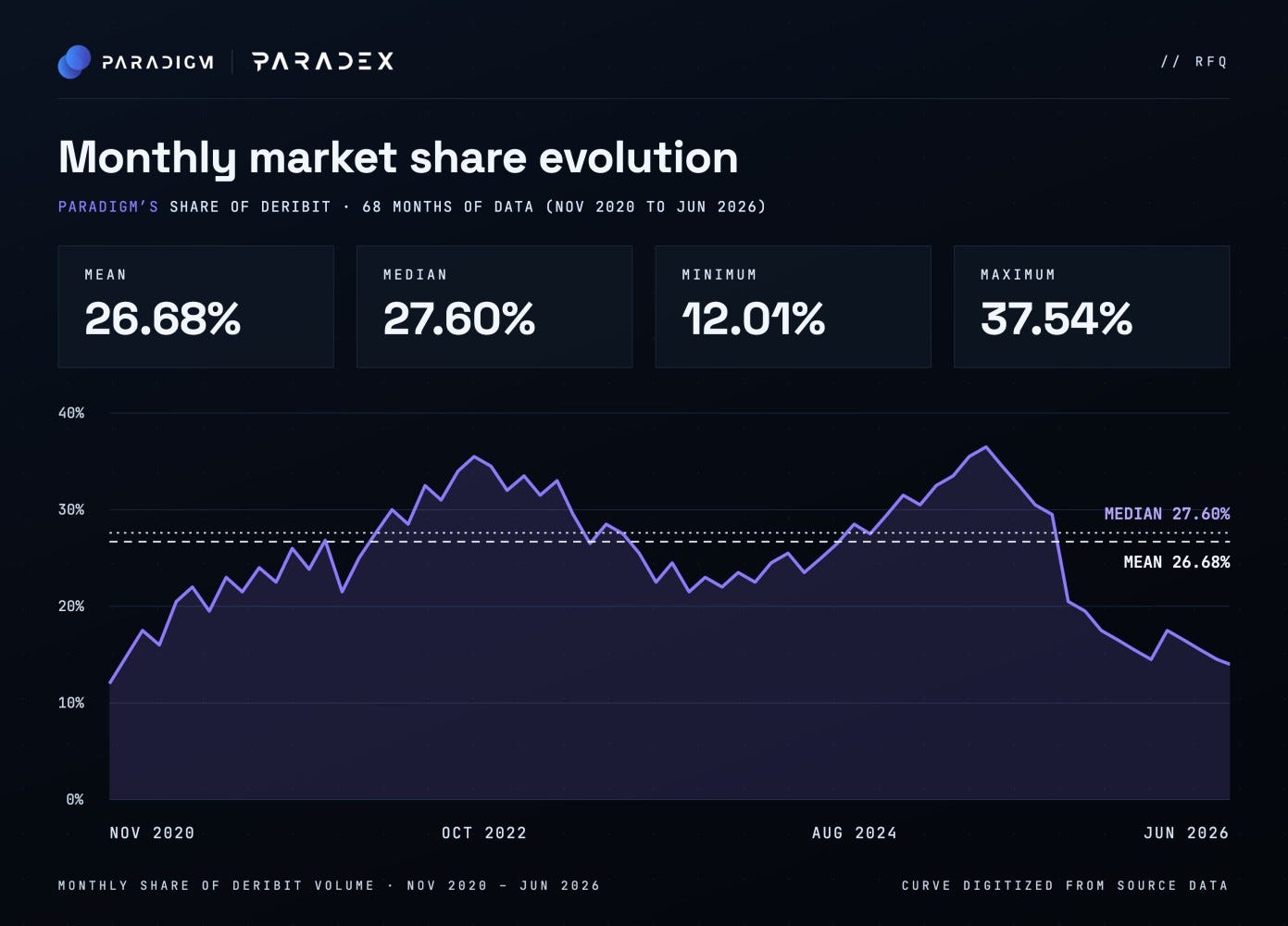
The options platform wants to provide as many assets and payoff designs as possible. However, execution quality and liquidity often constrain them. Rather than orderbook liquidity, more and more options platforms are relying on RFQ systems with professional market makers providing efficient quotes.
With this implementation, Paradex moves to a full-fledged option trading platform where users can pick their own RFQ structure and get quotes from one of the most liquid RFQs in the industry.
Binary Options
As we have already discussed in our previous report with Block Scholes, prediction markets are structurally identical to binary options.
Each contract pays a fixed amount if conditions are met at expiry; otherwise, it expires worthless.
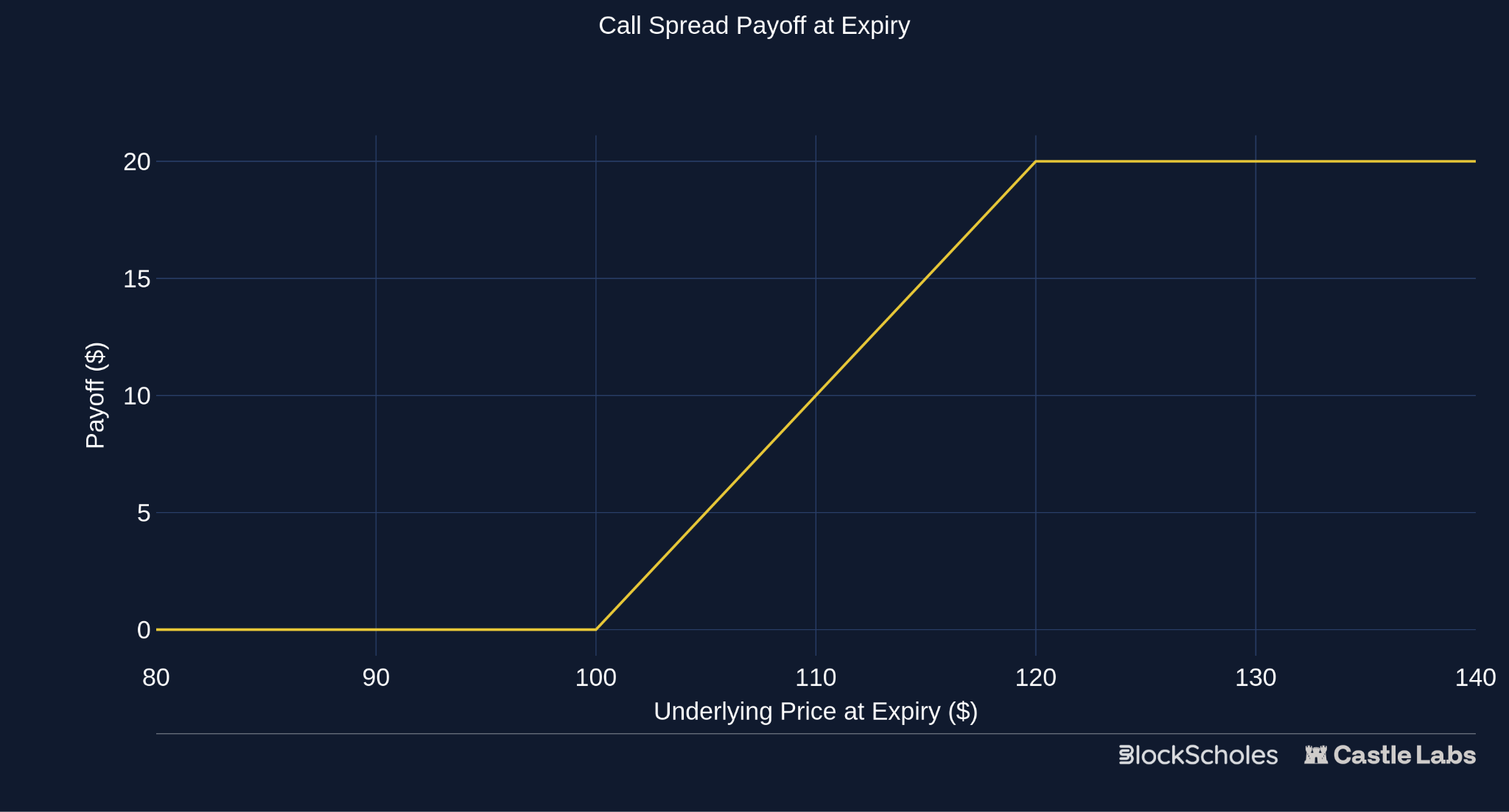
In that sense, prediction markets are determined by the price of vanilla call options and resemble a call spread, a “combination of two calls on the same underlying”.
Under this strategy, a user buys a call at a lower strike and sells another call at a higher strike. The result is a payoff with three zones, the two extremes of which resemble that of a binary option:
Below the lower strike: Both calls expire worthless. Payoff $0.
Above the upper strike: Payoff is the strike difference.
Between lower and upper strike: Payoff ramps up from $0 to the strike difference.
Polymarket
Polymarket relies on the Gnosis Conditional Token framework to create outcome contracts. To source liquidity, they leverage a hybrid CLOB model with market maker incentives.
Market resolution is perhaps one of Polymarket’s most criticised aspects, as it sources from UMA’s Optimistic Oracle and Chainlink for cryptocurrency markets. UMA has already had its fair share of issues, such as during a Zelensky market on whether he was wearing a suit.
These markets are inherently simpler than options and can appeal to more retail users because of their ultra-short expiry duration, making them a good complement to other sports or politics markets on the platform.
Currently, Polymarket offers 5-minute, 15-minute, and 1-hour markets, which users can go long or short. Because of their fixed expiration and binary payouts, these are binary options. However, the problem is that the payout depends on the price at the market’s final timestamp, which can be above or below the strike and doesn’t let traders express their view of the asset’s range.
Nonetheless, adoption for these markets grew rapidly, and Option protocols can learn from prediction markets by abstracting complex outcomes into a simple yes-or-no decision, rather than a multi-outcome event.
Kalshi
Kalshi has focused on a regulated approach to offering its products to US customers, which is its main differentiator.
Kalshi also offers both 5-minute and 15-minute markets, with a liquidity model similar to Polymarket, a hybrid between a CLOB and institutional market makers.
Currently, both Polymarket and Kalshi offer permissioned market creation; however, a permissionless process with user-generated markets (UGM) can eventually become an additional binary option, like a hedging instrument where users could set their own strike price and expiry. This will be complemented and boosted by asset class expansion across prediction market venues.
HIP-4
HIP-4 offers a slightly different approach than the two behemoths it shares this category with. In fact, we can argue HIP-4 is a framework for decentralised outcome markets.
HIP-4 went live in May 2026 as Hyperliquid’s implementation of outcome markets that support binary market outcomes and, at the end of August, opened permissionless deployment.
Launching these markets follows a similar procedure to HIP-3: users must put capital (over 500k HYPE) at stake to create them and earn 50% of the fees.
HIP-4 markets include not only prediction markets, but also options at scale. Beyond supporting these primitives, HIP-4’s major unlock is supporting everything within the same environment, enabling trading strategies that were much more complex before.
Users had to operate across at least two or three different venues (e.g. vote on a prediction market for a rate cut while hedging your position with a BTC short with the same collateral).
Eventually, with HIP-4, they can do it all on a single platform.
HIP-4 has had a phased rollout and, to date, has accumulated over $150 million in volume.
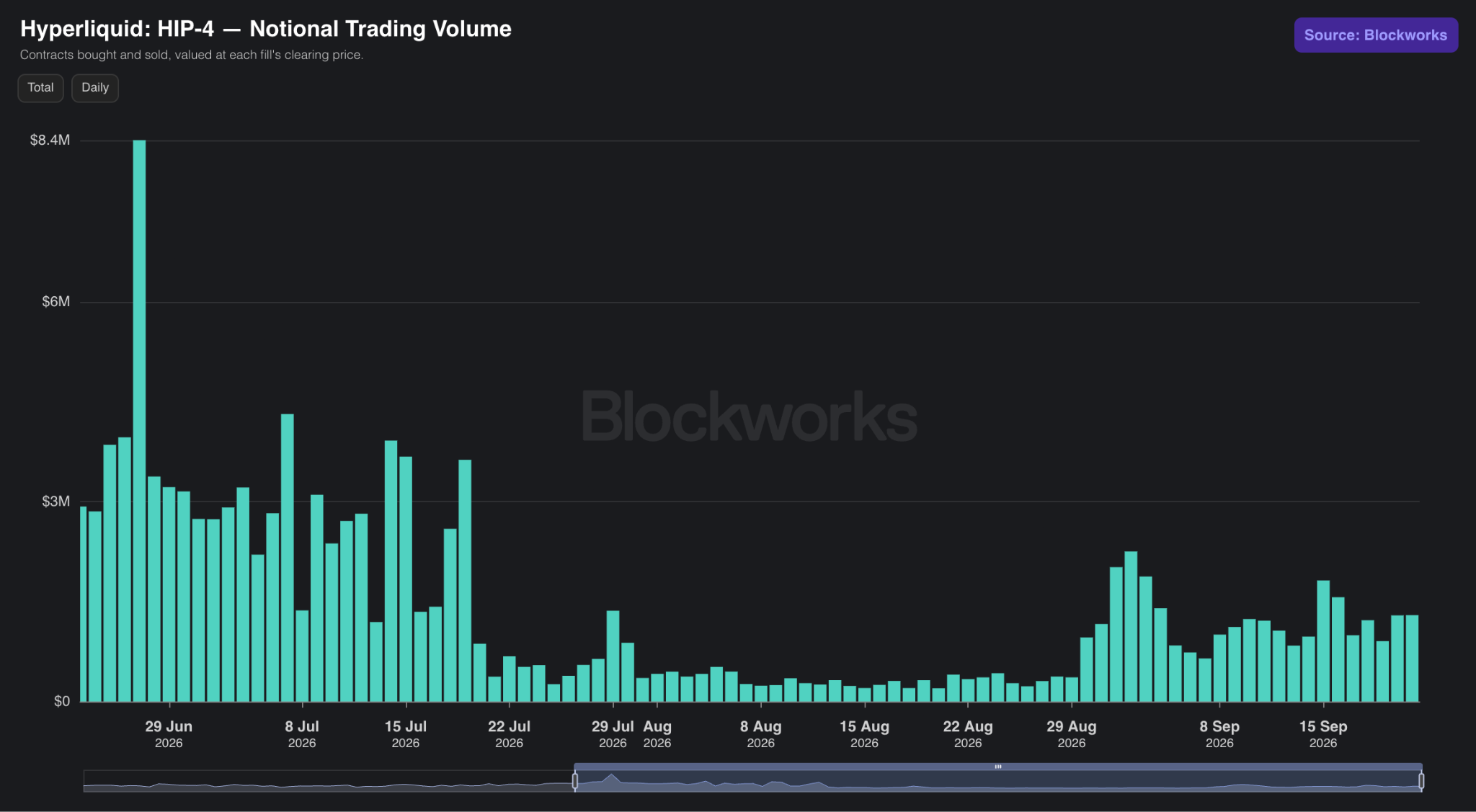
After the initial launch with 15-minute BTC markets, HIP-4 slowly cooled off until the recent enablement of permissionless deployment, when Outcome and Tradexyz launched their markets.
This is also extremely significant for builders, and another example of Hyperliquid’s infrastructure-first approach. Shared accounts and collateral, along with full composability, unlock entirely new opportunities for what can be built on Hyperliquid.
User fit: Active Hyperliquid traders, retail traders, sophisticated traders looking for hedging or complex strategies complementary to their spot or perp trading.
Less ideal for: passive holders looking for one-click yield, or prediction-market users.
Structured Products and Yield Products
Rather than being general platforms for purchasing and settling options, these protocols are more narrowly designed.
They focus on a specific aspect of option design and a specific use case; as such, they are less general than the ones we mentioned above, which mostly resemble exchange interfaces.
Rysk
Rysk has made options feel like an income product for HYPE holders rather than a professional volatility screen.
Initially launched on Arbitrum, they have found PMF on Hyperliquid.
Rysk’s value proposition is simple: it lets users earn yield upfront on their spot holdings.
There are, in fact, a lot of HYPE holders in massive profit; Rysk gives them a way to hedge their position while generating yield through covered calls.
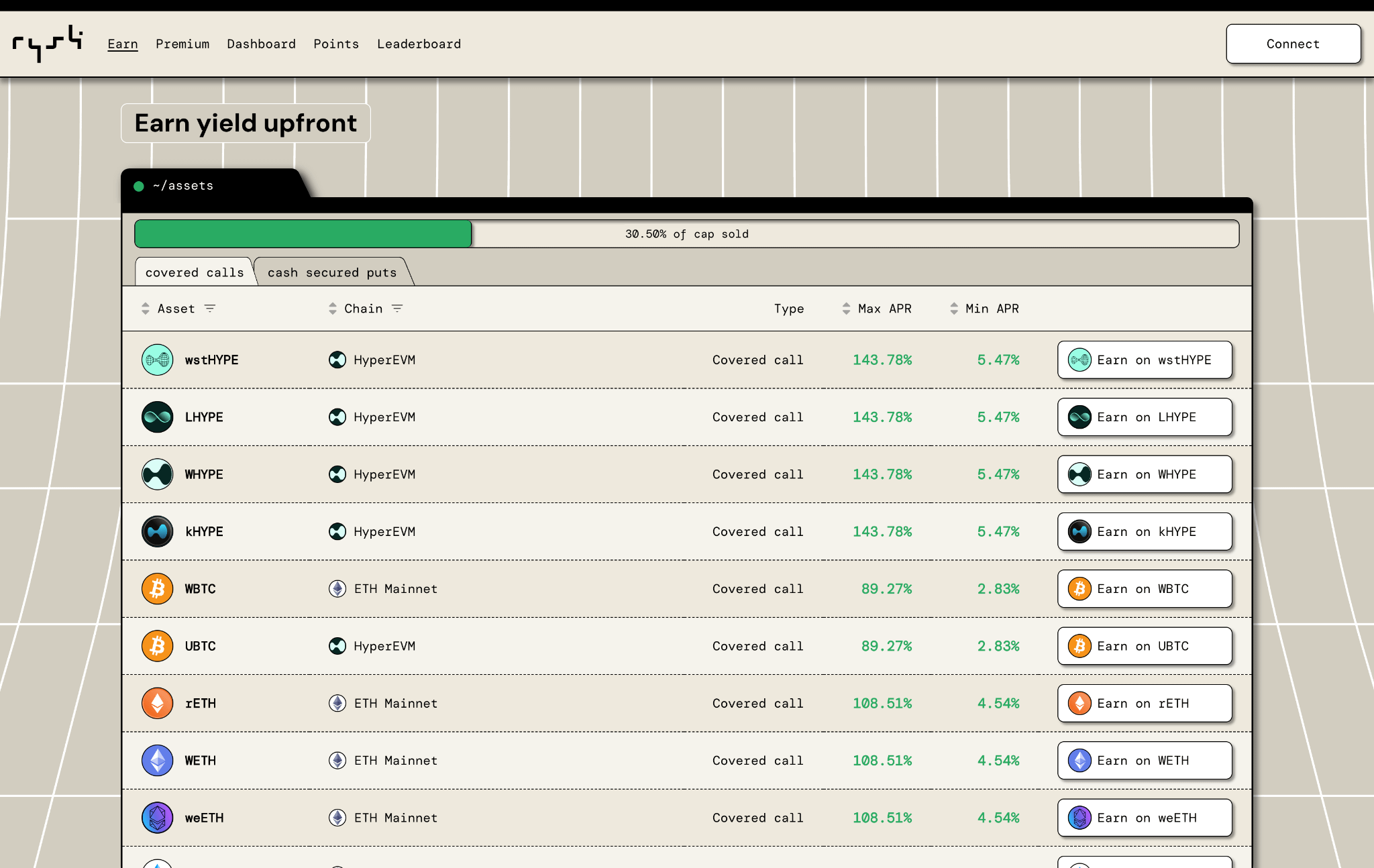
This highlights an immediate difference between the platform and others: this is not a platform for the general retail public looking for option strategies. On the other hand, Rysk has a specific utility: it lets users with spot exposure use covered calls to hedge their positions and generate yield.
In a way, it works similarly to Pendle: it transforms spot assets that aren’t yield-bearing into a yield-bearing product.
It takes what Pendle calls the YT and distributes it to users as yield until the covered call expires.
Let’s have a practical example of how Rysk works.
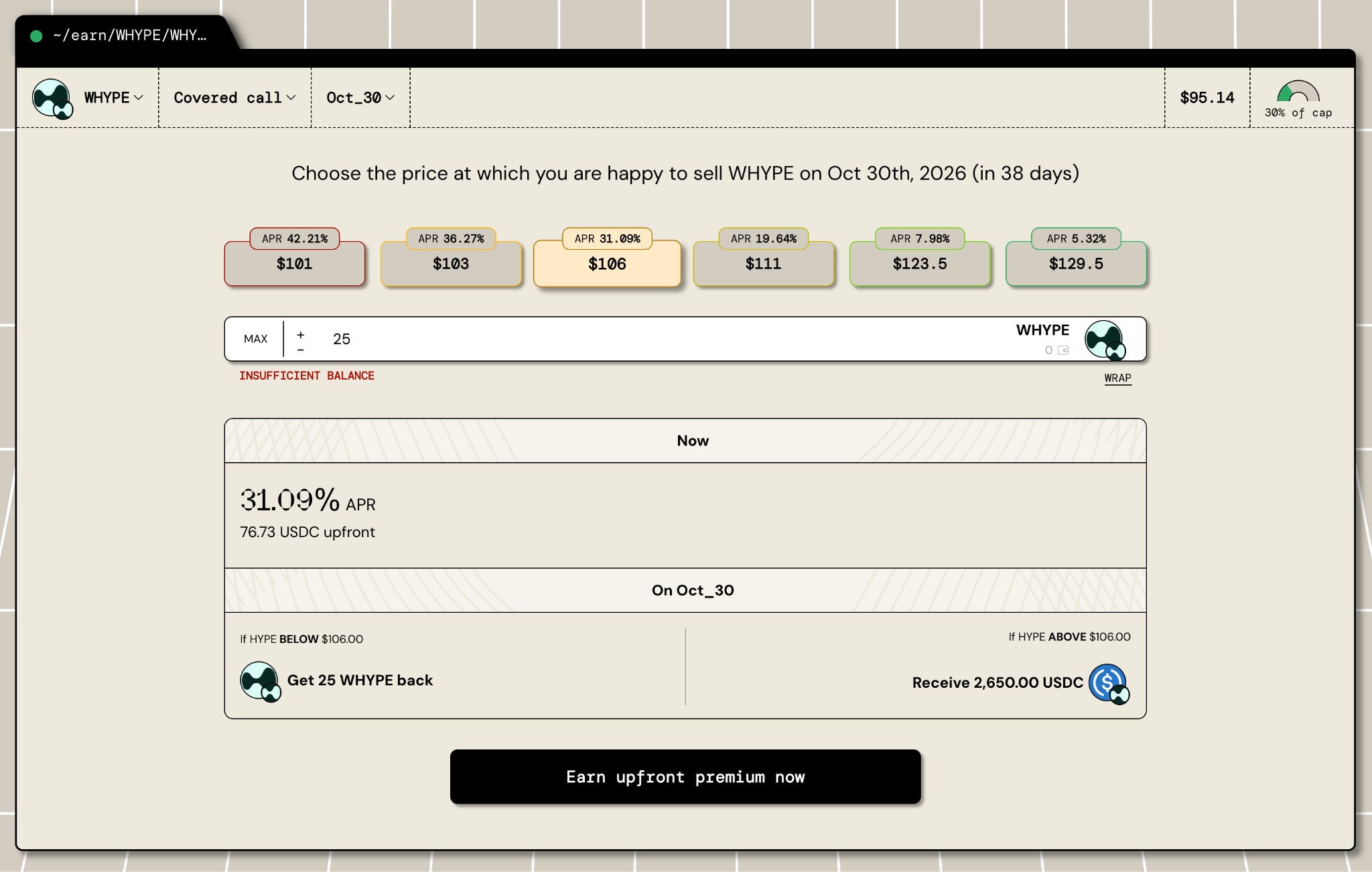
Users can pick their asset and expiry and clearly understand the yield they will generate.
They immediately receive the APR as upfront yield. Then, at expiry, if the asset price is below the strike, they will get their spot assets back plus the yield. If HYPE instead goes above $106, they will receive only the same amount in USDC plus the generated yield upfront.
For this reason, contrary to others, which are measured by option premium volumes, Rysk’s success is better defined by its TVL, that is, the amount of assets users are locking into covered calls to generate yield. Reaching $50 million recently is even more impressive, since monthly expiries reset TVL to 0.
This reflects a completely different user profile than other options platforms.
User fit: institutions, large treasuries, directional funds, market makers, retail whales, passive holders looking for one-click yield.
Less ideal for: retail option traders, neutral funds, prediction-market users who want yes/no outcomes.
Hegic
Hegic is an onchain options trading protocol that simplifies option trading into a one-click experience and lets users stay anonymous, like the Hegic dev.
Hegic restricts listed assets to ETH and BTC; however, compared to Rysk, it also lets users express different sentiments through strategies like spreads.
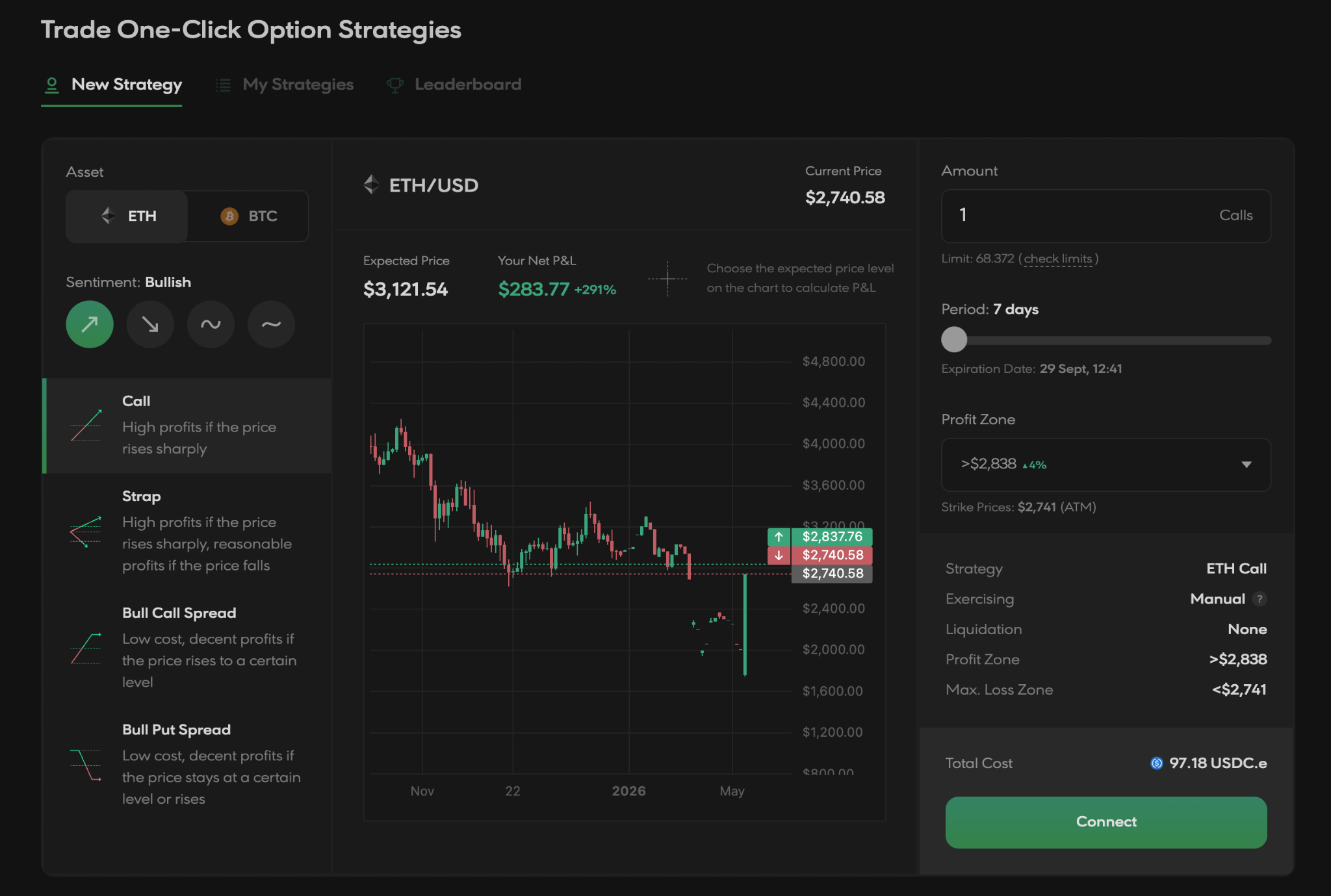
Hegic options are American-style, meaning users can exercise them any time before expiry.
Hegic also has its own native token, which users can deposit into its proprietary liquidity model called Stake&Cover (S&C).
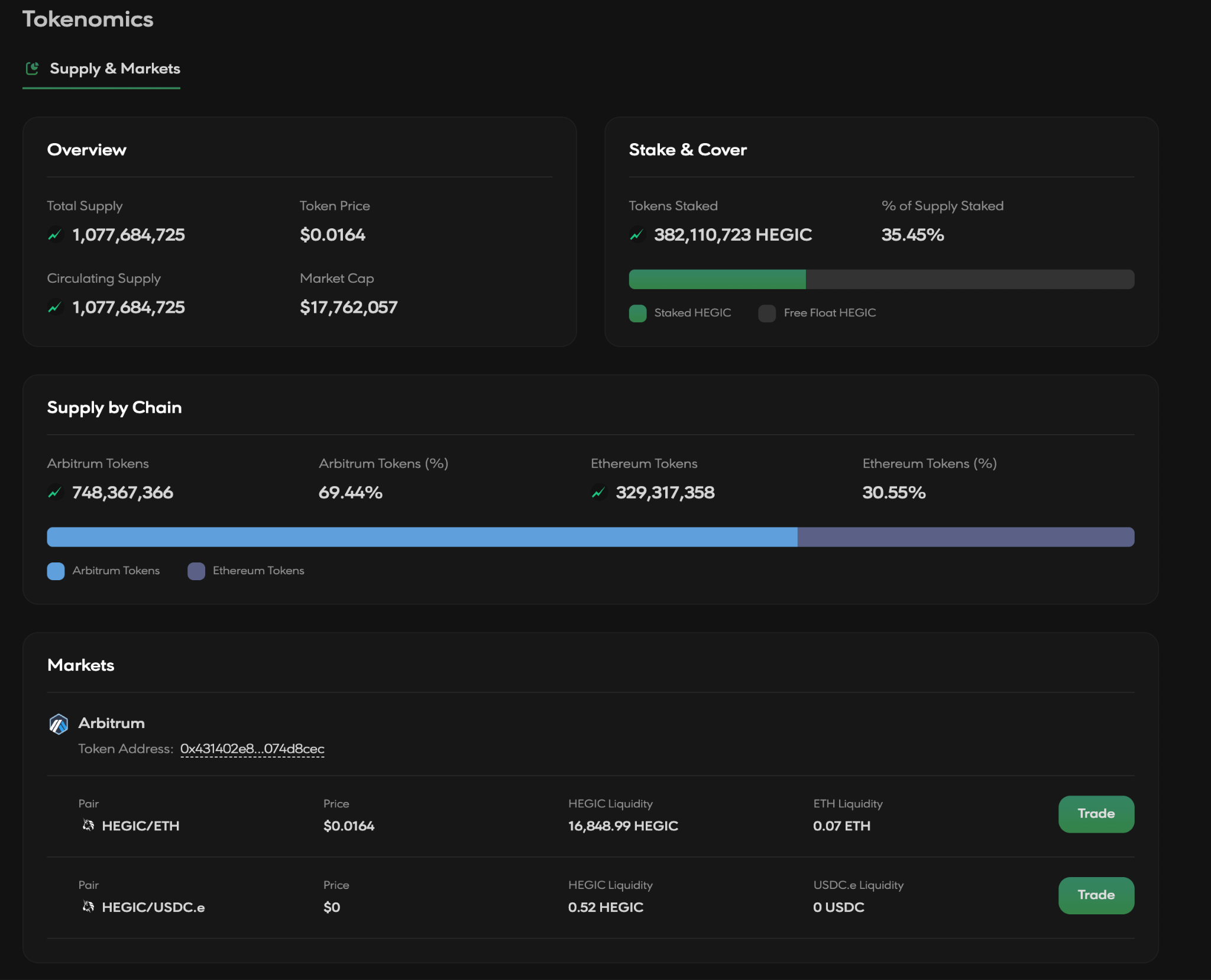
Hegic uses a peer-to-pool model.
In this model, Hegic tokens in the pool contribute to collateralising options and strategies, similar to the early GLP, where a vault takes the other side of traders on the platform.
As a result, S&C depositors get 100% of all P&L accrued by the protocol.
Compared to Rysk, Hegic is a broader platform that focuses on specific assets and offers a wider range of strategies beyond covered calls.
It sits between Rysk and Derive, offering a few assets but extensive strategies that are abstracted and made as easy as possible.
User fit: large BTC and ETH holders, large treasuries, market makers, DeFi whales.
Less ideal for: retail option traders, market neutral funds, prediction-market users who want yes/no outcomes.
Many Options for Options
This brief article shows that options is a broad term, and builders in the sector focus on different parts of the stack.
These days, we have seen strong growth from Derive, as the main options exchange platform.
Paradex has just announced its support for Paradigm RFQ, so we expect their quotes and volume to improve and grow accordingly. Others like Polymarket and Kalshi are still figuring out how to expand their total addressable markets by attracting more options traders and combining that with their event markets.
HIP-4 events by Tradexyz will be a defining moment, showing whether Hyperliquid is the right place for event markets and eventually leading to competition with major binary options venues such as Polymarket and Kalshi.
However, yield products like Rysk are extremely interesting to us, with a clear niche and utility. Expanding to more assets and chains is only the first step toward growing the user base.
Expanding the scope of complex strategies is also a priority, as it currently mostly focuses on users with spot holdings who are sophisticated enough to want to hedge or generate yield.
Nonetheless, we feel the options sector is just getting started, with market conditions aligning and user profiles evolving accordingly. Institutional investors will become more sophisticated, and we expect the recent payout-virality posts to drive more retail users to experiment with these products eventually.
written by @francescoweb3
Every week for the last 3 years, we have shared our research for free, directly in your email. Not a subscriber yet? Let’s fix it:
https://research.castlelabs.io/subscribe
PLUS, don’t forget to join our Telegram channel for the latest updates from Castle and all our research: Link here