

This article follows up on our previous report, which introduced OpenEden and its Real World Assets (RWA) product offering. Since then, they launched their token EDEN, with TGE at the end of September.
So, how’s this token used within the OpenEden Ecosystem?
What else is coming, and how much more of the market can OpenEden capture?
Let’s start answering each of these questions, starting with a caveat on the importance of this opportunity.

The RWA Opportunity
First things first, let’s talk about the actual size of the Total Addressable Market (TAM) for OpenEden.
RWA has witnessed immense growth over the last two years, increasing by over 300% since the start of 2024. The total RWA value onchain stands at $35.54 billion today. OpenEden is a core contributor in the space, involved since 2022 and positioned to solidify its stance further, thanks to its future vision and roadmap, which we’ll dive deeper into in the upcoming sections.
Given that OpenEden’s current tokenised value is $225m, there is still a huge market to address for bringing traditional assets onchain, even at current levels.
Even if we consider only the US Treasury bills (T-bills) held by the public, their outstanding value is well over $6 trillion. This figure already exceeds the total market cap of digital assets, and we haven’t even accounted for the global T-bill market and other assets, funds, bonds, and commodities that can be bought onchain.
While there are competitors to OpenEden that represent a larger share of this pie, at the end of the day, there is room for everyone, given the significant opportunity for the pie to grow and for OpenEden to capture a larger share of this category.
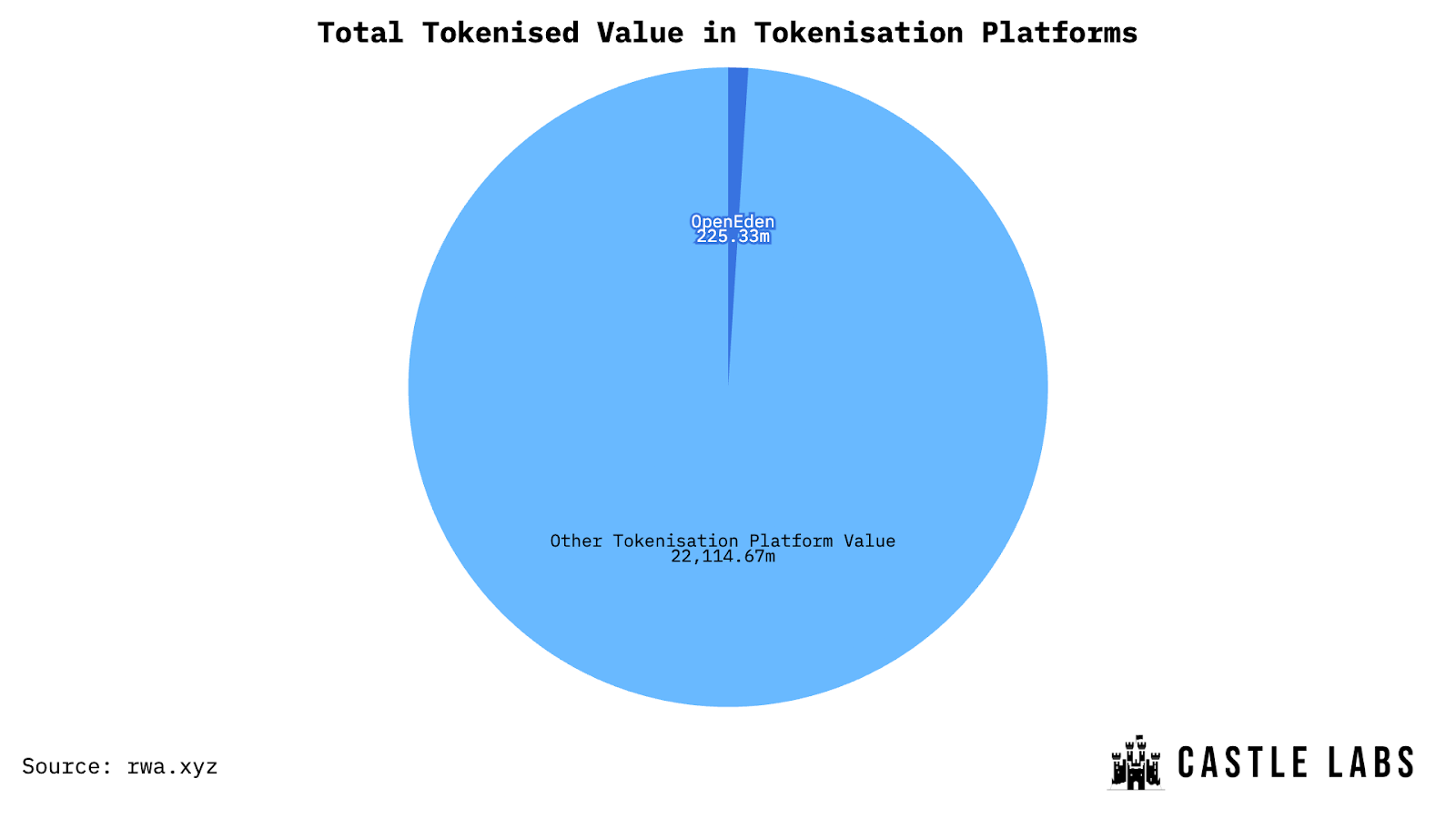
Source: https://app.rwa.xyz/platforms
The EDEN Token
The native token of OpenEden can take two forms:
EDEN
xEDEN
We start by introducing EDEN, the platform’s utility token. The main utility envisioned for EDEN is across four verticals:
Giving access to lower fees for EDEN holders (e.g. reduced management and transaction fees)
Providing preferential access to tokenised RWA products and yield instruments, new fund launches and liquidity programs
Governance participation in key proposals
Providing rewards for users staking EDEN into xEDEN
Aside from this, the protocol envisions periodic EDEN buybacks funded by RWA fund revenues, which can be staked or used for liquidity or market-stability programs, aimed at increasing asset price stability and reducing slippage on both centralised and decentralised platforms.
However, to access governance rights and incentives, users must stake their EDEN into xEDEN.
xEDEN is designed to accrue value without requiring users to claim their rewards. The token has an inflationary design, which is expected to balance out over time as emissions decline and platform revenues grow.
Currently, about 12% of the total supply is staked, with an average APY of 8.38%.
The EDEN token suffered from a steep decline since its launch in the end of September due to the fact that a lot of holders were involved in one way or another since 2023, and therefore expected for TGE as their exit, as well as a big part of the supply dedicated to their Bills points campaign, which has further consolidated the selling pressure.
Nonetheless, after this shakeout, OpenEden is ready to further link its token with its vision.
Expanding within the RWA Niche
The launch of EDEN coincides with OpenEden’s aggressive expansion strategy.
On the one hand, they are focusing on more integrations for USDO, a yield-bearing stablecoin backed by T-bills and BUIDL tokens and represent a key part of the OpenEden ecosystem.
Through cUSDO, the token is already integrated into a wide range of DeFi protocols, including Pendle, Morpho, Euler, Balancer, Upshift and more, highlighting its composability.
As part of their campaign, OpenEden is focusing on further USDO integration across consumer-facing platforms, with one upcoming integration with a messaging app with over 250 million users.
The target is to have USDO deeply integrated with retail consumers so they can spend and send it across applications they are already familiar with.
One of the initial use cases of stablecoins was simplifying remittances: targeting this vertical is strategically essential, first to have a real impact and second to capture an opportunity by transforming remittances from being plagued by third-party costs into yield-bearing payments.
Both developments indicate OpenEden’s expanded focus on retail, which is in step with the ongoing development of its institutional-grade products.
As part of their efforts to expand to a broader and more global customer base, OpenEden is launching a multi-currency stablecoin framework, including securities from Asian markets, with an Asia-focused deployment. This is how OpenEden contributes to growing the RWA pie altogether by targeting untapped regions.
Like all other OpenEden developments, this will focus on enabling enterprises and institutions to earn regulated yield and transact in their local currencies easily.
Efforts to expand into institutional markets extend beyond the current offerings, with a targeted future inclusion of:
Tokenised Funds: These funds will be focused on Short-duration Global High-Yield Bonds, increasing the availability of fixed income instruments onchain.
Delta-Neutral Yield Token: OpenEden is planning to launch a delta-neutral “high-yield token designed to deliver consistent, risk-adjusted yield across different market conditions”. What we know so far is that this will include a combination of yield strategies across both CeFi (US Treasury-backed assets, cash-and-carry arbitrage) and DeFi (Overcollateralised lending, Blue-Chip DeFi Yields).
Certain structured products: There is a whole class of products in TradFi that allow investors to choose different payoffs based on their risk tolerance, and OpenEden plans to expand and bring them onchain as composable products, providing diversified yields comparable to TradFi.
Food for Thought
OpenEden is expanding and has been building and contributing to the RWA category since their launch in 2022.
With their focused approach to introducing new product offerings and improving the composability and use of the current ones, their growth trajectory can be predicted.
The launch of EDEN represents a significant milestone for the team, which can now leverage this asset for deeper integrations and to increase benefits for holders, further boosting tokeandn utility.
We can also observe how they are moving hand in hand across two different strategic focuses:
Connect and integrate USDO and other assets deeper into retail-facing applications.
Dive deeper into exploring further institutional opportunities.
This allows OpenEden to remain flexible and to expand its product base, which can respond to timely developments in the RWA market.
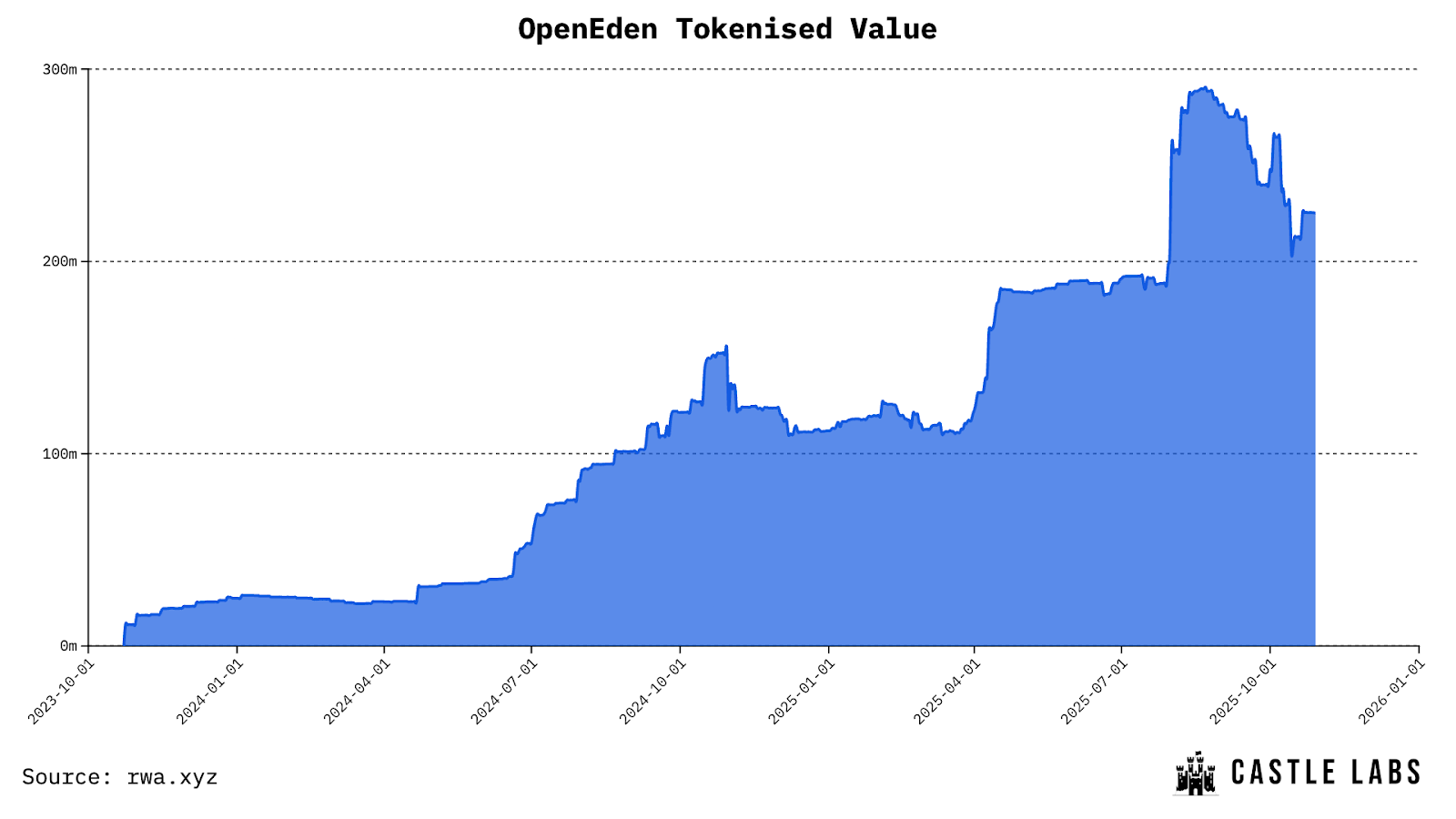
The RWA market is huge and has been constantly growing.
There is a lot of opportunity hidden in this category, such as introducing new instruments backed by onchain assets, tapping into the yield of different regions around the world, and providing more sophisticated products for everyday onchain users.
The product that tests these new domains and offers diversified yield options will win in the long term, and OpenEden is well-positioned to be among the main players in this vertical.
RWA providers are experimenting with different native token structures. While the fact that OpenEden has conducted a long pre-TGE campaign has resulted in increased selling pressure, we believe the flows have relatively stabilised, and now the protocol can focus on establishing more direct links, driving value to EDEN.