


Artificial Intelligence (AI) is a pivotal technology, and as its use grows, it demands more computational throughput than ever.
To deliver this throughput, AI companies need GPUs and energy. Even well-capitalised companies may not be able to source enough because GPU supply is limited and energy is scarce.
A good solution is often to rent the infrastructure.
For several years, Bitcoin miners have built industrial-scale mining infrastructure and secured the most important resource: access to energy, or power. This edge is now being priced in as demand for AI computation grows. Although these miners run ASICs, they don’t use their compute capability directly for AI; instead, they lease their sites and power to AI tenants.
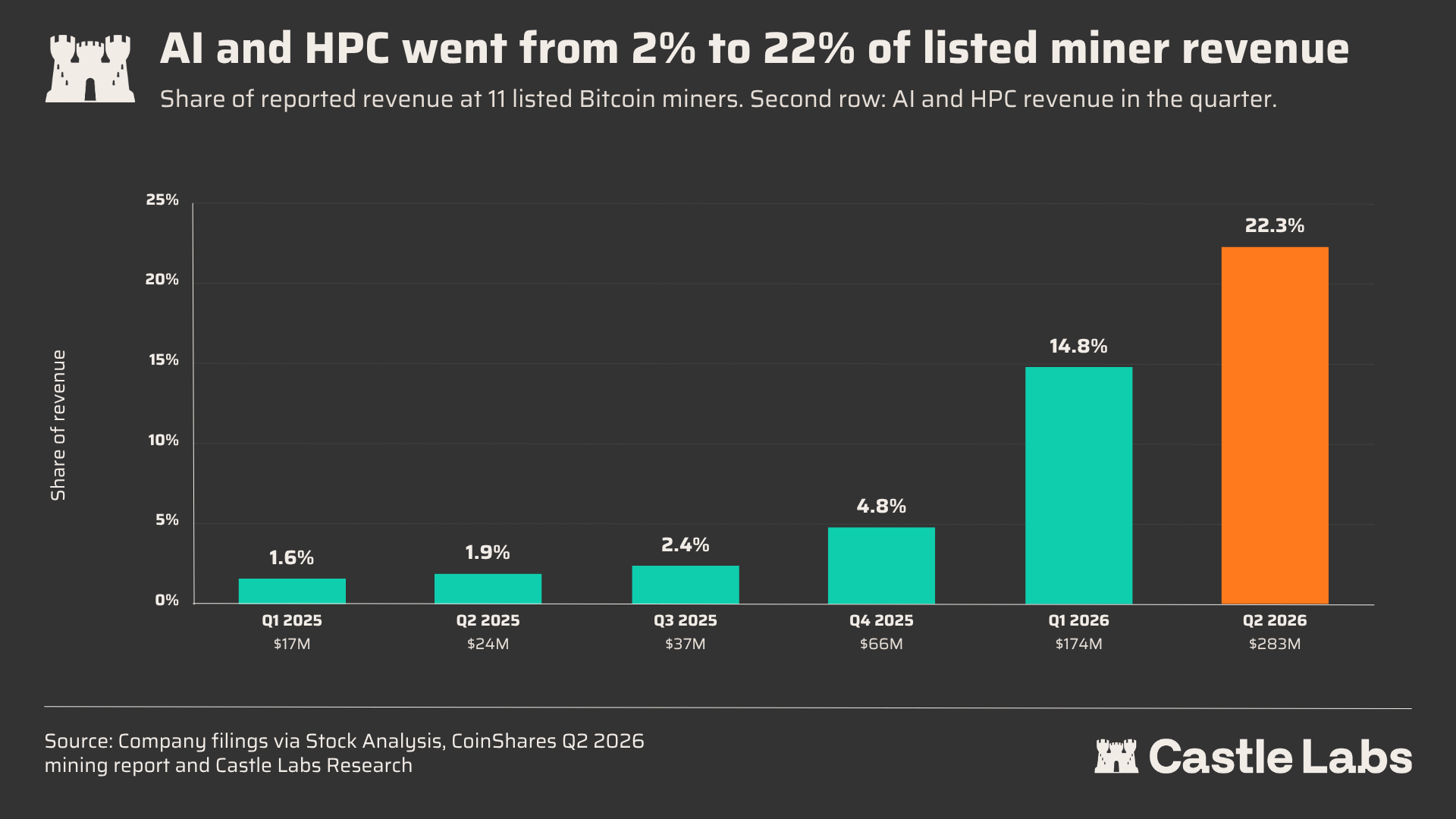
This offers a better chance to tap a more sustainable revenue stream by using the electricity they draw to power AI-related computations. Revenue across miners already reflects this: AI and HPC revenue grew from just 2% of miner revenue to 22% of 11 listed miners between Q1 2025 and Q2 2026.
As a result, Bitcoin hash power may face increased competition from AI inference.
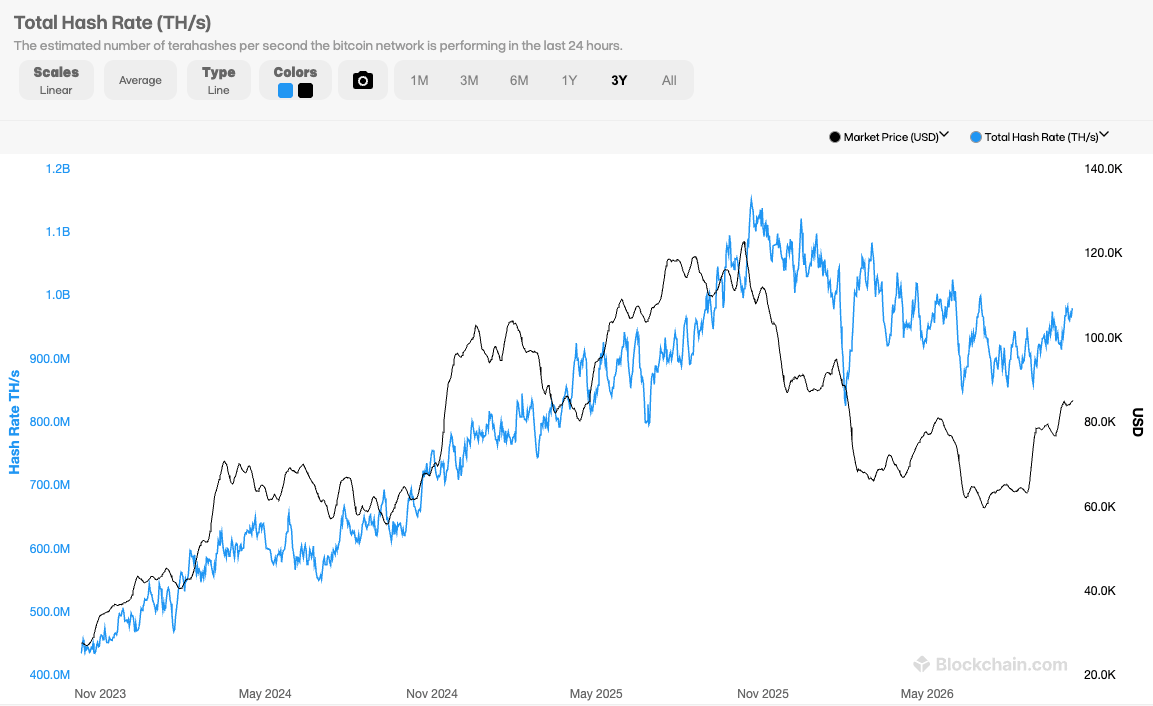
Another way to view this growing relationship between AI and miner infrastructure is to look at how BTC is mined. Under the Proof-of-Work (PoW) mechanism, miners deploy intensive computational power to secure the Bitcoin network and validate transactions. This process requires continuously calculating cryptographic hashes, a computational asset with no value once processed, making mining economically viable when the value of earned BTC outweighs the cost of computation and infrastructure.
So why not have both?
The computation can power AI inference while still securing the network and mining the asset, a solution called “Proof-of-Useful Work (PoUW)”. The Pearl network, which we discuss in detail in the next section, focuses on this intersection of AI adoption and blockchain.

What is Pearl Network?
Pearl is an L1 blockchain, launched in April, forked from Bitcoin’s code, which replaces the SHA-256 hashing with matrix multiplication (matmul), the operation GPUs run for AI inference.
This is exactly what Pearl is set up to do: turn Bitcoin POW into useful compute for AI (PoUW).
To integrate AI inference into mining, Pearl designed a system that verifies matrix multiplication instead of Bitcoin’s standard SHA-256 hashes.
Matrix multiplication is how you train and run AI inference, and it requires a lot of computing power.
They share a lot in common with SHA-256:
Require significant compute to solve quickly
The solutions to the algorithm are not subjective
Cannot be forged or guessed (nor can you guess ahead of time what the next block’s function will be)
In turn, these still “need to be expensive to perform, but the answer also needs to be objective and cheap for everyone else to verify”, which is why Pearl uses Zero-knowledge (ZK) proofs to make these results cheap to verify.
To source AI-related compute needs, Pearl connects with aggregate compute networks and inference providers like Together AI, so businesses can use the compute they produce while miners earn $PRL. However, Together AI runs its own mining infrastructure for the network and uses the PRL rewards to essentially discount its customers.
Ultimately, Pearl aims to replace the computations BTC miners do to mine BTC with the more useful matmul AI uses daily, keeping the core blockchain economics while prioritising AI.
It’s, however, worth staying a bit more on the “useful” part of POUW, with part of the criticism addressed to Pearl being that the protocol does not prove whether the matrix multiplications came from actually paying customers or useful work, as miners could feed synthetic matrices and still get $PRL rewards.
In fact, a paper from June found that the dominant mining software at the time produced “verifiable MatMul but no external inference output”, as highlighted by Brian Breslow in his $PRL thesis.
This is exactly the point: avoiding the subjective task of assessing the utility of inferences, as a similar system was already implemented by Bittensor:
A scarce native token
AI-related resources supplied by miners
Validators judging outputs
Emissions flowing to what the network deems valuable
However, this introduces subjectivity and more judgment. This also includes previous examples of collusion, as “validators are incentivised to work together to vote on usefulness”.
Instead, Pearl’s AI inferences are not subjective.
This is the most important aspect of adoption: the entire value proposition depends on the simplicity of committing two matrices for AI inferences, with little to no overhead (the value of PRL received has to outweigh integration friction, risk, lost throughput, and overhead).
Miners still have to pay the full GPU cost to earn PRL. As difficulty rises, only miners with the highest GPU class will be profitable because they have the most mining power.
If enough useful miners join the network, others won’t be profitable anymore and will have no incentive to keep mining.
Avoiding anything that could introduce subjectivity helps prevent the miner collusion issues previously seen in other networks such as Bittensor.
However, this assumes that overhead costs, currently estimated at about 10-15% because the network runs on a simplified number format (INT8), will fall enough for useful miners to become the most efficient block producers. To address this concern, efforts are already underway: Pearl-GEMM is live on testnet and handles the standard format with a 0-3% slowdown.
PRL: Tokenomics and Future Value Accrual
The token has a hard cap of 2.1 billion tokens. Instead of halving like BTC, emissions decay, and the supply is projected to be about 50% out by year 4.
At the time of writing, PRL has a market cap of $475 million, with a mined supply of 339 million PRL (16.2% circulating supply), and is expected to issue about 305 million more PRL over the next 12 months, nearly doubling the circulating supply.
It is currently listed on two venues (BigONE and SafeTrade), with $6 million in daily volume and about $22k of bids within 2% of the price range.
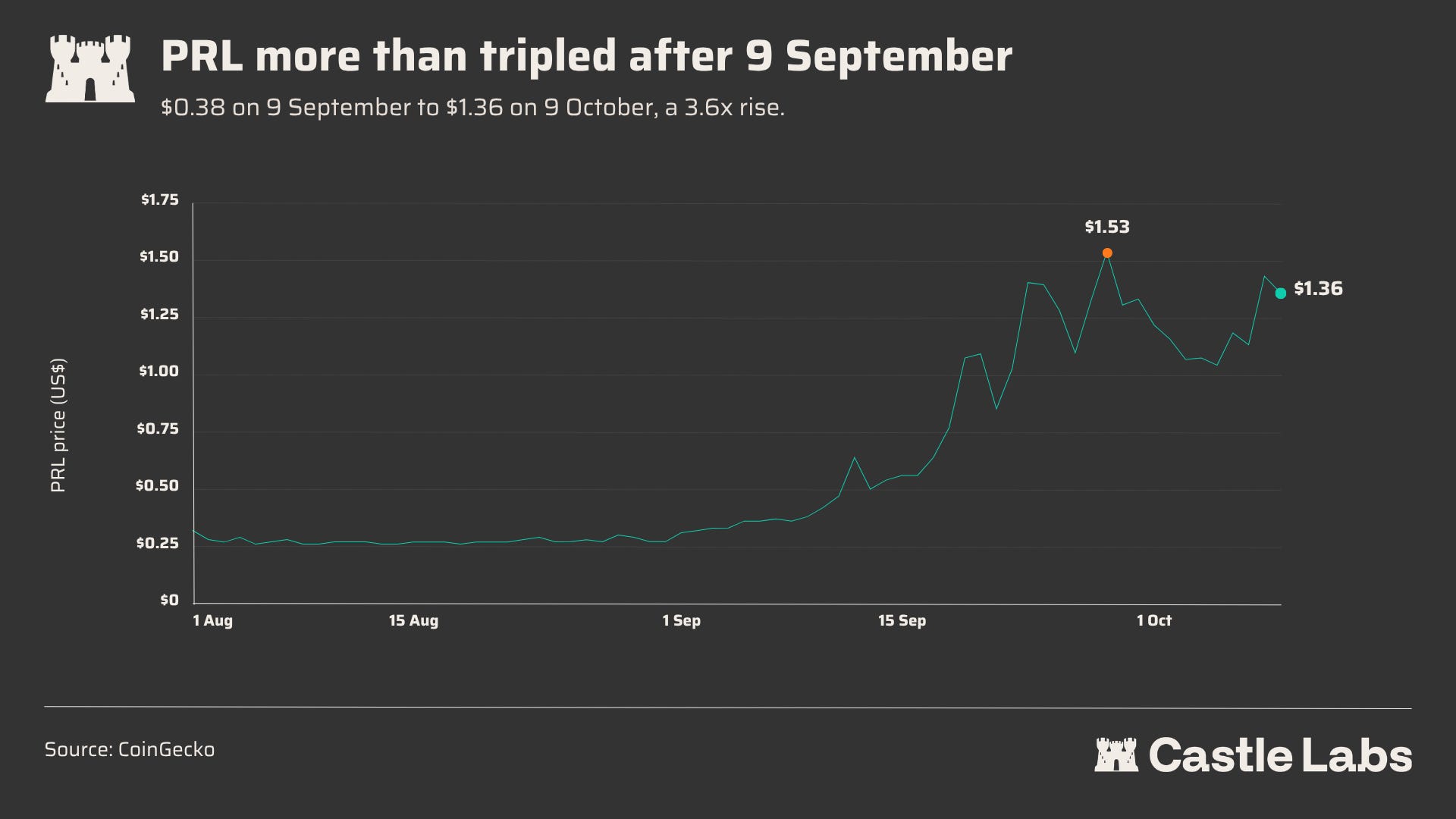
Nonetheless, $PRL’s re-rating seems to be outpacing its actual use. PRL has more than tripled since September, and it gained the most traction after Brian Breslow of No Limit Holdings published his thesis.
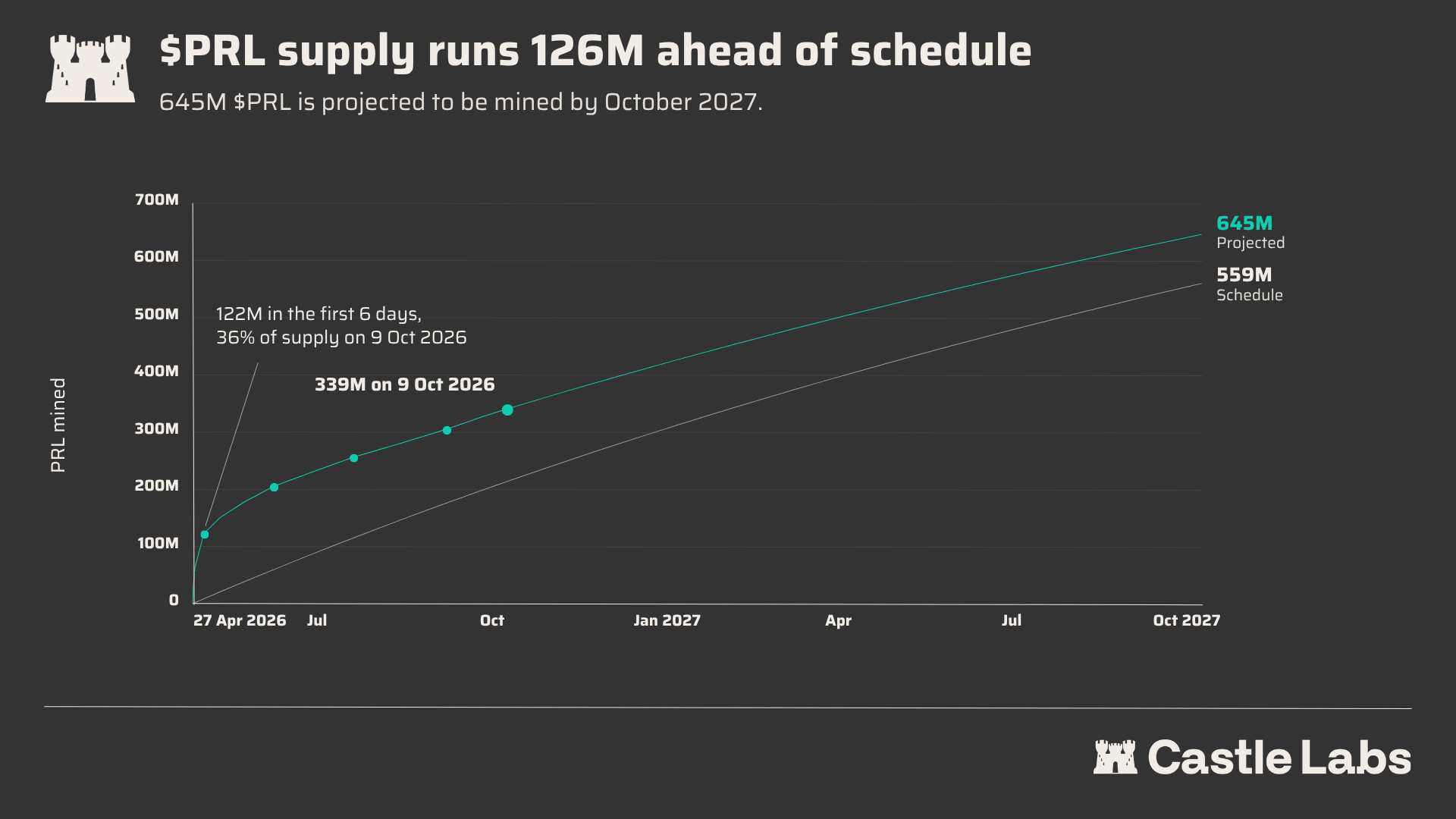
Additionally, PRL is currently dilutive. Pearl has no halvings and about 1.01 million PRL, valued at $1.4 million at the time of writing, reaching miners every day. On top of this, the PRL supply isn’t following the schedule: it issued about 122 million in the first 6 days (36% of the current circulating supply) when mining difficulty was at its minimum, and 20k blocks were mined within the first 30 hours of launch. Block times have since settled near the 194-second target. This initial lead created unwanted dilution and benefited the miners who mined in the first week, contributing to the supply concentration.
There is no revenue attached to the token. Miners mine PRL, provide AI inference services, and earn stablecoins, but there is no mechanism for PRL to burn or for the supply to shrink.
However, there are solutions that are being worked on to solve the current issues, including the overhead, synthetic mining, and token value accrual:
The Pearl-GEMM upgrade: The version of Pearl running today only handles a simplified number format (INT8), which most compatible AI models don’t use, and it slows them by 10-15%. At that overhead, an AI company has little reason to source the computation from miners. A solution, however, is in testnet: Pearl-GEMM, which handles the standard format with a 0-3% slowdown. This upgrade is essential, as an AI operator isn’t ready to sacrifice 10-15% of its output.
Real AI work has to replace synthetic mining: Currently, not all the mining is useful AI inference. Research in June examined about 8k machines running on inference-capable hardware but with no AI-related code. The decentralised compute marketplace Pearl envisions can solve this with partnerships with AI businesses: users can pay and get paid in PRL to run inference on the network. These include reserving GPU capacity, fine-tuning models, or settling compute contracts without relying on traditional cloud solutions.
AI usage creating buy pressure and a potential burn mechanism: AI inference usage creates sell pressure today. Together AI, a US cloud provider that sells access to AI models, launched a model in May 2026 and discounted access by 25%, which they earn through $PRL mining they perform to meet compute demand. The team is considering pricing AI services in PRL, or burning some PRL with each purchase, to remove dollar-based pricing and create more demand for the asset.
Closing Thoughts
Pearl is making compute useful, and its target market is compelling given AI’s growth and eventual adoption.
Building a novel network comes with challenges, and for Pearl, these include high overhead, synthetic mining, and a token value-accrual mechanism, all of which the team is working on.
Most importantly, Pearl serves models in exchange for USD, with little to no flow back to the token; using PRL will be fundamental to drive token value and improve sinks. Most PRL minted is used as incentives and may end up being sold by miners for profit.
Also, PRL is expected to be the utility token of the decentralised marketplace the team envisions, which makes flows and volume hard to predict. At this point, we believe a direct comparison to BTC price (e.g., Pearl reaching 1% of BTC market capitalisation) is more speculation than fact.
However, we believe this is a valuable proposition for BTC miners already selling AI inference and could capture a good percentage of miner computing power, especially given future growth in the AI inference market.
Every week for the last 3 years, we have shared our research for free, directly in your email. Not a subscriber yet? Let’s fix it:
https://research.castlelabs.io/subscribe
PLUS, don’t forget to join our Telegram channel for the latest updates from Castle and all our research: Link here