


PropAMMs are all about onchain execution
As @jump_mentioned in their last article on the matter, “permissionless blockchains have reached the point where the market structures built atop them can not only provide comparable execution to centralised exchanges (CEXs) but outcompete them entirely”.
PropAMM build on the current passive AMM models, providing tangible advantages resulting in better pricing and execution than CEXs counterparts.
Up until now, operating onchain has been a trade-off in favour of accessibility, at the expense of pricing and poorer execution. PropAMMs promise to solve this.
We begin by introducing the concept and its significance, and then dive into the evolution of the propAMM ecosystem on Ethereum.

Intro to PropAMMS
Up until now, the pricing of AMMs was left to a pricing curve (x × y = k) and moving anytime someone trades against a liquidity pool. These AMMs are labelled passive because they have no pricing power: asset pricing is left to the market.
By itself, this model has revolutionised price discovery for assets which were previously impossible to price. However, it comes with its own trade-offs regarding execution.
Anyone who has traded onchain, especially in the early DeFi days, is extremely familiar with the issues that come with it. AMMs are essentially held hostage by market liquidity and liquidity providers, with no direct ability to impact price unless through indirect mechanisms such as incentives.
The passive AMM model is suitable for new assets, as it provides an avenue for their price discovery. Nonetheless, while users might be willing to accept slippage and low liquidity in new markets, this design risks alienating more professional traders, who care most about execution.
For professional firms, institutional investors, and onchain strategies, a few % points of loss execution can make the difference between success and a strategy which cannot be leveraged in production.
So far, this has been a strong limitation of executing onchain, with those concerned about execution often resorting to operating on CEXs.
PropAMMs promise to solve this trade-off and bring efficient onchain execution that can compare with and go beyond those of CEXs.
At their core, propAMMs are smart contracts that live onchain, allowing builders to facilitate price updates and provide competitive quotes.
We refer to this as “application-controlled execution”.


They enable AMMs to price their own assets by continuously providing bids and offers for trading pairs.
propAMMs have already been live on @Solana for some time. At a technical level, this was possible because Solana already allows maker price updates before taker swaps, which are already intrinsically in the compute pricing.
Now the same can be done in Ethereum using offchain transactions.
propAMMs are able to do so by relying on an offchain pricing engine, which has to be intended as an “oracle”, posting updates based on the computation of observing CEXs order books, and any other relevant pricing data. To determine the appropriate updates, propAMMs use a “fair value” as a benchmark, which is continually recomputed after pricing information is collected.
Let’s have a look at how the flow works:
When a trade is placed, the propAMM contract runs through a checklist. This includes oracle-freshness quotes, flow history, pool inventory, and many other findings.
Each transaction is then scored before it’s committed to a specific price
This is different to a traditional AMM, where every trade is executed with the same conditions.
PropAMMs address the previous limitations of limited pricing power and reliance on a mathematical curve by enabling autonomous liquidity pricing. To a certain extent, AMMs can create their own markets by continuously providing quotes for the price at which they can trade.
For those interested in how propAMMs pricing works, here is a technical post on it.

The possibilities enabled by this design extend beyond efficient pricing, giving propAMMs a much broader space to experiment with orderbook construction, inventory management, and a defensible login directly embedded onchain, atomically (within the same transaction as a trade).
For example, quote transactions that update the price are included in the block, and swaps behave normally, as in any other AMM.
Furthermore, this design freedom enables broader experimentation and the development of custom logic within propAMMs.
Better than CEX
The ultimate proof of propAMMs is in their execution.
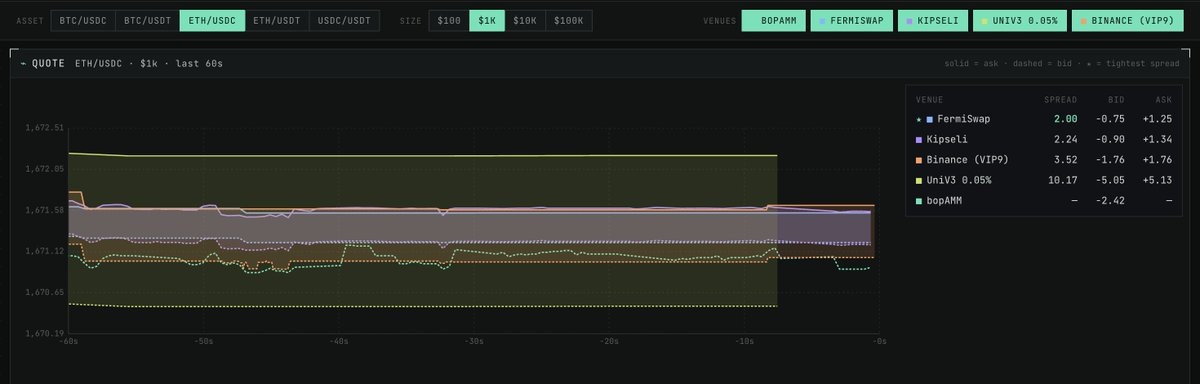
We can already observe that they have achieved a spread of 20 bps lower than their CEX counterparts.
Currently, this is true for 1k orders for both ETH/USDT and ETH/USDC, as shown in the image below.
For 10k trades onwards, Binance still leads.
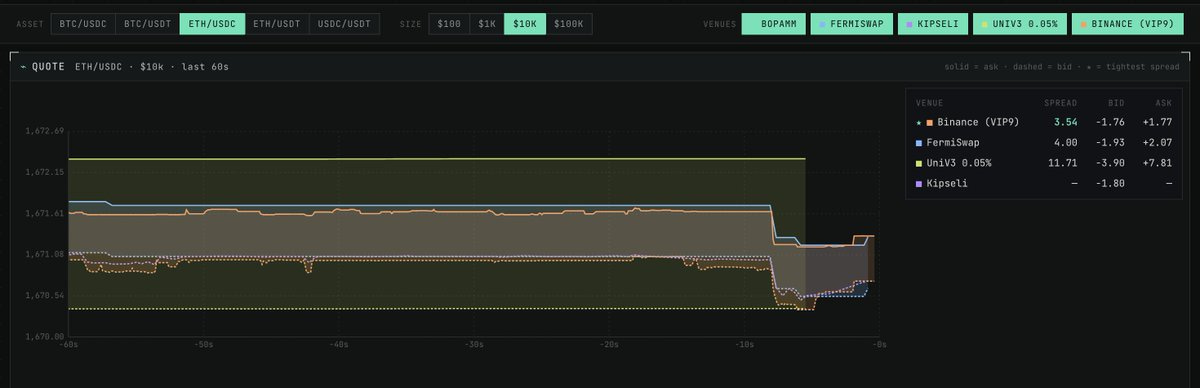
Being ahead in the 1k order category is already a massive win for onchain execution.
As Fede points out, the reason for this is not really technical but rather a lack of liquidity, which is expected to grow as more propAMMs and market makers join.


Currently, most of this liquidity is allocated elsewhere, but as onchain execution improves, the incentives are to move it to where demand will be highest.
@jump_ ran an analysis on the propAMM ecosystem on Solana (as of March 2026) showing how most propAMMs fills ended up between 0.33 and 1.36 bps from the best CEX mid execution, beating it nearly every fill analysed.
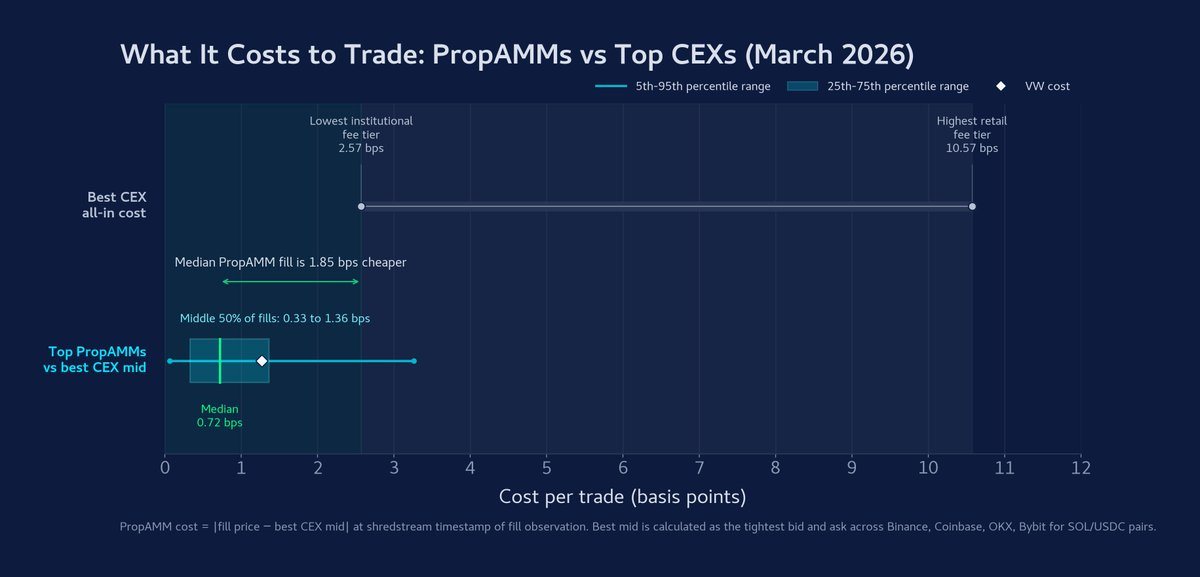
The image below (since 13th May) gives an idea of how novel this blockspace primitive really is.
Also, it shows remarkable growth, with over $10 million daily volume on the 10th of June, mostly on FermiSwap.
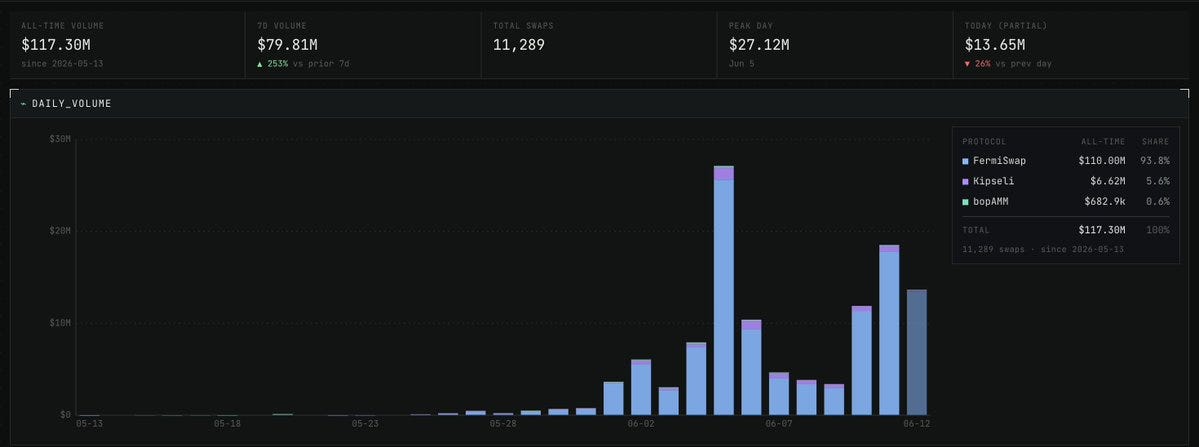
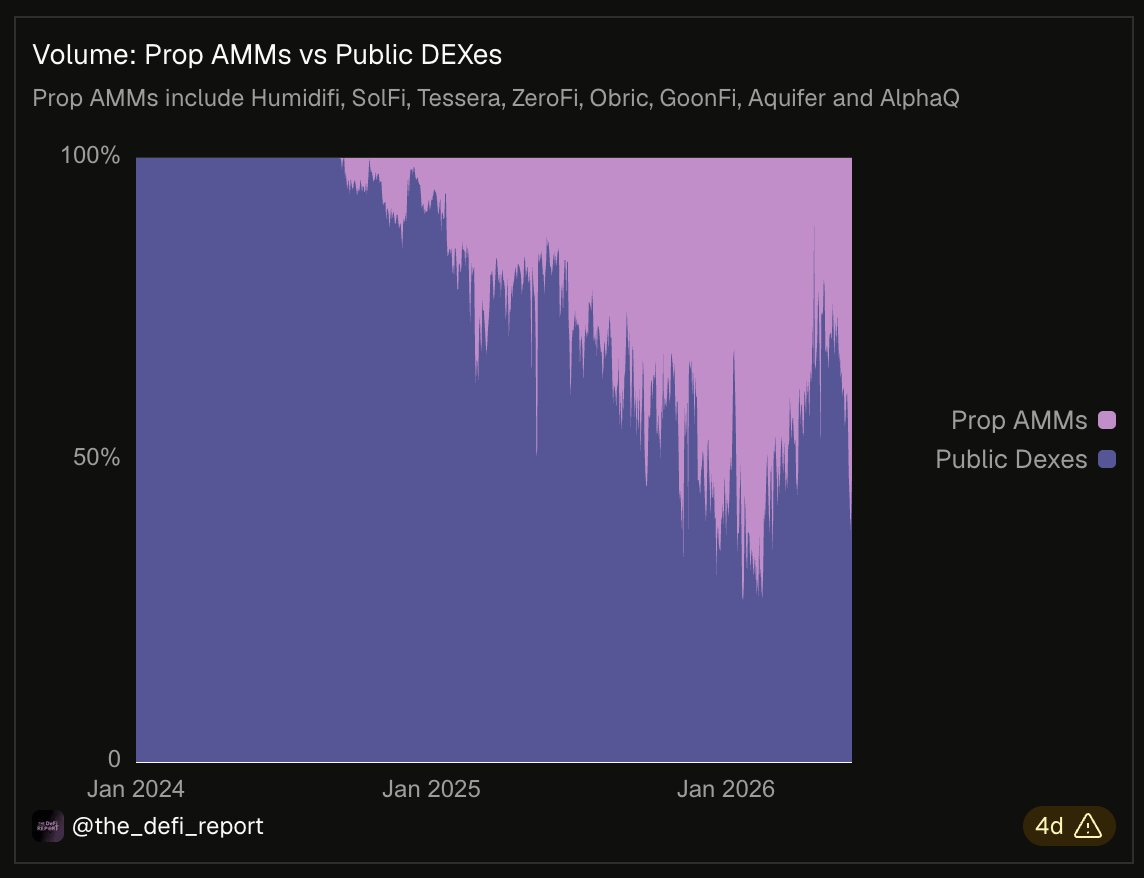
The @Dune below also highlights how propAMMs have steadily gained market share relative to public DEXs.
propAMMs can also be used in the backend and benefit from integration with external distribution venues. Such is the case with @KyberNetwork, which powers its aggregator via propAMMs built with Titan Builder.
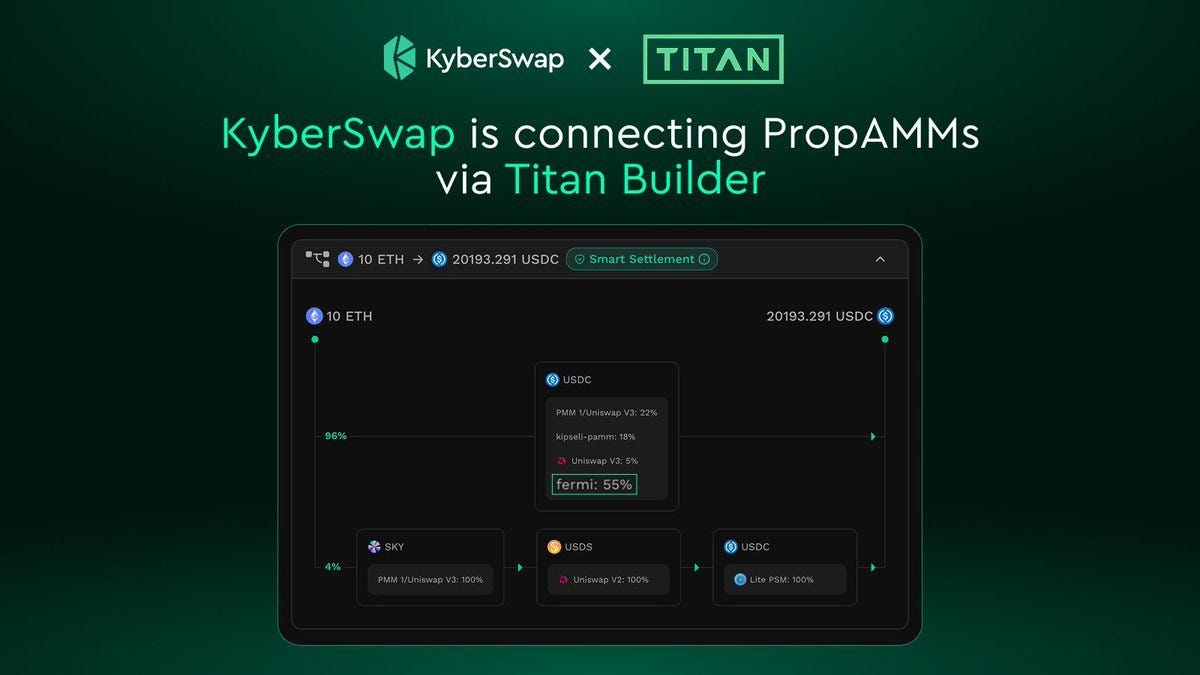
In practice, this means their aggregator will protect takers against stale pricing, leaking less value to makers and providing more efficient execution and, therefore, a more efficient market.
propAMMs also entail trade-offs, especially when design and specific logic are not transparent or public.
In the past, there have been some examples of misquoting by propAMMs on Base.
An attractive price was initially provided in the next Flashblock (~200ms) of each block, and was thus displayed by aggregators. However, it would then reprice to a worse one in the first Flashblock of the next block, which is the price at which the actual trade would settle (average loss of 5-10 bps).
A propAMM can quote a tighter spread to be selected by aggregators. Before the transaction settles, the propAMMs widen the spread, leading to the transaction ending up at the wider end of the price spectrum and exploiting the “latency between quote and settlement” (average loss of 3-6 bps).
A similar example of Aggregator spoofing can be observed on Solana. Other areas for future reflection and discussion on propAMMs are also raised in this post.

We believe this to be one of the most onchain developments, especially for Ethereum.
Next week, we’ll dive deeper into propAMMs, interviewing the most prominent builders in this vertical.
Building a propAMM?
Reach out to us.
written by @francescoweb3 ✍️
Every week for the last 3 years, we have shared our research for free, directly in your email. Not a subscriber yet? Let’s fix it:

If you are more of a Telegram person, you can read all of our research without the noise on our TG channel: