

Over the past year, Layer 2 (L2) competition has been fierce, but Base has managed to stand out, attracting over $4.9B in TVL, while fostering a thriving mix of DeFi, NFTs, and rapidly expanding SocialFi applications.
But TVL is not the only focus of Base. As emphasised by its initiatives, it has put a strong focus on the “culture” aspect of cryptocurrency.
This choice seems to be paying off, as the number of tokens launched on Base recently surpassed Solana's, driven largely by Coinbase’s bold rebrand of its wallet into the Base app, a crypto superapp for the creator economy.
Through deep integrations with SocialFi platforms like Farcaster, Zora, Clanker, and mini-apps like Noice, the Base app transforms social content into tradable onchain assets, reshaping how creators monetise and how communities interact.
This is the story of how Base and Zora are scaling culture onchain.
A Quick Recap of Base
Base is an L2 blockchain, built by Coinbase on Optimism’s OP Stack, designed to make Ethereum faster, cheaper, and more accessible.
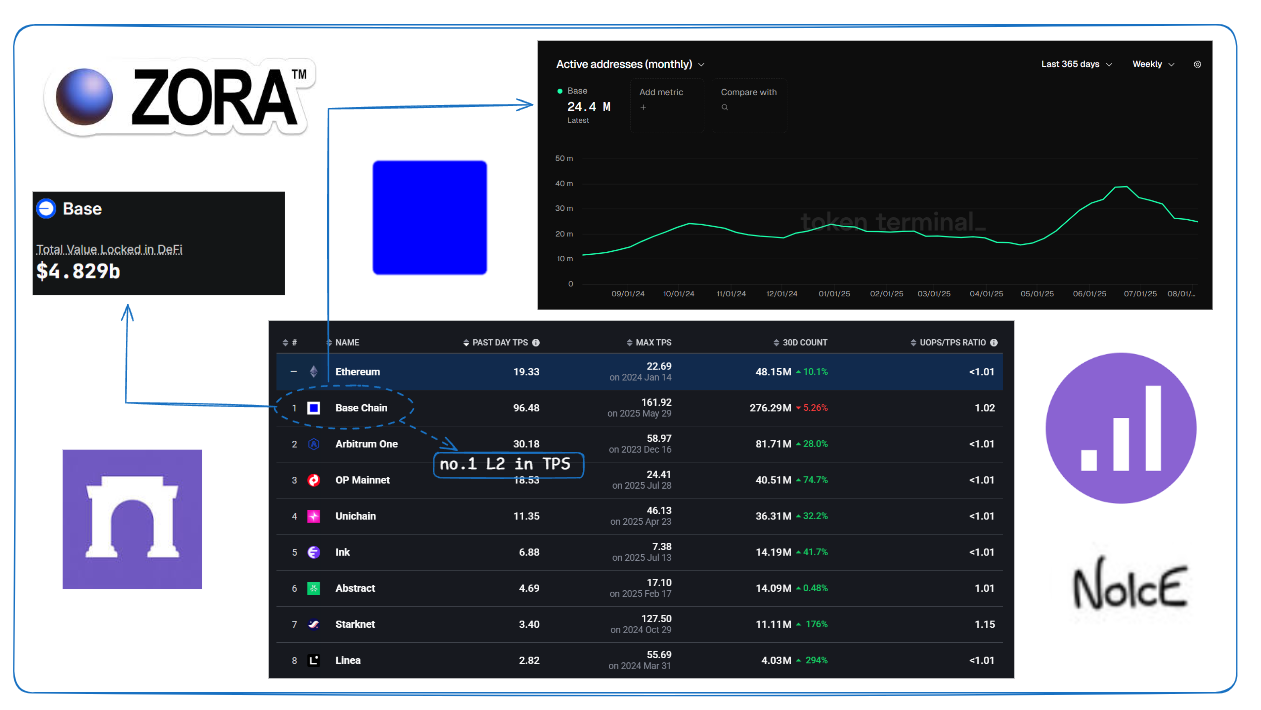
As of mid-2025, Base has achieved:
$4.9B in total value locked (TVL)
24.4M monthly active addresses
A maximum of 161.92 TPS
Over 276M transactions in the past 30 days, far outpacing other major Layer 2 networks.
A vibrant mix of DeFi, NFTs, and SocialFi projects
Initiatives like Base Onchain Summer signal that its ambition goes beyond scaling Ethereum, with a strong focus on building the rails to onboard millions of creators and communities into Web3.
The Base App
As Base moves beyond being just infrastructure and into becoming a cultural hub, it’s putting the creator economy at the core of its next growth phase. The launch of the new Base app in July 2025 marked more than just a rebrand, signalling Coinbase’s evolution from supporting a single chain to building a full ecosystem empowering builders, creators, and everyday users worldwide with a direct path to monetise and own their work onchain.
Coinbase’s vision for the Base app is clear: create a “super app” for crypto.
The main features of the Baseapp are:
Wallet functions
Social feeds
Payments
Mini apps
AI assistance

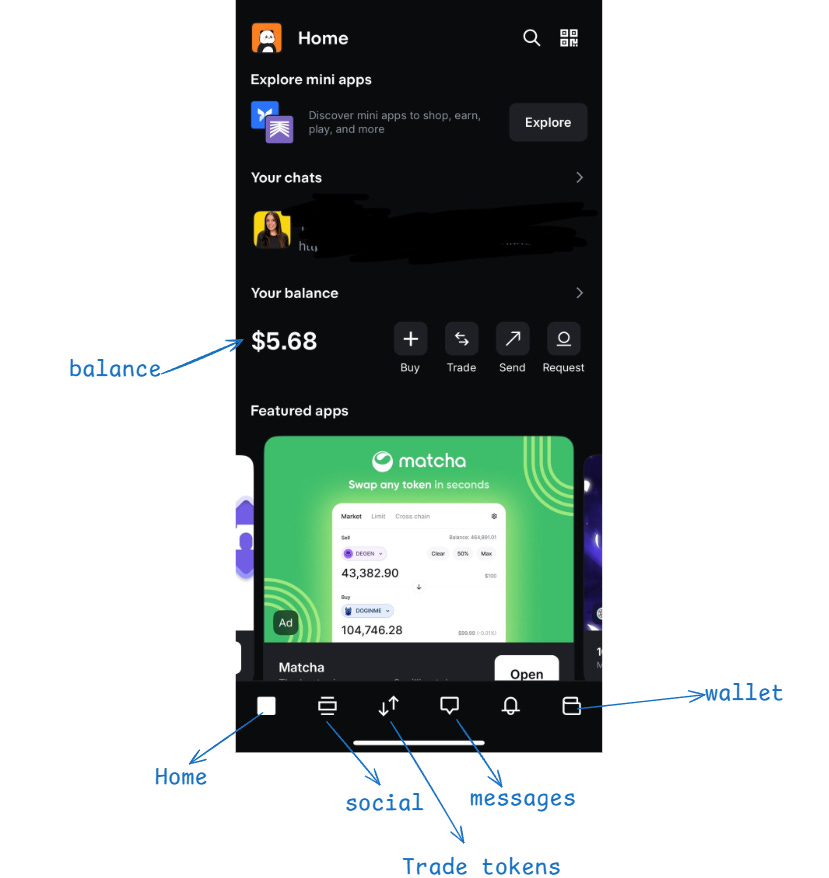
Think of it as Apple Pay meets decentralised social media. The aim is to remove the friction that keeps everyday people from participating in Web3. When one logs into the app, a smart wallet is automatically created without the hassle of storing seed phrases.
What is a smart wallet?
A smart wallet is a passkey-secured, self-custodial onchain wallet that’s embedded in the app. It’s designed for easy onboarding and a better user experience: No browser extensions, no app switching.
The most impactful part of this shift is Base’s SocialFi integrations. By embedding platforms like Zora and Farcaster along with other mini-apps, Base is challenging the traditional, platform-controlled creator economy, replacing it with one where creators truly own their content.
The flaws of the Web2 creator economy
In the current Web2 landscape, creators face steep trade-offs. Monetisation options are limited and often come at a cost to creative freedom or audience experience:
Subscriptions demand constant output, can feel impersonal, and lock content behind paywalls.
Ads require huge audiences to be viable and often disrupt the user experience.
Tips and one-off payments are inconsistent and rarely scale into sustainable income.
Worse still, platform economics are heavily skewed against creators. As the chart below shows, platforms like TikTok, Instagram, and X take 85–95% of the value, leaving creators with just 5–15%. Even “better” splits like YouTube’s 55/45% still hand nearly half of the revenue to the platform.
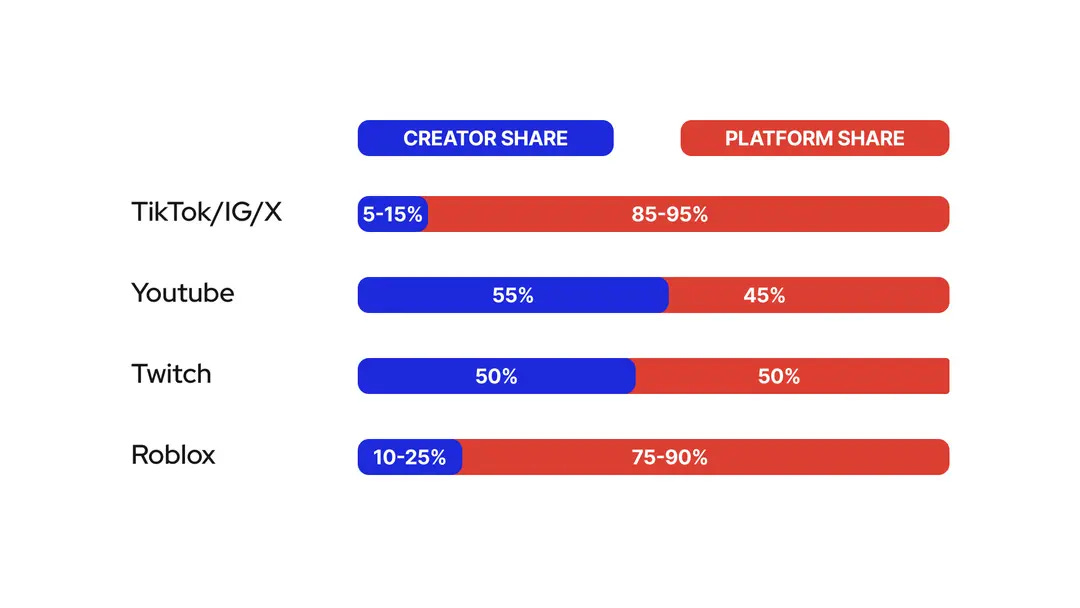
This imbalance is what Base’s new SocialFi push is aiming to change. The social layer runs on Farcaster, where posts can be instantly minted as tradable ERC20 tokens via Zora.
Tokenising content is a simple but powerful idea.
Every post, image, or video can be minted as a tradable ERC-20 token, called a Content Coin. This turns social media interactions into liquid, ownable assets, creating new ways for creators to monetise and for fans to participate directly in the success of content.
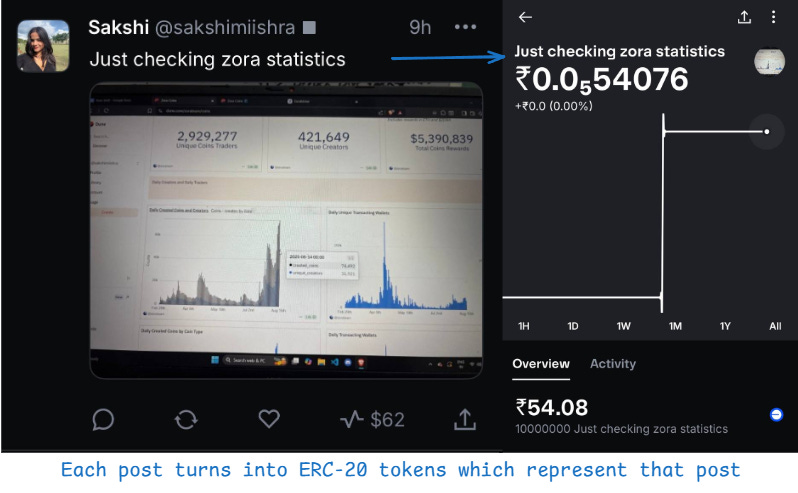
Aside from direct monetisation opportunities, mini-apps like Noice also support tipping.
By far, more than $250K has been tipped on Noice, now solidifying itself as an additional monetisation opportunity for creators.
Other income streams for creators include:
Trading fee on content coins (0.5%)
1% share of their content coin, which they can sell and make money (but it is not as easy as we will highlight in the later section).
Weekly distributed rewards: in the last week of July, Baseapp distributed $10K USDC to over 2900 accounts (source: Baseapp on X)
Mechanics of Base’s Creator Rewards
Every post minted on Baseapp becomes a “Content Coin”, with a fixed supply of 1 billion tokens. From that, 10 million tokens (1% of the total supply) are reserved directly for the creator, giving them immediate ownership and upside if their content gains traction. Alongside these, “Creator Coins” are tied to individual profiles serving as tradable assets that represent the creator themselves.
The incentive model is built into the protocol through smart contract-enforced fee splits:
1% trading fee on all Content Coin transactions
0.5% to the creator
0.3% to referrers (0.15% to trade referrers and 0.15% to create referrers)
0.2% to the Zora protocol
To date, this has already generated over 3.5K ETH in rewards to creators.
Trading of creator coins happens via Uniswap V3 pools, allowing instant buying/selling, although low liquidity remains a challenge for many smaller creators. Compared to traditional platforms like X, which take an 85%+ revenue cut, Zora’s system allows creators to retain over 50% of value flowing through their tokens, along with other earning opportunities.
What sets Zora apart from earlier attempts is its content-first model. Instead of turning creators into memecoins, Zora links tokens directly to the media they create, such as images, text, or videos, based on their posts. When uploading an image, creators can name the associated coin to reflect the content. This approach elevates the tokens' value beyond mere memecoins, making them more intrinsic and closely tied to the creator's expression.
Here are some of the existing applications integrated in Basepp:
Zora: Powers content tokenisation, enabling users to turn social media posts (e.g., text, images, videos) into tradable ERC-20 "content coins" with automatic Uniswap liquidity pools. Creators receive 10 million tokens per post and earn 1% of trading fees, making Zora central to minting and monetising content.
Farcaster: Provides the social infrastructure, a decentralised protocol for user interactions like posting and commenting. It integrates with the Base App to enable social media functionalities, serving as the platform where tokenised content is shared and engaged with.
Clanker: An AI-driven tool for quick memecoin launches via Farcaster. Users can tag @clanker on Farcaster to create ERC-20 tokens on Base, leveraging its social integration for community-driven token discovery and deployment within the Base App.
Noice: A Farcaster Mini App focused on tipping and interaction, acting as a traffic entry point to the Farcaster economy. It enhances user engagement by enabling tipping for content, complementing Zora’s tokenization and Farcaster’s social layer. Noice’s prominence was highlighted by its founder’s attendance at the Base TBA conference.
Here is how they work together:
The Base App combines Zora’s tokenisation tech with Farcaster’s social protocol to let users create, share, and trade tokenised content.
Clanker adds a streamlined token creation process through Farcaster’s social channels, while Noice boosts engagement via tipping.
This close feedback loop drives a network effect, attracting creators and traders.
The Base App as a Catalyst for $ZORA
The integration of the Base App with Zora has fueled a surge in $ZORA’s price and on-chain activity, from trading volume to the number of active creators. This momentum was amplified by smart community plays. Led by Jesse Pollak, Base’s creator, coordinated Farcaster promotions and grassroots hype campaigns drew in thousands of new creators and traders.
Let’s let the numbers tell the story:
The number of daily unique creators on Zora surged dramatically, jumping from 2,000 on July 16, 2025 (the day before the Base App announcement) to 22,500 by July 27, 2025.
$ZORA surged 600% in the last 30 days, turbocharged by a Binance listing that spiked visibility and liquidity. It also had an ATH of $0.14, which was a 1400% price rise
Base surpassed Solana on daily token launches. Zora created 51,575 tokens on August 4, crushing Solana's Pump.fun at just 4,173 launches. This marks the first time since early 2023 that any chain has beaten Solana in daily token creation volume.
Coinbase’s standing was influential in amplifying Zora’s growth. From Brian Armstrong’s “Base Shake” meme coin to Pollak’s relentless Farcaster presence, the community was constantly fed reasons to create, trade, and engage.
Risks: Hype, Speculation & the Limits of the Model
Earlier in this article, we discussed four major ways of earning for creators, including selling their 1% allocated content coin, but this brings in many critiques.
Among the most common is whether the platform is building a sustainable creator economy or just another speculative playground.
The April 2025 airdrop of 1B ZORA tokens to over 2.4M wallets added fuel to that narrative. Though it was meant to celebrate growth, many tokens were worth less than the gas it cost to claim them, with no governance utility. Critics called it “just for fun” and some saw it as a distraction from long-term value creation.
Token distribution has also raised eyebrows:
38.9% to team/treasury
26.1% to investors
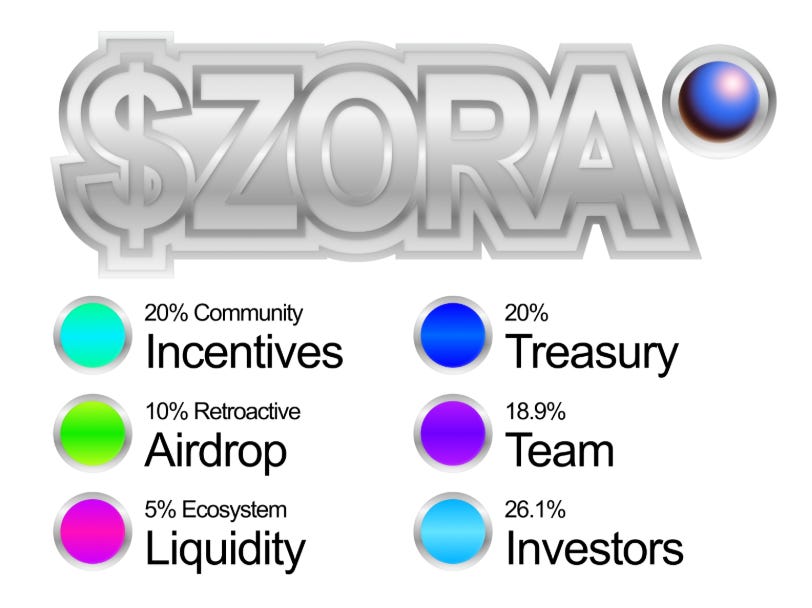
This concentrated ownership sparked concerns about centralisation, especially for a platform claiming to empower creators.
There were numerous debates on the sustainability of Baseapp’s economic model.
One of the critiques describes Zora as a “hypercasino hellscape” where Content Coins are likened to memecoins with no intrinsic value, and trading is driven more by social hype than meaningful content engagement. This zero-sum framing sees Zora less as a tool for creators and more as a short-term speculative game.
In the end, we’ve already seen the emergence (and failure) of the creator model with NFTs.
One big debate was between Solana Co-founder Toly and Base Founder Jesse on X. (link)
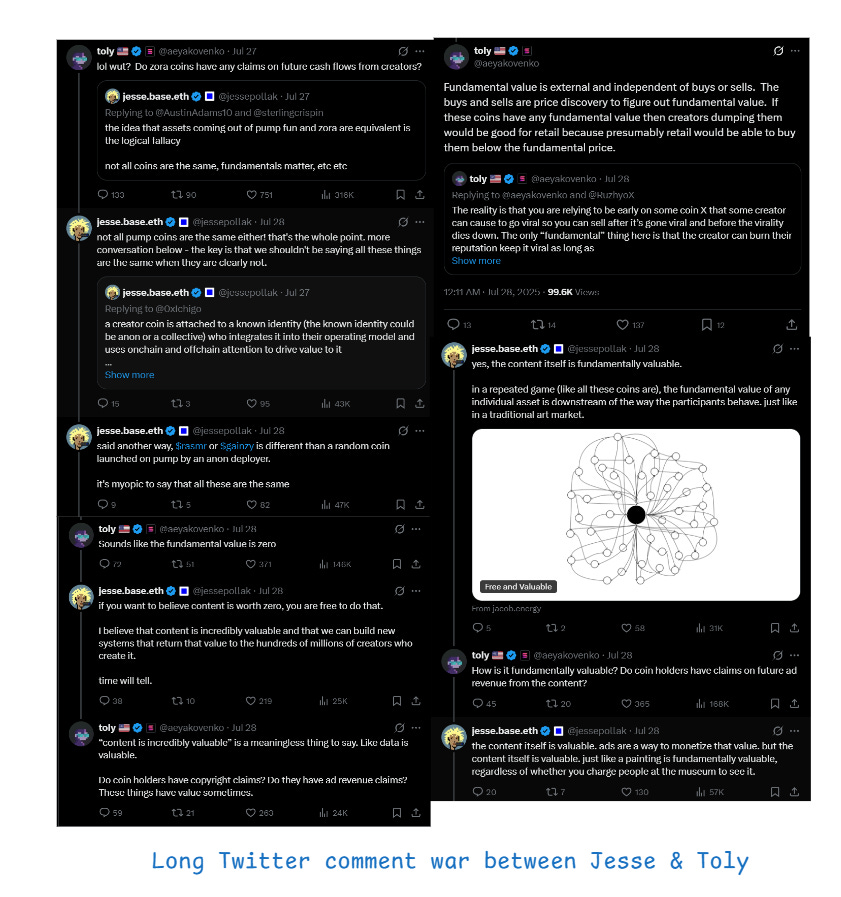
The summary of this philosophical discussion is as follows:
Toly’s Argument
Toly questioned the value of Zora’s tokenized social media posts, sarcastically asking, “lol wut? Does the coin on Zora have any claim to future cash flows from creators?” He labelled them “digital garbage,” comparing them to speculative NFTs or mobile game loot boxes.
He argued that Zora tokens lack fundamental value, as they don’t provide holders with rights to creators’ future revenue (e.g., ad income), implying their worth is purely speculative.
Toly suggested Coinbase should buy these “near-worthless” tokens if Jesse truly believes in their intrinsic value, pushing for proof of financial utility.
Jesse’s Reply
Jesse asserted that content has intrinsic value, like art, regardless of immediate monetisation. He argued Zora’s tokens, integrated with the Base App, redistribute value to creators, emphasising their “fundamentals” tied to creator activity.
He framed Zora as part of an “infinite game” where community-driven actions create systemic value, not just speculative trading, empowering millions of creators.
Users reflect mixed sentiment:
Some users criticise Toly’s stance as hypocritical, given Solana’s memecoin focus.
Others see the debate as a clash of blockchain ideologies, with Base prioritising creator economies and Solana leaning toward speculative markets.
But beyond philosophical debates, there were few issues worth highlighting around Baseapp: .
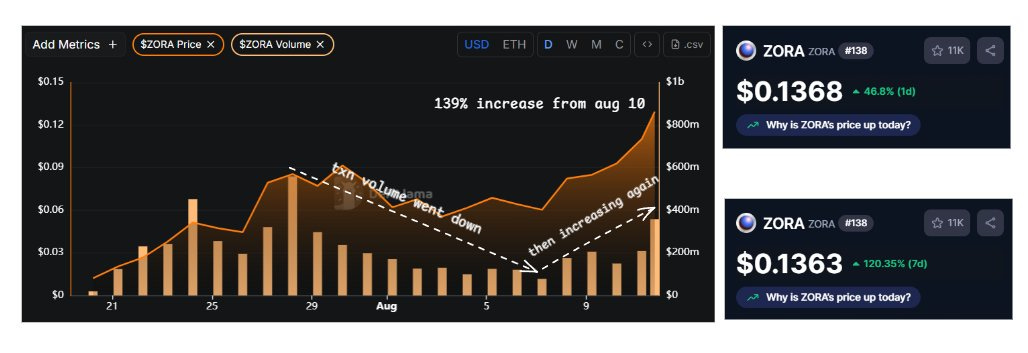
The first week of August was really slow in terms of transaction volume, going from Peak volume of $550M to $77M (source: tokenterminal)
Transparency issues, including alleged insider wallet trades and poor communication, have damaged trust. Zora’s Ethos page received negative reviews, affecting community sentiment.
Users complained that posting on Baseapp is really slow, which is a bad UX issue
Last week, the top coin creator on Base was a porn site, which brought in a lot of criticism (Source: Decrypt)
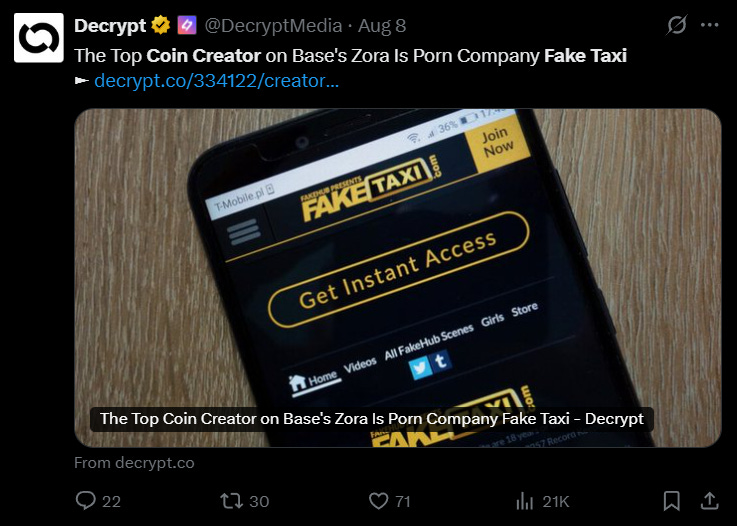
Still, defenders argue this is just part of the cycle for any breakout product. At least for the moment, it turns out they were quite right, as in the second week of August $ZORA picked up the pace again:
The trading volume, which went down in just a few days, picked up again in the 2nd week of August
New Money with smart wallets and whales are entering the $ZORA token, resulting token surge of 46% in just a day and hitting ATH of $0.14
Recent weekly upgrades include faster everything and better performance on Android devices.
The question now is whether the Zora model can evolve past speculation, strengthen trust, and scale meaningfully without diluting its core premise of onchain creative ownership and not just being another memecoin platform.
Opportunities & Roadmap for Zora
Despite the noise, Zora is still in the early innings of what could become a major shift in how digital content is valued and monetised.
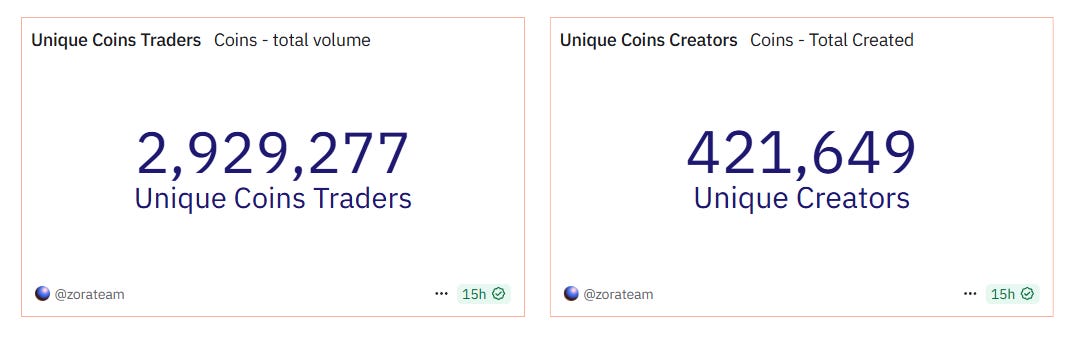
With 421,000+ creators, almost 3 million collectors, and seamless scaling via Base’s OP Stack, Baseapp has the infrastructure and momentum to push this new creator economy forward. Add to that access to Coinbase’s user base, and the surface area for adoption is massive.
A few key developments stand out:
Deeper integration with Farcaster, enabling richer social + economic interactions.
A Coins SDK, making it easier for developers to build on top of the Content Coin model.
Global, mobile-first expansion, tapping into markets where creator monetisation is still underserved.
Conclusion: A New Layer for Onchain Culture?
Base started as a technical solution for a faster, cheaper Ethereum L2. But through platforms like the Baseapp, it’s morphing into something much more: an economic layer for culture, creativity, and community. With this rebrand, Coinbase has made it clear that they are moving from a CEX towards a more decentralised Web3 infrastructure
Base’s go-to-market strategy is clear: build primitives, onboard creators, and let onchain culture compound. Zora is central to that, turning content into coins and creators into stakeholders.
Still, risks remain. Hype cycles fade, trust takes time to build, and the speculative nature of tokenised content may turn away as many as it attracts. Centralised token allocations and transparency missteps are real issues that need to be addressed head-on.
But if Zora and Base can refine the model, improve user experience, and align incentives, they have a real shot at reshaping digital ownership.
An open question remains:
Will Content Coins become the next evolution of creator monetisation, or will they fade out as another experiment in crypto’s long list of hype cycles?