


The increased presence of institutions is reflected in the products being launched in the market lately.
This is evident with the growth of vaults as yield instruments, which have become increasingly popular. Recent examples include Coinbase launching curated vaults in partnership with Morpho on Base, and Kraken doing the same on Ink, in partnership with Veda Labs and Sentora.
With DeFi projected to grow at a 43.3% CAGR through 2026–2030, this trend is expected to be a key driver, as more partnerships among technology providers, quantitative asset managers, and established distribution platforms emerge. While not encompassing the full range of providers offering institutional services, lending protocols already account for over 20% of Total Value Locked (TVL).
While vault curation is currently not highly profitable for those involved, given the associated risks, most growth in this vertical will come from institutional and more retail appetite for these products. An example is Bitwise’s first onchain vault on Morpho
In fact, while vaults are the structure of choice for many seeking to attract capital from retail investors by abstracting away the complexity of strategies, they are also an incredibly powerful tool for institutional investors.
However, the inherent volatility of digital assets is often a decisive factor for institutional investors when evaluating these alternative investments.
In particular, they require two key properties in the investments they make:
Risk-adjusted returns
Regulatory clarity
While the regulatory component is due under the CLARITY Act, pending a vote in the U.S. Senate, the risk-adjusted returns are subject to active remediation. To address this, it is necessary to differentiate the asset composition of investment portfolios, on the one hand, to gain exposure to the growing opportunities in the sector and, on the other, to ensure low correlation with crypto-related volatility.
This article explores a broader shift in the landscape, using PRISM (Portfolio of Risk-adjusted Investment Strategy Mix) as a case study to illustrate the design and unique value proposition of yield products aimed at attracting both institutional and retail flows.
Light Through the Prism
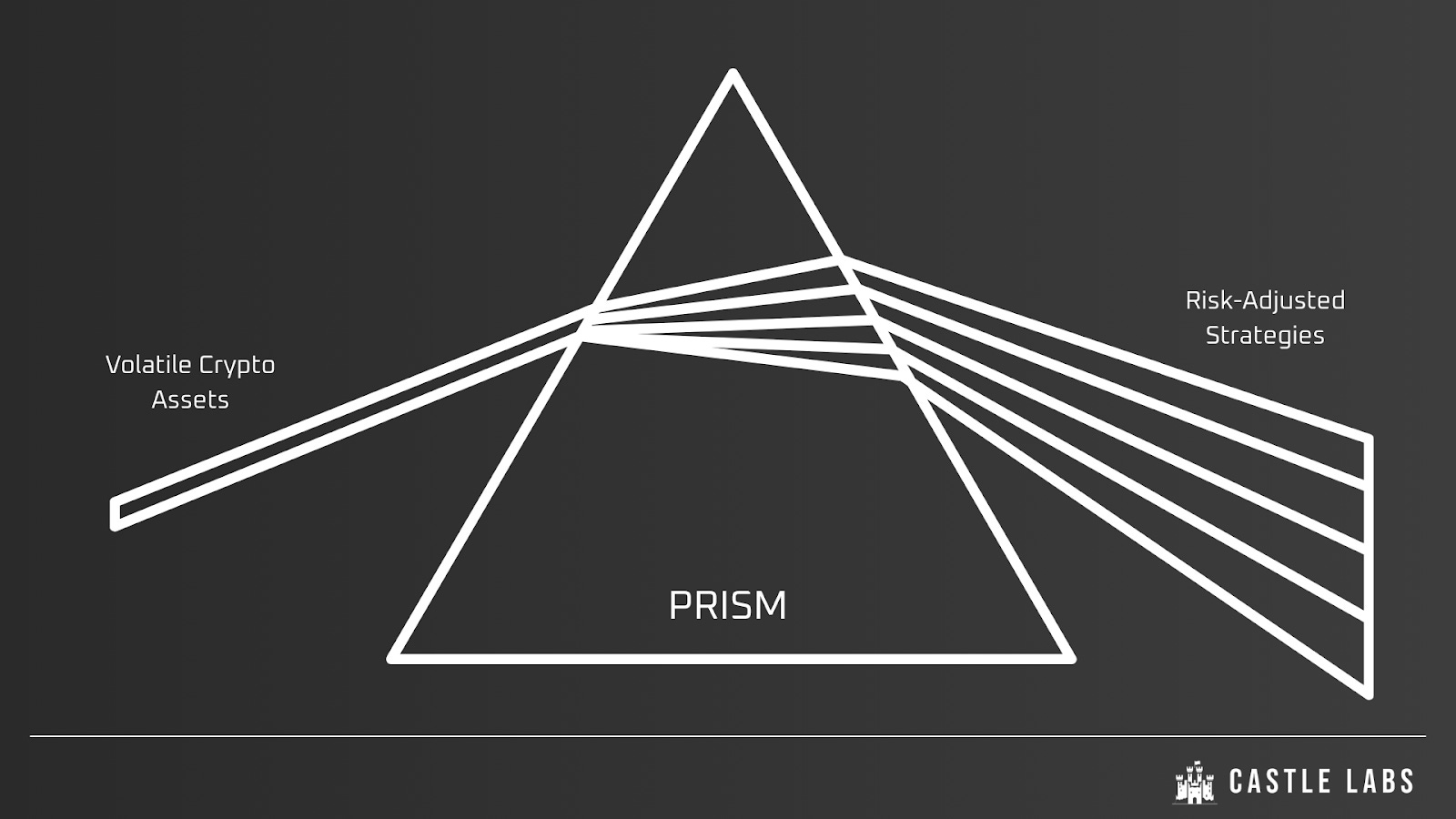
In the 1660s, Isaac Newton performed the Prism experiment, in which he allowed a single ray of light to pass through a glass prism, producing a multicoloured band of light resembling a rainbow. All these different-coloured lights had different wavelengths but originated from a single beam of sunlight.
If we apply the same context to any asset class, many of them are volatile when considered in isolation. Once placed in a fund or index, these assets are less volatile because the exposure is often neutralised. The same idea applies to crypto and PRISM, which is issued by OpenEden and whose strategies are managed by Monarq, the quantitative asset arm of FalconX, which seeks to achieve the same neutralisation in this highly volatile asset class.
The main idea behind this product is to reflect how onchain investment products are evolving toward more regulated, professionally managed offerings, and to provide users and partners with OpenEden’s “regulatory-compliant tokenisation infrastructure that allows strategies like this to be accessed in a transparent and scalable format”.
The role of Monarq is instrumental in providing expertise in “sophisticated quantitative strategies and multi-layered risk management framework”, specifically focused on strategies that reduce the correlation of PRISM with cryptocurrency prices. This is the key behind PRISM, to leverage onchain strategies while minimising exposure to cryptocurrency assets themselves.
Most onchain tokens provide exposure to a single asset or yield source, leaving users concentrated in one risk stream. Instead, PRISM takes a different approach. It integrates multiple strategies within a defined risk framework under a single token, delivering professionally managed, diversified allocation designed to balance risk and return across market conditions.
According to OpenEden, PRISM should be considered a “new class of onchain products,” moving onchain strategies further from the more traditional delta-neutral or single-strategy approach to better account for risk-adjusted returns for both retail and institutions.
Strategies and Risks
Prism shies away from single strategies in favour of a multi-strategy approach.
The strategies of PRISM include:
Cash-and-carry arbitrage
Overcollateralised secured lending to institutional counterparties
Participation in established onchain yield venues
Allocations to regulated tokenised RWAs, including U.S. Treasury–backed assets
As the strategies are proprietary to Monarq, we are unable to share the backend details. While not ideal, this is understandable, as they are trying to preserve their edge and competitive advantage. Building institutional products inevitably entails trade-offs. For transparency into PRISM’s backing, users can track onchain reserves on the transparency dashboard, once it is live.
PRISM is currently permissioned. To access the strategy as a primary client, users must complete KYC and onboard with OpenEden. Though it would be worthwhile to explore secondary markets in the future.
To understand the complexity and level of collaboration and professionalisation required for this category of products, here are the service providers involved in PRISM:
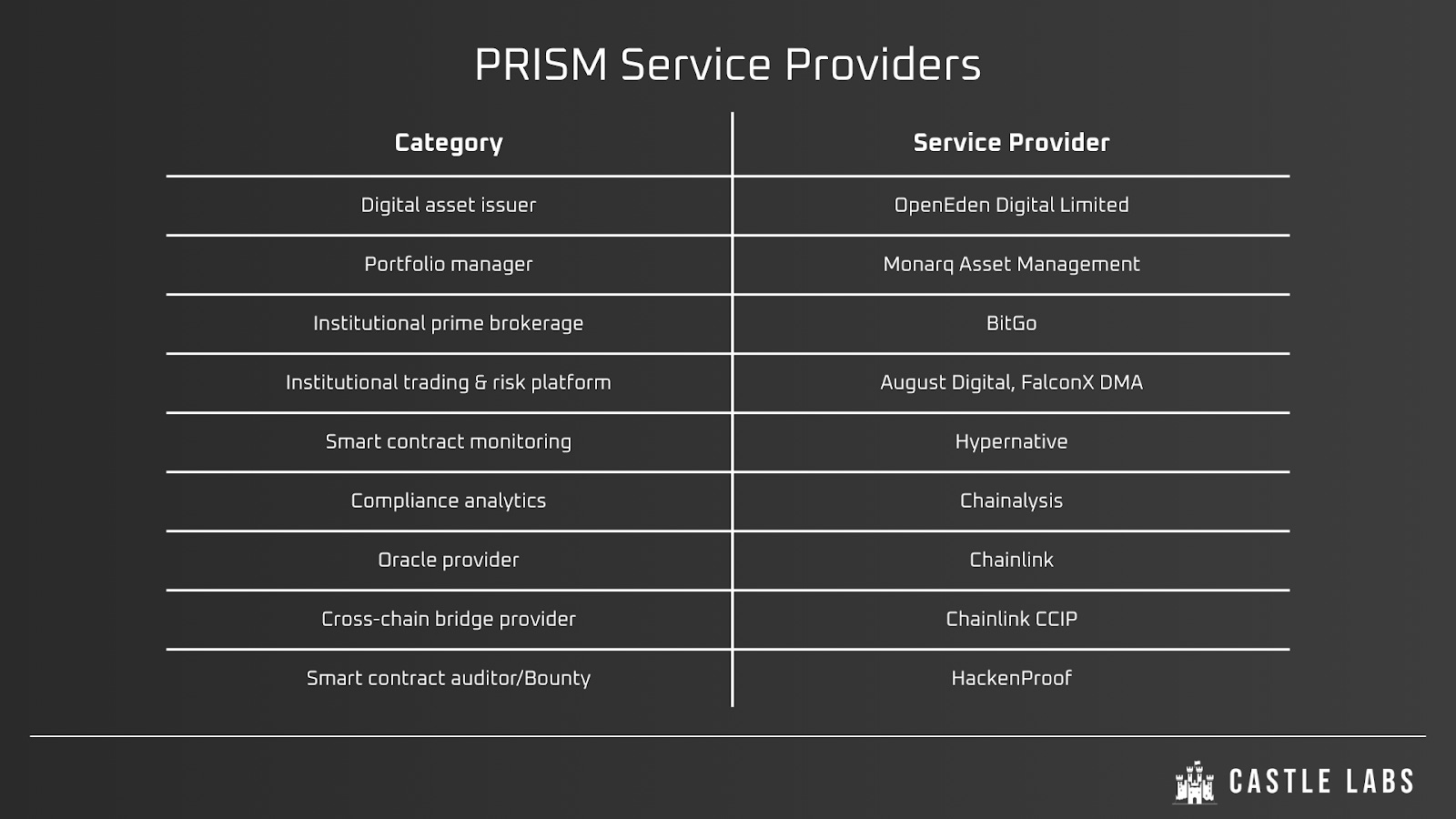
Notwithstanding the regulated and transparent approach and the calibre of the service providers involved, these products still present several risks, including counterparty, smart contract, regulatory change, and liquidity risks.
Food for Thought
The launch of PRISM reflects a broader trend in the sector, with most innovation coming from products targeting institutional players and offering better opportunities for retail audiences.
In 2026, crypto went from a narrative trade to an institutional portfolio allocation.
This is exactly the value proposition of PRISM: elevating traditional onchain strategies with a regulated approach, delivering returns without exposing oneself to the volatility of digital assets.
The result is a multi-strategy approach which focuses on becoming increasingly disconnected from market cycles by:
Reducing concentration risk
Prioritising risk-adjusted returns
Nonetheless, competition in the sector is ferocious.
Other incumbents include:
Ethena (delta-neutral yield)
Ondo (tokenised treasuries)
Superstate (regulated onchain funds)
Matrixport/Maple (institutional lending)
While these are all single strategies, PRISM leverages multiple strategies to reduce risk and correlation with market cycles.
Furthermore, as part of the current roadmap, PRISM will evolve into “a multi-strategy, multi-manager product rather than remain a single-manager product,” integrating additional institutional-grade managers and offering different liquidity and risk parameters.
Last but not least, PRISM is issued through OpenEden’s regulatory-compliant tokenisation infrastructure, which includes KYC requirements. This matters for the audience it targets: institutions that cannot touch unregulated products.
The flip side of this design is opacity (proprietary strategies) and permissioned access for primary clients (KYC-gated). While the Monarq team has real institutional and quantitative credentials, with a history in digital asset trading dating back to 2017, the firm has no public track record yet. For an institutional audience, the regulatory wrapper and diversified approach outweigh these concerns, and for a crypto-native audience, the lack of secondary markets can be seen as a problem.
We expect the coming months to be characterised by further integration and collaboration among distribution networks, vault providers, and curators.
Within this framework, the unique differentiating factor of these solutions will be defining their target audience.
For institutional investors, the feasibility of considering these alternative investments comes down to how solid the guarantees of regulatory clarity and the strategies’ risk-adjusted returns are. For retail investors, the primary value proposition is the product’s ability to deliver market-neutral yields.
written by Francesco and Noveleader ✍️
Every week for the last 3 years, we have shared our research for free, directly in your email. Not a subscriber yet? Let’s fix it:

If you are more of a Telegram guy, you can read all of our research without the noise on our TG channel:
Disclaimer: This article was produced in collaboration with OpenEden. Castle Labs applies the same standard to sponsored content as in our independent research. We strive to be accurate, unbiased, and educational. Commissioned partnerships provide resourcing and distribution, not editorial control.