


This excerpt is from our research on Fixed-Rate Lending: Market Structure and Protocol Design, highlighting new and emerging designs in the category.
Download the complete report here.

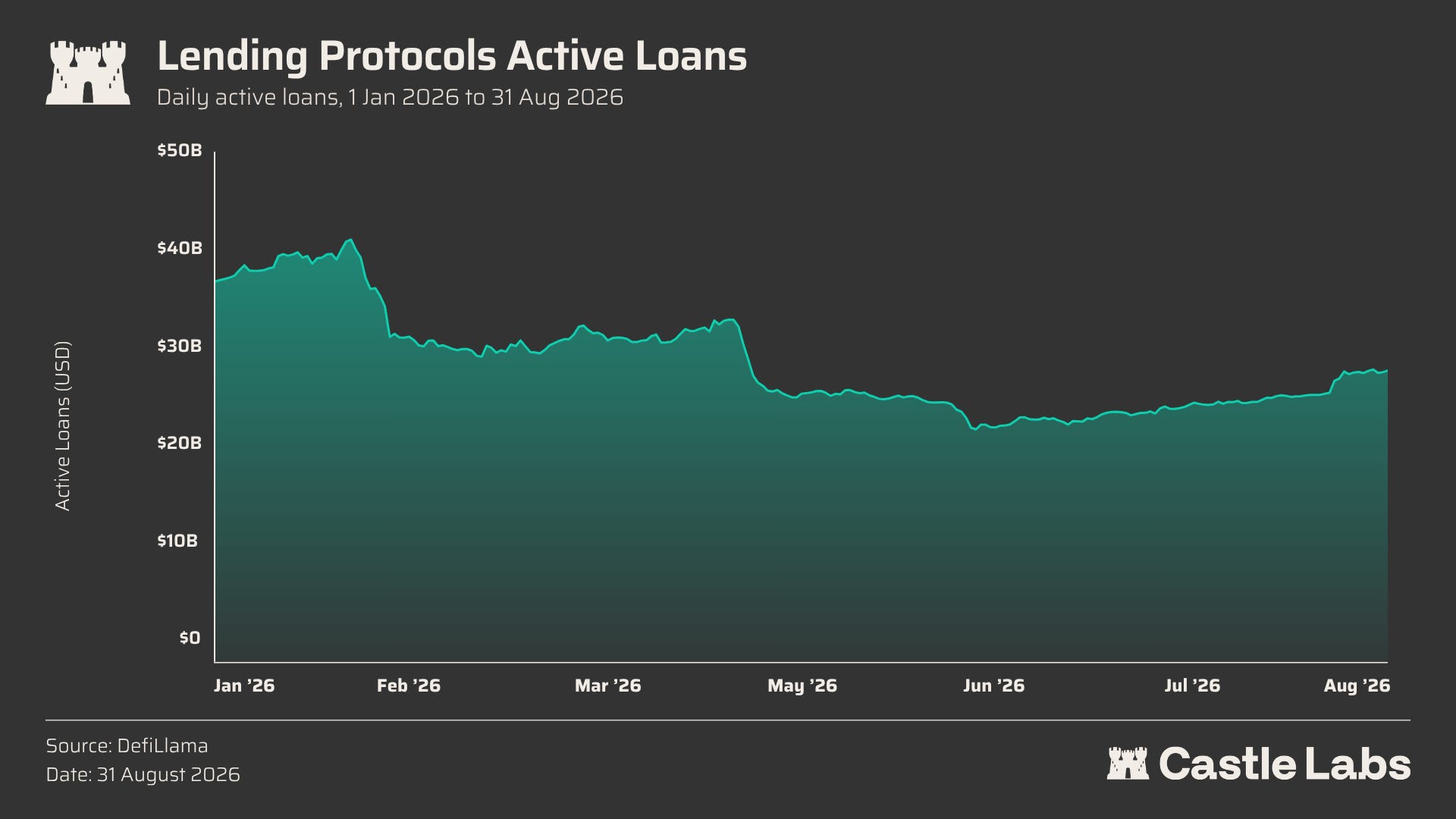
Today, the lending category has active loans of $28.5 billion, and almost all of that demand comes from variable-rate lending. This works fine in periods of stability; however, during stress events, as utilisation curves move, borrowing rates can spike. This surge in rates forces some borrowers to exit or deleverage their positions, making the overall credit market inefficient.
DeFi money markets, in fact, solved one problem traditional credit cannot offer by providing near-instant borrowing against collateral.
One problem remains: knowing the cost of debt before the loan is over.
That’s what many products are focusing on today: moving toward fixed-rate, fixed-maturity credit products. In such a market, lenders get a fixed yield and know exactly how much they will make on their deposit, and borrowers know how much they will pay.
The demand for such markets can be distributed across 3 major entities:
Date borrowers: Funds, treasuries, RWA issuers, basis/carry desks that need debt maturity to match an asset maturity, redemption window or strategy horizon.
Certainty Borrowers: Loopers, levered yield users and traders who may not care about a precise maturity, but need stable borrowing costs so their spread doesn’t contract.
Lenders/Curators: Vaults, market makers, and allocators that want to choose duration, collateral, and return rather than accept whatever utilisation is produced.
Earlier iterations of fixed-rate lending faced three major problems:
Liquidity Fragmentation: Fixed-rate markets fragment liquidity across maturity, rate, collateral and duration. That makes matching harder than in a single variable-rate pool.
No Early Exit: Once the loan period starts, the lenders can struggle to exit before maturity unless there is secondary liquidity, a redemption path, or another buyer, which isn’t the problem in variable-rate lending.
Cold-start problem: Lenders don’t want to keep their collateral locked and earn no yield until it matches with a counterparty.
With more institutional allocation and more sophisticated strategies like looping, the user base has evolved, increasing demand for fixed-term markets. One of the main issues with onchain lending is the uncertainty of variable rates; with fixed-rate lending, users know their yield and cost upfront. Additionally, it also provides a better UX because it forces protocols to price duration, collateral quality, exit liquidity and refinancing risk directly.
In this piece, we cover the design adopted by variable-rate lending incumbents, including Morpho, Jupiter, and Kamino, which together account for $6.83 billion in active loans and have recently entered the fixed-rate and fixed-term market, keeping the problem set in mind.
Morpho Midnight and Tenor Finance
Morpho, a variable-rate incumbent, launched Morpho Midnight in July. It is an intent-based zero-coupon lending protocol in which lenders and borrowers express their intent, and their positions are represented by debt units (an obligation to repay one loan token per unit before maturity) and credit units (a claim on repaid loan tokens). Midnight tackles the fixed-rate problem by making the loan tradable, providing duration flexibility and predictable underwriting for institutions. The rate is determined by the price of fixed-maturity credit and debt units traded by borrowers and lenders.
In Midnight, lenders and borrowers post “offers” that do not lock capital but are intentions to lend or borrow in a specific market at a specified price, maturity, and collateral configuration.
Capital is sourced only at settlement (callback), solving the cold-start problem, as lenders commit capital only once a match executes, improving capital efficiency. This also helps with attracting more liquidity, as put by the Morpho team:
“By allowing users to earn a variable rate on protocols like Morpho Blue, you can remove the opportunity cost usually borne when waiting for offers to be matched and create more demand to make offers, increasing the total liquidity available to users.”
Another problem Fixed-rate markets face is capital fragmentation, as each maturity, collateral type and rate band can become its own market. In Midnight, this capital is not sourced at intent, and users can post multi-market offers: “Since the same capital can be offered across multiple markets, the total liquidity available to users from a single maker = available capital x number of markets.”
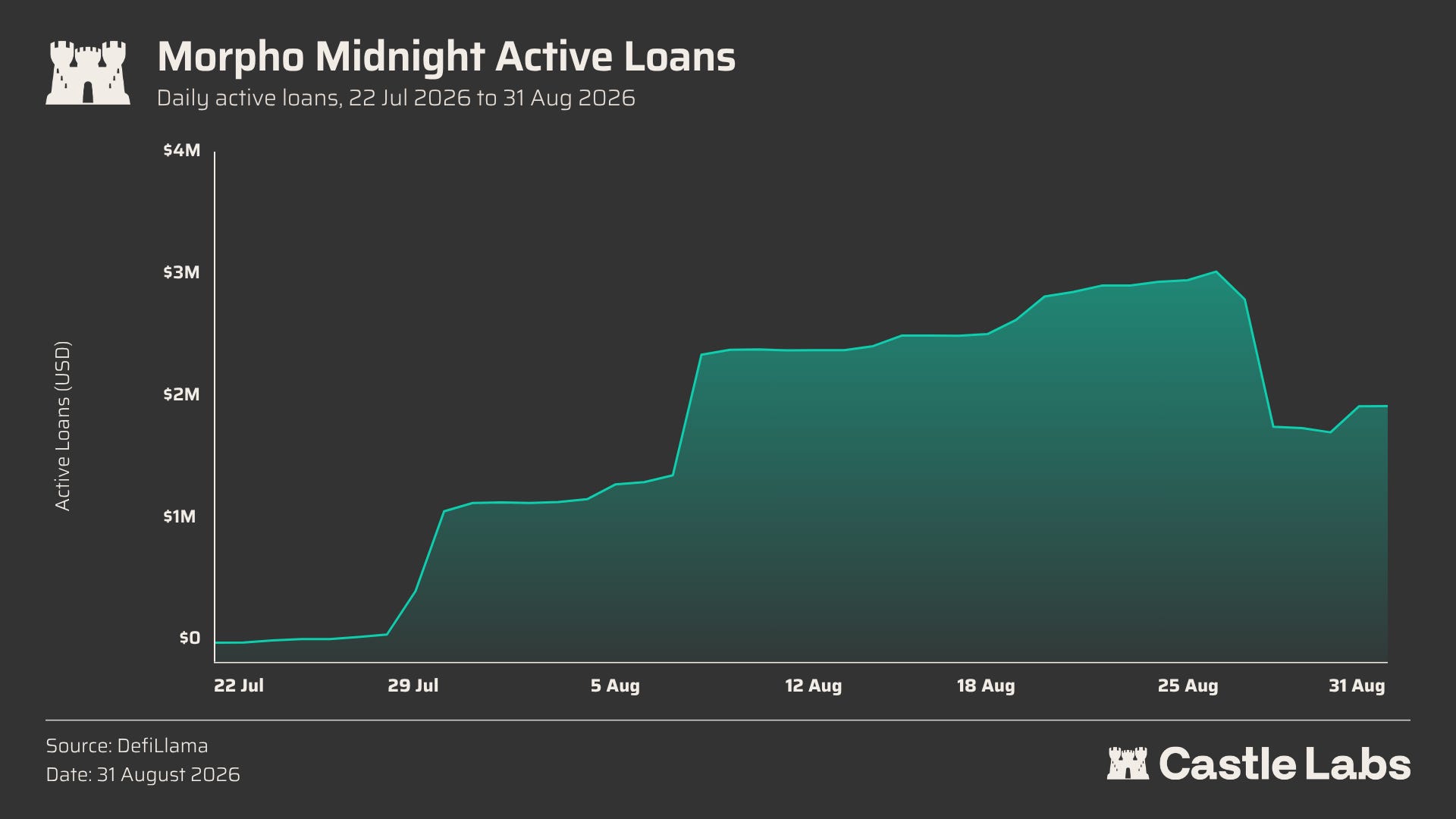
Since launch in July 2026, Midnight markets have now reached active loans of $3 million. While this number is small, the team expects this to change soon, as “it also inherits Morpho’s existing network effects and ecosystem. For example, Morpho Vaults hold over $4 billion in capital today. This capital can start quoting on Morpho Midnight as soon as the vault adapter is released, and play a major role in building deep liquidity.”
The most interesting problem Midnight solves is early exit. In older or less liquid fixed-term markets, borrowers and lenders often had limited exit options before maturity. Midnight improves this by making positions fungible: lenders can sell credit units, while borrowers can buy debt units to reduce their outstanding obligation.
While Midnight can be interpreted as an underlying architecture for fixed-rate loans, an access layer is already being built on top of it: Tenor Finance. DeFi Frontier refers to Tenor as the “HIP-3 of Midnight”.
Tenor essentially gets all the features of the base layer, Morpho Midnight, and builds additional features on top of it:
Auto-Renewal and Fallback Options: Tenor introduces auto-renewal of the position to prevent post-maturity liquidation. It utilises independent keepers to roll the loan into a new fixed-rate term before maturity. If no fixed-rate match is found, it can simply fall back to the variable-rate pool on Morpho Blue.
Onchain OTC Agreements: Tenor enables users to request quotes and broadcast bespoke OTC offers. These offers can be shared with whitelisted counterparties, allowing direct negotiations.
Organisation Tooling and Gated Access: Tenor provides organisation accounts with role-based permissions to institutions. Through these accounts, they can deploy custom, gated credit markets that can restrict who can borrow or lend based on specific compliance or KYC requirements.
Tenor reduces maturity friction by adding auto-renewal and fallback options, so fixed-term positions can continue more smoothly if matching liquidity exists or if fallback conditions are met. On top of this, the customisability makes it more institution-friendly; in the long run, the team expects the platform to be used by “asset managers on one side and businesses on the other side.”
Jupiter Offerbook
Jupiter’s offerbook by Jupiter Exchange entered public beta in June 2026, around the same time as the release of the Morpho Midnight whitepaper. Jupiter Lend, a variable-rate product launched last year, was Jupiter’s first attempt to get into the lending category. Now, with Offerbook, they are entering fixed-term markets.
Offerbook is an intent-based lending protocol which features no price-based liquidation, enabling long-tail asset fixed-term lending.
Loans on the platform are shorter-term, usually 1 to 30 days, and at maturity, if the borrower doesn’t pay, the lender simply claims the collateral and no liquidation occurs. This type of market enables any long-tail collateral to be used, whether it is NFTs, RWAs, or any other asset with no active price discovery, provided lenders are willing to underwrite it. This is a unique offering because it replaces continuous price-based liquidation with maturity-based collateral transfer and helps create specialised markets that support assets that would otherwise be difficult to support.
On Offerbook, users can post intents for their loan or borrowing request, and they appear in the application; liquidity is sourced when the offer is accepted. Since the user accepts when a match occurs, they are free to use their funds elsewhere until the matched order executes addressing the cold-start problem. This opens opportunities for both lenders and borrowers to earn yield until they find a match of their exact terms.
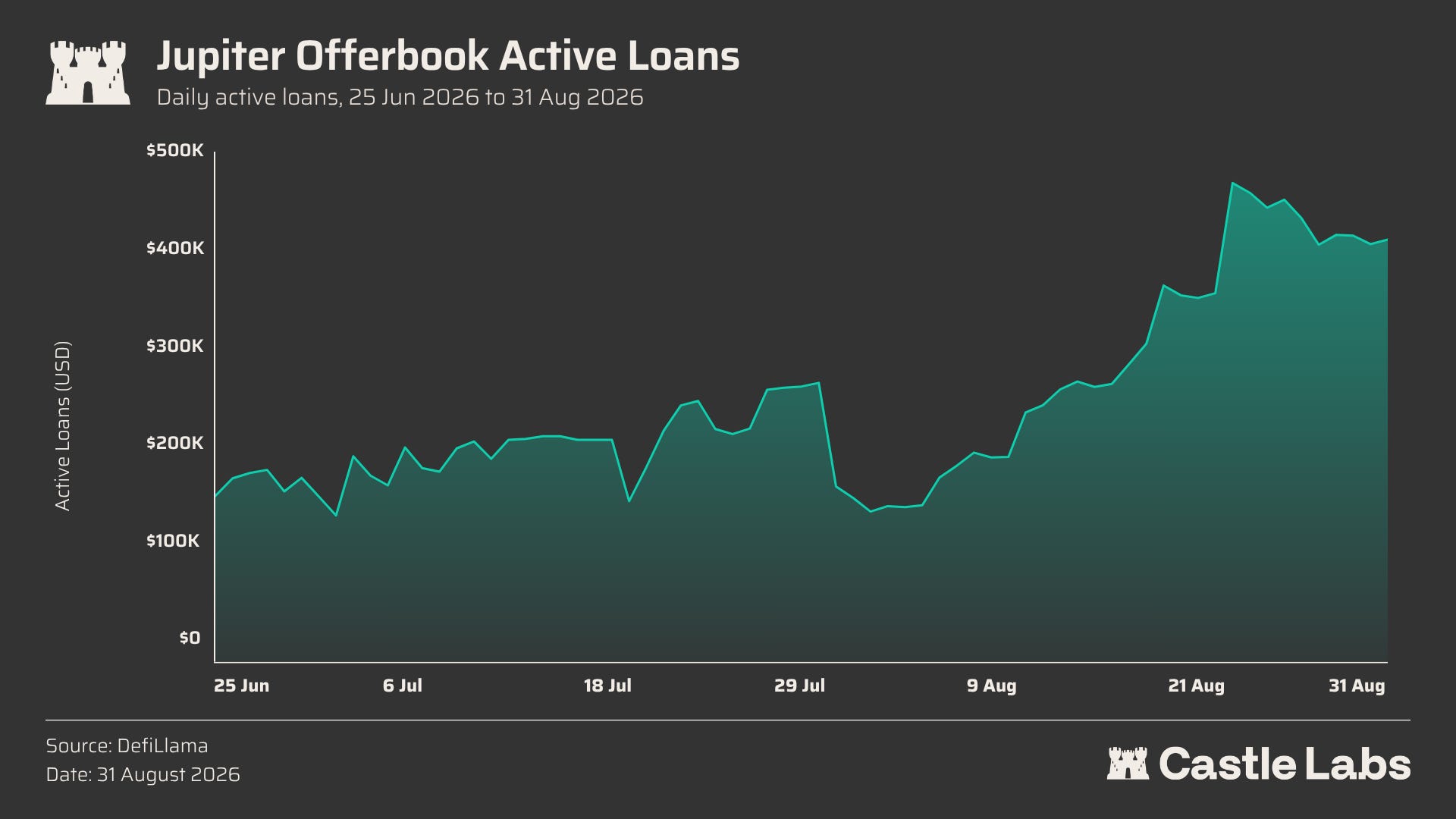
Since its launch, Jupiter Offerbook has now reached active loans of $450k. While their model is unique, it would be hard to prove its market and generate demand, as its scalability is limited by lenders’ willingness to underwrite the collateral directly.
Kamino
Kamino recently released the whitepaper for its Fixed Rate Lending protocol. Instead of building a standalone fixed-rate marketplace, it adds fixed-rate reserves inside Kamino Lend. The benefit of such placement is distribution: borrowers see a visible term structure, while lenders can quote specific rates and durations without fully exiting the variable-rate system, making fixed-rate borrowing additive.
Each reserve on the platform is defined by a rate and duration: for example, borrowing USDC at different rates for different durations. All these different rates and durations form a grid.
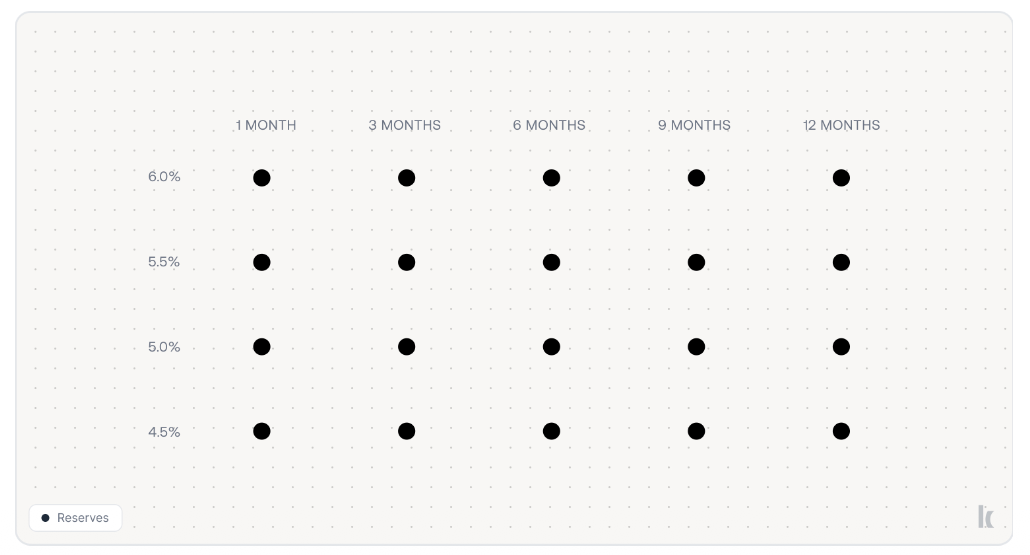
With this grid, Kamino lets borrowers and lenders express where they want to transact across both price and time. Borrowers post borrow intents specifying collateral, size, maximum rate, and term. Lenders post conditional liquidity specifying the rates, durations, and amounts they are willing to fund. The grid becomes the execution surface: borrowers draw from available fixed-rate liquidity across predefined rates and duration combinations.
Instead of direct matching, lenders quote across a structured grid of predefined rates and durations (e.g., 1-month at 4.5%, 3-month at 5%, and so on), building a visible term structure and yield curve for different assets. By leveraging Kamino’s infrastructure, borrowers can either post an intent and wait for matching liquidity, or draw directly from available fixed-rate liquidity in the grid. On top of this, Kamino can automatically roll a loan into the next term if liquidity permits, similar to Tenor; if no Fixed-Rate liquidity is available, it can fall back to variable-rate. This solves the maturity problem and supports loan continuance, reducing the need for borrowers to manually manage every maturity.
For exits, lenders have to go through a Withdrawal Queue. If a lender cannot exit instantly because liquidity is already deployed, they enter a first-in, first-out (FIFO) queue and are repaid as loans in that reserve mature. This design ensures that the maximum waiting period for a lender is bounded by the reserve duration.
While matching happens between parties, the capital doesn’t sit idle. It keeps earning yield from variable-rate reserves, helping address the cold-start problem.
Closing Thoughts
Fixed rates do not remove any risk that variable-rate lending has uncovered over the years, but they make the cost of debt explicit.
This is what DeFi credit has been missing.
Variable-rate pools are powerful because they make borrowing instantly available, but they compress everything into one utilisation curve. Fixed-rate markets, by contrast, let borrowers price duration, lenders choose term and collateral risk, curators allocate across maturities, and apps package more predictable credit products. We have also started to see the initial iterations of predictable credit products from Aave, which launched Stable Vaults in July.
This matters because DeFi lending is expanding. It now supports looping, basis strategies, treasury management, RWA-linked assets, and consumer-facing applications. These users need more than liquidity: they need clear and fixed financing terms.
We expect competition in this category to grow, with more novel solutions emerging to scale fixed-rate lending.
Current adoption is also relatively low, and variable-rate lending still represents the majority of the market, but the goal is to expand the pie because these products can serve many use cases that current DeFi lending cannot address.
Moreover, these products aim to solve the problems earlier protocols in the category faced, and they also have much stronger distribution because their variable-rate lending counterpart has already matured. For example, capital in variable-rate markets can quote in fixed-rate markets while still earning yield and remaining efficient.
As these products mature, we should see a fair number of strategies which simply weren’t possible before, and a new flywheel in lending.
We cover more protocols and design approaches to fixed-rate lending which are built with the problem set in mind. Find our complete report here.


Every week for the last 3 years, we have shared our research for free, directly in your email. Not a subscriber yet? Let’s fix it:
https://research.castlelabs.io/subscribe
PLUS, don’t forget to join our Telegram channel for the latest updates from Castle and all our research: Link here