

Welcome to another edition of the AI Dispatch.
For the last month and more, we have also started focusing on robotics.
First, we introduced the sector as a whole in the report below:

Now it’s time to make things practical and dive deeper into each of the interesting applications in an effort to share a more practical understanding of what these crypto x robotics companies are about.
It’s no secret that robots are one of the most influential new pieces of technology in the world, possibly ever. They are the future, but robots still come with problems out of the gate.
Hardware is still incredibly expensive, the robotics data and software landscape is fragmented, and developers are using a mix of varied public and proprietary solutions that keep robots from having out-of-the-box functionality.
Before robots can progress any further, these issues need to be addressed.
This report introduces Homebrew Robotics, a project operating at the intersection of software and hardware, planning to solve these problems by creating a Robotics Data and Package Marketplace, AI-assisted programming, Voice-to-action translation, and an affordable robot.

The Homebrew Robotic Club
The Homebrew Robotics Club (Homebrew) is a particularly interesting robotics protocol to research, as it lays out a multi-layered roadmap.
1. The Homebrew Exchange
First, they plan to launch a marketplace for robotics data and software packages.
Currently, data access is fragmented, and most released robots lack comprehensive software packages and integrations, as companies are focused on just shipping them and mostly operate with “closed-source communities for trading software packages”. In addition to this, developers and robot owners don’t have access to a clear path to monetise their skills and data.
To solve these problems, the Homebrew Data Marketplace will act as an aggregator, improving access to data and providing monetisation and revenue-generating opportunities (e.g., robot owners can upload and sell their sensor data, developers selling/creating packages for companies).
The marketplace will be “divided” across a software package marketplace and a data marketplace.
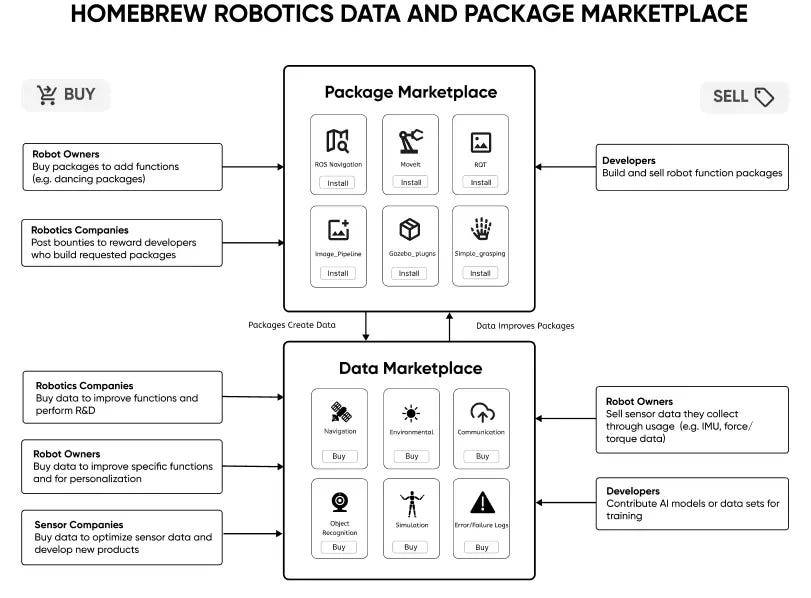
These two are interconnected: packages create data, and in turn, new data can be used to improve packages.
Up until now, released robots have been very basic in their out-of-the-box functionalities; the data marketplace envisioned will provide a place to expand on those.
For instance, robotics companies can create bounties for developing software packages that the community can fulfil.
Anyone will be able to monetise their technical knowledge with regard to software packages through “licensing, subscriptions or one-time purchases”.
To maximise its reach, the marketplace is expected to support most robotics Operating Systems (e.g., ROS, Groot, NAOqi) to ensure compatibility of software packages.
As Homebrew focuses on humanoid robots, it highlights that they require larger datasets due to their greater range of motion.
What could you possibly use this data for, you might be wondering?
Train robot algorithms
Optimise performance
Expand functionality
An example of a software package is Brewpay V1, which gives robots the ability to pay via voice commands and is now evolving into V2, intended to have a broader impact via x402.
Another example includes a “math layer” to optimise VR controls.
They are currently focusing on the most helpful type of data:
General physics data gathered from robots performing tasks such as walking, balancing, and more; it includes force, torque, and “kinematic feedback”. This data is used to improve “robot locomotion, balance, and task execution, making robots more adaptable in real-world environments”
Cross-domain Human-Robot Interaction dataset: Gathered from interactions in homes, workplaces, provides data on speech, gesture training, context and emotional cues which can be used to improve robot-to-human communication and collaboration (e.g. personal assistant or healthcare robots).
Multimodal Sensory Feedback Data: Gathered during tasks like grasping or lifting, this data combines tactile feedback with RGB images, depth maps, force/torque sensors and is helpful to improve how robots manipulate objects.
Robotic Perception Dataset for Object and Context Understanding: This data is fundamental to help robots understand objects within their context and consists of object recognition through cameras, spatial understanding (LIDAR and “contextual annotations (IMUs)”,
Advanced Human-Robot Collaborative Task Dataset: Data on “joint actions, coordination, timing, and human feedback”, used to improve human-robot coordination.
2. The Homebrew AI Toolset
After creating the marketplace, their medium-term objective is to introduce a series of AI tools to support developers across robot frameworks, including assisted programming, voice-to-action inputs, and expanded hardware support for integrations.
The AI-assisted programming will be widely used across the Homebrew Exchange. For instance, developers can use it to automatically integrate data from the marketplace.
Imagine Cursor or Co-pilot for robotics.
Before these tools can be created, Homebrew needs to train the AI on ROS code and best practices, create an “IDE” plugin that integrates the AI into the workflow and provides suggestions, and make sure the tools are widely compatible with existing packages and simulation tools.
The second aspect beyond assisted programming is AI-assisted task execution via voice commands. Users can trigger workflows and call packages using voice commands through a widely compatible command interface.
To train the AI model, it requires awareness of different voice commands and task execution scenarios, as well as an understanding of complex instructions.
From there, the AI can be trained to trigger the right action across multiple packages and systems to perform tasks.
Last but not least, to maximise the impact and scalability of this AI model, they are planning to continue integrating new humanoid hardware.
In the long term, this will be instrumental in Homebrew’s vision to develop its own humanoid robot.
3. Baby Brewie: The Homebrew Humanoid Robot
The Homebrew club’s long-term vision is to release Baby Brewie, an affordable, small humanoid robot. Since inception, it will be supported within the Homebrew Exchange, allowing the creation and integration of specialised packages and data.
Current humanoids are full-sized, expensive and limited, while Baby Brewie leverages the same value chain as large robots (ROS, Gazebo, and, in terms of sensors) at a much lower cost and size (will be smaller than one meter).
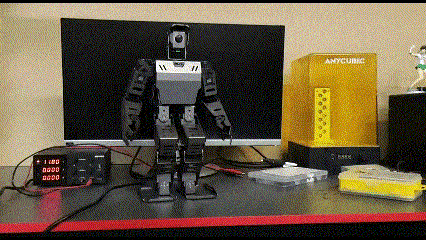
The main focus is on demonstrating the potential of affordable, smaller humanoid robots, making it easier for users to access hardware and test them out.
What’s their approach to building an affordable robot?
Re-using open-source frameworks: ROS, Arduino, Raspberry Pi (cost-effective integrations).
Modular Design: off-the-shelf components, 3D printed custom parts.
Affordable computing: Budget-friendly computing units, handling applications at a fraction of the cost of traditional hardware.
Simple Functionalities: focus on core capabilities (mobility, task execution) and gradually adding on top.
Collaboration: Shared code, open source designs and funding to cut development time and costs.
As part of this, Homebrew recently integrated the Codec OPTR toolkit into Brewie.
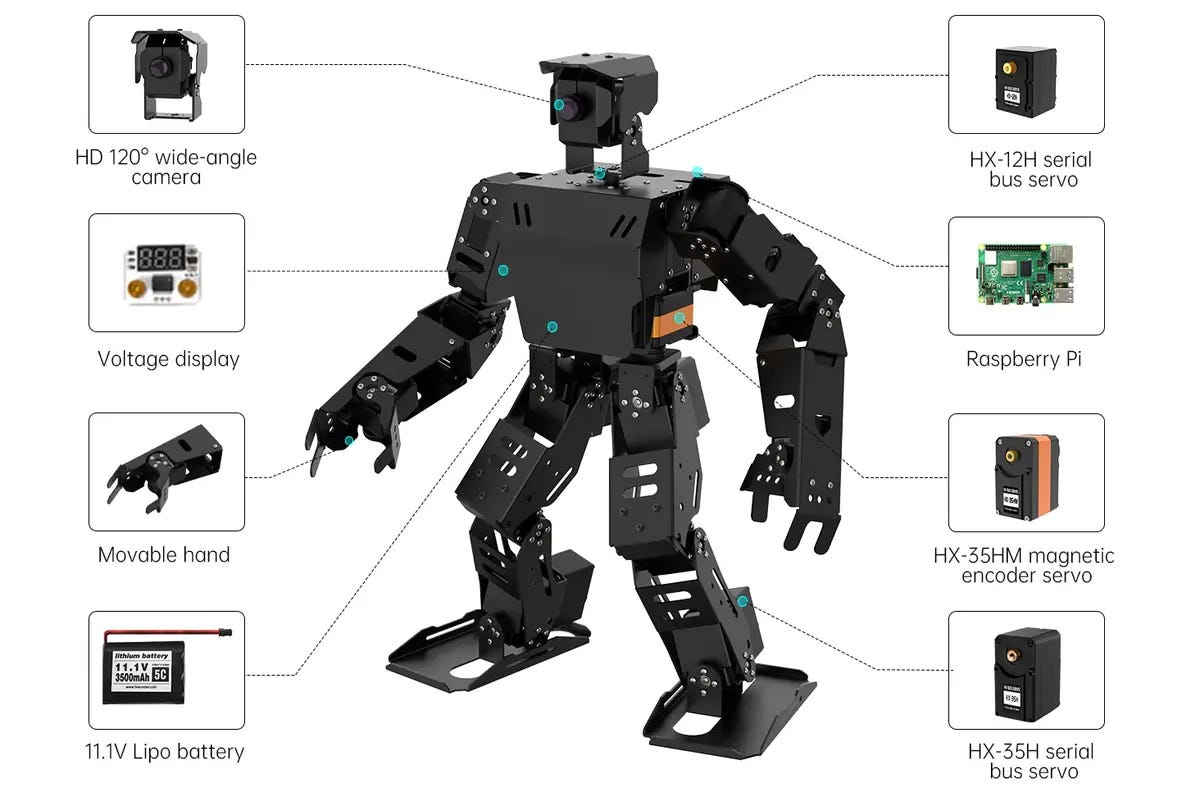
Here’s a mockup of Baby Brewie:
Food for thought and conclusion
Homebrew has a very pragmatic approach to robotics. Instead of multi-year plans, it lays down a three-layered approach that reinforces each other.
First, the launch of the marketplace addresses current inefficiencies in data access, fragmentation, and monetisation opportunities. By developing AI tools, developers and robot owners alike can benefit from voice-based execution and AI-assisted programming, making it easier to add data to the marketplace and integrate it within existing hardware. Last but not least, they envision a practical implementation through Baby Brewie, their small humanoid robot.
In addition, it’s been very interesting to learn which tweaks can reduce the cost of robotics hardware production, enabling more affordable humanoids. As the initial, larger-scale humanoids slowly gain prominence, we expect this approach to be adopted by many more companies.
Together, the Homebrew Club is positioned to be a source of data and software for robotics, tools to better produce and integrate them, and a final piece of hardware that brings it all together.
Great post. I like the idea of companies reusing open source frameworks for this space. It makes a lot of sense to me