


Introduction
Berachain’s architecture is grounded in a core principle: liquidity should be the engine of incentive design, not inflation. Through PoL V1, Berachain distributed emissions to vaults seeded by protocols, aligning rewards with active liquidity provision instead of passive consensus participation. This rewarded active builders over passive stakers and laid the foundation for an application-first Layer 1.
However, v1 had its limitations:
Most rewards were concentrated among BGT holders and LPs
$BERA, the gas token securing the network, had no native yield or value flowing back to it.
Retail participation was constrained while institutional access lacked simplicity.
PoLv2 was initially proposed on the governance forum and went live on July 21st, seeking to restore balance within the ecosystem. It introduces a native staking module that routes emissions to $BERA holders, with transparent and liquid yield, backed by real protocol activity. The result is better alignment across Berachain's three tokens, more flexibility for developers, and a straightforward path for users and institutions seeking on-chain yield.
PoL V1: Foundation and Friction
The original PoL design was effective in catalysing onchain liquidity. Protocols could launch vaults by pairing their token with $BERA or $HONEY, attracting deposits from LPs. $BGT holders then delegated emissions toward these vaults, creating a competitive market for liquidity-based incentives.
Protocols that bootstrapped vaults with meaningful liquidity quickly gained validator support, application traction, and community attention. Builders were rewarded for skin in the game, and the system favored protocols that could deploy capital strategically. Vault emissions were routed through $BGT, which became the central lever for emissions capture.
However, this design left $BERA with limited functionality. It remained a pure gas token with minimal staking rewards. While PoL fueled protocol growth, the role of $BERA in value accrual was unclear, as it lacked a clear link between ecosystem activity and token value accrual. Retail users deposit into vaults by pairing $BERA or HONEY with protocol tokens, then wrapping the LP tokens to earn $BGT emissions. This added complexity, smart contract risk, and poor UX. Institutions saw no clean way to earn rewards from $BERA without engaging in non-custodial strategies that conflicted with compliance and custody frameworks.
The disconnect was clear. While Berachain grew as an application-centric ecosystem, its base token lacked a participation mechanism that aligned with user expectations and institutional standards.
PoL V2: Yield for the Base Asset
PoL V2 introduces the BERA Yield Module (BYM), which redirects 33% of PoL emissions toward staked $BERA. The design enables users to stake $BERA directly through on-chain delegation or CEX interfaces, without the need for bonding, wrapping, or managing third-party derivatives.
The staking module operates with a seven-day unbonding period to discourage mercenary capital while maintaining accessibility for users who need liquidity. Yield is funded by bribes paid in BGT by protocols seeking emissions, then routed through an automatic buyback system into $BERA. This converts demand for emissions into direct rewards for the network’s foundational asset.
Implementation is straightforward. The BYM is integrated through the PoL incentive router and does not require any change to consensus logic. No hard fork, validator upgrade, or audit-intensive protocol overhaul is needed. Emissions routing now includes a direct path to the base token, aligning $BERA with protocol revenue and staking participation.
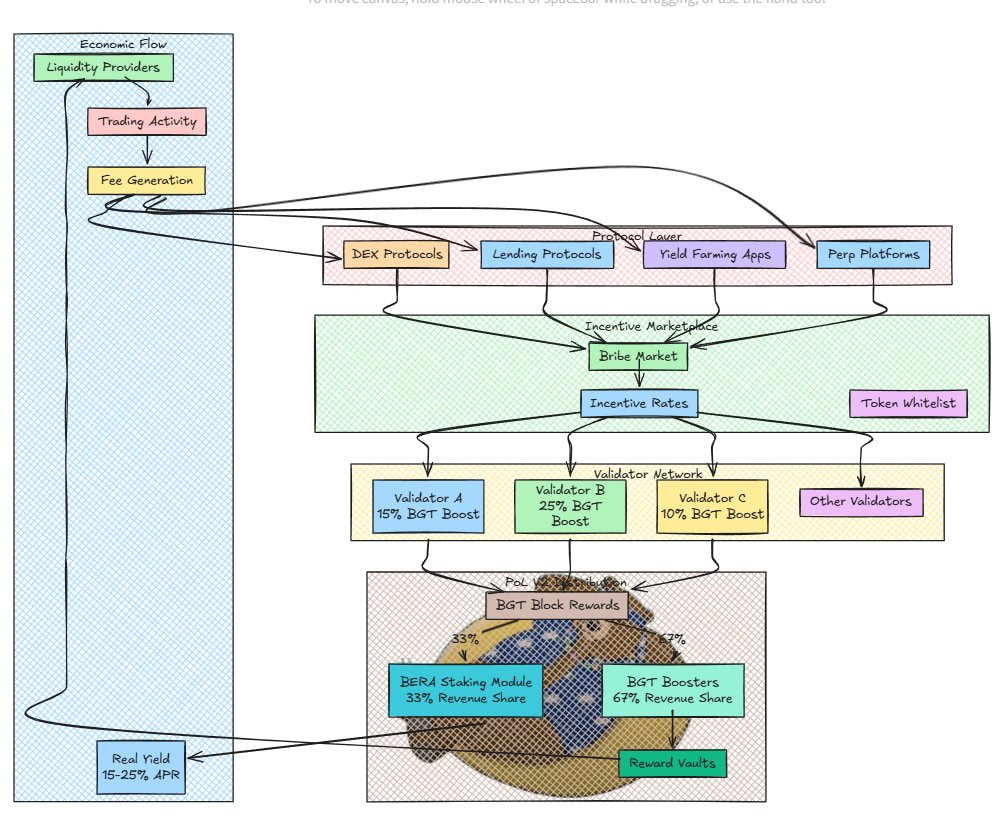
POL v2 economic flow: Illustration by https://x.com/0xRavenium
Source :https://x.com/0xRavenium/status/1945645817248743528
Design Rationale and Tradeoffs
PoL V2 solves a core inefficiency: BERA had no real demand beyond gas usage, and users lacked incentive to hold or stake it. Yield flowed almost entirely to BGT vaults, ignoring the base layer's role in security and economics.
The Berachain team considered other fixes, such as BGT vesting, validator reward boosts, or BERA-to-BGT swaps, but each added complexity or overhead. BYM avoids all of that. It integrates seamlessly into the existing architecture, requires no new oracles, and keeps the validator logic simple. A 7-day unbonding window filters out short-term capital and rewards participants who are aligned.
Strategic Outcomes for Stakeholders
Retail Users
Staking $BERA now resembles the experience users expect from mature proof-of-stake chains. A single-click delegation flow via CEXs or wallets replaces the prior reliance on LP tokens and derivative abstractions. APR visibility improves user understanding, and protocol alignment becomes frictionless.Developers
$BERA transitions into a yield-bearing primitive. This opens pathways for native integrations: interest-bearing tokens, overcollateralized stablecoins, fee-sharing mechanics, and emission-linked vaults. Features like $BERA Bonding for Reward-Vault Access and Fixed Emissions Streams give developers the tools to structure long-term incentives directly through protocol logic.Validators
Rewards for validators now come from two channels: base staking rewards and BYM emissions routed by delegation weight. The consolidation of rewards into $BERA simplifies validator treasury management, accounting, and operational security. The upgrade lowers entry barriers for new validators and strengthens incentives for maintaining a healthy validator set.Institutional Capital
PoL V2 enables institutions to access chain-native yield without engaging in complex DeFi strategies. BERA becomes a clean, transparent, exchange-listed yield asset with a clearly defined reward stream. This removes friction in custody, reporting, and compliance, allowing BERA to be incorporated into structured products, staking mandates, and passive yield portfolios.
Reaffirming the Fat BERA Thesis
Berachain has always treated the application layer as the centre of value. PoL V2 builds on that by routing emissions through BERA, the asset that powers execution, participation, and security. Yield is now tied directly to usage.
For builders, this unlocks simpler design. No governance delays, no new token flows. Apps can stake BERA, offer direct incentives, or lock in user rewards through fixed emission streams. BERA becomes a programmable layer for rewards.
The result is clear differentiation. Berachain’s system is driven by real activity, not passive inflation or hype cycles.
Ecosystem Maturity and Roadmap Alignment
PoL V2 coincides with major product launches and upgrades across the Berachain stack. These include:
BEND, the native lending protocol
BERPS, the upcoming perpetuals platform
HONEY, an expanded stablecoin collateral suite
BeaconKit upgrades, improving gas mechanics, reducing spam, and optimising block production
Fixed BGT Emissions, establishing predictable emission structures for high-throughput apps
Institutional Pathways and Strategic Positioning
PoL V2 turns $BERA into a dividend-bearing asset backed by protocol revenue. This structure opens a clear path for institutional access to Berachain’s yield.
Staking is simple, emissions are transparent, and rewards are native. Institutions can build structured products, ETFs, or custodial offerings on top of predictable, on-chain revenue.
The dual-token setup keeps roles clean. $BGT handles emissions and coordination. $BERA secures the chain and captures value. There’s no overlap between the two, but rather modular alignment between governance, rewards, and security.
Conclusion
PoL V2 is not a change in direction, but rather the refinement of the same thesis that defined Berachain from the beginning: liquidity is the foundation of sustainable blockchains. The new module brings $BERA into alignment with that thesis by attaching protocol yield directly to the asset that underpins consensus.