


The Birth of Bitcoin-Native Finance: Turning Idle BTC into Productive Capital
Bitcoin (BTC) is the 13th-largest asset in the world, with ~$1.3 trillion in market capitalisation, and is increasingly being adopted by company treasuries, ETFs, investment portfolios, and more, positioning it as a “reserve asset”.
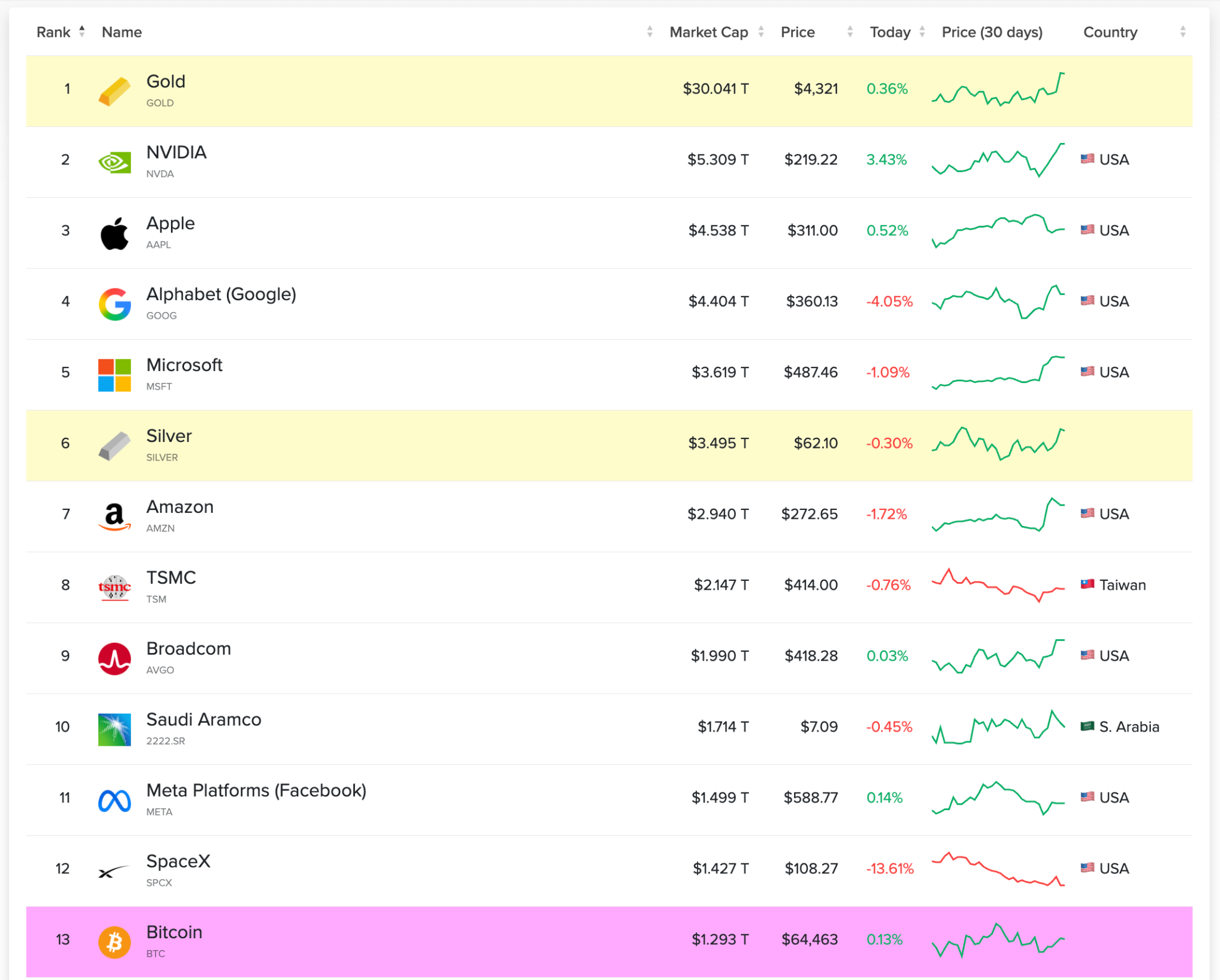
Even after establishing its position in the financial market, Bitcoin’s financial utility remains underdeveloped compared with that of traditional assets of similar scale. A BTC holder today primarily holds the asset for pure price exposure, lacking access to any native, underlying yield that naturally accrues value over time. In traditional finance, assets can be securely leveraged to borrow against or generate dividends from corporate cash flows. While Bitcoin can also be used as collateral for borrowing, most current solutions introduce smart-contract or counterparty risk that might not align with the risk profiles of current holders.
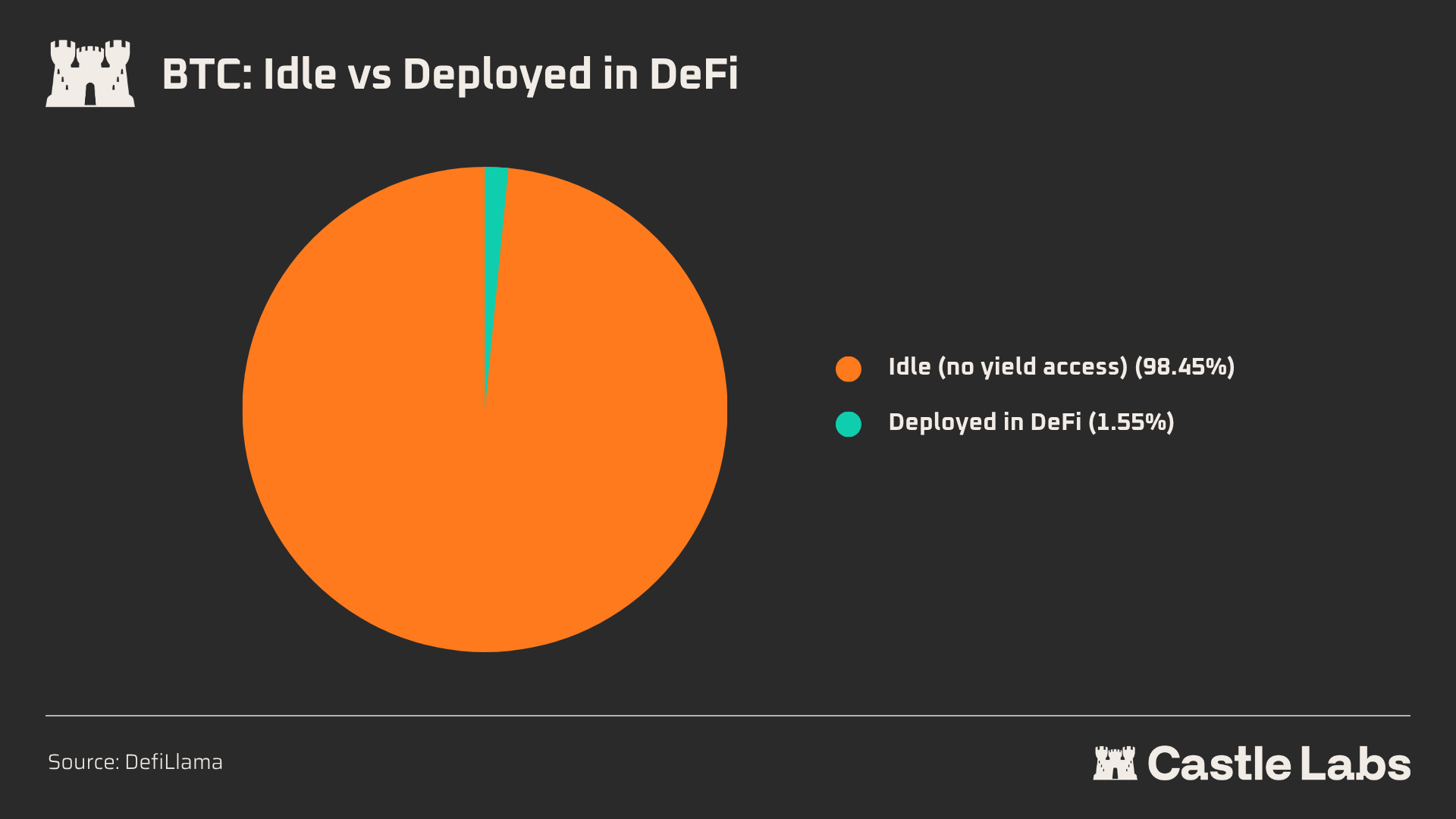
As a result, out of the active supply of 20.05 million BTC, only 311k (~1.5%) have access to any yield, including Decentralised Finance (DeFi) lending, staked BTC, BTC deployed on Decentralised Exchanges (DEXs), and vaults.
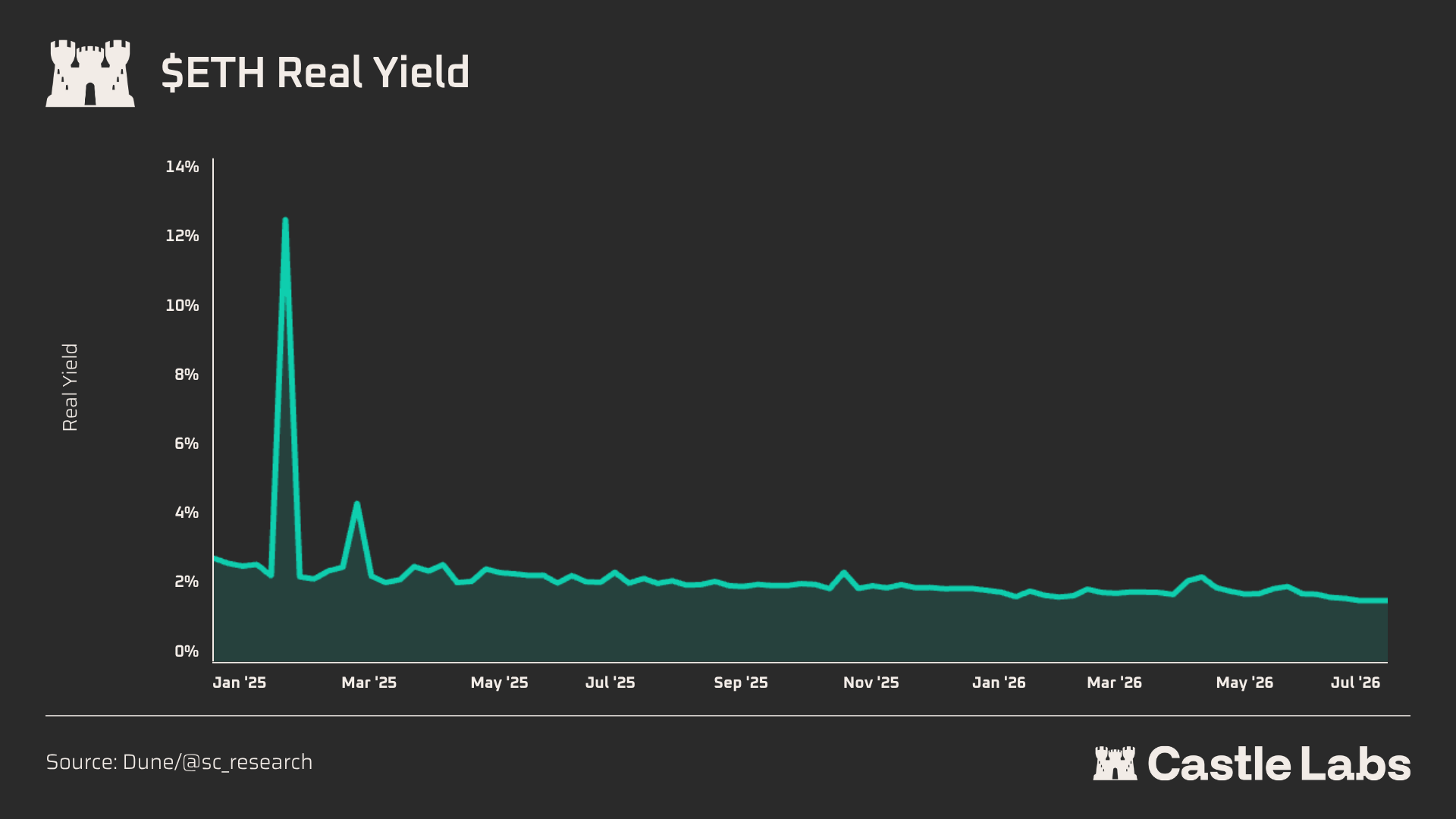
Ethereum (ETH), the second-largest asset, has built a layered set of financial primitives that convert idle ETH into working capital. Almost 32.5% of all ETH in circulation is staked, earning a native yield of ~2%. On top of base staking sits a second layer of liquid staking: Lido alone represents ~21% of all staked ETH, issuing stETH, a rebasing asset that is usable across DeFi.
This gap is a downstream effect of Bitcoin’s design and the holder behaviour.
Bitcoin is a proof-of-work network that has no staking mechanism.
Holders’ behaviour is deliberately conservative, meaning those with large holdings would never want to risk their assets for the yield that comes with additional risk, as seen in the centralised BTC lending cascade in 2022, with the collapses of Celsius, BlockFi and Voyager.
In this piece, we aim to highlight the current problems that lead to BTC being underutilised as an asset, while also reflecting on the steady development going forward to solve this exact problem through a case study using Stacks.

The Bitcoin Yield Stack
Only a limited amount of BTC earns any active yield, and almost all of that yield originates in the developed DeFi ecosystems of EVM chains and Solana, because those ecosystems already have financial primitives like lending markets, DEXs, and vaults that can support consistent yield generation. In this section, we highlight the BTC yield stack and the development in its sources over time.
Centralised BTC Lending
Before the onchain ecosystem matured, centralised platforms like Celsius, BlockFi, and Voyager offered BTC yield but sacrificed custody. All these platforms eventually collapsed in 2022 through a nearly identical mechanism: taking legal title to deposited crypto (Celsius’ terms explicitly transferred “all right and title” to depositors’ assets, entitling the platform to rehypothecate them), and re-lending to opaque counterparties. Celsius’ failure was triggered by a liquidity crunch following the Terra/Luna collapse: 75% of the platform’s withdrawals came after this event, forcing it to pause redemptions. Voyager failed when 3AC defaulted on a $350 million USDC and 15,250 BTC loan. BlockFi took the same 3AC hit, then a second one from Alameda Research’s roughly $680 million loan default.
What was common among them was undercollateralised institutional lending funded by retail deposits, with contractual terms that stripped depositors of ownership of the underlying assets.
The DeFi Ecosystem
DeFi is battle-tested in the EVM and Solana ecosystem, which gives users greater confidence in using it. However, to use these products, a BTC holder must first convert native BTC into a representation that the destination chain understands. This includes asset categories such as custodial mints (WBTC and cbBTC from Coinbase), decentralised bridged assets (tBTC), and Liquid Staking Tokens (LBTC). All these categories add a risk layer:
Bridge Risk: To mint a representation, a user sends native BTC to an address or custodian that holds it and receives a 1:1 receipt token on the destination chain. For custodial mints (WBTC and cbBTC), the mechanism is operated by centralised operators who are vulnerable to private-key compromise or social-engineering attacks. Threshold’s tBTC has a signer network with no single custodian, though it still carries signer-set and smart-contract risk.
Custodian Risk: For assets like WBTC, the custodian, BitGo, shifted from unilaterally holding all three keys of WBTC’s 2-of-3 multisig to a multi-jurisdictional split across BitGo Inc (US), BitGo Singapore Ltd. and BiT Global (Hong Kong) in August 2024. Even after this change, the third key remains with BiT Global, a joint venture connected to Justin Sun’s Tron ecosystem, in which BitGo is only a minority shareholder, making it still a key risk for the asset. On the other hand, cbBTC is backed 1:1 but held entirely by Coinbase, a single custodian that can freeze or seize funds under its user agreement.
Smart Contract Risk: Using any DeFi protocol exposes depositors to smart contracts. There have been multiple instances in which protocols have been hacked, and there is simply no resolution. In the November 2025 Balancer hack, liquidity providers (LPs) suffered significant losses after ~$128 million was drained from Balancer V2 pools, despite the protocol having undergone multiple audits.
Even after years of battle testing, DeFi protocols are not the perfect place to park capital.
In the recent kelpDAO rsETH exploit, over 8.6k BTC left the protocol amid fears of contagion in the first six hours. In the kelpDAO hack, the attacker deposited rsETH as collateral and borrowed a large amount of wETH against it. Since all the wETH liquidity was siphoned off, lenders began using their deposits as collateral to borrow in other stablecoin markets. To avoid becoming part of this contagion, users simply decided to withdraw their assets. These withdrawn assets represented ~12% of BTC-based assets deployed on the protocol.
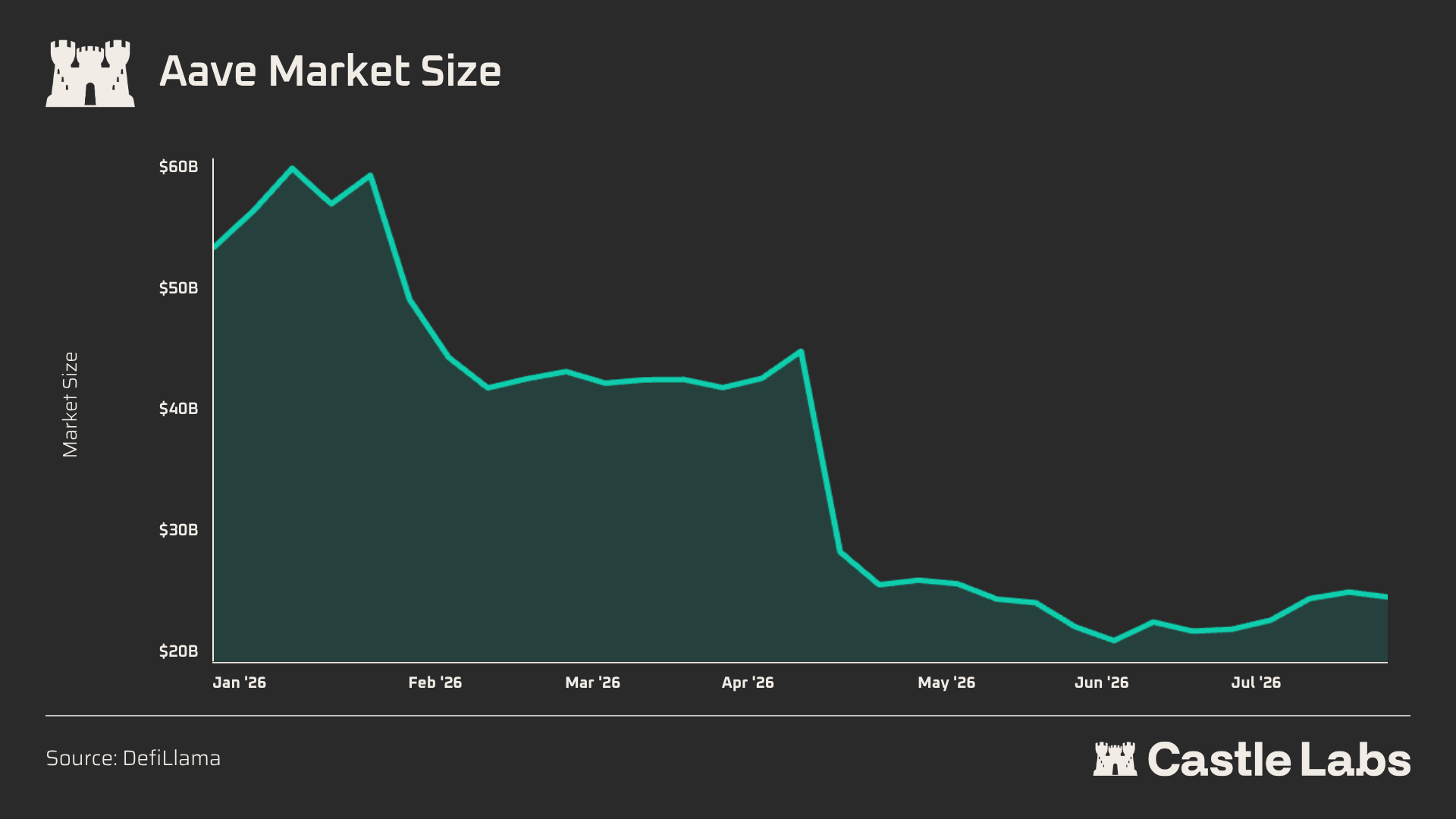
It was a major breach of confidence, as Aave is the largest lending protocol, and an attack on an external asset sent the protocol off a cliff due to factors including its pool-based design and a gap in governance oversight during asset onboarding to E-mode, which pushed its LTV to 93%. Post this, Aave’s market size is down by over 50%.
Bitcoin L2s and Staking Protocols
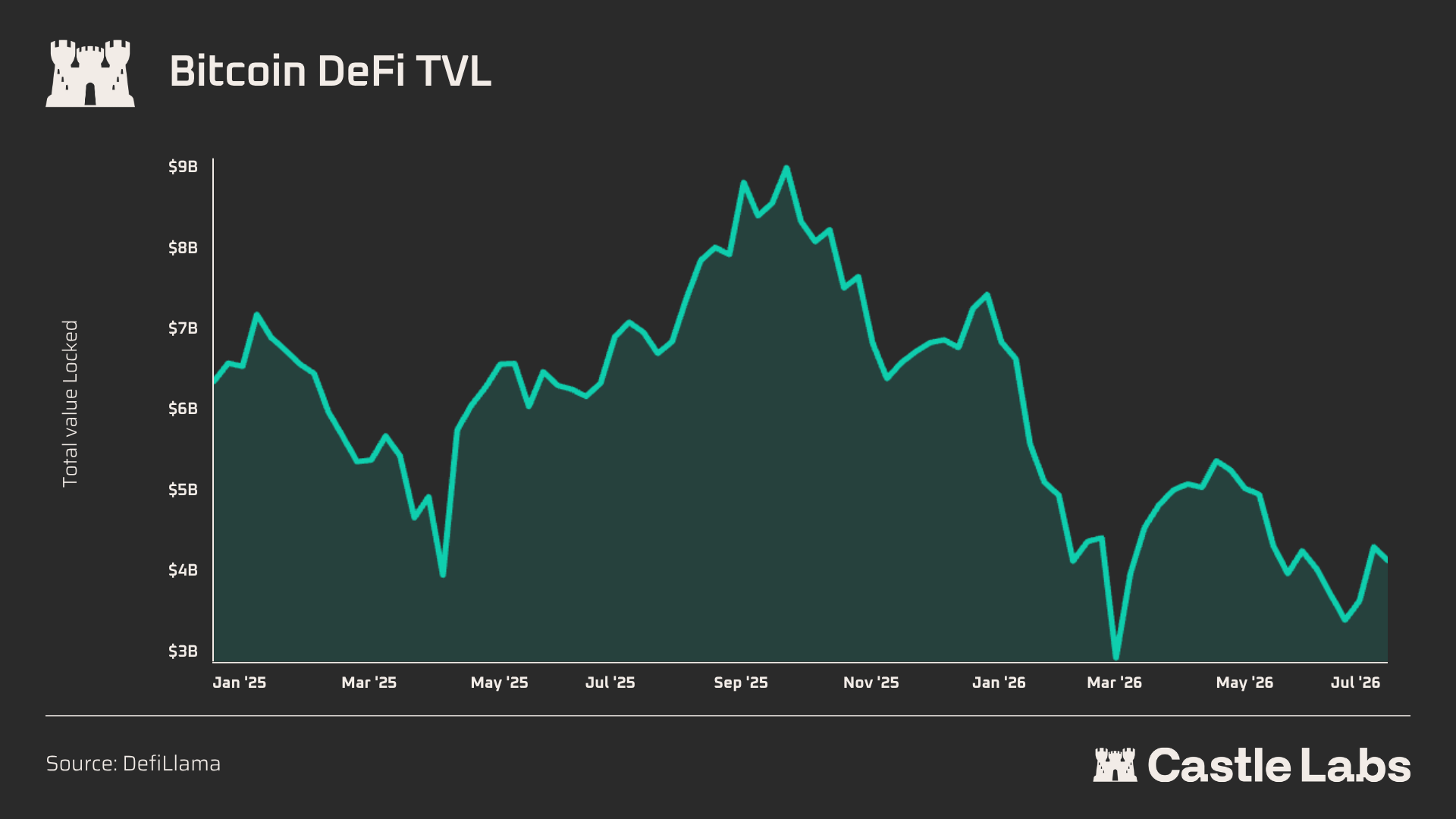
The second route to BTC yield runs through Bitcoin L2s and staking protocols, such as Babylon, Lombard, Stacks, Rootstock, BOB, and others cumulatively accounting for ~$4 billion in total value locked (TVL).
Of these, Babylon represents the most value locked. It is primarily a staking protocol in which BTC holders lock their assets on the L1 itself, thereby securing Proof-of-Stake (PoS) networks with Bitcoin’s L1 security guarantees. In return, these users earn yield through the chain’s native tokens, whose security they help maintain.
To obtain liquid representations, holders simply deposit either native BTC or WBTC in Lombard, thereby receiving a liquid, yield-bearing representation of the asset, LBTC, making Lombard a liquid staking protocol.
Nonetheless, these assets still expose the BTC holders to slashing risks.
The remaining locked value comes from BTC L2s aiming to bootstrap their own chain, which has historically been more difficult because it requires bootstrapping activity on the chain, attracting builders, stablecoin rails, great UX, and providing incentives to retain capital.
Current gap and its trust assumptions
Cumulatively, all these routes of earning yield reflect that the market has demand and infrastructure, but they don’t essentially sit in the same place. EVMs have deep liquidity and applications but force custody/bridge risk. Bitcoin L2s have stronger philosophical alignment with BTC holders but lack yield variety and UX to retail capital. Centralised lending is structurally broken post 2022 collapse.
Each of these deployments carries a distinct trust assumption:
Wrapped BTC trusts a custodian, and/or bridge signer set, plus the wrapper and downstream smart contract risk.
Babylon native staking trusts a covenant committee and an M-of-N multisig (currently 6-of-9, including 3 signers from Babylon Labs, 1 from CoinSummer Labs, RockX, AltLayer, Zellic, Informal Systems, and Cubist) that co-signs unbonding and slashing transactions.
Stacks sBTC bridge trusts a 15-member set of institutional signers, including Figment, Chorus One, Stacking DAO, and more. For the bridge to function, it requires 70% (11-of-15) of signers to participate honestly, with system safety holding as well and allowing no withdrawals, even if 33% of the signing voting power is honest, i.e., 5-of-15.
The unmet need is an approach that keeps Bitcoin’s trust model as intact as possible while still delivering the applications and liquidity that make capital productive.
Bitcoin-Native Finance
Bitcoin-native finance refers to financial products that use BTC as the primary asset while keeping settlement, security, and asset movement as close as possible to Bitcoin’s base layer, minimising additional trust assumptions.
Bitcoin-native finance cannot be achieved on the L1 itself because of Bitcoin’s own design:
Bitcoin Script can enforce simple spending conditions but is not Turing-complete and cannot execute arbitrary complex logic or loops, so it cannot express the state machines DeFi protocols need (AMM curves, health-factor checks, liquidation logic, and more)
UTXO model has no shared, persistent state. Bitcoin scripts do not maintain state beyond the current transaction, whereas a lending market or an AMM requires exactly the shared, mutable state the UTXO model cannot provide.
Blockspace is scarce and slow. With roughly 10-minute block times and genuinely scarce block space, high-frequency DeFi actions cannot be executed on the L1.
There’s no native BTC yield mechanism to build derivative products upon because the chain is proof-of-work.
Bitcoin cannot verify external chain state, so moving BTC into any programmable environment requires custodians or signers.
Given these constraints, fully Bitcoin-native finance isn’t achievable. Every product on the market today relies on some trust assumption beyond Bitcoin’s consensus itself. To solve this problem, a certain set of protocols is building as close to Bitcoin as possible.
Babylon requires no bridging at all: the staked BTC stays in timelocked Bitcoin UTXOs, but assumes the risk of its covenant committee and of the finality providers it delegates to secure external proof-of-stake chains, introducing slashing risks.
BOB pairs Bitcoin finality with a full EVM environment via BitVM-style bridging: In practice, it currently settles on Ethereum and treats full Bitcoin security as a phased roadmap.
Stacks anchors its execution layer’s finality directly to Bitcoin consensus while accepting a signer set for its BTC-backed bridge asset, sBTC, which requires 70% (11-of-15) to move funds.
Among the current solutions, some have already reached a good scale. Babylon (staking protocol), Lombard (liquid staking protocol), and Solv (yield generation), each at the TVL of $2.6 billion, $800 million, and $480 million, respectively.
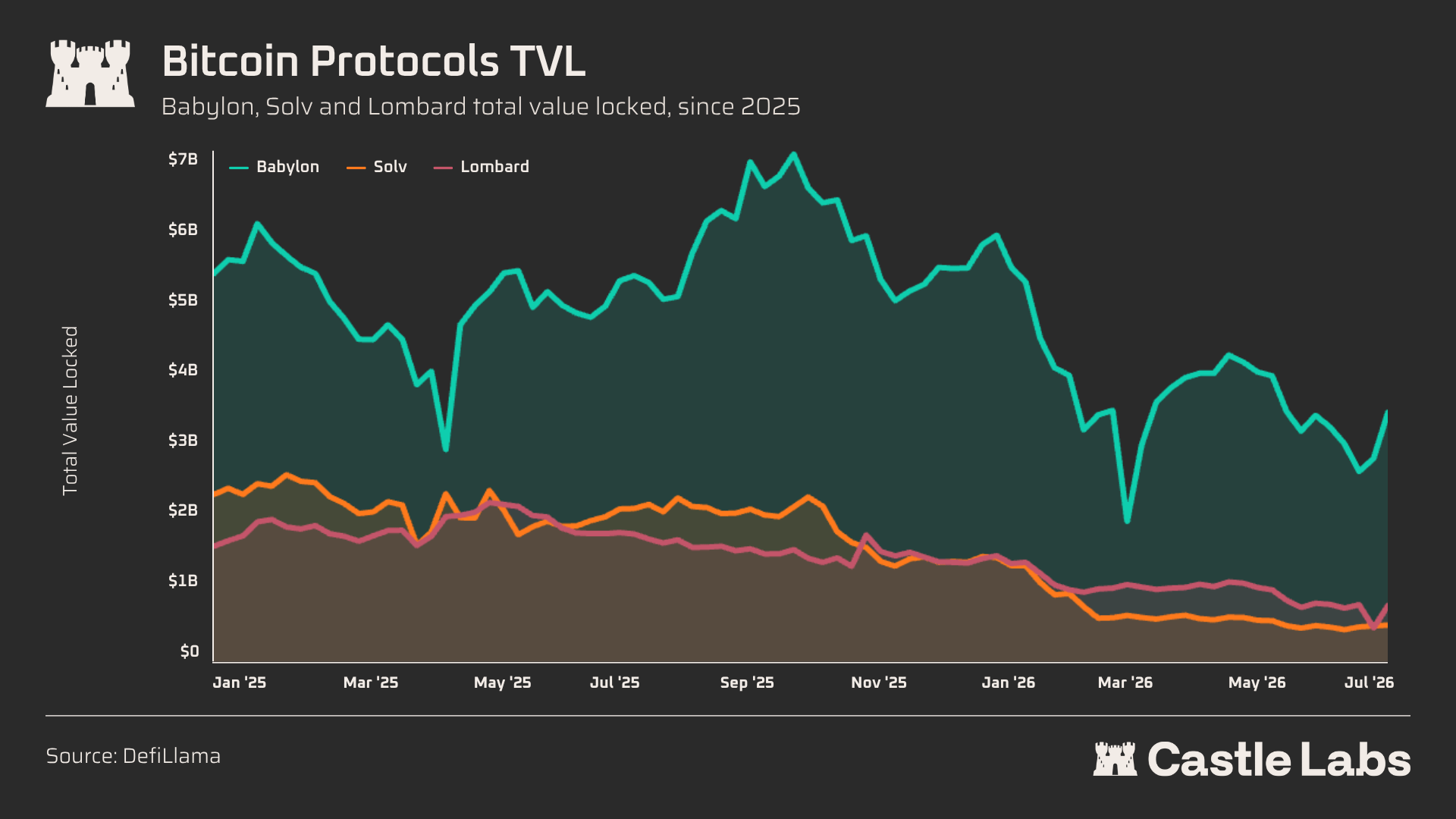
These protocols have gained traction for their strong composability with the rest of DeFi, enabling users to earn more on top of the base yield the asset accrues.
Yield comes from different sources. LBTC from Lombard does it through staking, sourcing yield from the Babylon network, which secures PoS blockchains. solvBTC from Solv generates yield from delta-neutral strategies, lending, liquidity provisioning, staking, and Real-World Assets (RWAs).
While currently there is no complete Bitcoin-native solution, today this means:
Getting yield directly on the Bitcoin L1 itself, without giving up self-custody and introducing any new risks.
Getting a liquid representation of the committed BTC, if the user requires it.
Having full transparency on the risks involved with each of these steps.
A series of questions users should ask in order to understand whether a solution is Bitcoin-native:
Does the solution allow self-custody?
How decentralised are the bridge signers?
Where does the yield actually come from?
Can a holder exit or demand, or is there a lockup?
In the following section, we discuss how to answer these questions using the case study of Stacks and how it is building towards Bitcoin-native finance.
How is Stacks building towards BTC Native Finance?
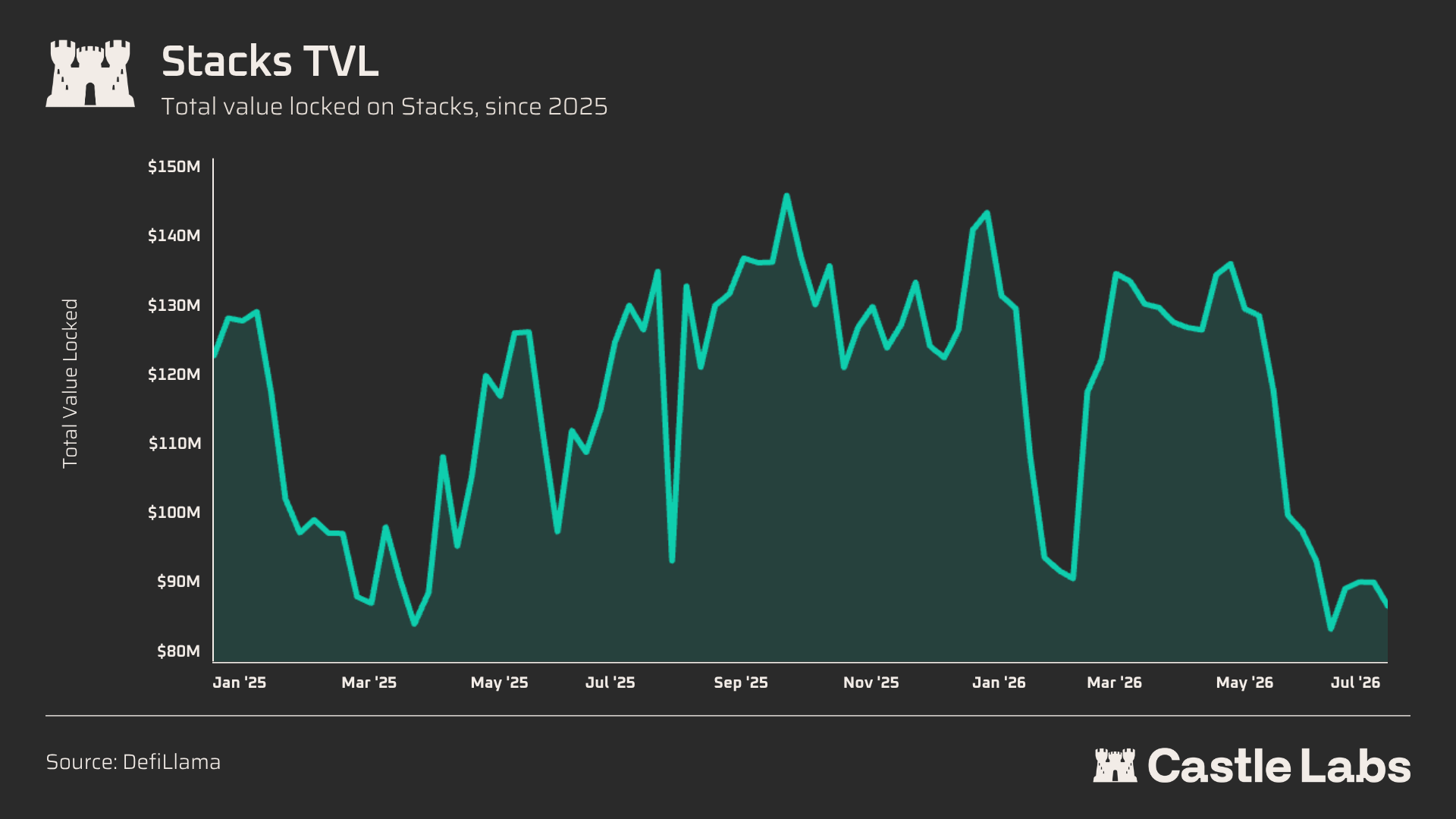
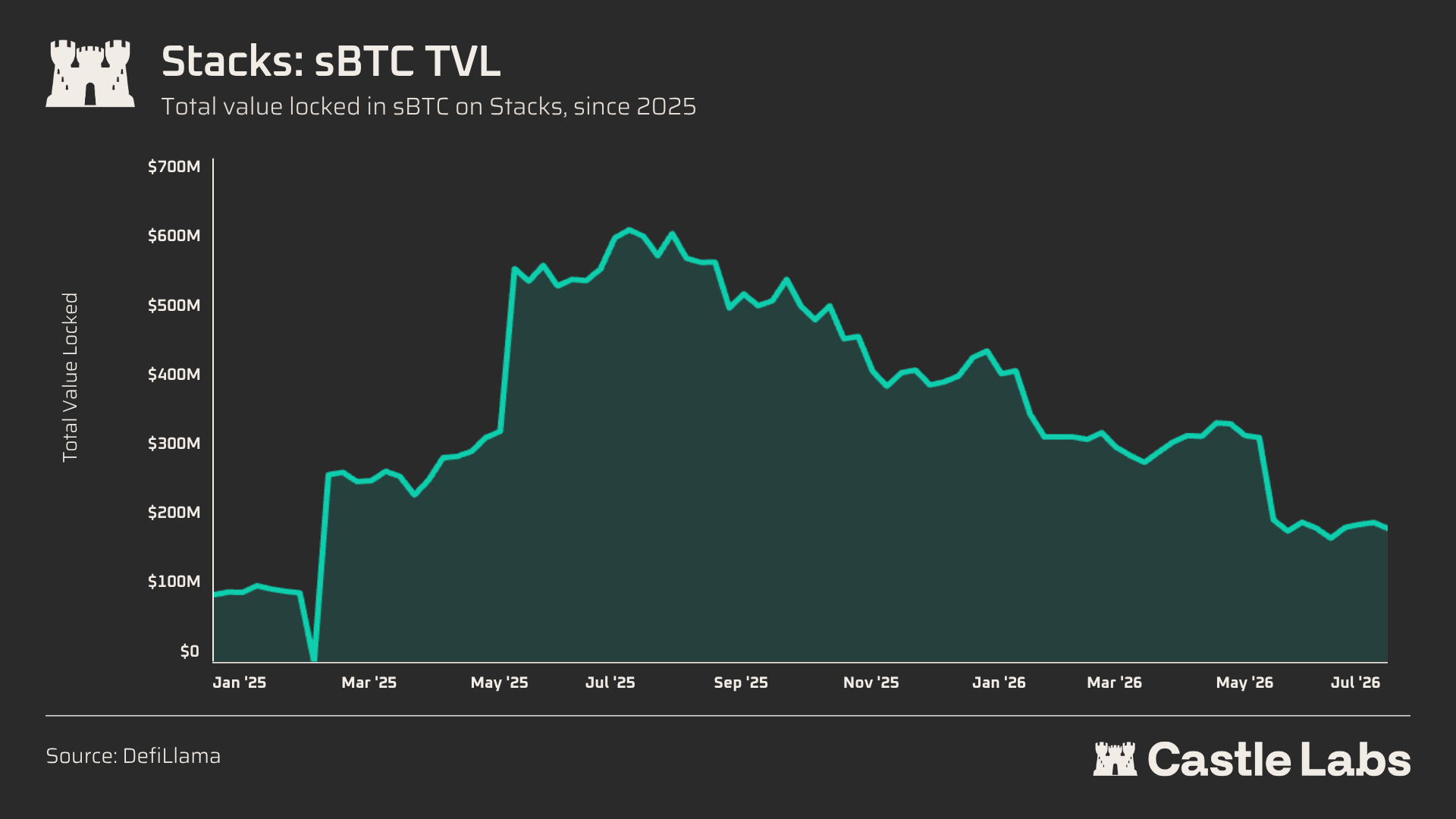
Stacks is a BTC L2 that anchors its execution to the Bitcoin base layer. It is currently at ~$90 million in onchain TVL, with an additional $190 million in sBTC. It is one of the most complete attempts to combine all the pieces of a Bitcoin-native stack in one place:
Bitcoin-anchored execution layer
A trust-minimised BTC bridge
Native BTC-denominated staking
A liquid-staked representation (sBTC to go live with self-custodial staking)
Live DeFi applications (Zest, Bitflow, StackingDAO, Hermetica, etc.)
Bitcoin-anchored Settlement
Underpinning both sBTC and the broader chain is a finality model anchored to Bitcoin. Since the Nakamoto upgrade in October 2024, every Stacks miner’s block-commit transaction anchors prior tenure’s full chain state to a Bitcoin transaction, so reversing finalised Stacks tenure would require reversing the corresponding Bitcoin block. Stacks blocks therefore acquire full Bitcoin finality roughly one Bitcoin block after their tenure closes.
sBTC: trust-minimised BTC movement
sBTC is the mechanism that enables BTC to move between L1 and Stacks without a traditional custodian, serving as a bridged representation of Bitcoin on Stacks, which currently has a TVL of ~$190 million.
All the bridged BTC sits in a single peg wallet, a Bitcoin Taproot address, whose movement is controlled by a 15-member, community-elected signer set requiring a 70% (11-of-15) threshold to move funds, as highlighted in the sections above.
Native, self-custodial Bitcoin staking
Stacks recently proposed a Proof-of-Transfer (PoX-5) upgrade that lets BTC holders earn BTC-denominated yield while their BTC stays locked on Bitcoin L1 (expected to go live in late August). For this to work, Stacks utilises a standard OP_CHECKLOCKTIMEVERIFY timelock that allows BTC to remain committed and yield-bearing while staying in the holder’s own custody; the lock is enforced by Bitcoin consensus itself, requiring no trust in a custodian, bridge, or signer set.
Yield in PoX-5 is sourced from the Stacks consensus mechanism as miners bid BTC to mine Stacks blocks. We also covered this mechanism in detail in our previous research on the PoX-5 upgrade.
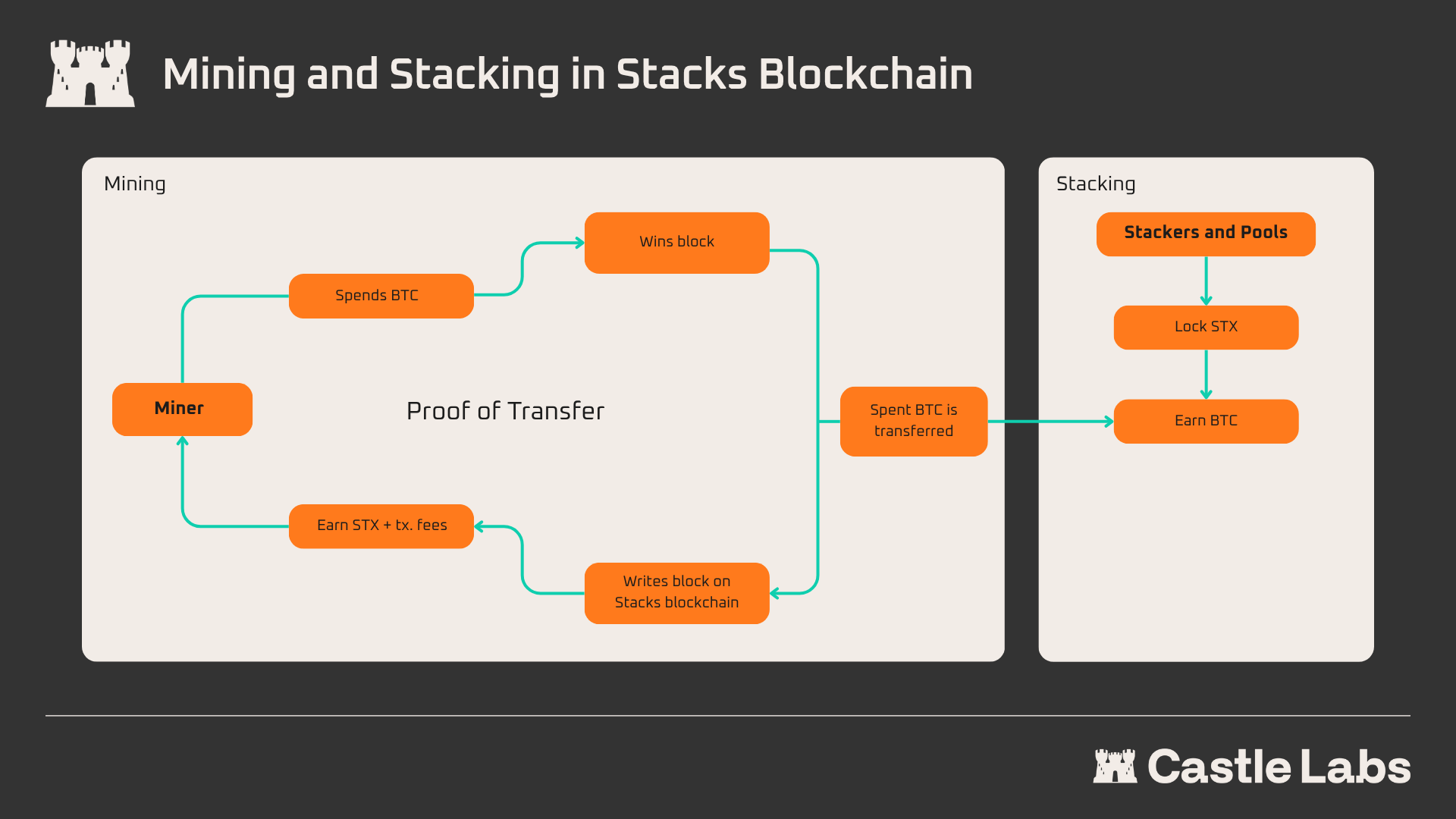
Since January 2021, this mechanism has already distributed over 4200 BTC to STX stakers. Now BTC stakers will be able to earn yield through the same mechanism.
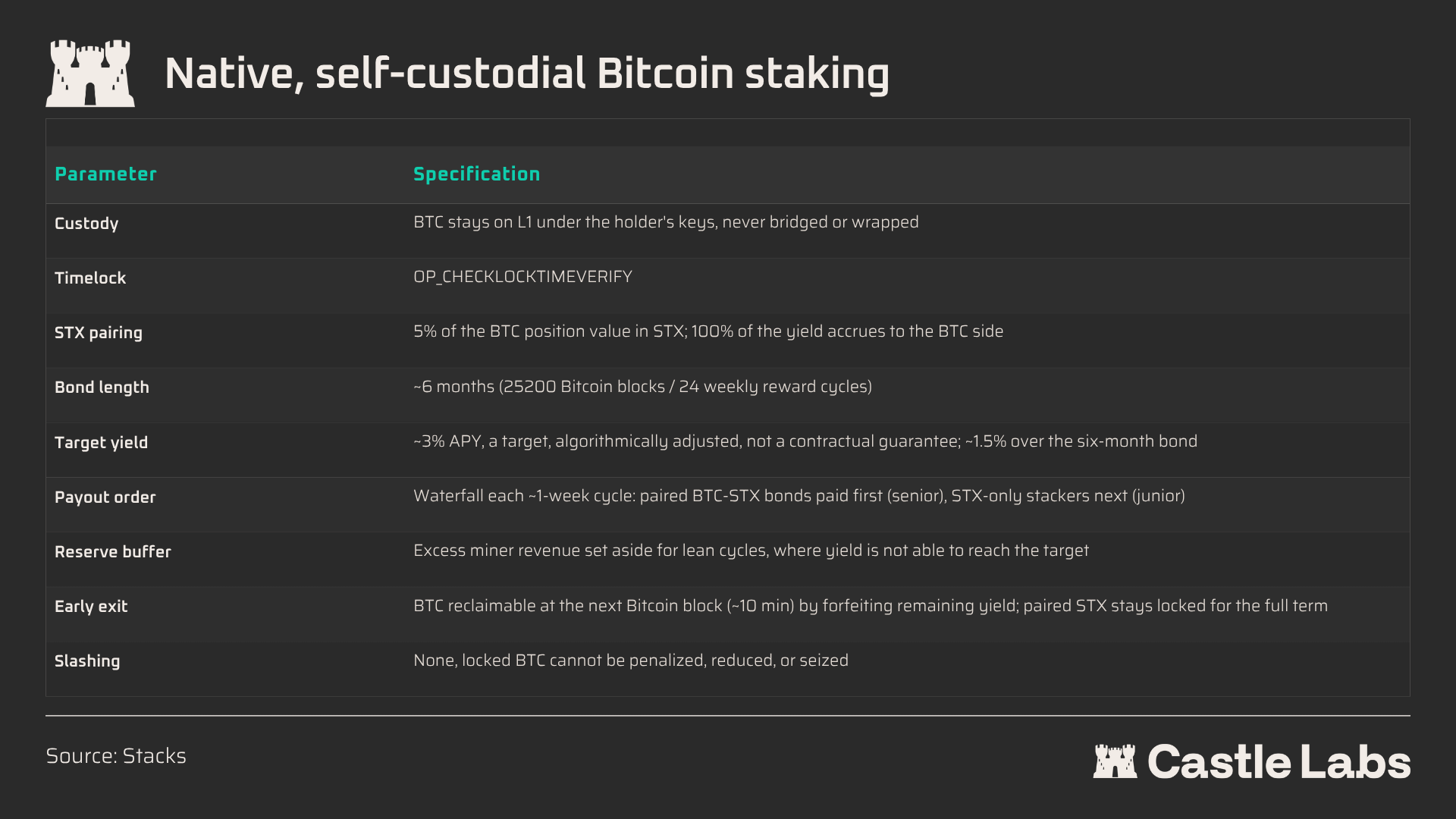
Participation in BTC staking will require a protocol bond that locks BTC on L1, along with an STX position equal to at least 5% of the BTC value, for a six-month term. The paired BTC-STX bonds form a senior tranche with first claim on each cycle’s miner-BTC pool, targeting 3% APY. The remaining yield is distributed amongst STX-only stakers, forming the junior tranche, and the reserve fund, which accrues excess miner revenue. The reserve fund is used to pay yield in future cycles where miner revenue might be short and unable to fulfil the yield obligation.
Additionally, there is no binding exit, and holders can exit with their BTC in the time it takes for a couple of Bitcoin blocks by giving up the remaining term yield, while the paired STX are locked for the full term. In this model, there is no slashing risk involved, meaning stakers won’t risk losing their funds.
Making BTC productive natively is one of the first steps in the Stacks roadmap; the team is also actively putting research efforts into self-custodial bitcoin borrowing. Through this, users will be able to use BTC as collateral in lending protocols like Zest on Stacks while their BTC never leaves the L1. Stacks constantly verifies the bitcoin collateral on the L1 by reading the Bitcoin state, allowing borrowers to access stablecoins like Circle’s USDCx and Hermetica’s Bitcoin-backed USDh to further produce yield on their assets while still earning the staking yield from PoX-5.
stBTC and the application layer
The BTC that is staked on the L1 with STX is productive in practice, as it earns a base yield and is redeemable at any time. But the same BTC, while staked, cannot be used elsewhere, lacking composability. A possible solution to this is a Liquid Staking Asset (LST) for those seeking DeFi use cases.
StackingDAO is set to launch one such product, stBTC. It is a liquid, staked Bitcoin token, a Bitcoin analogue of stETH.
The major benefit of staking through stBTC is that the BTC holder doesn’t need to source the 5% STX pairing themselves. StackingDAO supplies it from the STX already backing its stSTX and stSTXbtc products, so the holder earns BTC yield on BTC with no STX exposure while remaining in the senior tranche and retaining the highest rights to the yield.
In their model, a user deposits native L1 BTC or sBTC and receives stBTC, whose value autocompounds as sBTC rewards accrue from the PoX-5 mechanism, paid at the end of each cycle. A portion of these rewards goes to the STX backers who lend stSTX and stSTXbtc for the STX pairing. The remaining sBTC is reinvested into the pool backing stBTC (auto-compounded), increasing the stBTC/sBTC ratio.
Additionally, for withdrawals, stBTC exits are facilitated via a reserve buffer for a small fee, or via a one-cycle cooldown using a withdrawal NFT if the buffer is drained.
The applications into which all this value flows are DeFi applications.
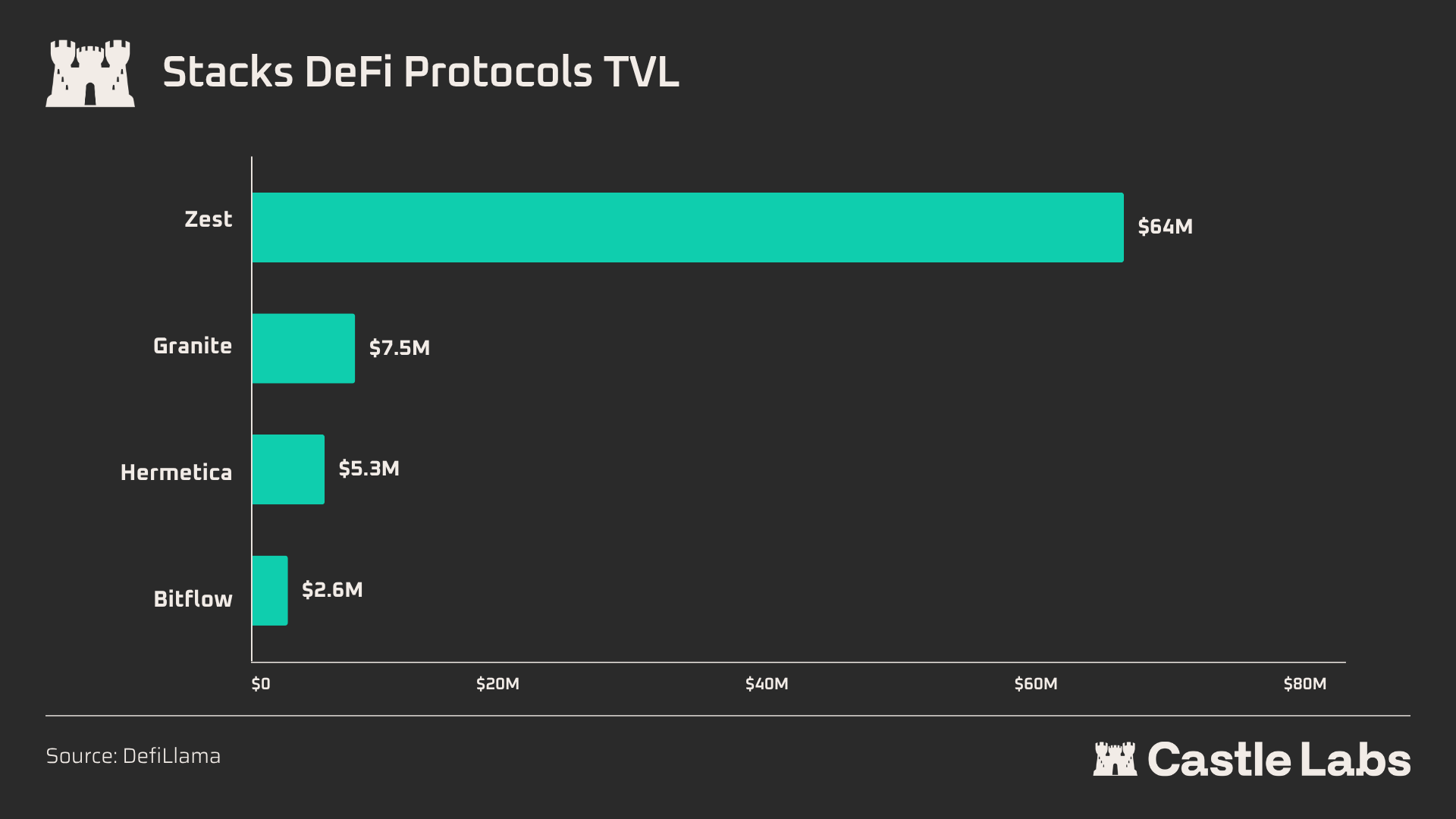
Zest is the largest DeFi application on the chain and the lending market. Zest enables its users to deposit BTC-denominated collateral (sBTC, STX, stSTX) and borrow stablecoins with risk-isolated markets. Zest also announced its ‘Stacks Vaults’, which will go live alongside Stacks’ BTC staking. The first vault will be a fully automated stBTC looping strategy, targeting a 6-8% APY, the first example of liquid staked BTC being made productive through Stacks’ finance stack. Followed by them is another lending protocol, Granite. Granite lets its users borrow stablecoins against BTC/sBTC collateral with isolated exposure.
Hermetica issues USDh, a Bitcoin-backed, basis-trade synthetic dollar.
Bitflow is the main DEX on Stacks and recently launched their ‘HODLMM’ which offers concentrated liquidity pools for tokens like STX, sBTC, USDCx, USDh and more. This provides traders and LPs alike the tools they are usually familiar with on Ethereum or Solana.
Top-of-funnel model
Bitcoin Staking is top-of-funnel for Stacks; it attracts BTC capital seeking yield without giving up custody. Once bonded, that capital becomes legible to the surrounding app layer: Zest for borrowing, Bitflow for swaps, Hermetica for structured basis-trade yield, and StackingDAO for liquidity once stBTC goes live. Use of those apps drives chain activity, generating transaction fees that eventually become a meaningful, self-sustaining source of consensus yield alongside the minder-bid PoX pool.
Closing Thoughts
The Bitcoin idle capital problem is real and structural.
Bitcoin lacks a native yield mechanism, and every route built to compensate for that, whether it is wrapped BTC, BTC L2s, or CeFi lending, has come with certain trust assumptions.
There is adoption of these routes, and BTC currently represents ~7% of the DeFi TVL ($5.2 billion). But given its size, it’s underrepresented. Most of the BTC today lacks productivity and remains an asset to hold for price appreciation.
Stacks has been steadily building for many years now to reduce these trust assumptions, and with its upcoming PoX-5 upgrade, Bitcoin holders can natively earn yield from Stacks blockchain miners who bid BTC to mine Stacks blocks.
Whether their model becomes the most adopted or utilised depends on how closely their ecosystem grows alongside native BTC staking, because for the yield to sustain (3% APY), miners have to constantly bid. For now, this has been proven, with 5+ years of activity since the Stacks mainnet launch.
Nonetheless, BTC remains a reserve asset and is being widely adopted by institutions. The increase in its productivity would only expand the asset’s ability to consistently be part of more balance sheets and be lucrative for new holders.
written by @Noveleader
Every week for the last 3 years, we have shared our research for free, directly in your email. Not a subscriber yet? Let’s fix it:
https://research.castlelabs.io/subscribe
PLUS, don’t forget to join our Telegram channel for the latest updates from Castle and all our research: Link here
Disclaimer: This article was produced in collaboration with Stacks. Castle Labs applies the same standard to sponsored content as in our independent research. We strive to be accurate, unbiased, and educational. Commissioned partnerships provide resourcing and distribution, not editorial control.