


Welcome to Edition 148 of The Castle Chronicle!
Hello all!
Quick edition this week:
🔍 Market Watch
Basis trade on HIP-3: a new primitive
A Story of Greed and Gambling

🔍 Market Watch
Gm frens! The crypto market continues getting obliterated as sellers are clearly in control right now.
Price Action
BTC continues seeking liquidity on the downside, but the expectation remains the same. Eventually we’re gonna find some equilibrium resulting in a sideways market and that’s when we’ll get our confirmation. Given the HTF trend, I still expect bullish continuation, but if price breaks down from there, I’ll flip my bias short. Either way, this is all a waiting game now
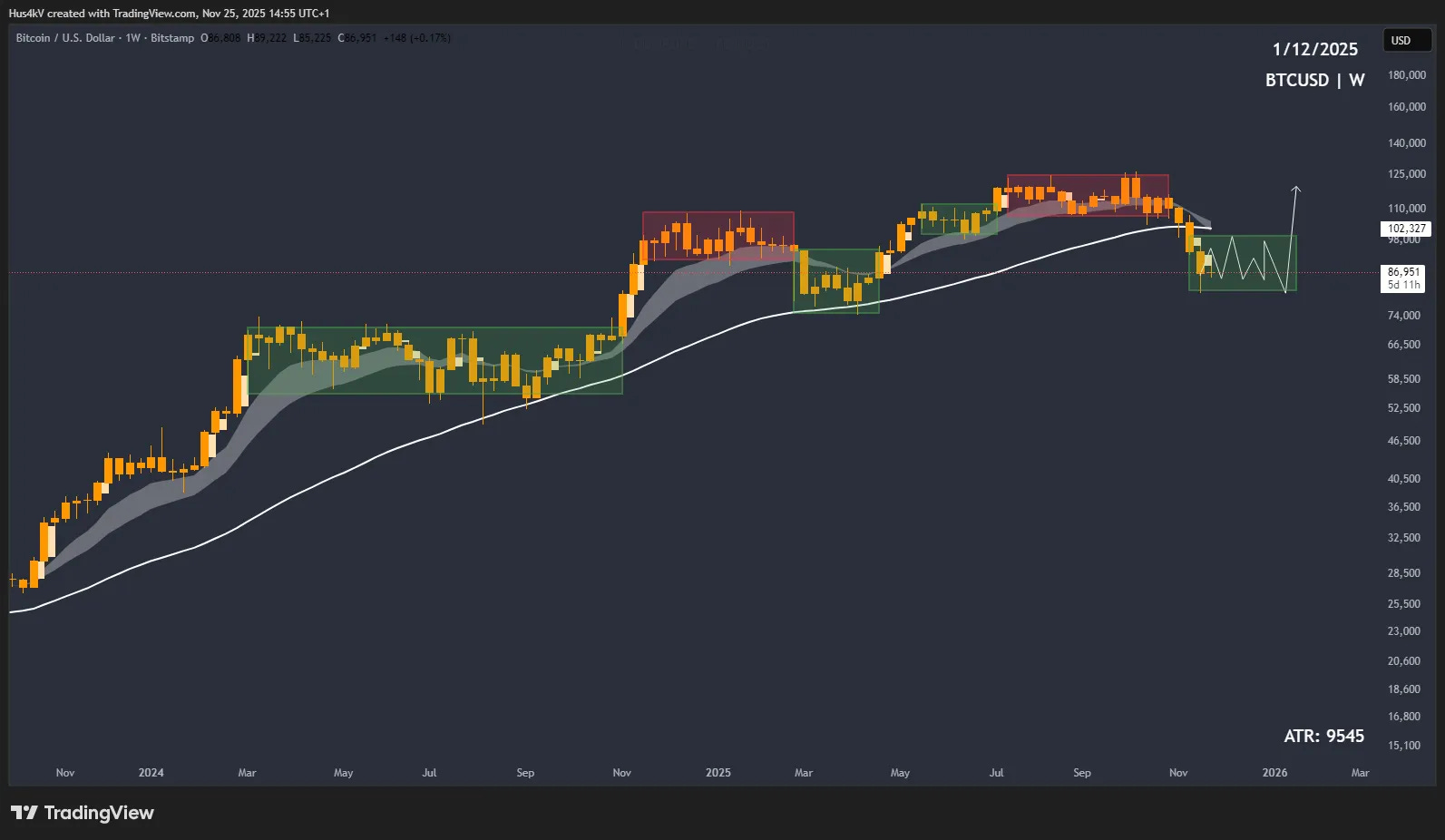
In this state of the market I’m not really looking for any opportunities whatsoever. There is a clear misalignment right now. I’m just waiting for BTC to find a bottom and then either build itself up or break down lower. Until that happens, it’s off-season!
Risk responsibly, and I’ll see y’all next time!
Courtesy of 0x_Vlad - trend-based trader and MentFX student
Not following what I’m talking about? Check out my quick cheatsheet to understand how I approach a chart.
Basis trade on HIP-3 : a new primitive
I had some great encounter during Token 2049 in SG this year and one of them was the Basis trade team.
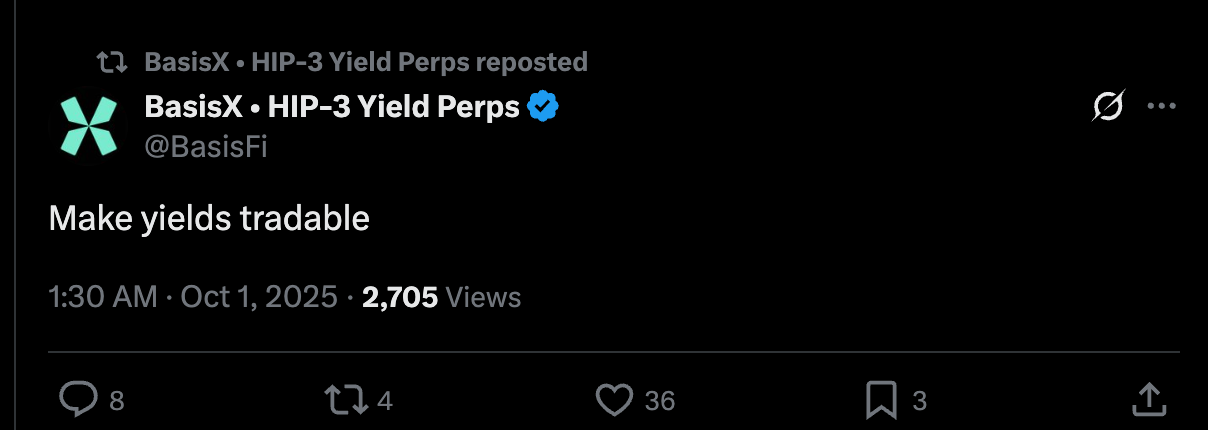
Simply said, BasisX is focusing on transforming bonds, funding rates, and onchain yield into tradable perpetual markets, shifting from price-centric trading to yield-driven markets.
Building as an HIP-3 market, they will enable new primitive on Hyperliquid that have not been seen yet.
For information, a big part of this newsletter piece was inspired by a long form on X by the BasisX team.
Thus, BasisX will bring couple of new product in the HL ecosystem. Let me explain briefly the two primitives they looking to deploy at first.
1) Bond Perps
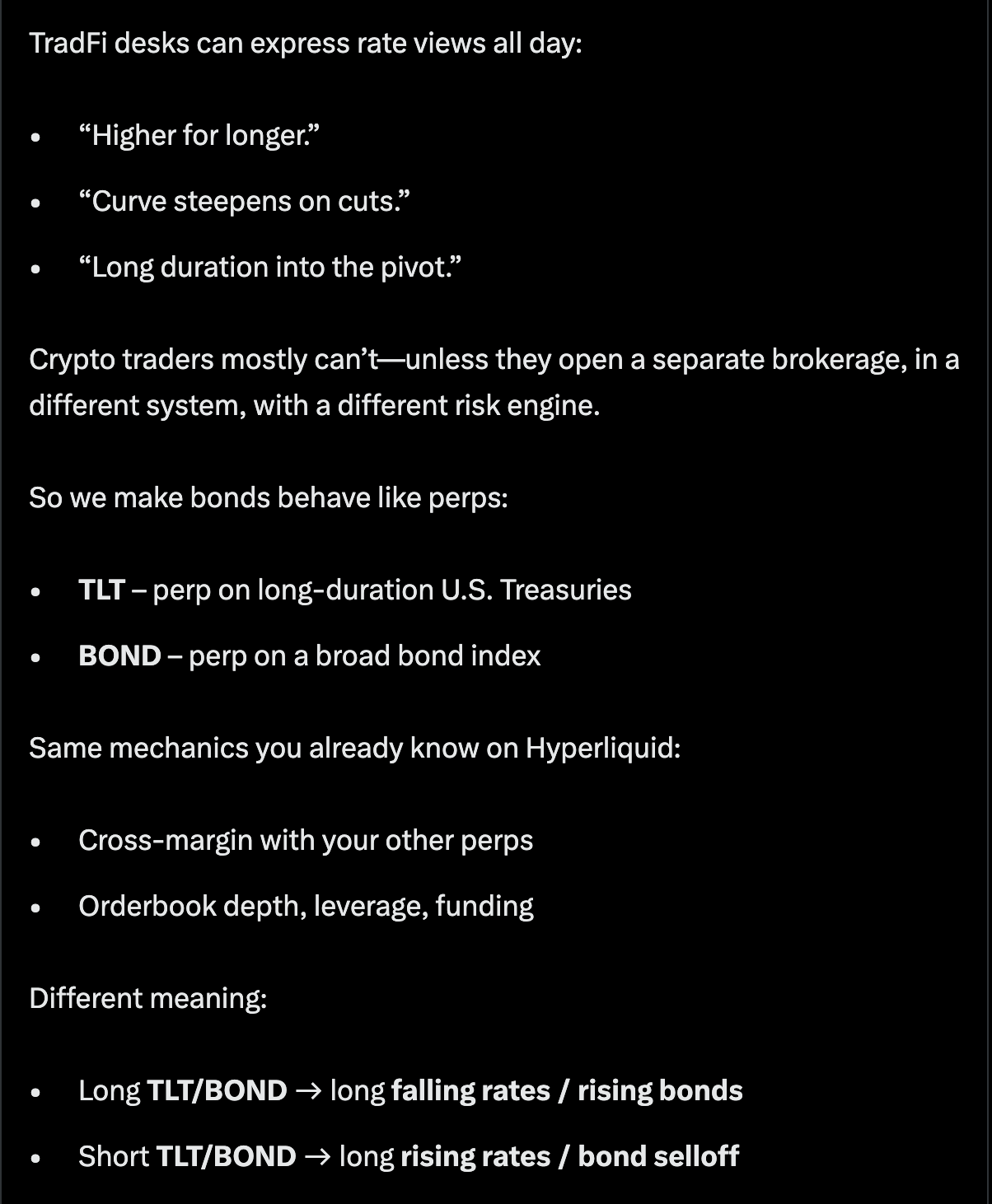
Those new bonds product will let trader on HL express much more sophisticated opinions, you could be long BTC but hedging ur Long with a Short TLT/BOND in case inflation comes back. IMO, this could create GREAT pair trade.
2) Funding rate perps
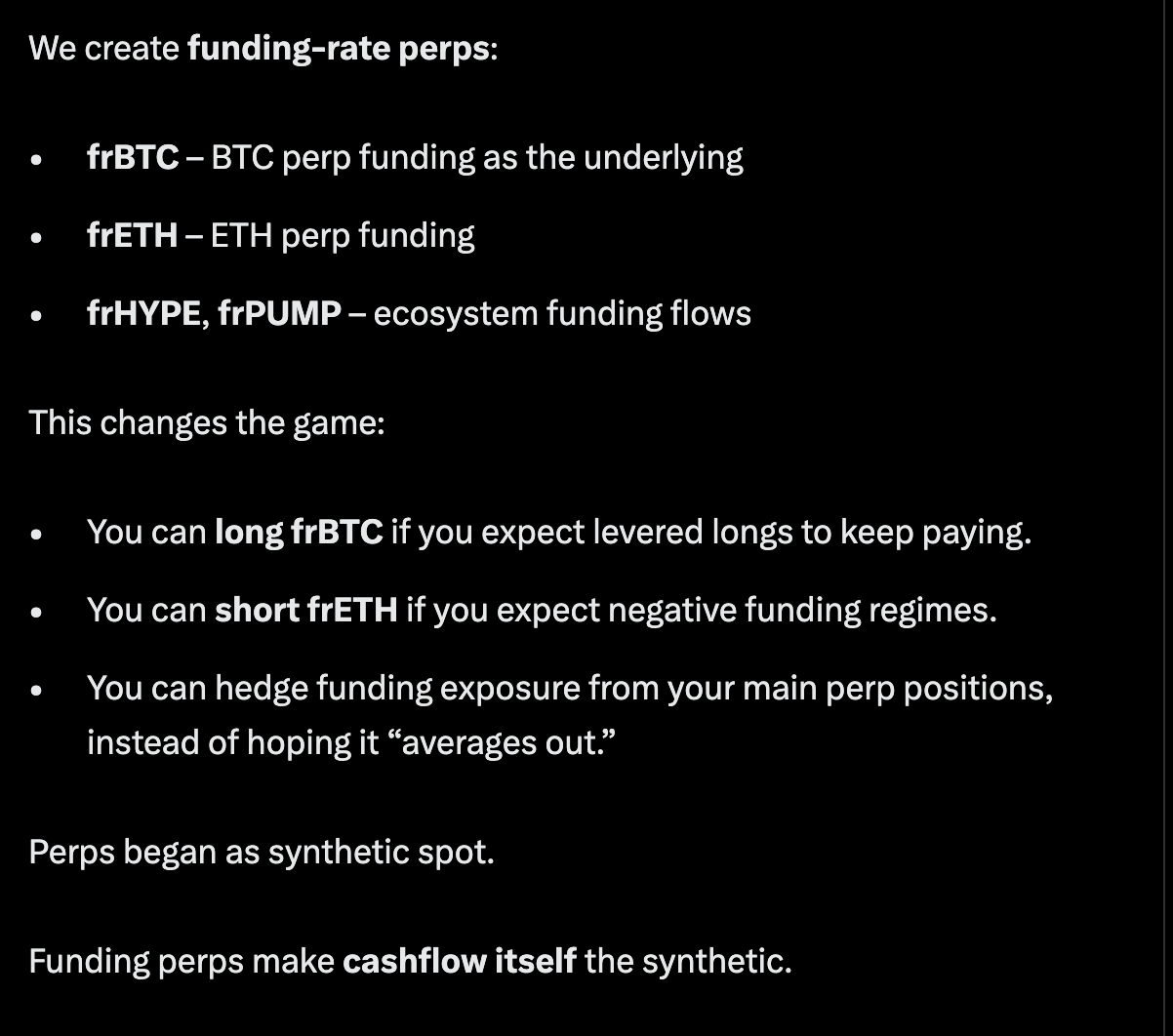
Pretty sure it has not been done elsewhere. But those funding-rate perps create some totally new trading instrument in the crypto space. Instead of degen long BTC during the downside, you can simply trade the funding rate & make money if the degen keep longing BTC in the downside :).
They plan to introduce other primitives like market on staked yield ( a bit a la pendle) or some spread product. But their main focus at launch will be on 1) & 2). I think both will be able to attract great attention & catch a serious amount of volume.
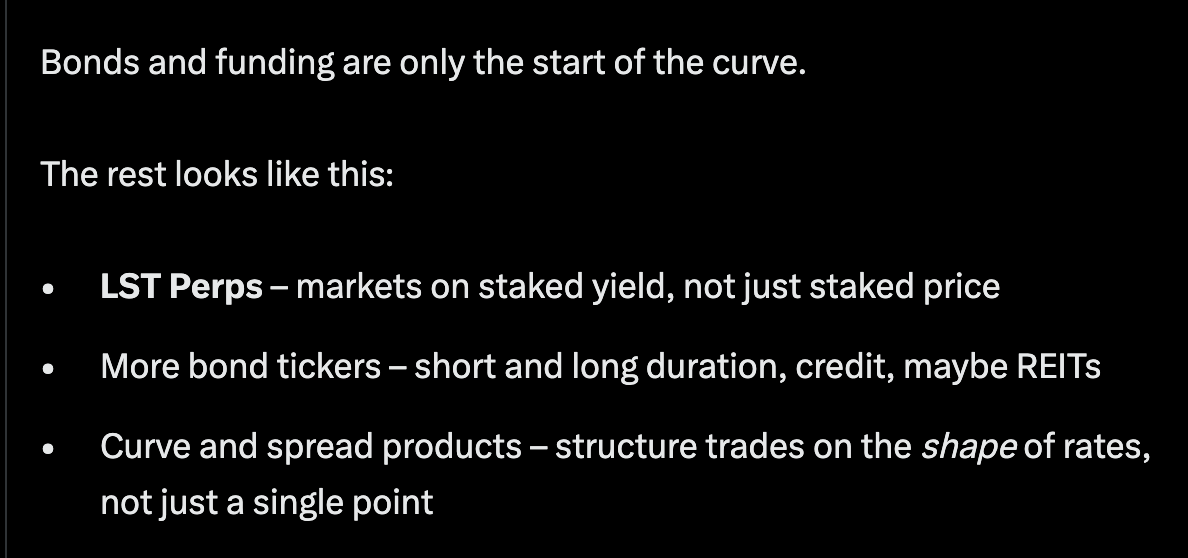
Anyway, I encourage all our reader to check the primary source I quoted above (the X long form) & to click the like button on the BasisX account.
Have a gUd W33k
From CL, with love
A Story of Greed and Gambling
When we use the word “Gambling”, we usually mean that the player, for most of the game, is unaware of its mechanics or doesn’t have any idea of how the outcome might look. Essentially, “Gambling is just lighting money on fire and hoping you get rewarded for doing so.”
Now, in crypto, we have multiple ways to gamble our port away. For a long time, crypto has been like this, where we jump onto new narratives and hope to exit before everyone else does. The most recent highs our dopamine-chasing mind has been craving are prediction markets, the points ecosystem, looping, and yield-bearing stablecoins.
We have also recently witnessed multiple incidents in which some of us were exposed to risks we were unaware of. A prime example of this is the series of stablecoins that depegged after losing their backing value. However, none of us could have ever predicted that those high, juicy APYs were sourced from highly risky venues, as if that wasn’t obvious. We are all chasing those high returns, with a hint of dopamine acting as a great topping. If you remove that topping, that’s how general investing works. We’re all working to chase higher returns on our capital. Still, when we combine that with dopamine and the high of leverage, the whole experience of investing flips, and this is not just with the crypto market; even TradFi is going through this phenomenon.
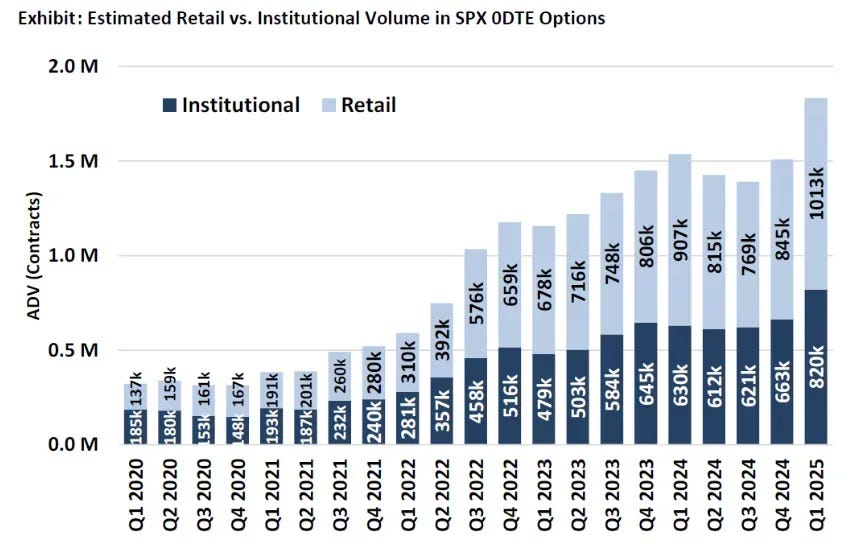
“For daily investors in TradFi, it is 0DTE (Zero Days to Expiry) options, while in crypto, it is leverage trading, prediction markets expiring within a day, exiting that memecoin faster than others, and much more.”
The Winners will Win Everywhere
This is an interesting concept to consider, as there will always be a winner in any of these markets. The game is unfortunately rigged in their favour, and you may not even realise they exist!
In memecoins, it is our dear snipers.
For money market vaults, there are the vault managers who take performance fees.
Only those who are actually going to get suffocated are the ones who are holding for 100x or don’t understand the risks thoroughly. I don’t wanna get into the argument structurally, but let’s try to divide the equation into the following episodes:
Episode 1: Greed for quick profits - If you sell before everyone else, you WIN
Episode 2: Greed for Yield - Vault Managers Win, they get performance fees
Episode 3: Greed for Points and Airdrops - Protocol Wins; they get fees; if not, they raise big due to their better positioning and user interest.
There is obviously some overlap between these users, but these are the primary episodes we go through. I personally went through the first episode while chasing that quick flip. Now, based on your strategy, you might be exposed to a combination of a few or all of them in some cases.
The question remains: How comfortable are you with losing until you exit at the top before everyone else?
There was a time late last year, and early this year, when multiple AI-related projects were coming up: some were building SDKs for AI agent deployment, others were building agents with those SDKs, and then there were the launchpads. Some of those trades were actually profitable, but some just drained me because I wasn’t able to exit before everyone else.
All of that went down with the launch of the TRUMP token, which pooled liquidity from these AI agent coins. It ended a lot of tokens right then and there. There were very few people who predicted the dump that came next. Some of these people left their projects, some rugged, while some just kept working and chasing that next AI run.
So, what was I chasing? Exiting before everyone else.
There was no time to research the coin; either you buy now and exit in the next 6 hours, or do your research, miss the pump and risk becoming a bag holder. Most people would rather take the risk of losing money than the boring option: waiting. I mean, really, who likes to wait?
In my case, I did end up making money on some plays and losing on others, with an overall positive delta, but it took way too much time. I didn’t talk to my family and friends much, constantly gazing at the screen like a “Zombie”, deteriorating my health, and not living my life. Hence, I quit it all, or in other words, the Trump coin made me leave, but it was a good time until it lasted. Will I do it again? No.
End of Episode 1: This was the “Greed for quick profits” episode, where we try to chase the next runner and, almost every time, round-trip ourselves.
Chase for Yield and Pursuit of Leverage
“If you are not paying for the product, you are the product. Similarly, if you can’t validate the source of yield, you are the yield.”
This was especially true when Stream Finance collapsed. They were basically selling an overleveraged, undercollateralised trade wrapped in a stablecoin, “xUSD”. Whenever a user deposited collateral into their protocol, they minted xUSD, swapped the user’s deposit into deUSD (which also has a high APY), and then deposited the deUSD across lending protocols like Euler and Morpho.
By borrowing capital against their deposit, they didn’t run a simple loop; they minted more xUSD, inflating its supply to over 7x synthetic exposure, with only $1.9 million in verifiable USDC collateral representing $14.5 million in xUSD.
They also had some offchain dependencies which users weren’t aware of. During the 10/10 liquidation event, their prominent offchain positions were liquidated as well, leading to the collapse and a $93 million loss, after which they closed their withdrawals. This withdrawal closure panicked xUSD holders, who sold their assets in secondary markets with thin liquidity, causing the token to lose its peg very quickly.
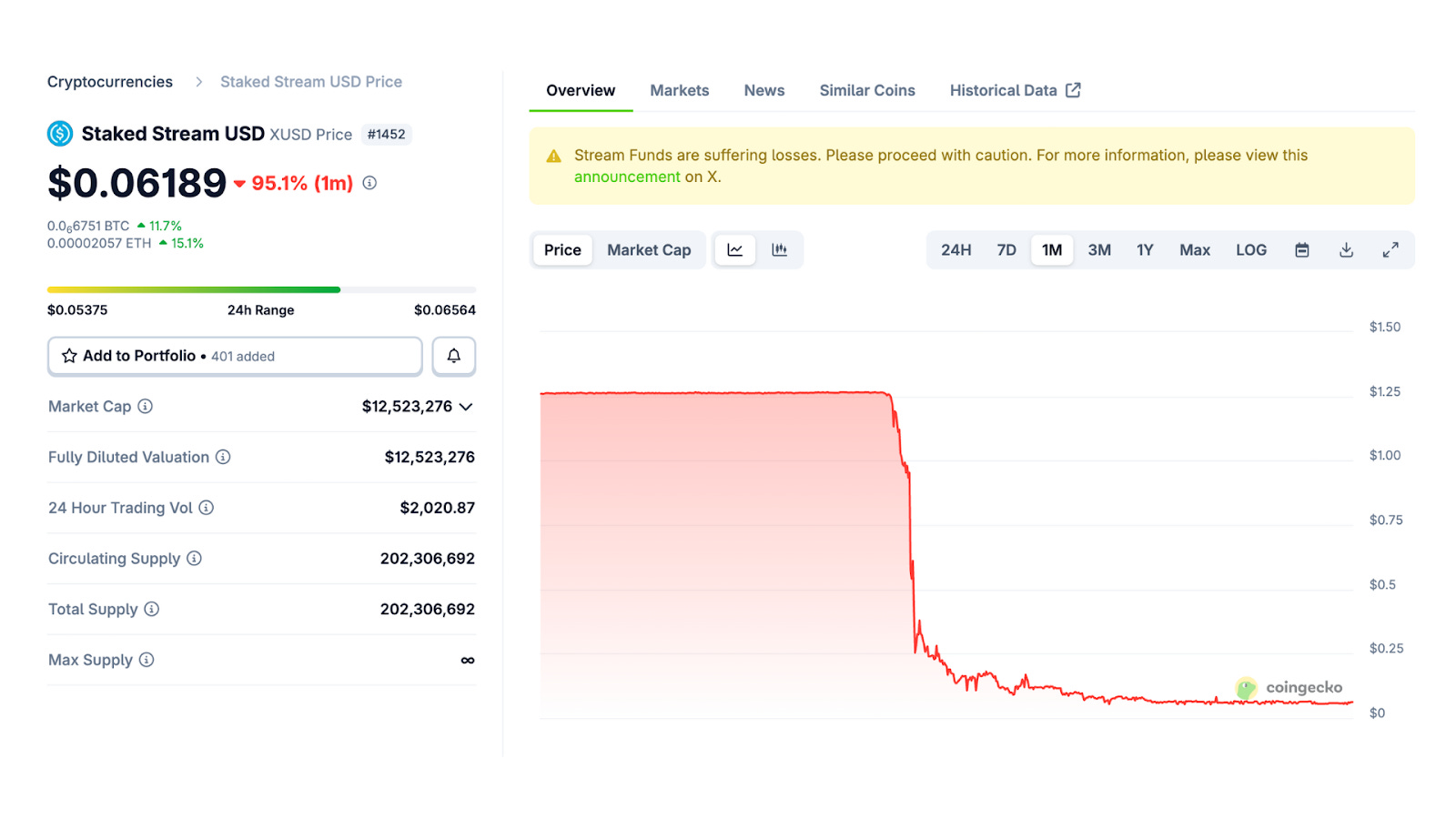
In this series of events, vault curators whose vaults were exposed to such a risk stumbled and took a reputational hit. But they still received their performance fee and didn’t leave empty-handed, unlike most vault depositors and token holders.
End of Episode 2: This was the “Greed for Yield” Episode, where users lost a ton of their capital chasing those high APY numbers.
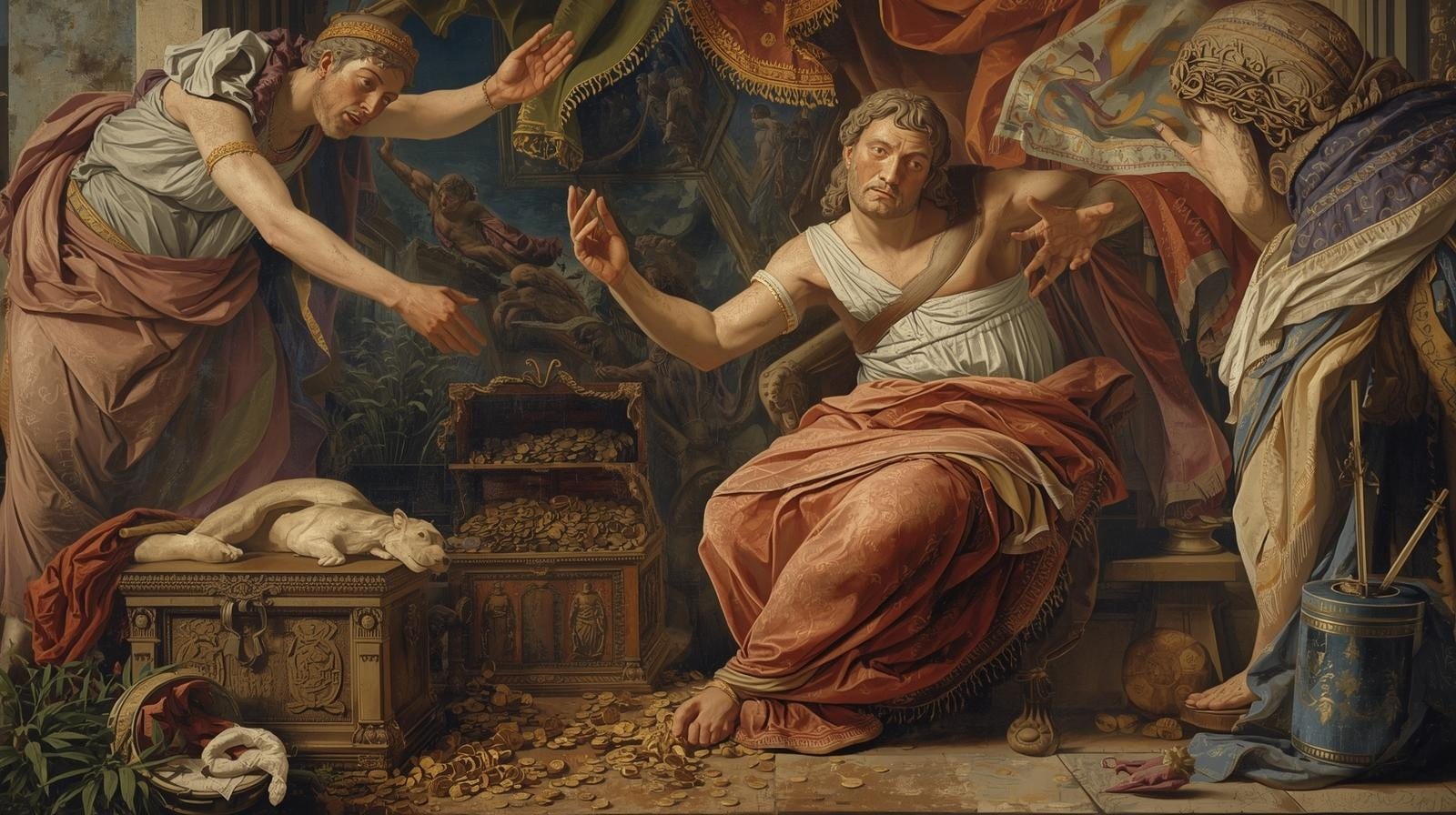
Now comes the points: points were good and mainly emerged, making their place in DeFi with Blur, an NFT marketplace. There are multiple projects today that offer points to their users, promising a future airdrop. This leads to extensive farming on the platform, and in exchange, the protocol earns fees or gains recognition, enabling it to raise a round at a better valuation in some cases. This is a good strategy, but it often leads to over-farming, and the users usually go missing after the airdrop.
That’s, unfortunately, the sad reality of DeFi: No matter how good the product is, you gotta compete on incentives.
At the end, users won’t be satisfied with the airdrop they received; in some cases, the project might also have malicious intent and doesn’t deliver the anticipated airdrop to its farmers. You might have your own experiences with this one.
End of Episode 3: This was the “Greed for Points and Airdrop” Episode, where users are continuously farming specific projects just to sell their tokens after the airdrop.

Closing Thoughts
At the end of it all, everyone is just greedy, and they should be. The decision is in your hands on how much of that greed you’re gonna allow to eat your own dinner. If you know when to stop and take a break, then you’re good.
These multiple episodes, and even others I might have missed, are the daily story of each of us. At any given time, we are going through at least some of them, and sometimes all of them. They can be good, bad, or just simply might not feel real when you make it, but when you make it, don’t just go to your next episode; take that break.
Schizo also wrote a great piece about taking some chips off the table and taking control of your own money. You might wanna read that:

A good player knows how to play well, but a great player also knows when to stop playing.
Written by Noveleader.
That’s it for today’s issue, we hope you enjoyed it.
You can check out our X for new research reports and weekly gigabrain content.
See you in the next issue,
The Castle Team

In our newsletter, we may discuss projects or tokens in which we hold positions. While we aim to provide informative content, our views are not financial advice. Please conduct your research and consult professionals before making investment decisions. Crypto markets are volatile, and past performance doesn't guarantee future results. Invest responsibly, and be aware of the risks. Your capital is at risk, and we do not accept liability for any losses.