

Perpetual futures (perps) have become one of the strongest instruments for digital asset trading. They are capital-efficient and allow users to gain price exposure without holding the underlying assets.
Initially, perps competed within the same arena, focusing on cryptocurrency assets and liquidity.
As perps expanded to more assets, especially Real World Assets (RWAs), the competitive landscape has broadened, leading to different approaches to an ever-shifting market.
The category is already expanding into equities, commodities, indices, foreign exchange, pre-IPO markets and other assets that do not naturally fit the crypto-native exchange model.
RWAs, in fact, differ significantly from crypto-native assets when it comes to listing them as perps. Listing these markets through a normal orderbook requires bootstrapping liquidity venue by venue, often through subsidies, incentives, and external market-maker relationships.
Inherently, perps that wanted to list RWAs had to find solutions that allow 24/7 trading beyond traditional market hours, ensuring enough liquidity for new and bootstrapped markets.
Furthermore, perps are not the ideal instrument for RWA trading.
The unpredictability of funding rates is a major concern for RWA perps.
Among those working to solve these problems, Variational just released swaps, their solution to support an ever-growing list of markets without rebuilding each market and liquidity from scratch, with predictable costs for traders.
Contrary to what the name suggests, this isn’t about AMM swaps. Swaps already exist in traditional finance (TradFi). For Variational users, swaps are a new way to trade RWA with predictable costs and liquidity sourced directly from TradFi.
This report starts by highlighting the growth of RWA perps and their rising market share, then dives into swaps, compares them with perps, and explains what makes them unique.
We then translate this implementation into practical user advantages by comparing order execution across different perps venues.

RWA Perps: From Niche to 1-in-8 Dollars of Onchain Perp Volume
RWA perps have gone from a small category to a structurally significant share of crypto trading in under a year. In October 2025, this category did under $1 billion in volume, while in August it did over $120 billion, increasing 120 times in a few quarters.
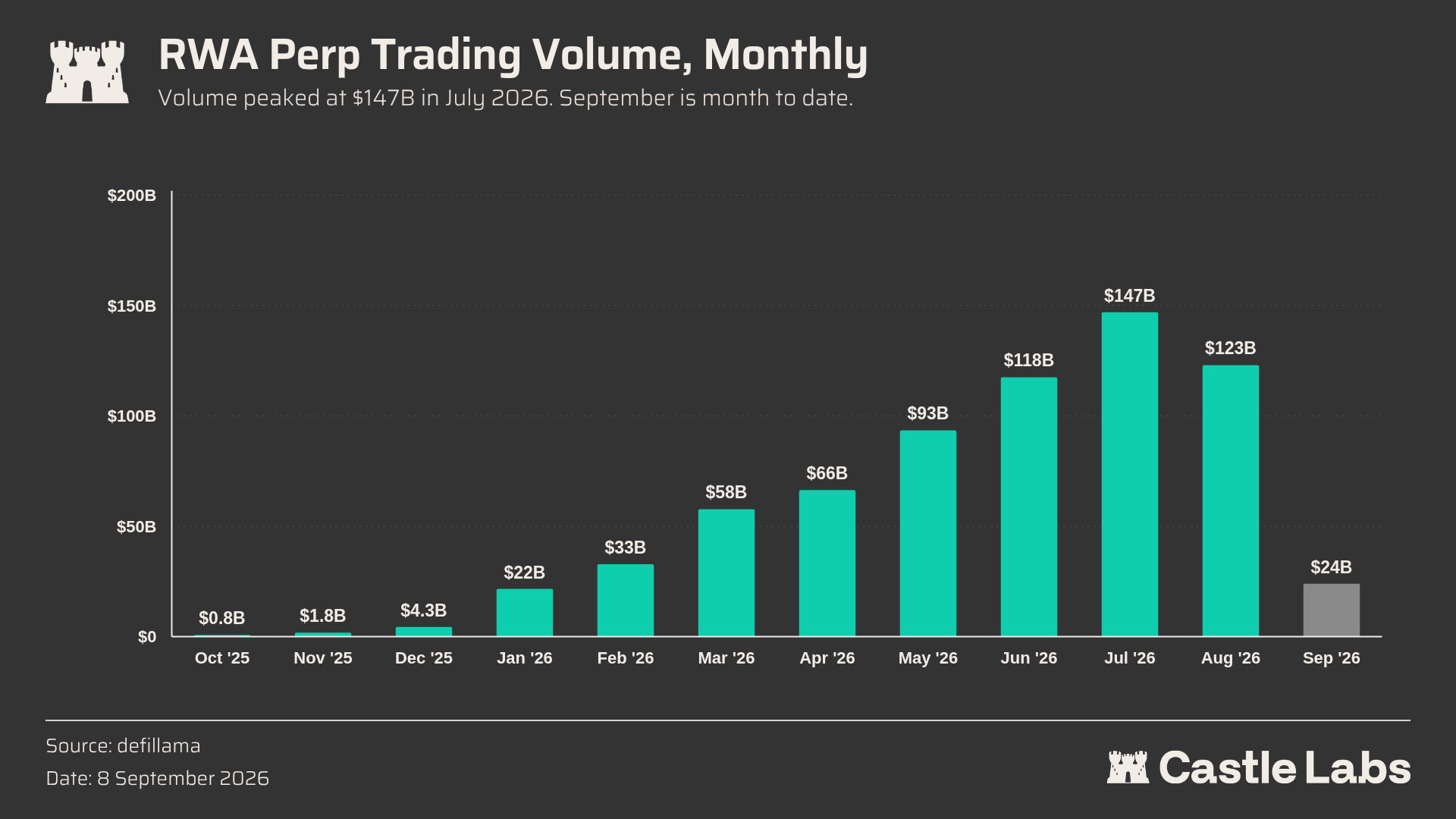
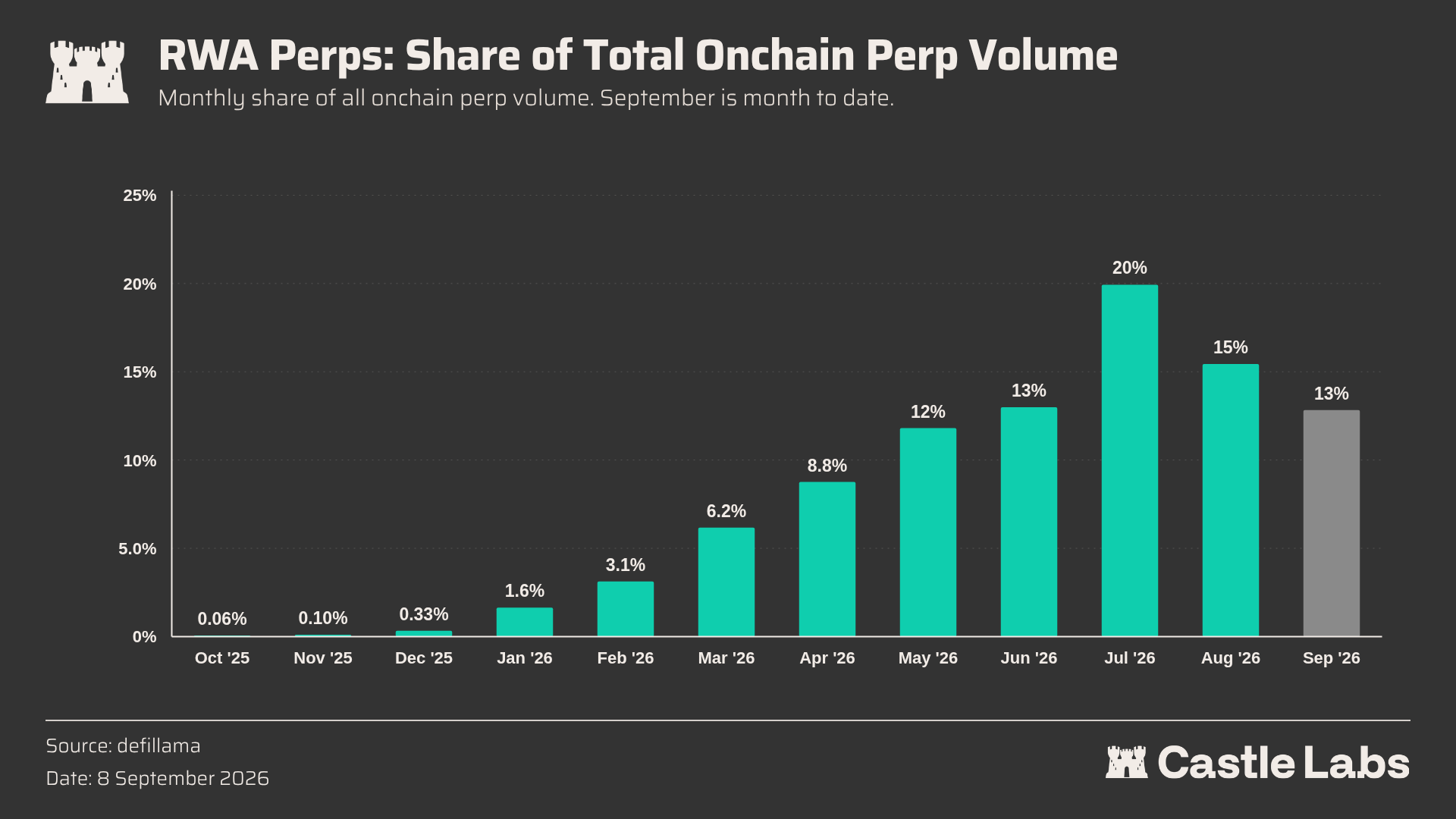
The category hit its first inflexion point in October last year when TradeXYZ launched as a HIP-3 deployer on Hyperliquid. Since then, it has grown continuously and peaked at 20% of onchain perp volume in July and averages around 12-13% most months, meaning close to one in every eight dollars traded in onchain perps is coming from RWAs. Moreover, over the last few months, it has also established a base volume level of $100 billion since June.
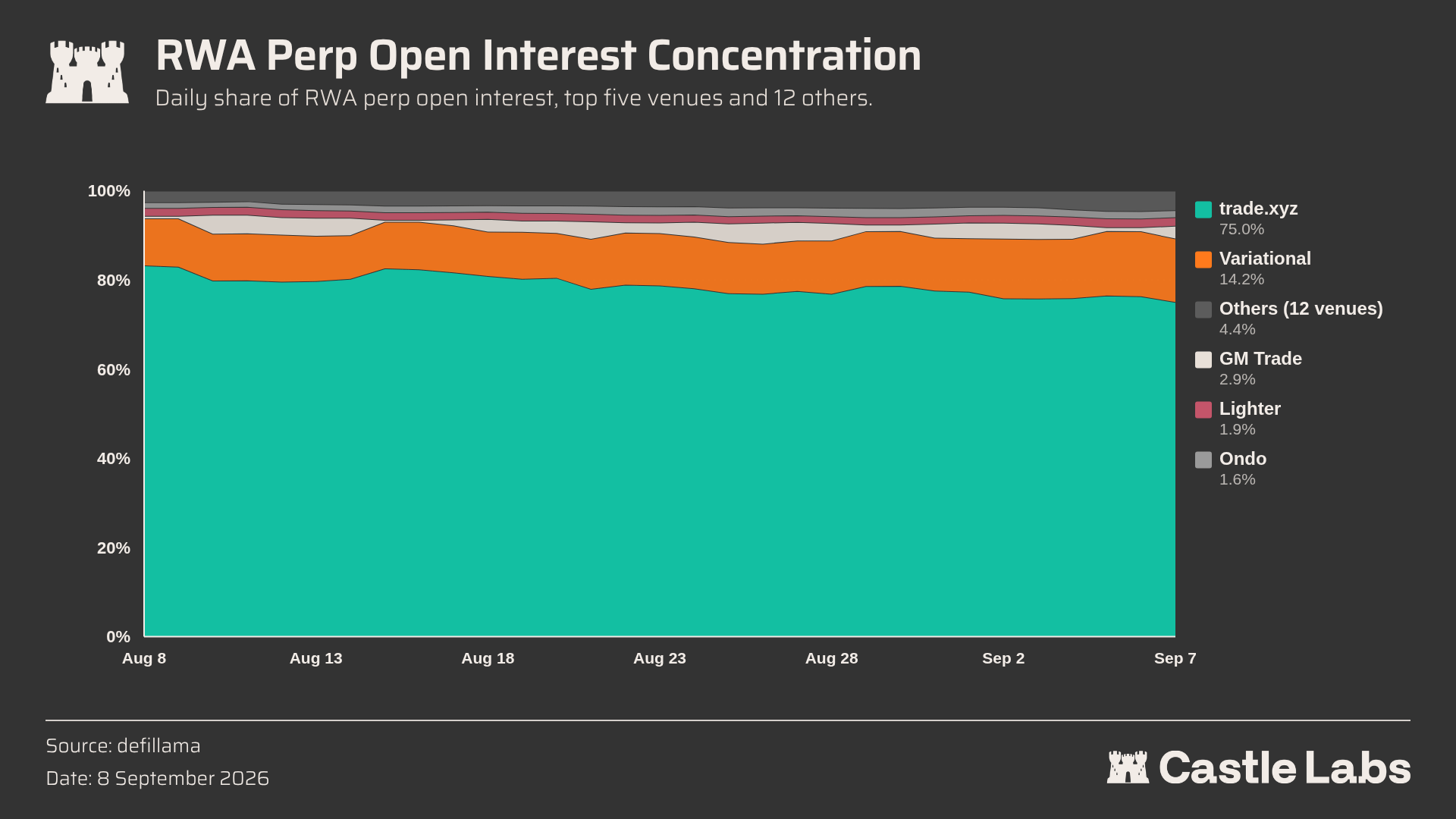
Though the category has grown massively, it’s also highly concentrated. As of today, total RWA perp OI sits at $4.9 billion, and the top 2 protocols in the category, TradeXYZ and Variational, represent almost 90% of the OI, followed by GMTrade, Lighter, Ondo, and others.
We expect the category to grow even more from here, and Variational swaps will be a major contributor. In the section that follows, we differentiate swaps and perps and explain why the former is a superior way to trade RWAs onchain.
Swaps or Perps?
This section defines swaps as a new primitive, highlighting the difference between them and perps as trading instruments.
At their core, both of them are “linear derivatives”, meaning their payoff is a linear function: the price movement of an asset translates into a dollar value generated by the contract.
However, perps and swaps differ at their core in what they are tracking.
Perps were created to closely track an asset’s underlying index price. As a consequence, they use funding rates to encourage rebalancing and closely follow the index price of spot assets.
Instead, swaps are used to “track the total return of an asset over time”.
This is reflected in differences in terms of funding rates. Compared to traditional perps, swaps only pay fees once a day at market close (5 pm EST) on positions they hold.
Instead of depending on supply and demand, as with perps funding rates, swaps fees are better conceptualised as a carry cost, calculated based on “the real cost of financing the underlying asset in traditional markets”.
For equities, this means the overnight interest rate of the index currency (e.g. SOFR for USD). For forex, the interest rate difference between currencies overnight, adjusted by a spread.
For metals, the implied cost of borrowing or lending against USD overnight.
These rates are strictly related to TradFi, as they are actual financing terms based on market rates that Variational receives from its TradFi liquidity partners.
Last but not least, swaps also allow users to receive dividends: long positions receive the dividend amount and short positions pay it.
Initially, swap markets will use isolated margin and will have initial opening and closing hours. Variational expects these markets to run 24/7 over time, with cross-margin across the platform.
The first swap markets to go live are US100, US500, XAU, XAG and USOIL. Since launching at the beginning of the month, these markets have already accounted for $3.8 billion in volume, with peak OI of $245 million.
Swaps are a necessary evolution from perps for Variational, considering that just two months after going live, TradFi perps already represented over 50% of volume and OI.
Instead of relying on supply and demand and frequent funding costs, Variational focuses on tapping directly into TradFi liquidity, turning unstable funding rates into predictable carry costs that can be annualised and easily forecast, making it easier for institutional investors to approach RWAs.
To sum it up, both swaps and perps give exposure to underlying assets.
Swaps source liquidity from a network of TradFi partners, and funding is replaced by a daily fee, which can be compared to a stable carry rate, “primarily benchmarked to USD borrow costs”.
Usually, this results in longs paying between 4-6% annually and shorts receiving 2-3% annually on live swap markets.
An important caveat before moving forward: swaps do not operate in isolation. To fully understand them, the next section dives into the Omni Liquidity Provider and how it works in symbiosis with swaps.
Omni and Swaps
Most perp exchanges need to bootstrap liquidity inside their own venue. That works for majors, but breaks down as soon as the venue tries to list more assets. Every new market needs makers, inventory, incentives, risk limits and enough two-sided demand for a deep orderbook.
A major differentiating factor for swaps is how they source liquidity, which is also why they can offer such improved execution.
Variational avoids the issue of ensuring enough liquidity by using a request-for-quote (RFQ) execution and a vertically integrated liquidity provider: Omni.
The Omni Liquidity Provider (OLP) is Variational’s own integrated market maker.
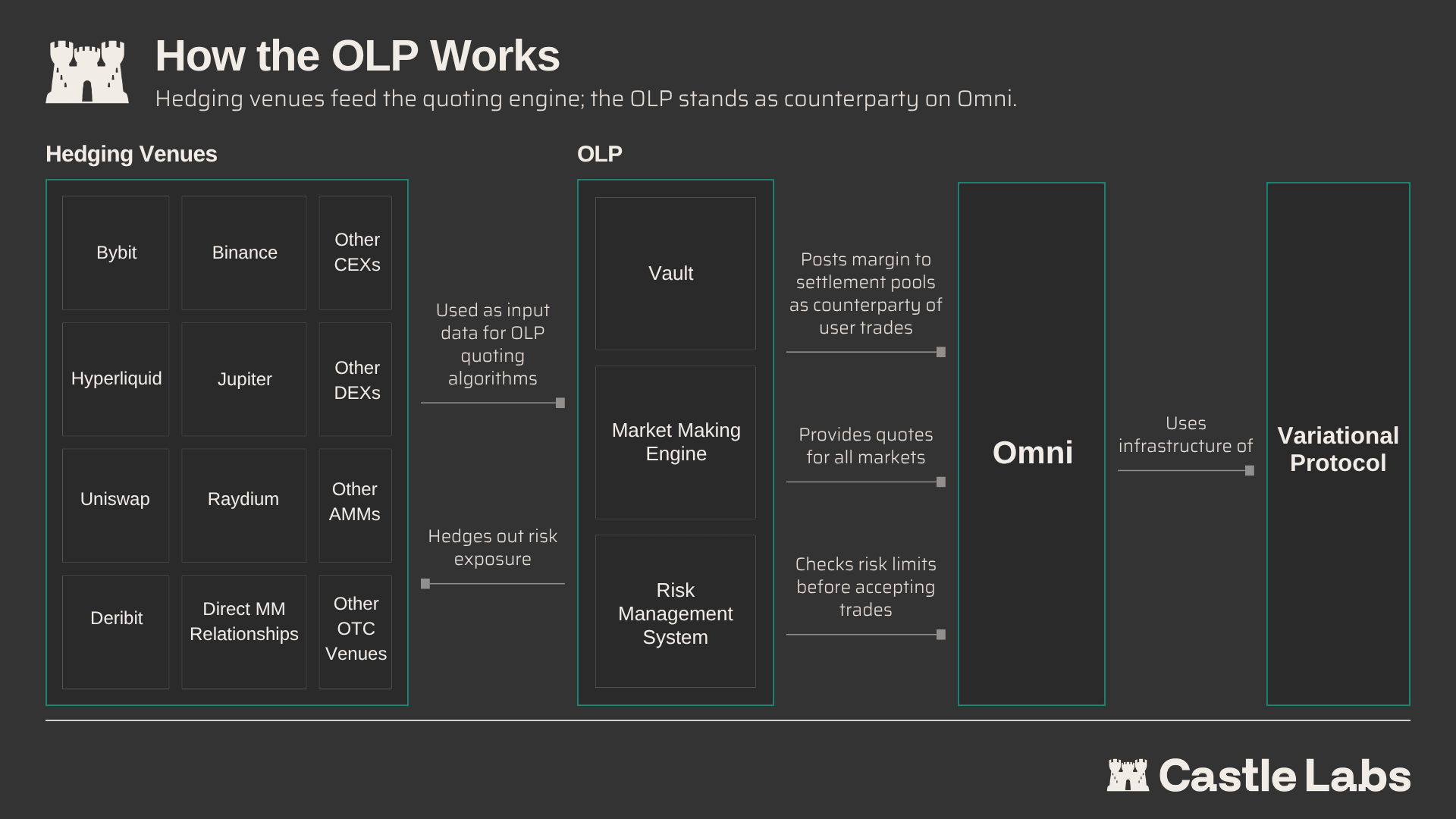
OLP faces the liquidity providers in Variational’s RFQ directly, bringing that liquidity onchain. As OLP is the counterparty to all trades on Omni, initial swap markets launch with a capped OI of $10 million (quickly raised) to give the team time to test OLP’s hedging strategies. The OLP manages and hedges risk using external liquidity from centralised exchanges, decentralised exchanges, and TradFi sources.
Variational aggregates swap liquidity from TradFi venues, so these instruments will initially follow traditional market hours, with 24/7 trading expected once more liquidity venues are aggregated and as traditional markets continue to move towards it.
The benefits of this approach are evident in how Variational can launch new markets without building an orderbook from zero. Instead, they only need a price feed, reliable partners in their RFQ system and a hedging strategy for the OLP.
Instead of suffering from liquidity risk, this design has trade-offs in pricing transparency and risk management.
In the next section, we see whether that’s the case by comparing order execution costs across Variational swaps and other perps trading venues.
Swaps greatly reduce execution costs on Variational, with costs up to 8x-12x lower than the most liquid onchain venues for TradFi perps.
If you have been following our research, you should know by now that this is the most important aspect that anyone trading RWAs is wary of. While RWAs have many advantages, including transparency, global accessibility and execution, these onchain assets are ultimately evaluated on whether their execution is comparable to, or better than, their TradFi representation.
A Comparative Analysis of Execution Costs of Swaps and Perps
Perps are better suited for 24/7 crypto-style markets where funding is set by exchange supply and demand. Swaps, by contrast, suit traditional assets where financing costs, dividends, and external liquidity matter more.
The strongest claim around Variational swaps is not just that it offers more markets, but that it can offer better execution.
To measure this carefully, we compare Variational’s swaps execution costs with major onchain venues that list TradFi perps. Our platform sample includes the main onchain perp trading venues such as TradeXYZ, Lighter, and Ostium.
Methodology
As part of our market sample, the analysis compares the US100, US500, XAU, and XAG markets, with the counterparts on other exchanges. As venues differ in how they execute orders, execution costs are measured differently.
For orderbook-based venues like TradeXYZ and Lighter, we fetch the book live, sort it, and walk through it, reflecting the market orders sitting on the book. For quote-based venues like Variational and Ostium, we take the published quotes at different sizes for the analysis.
We measure the execution cost by averaging the cost of positions in both directions, long and short. This gives us a better picture of the quotes and the book’s actual state.
The Analysis
Some venues, such as Lighter and Variational, don’t charge any trade fees, so their execution cost is calculated entirely from the spread. Other platforms charge fees, which increase execution costs.
The first market we analyse is US100.
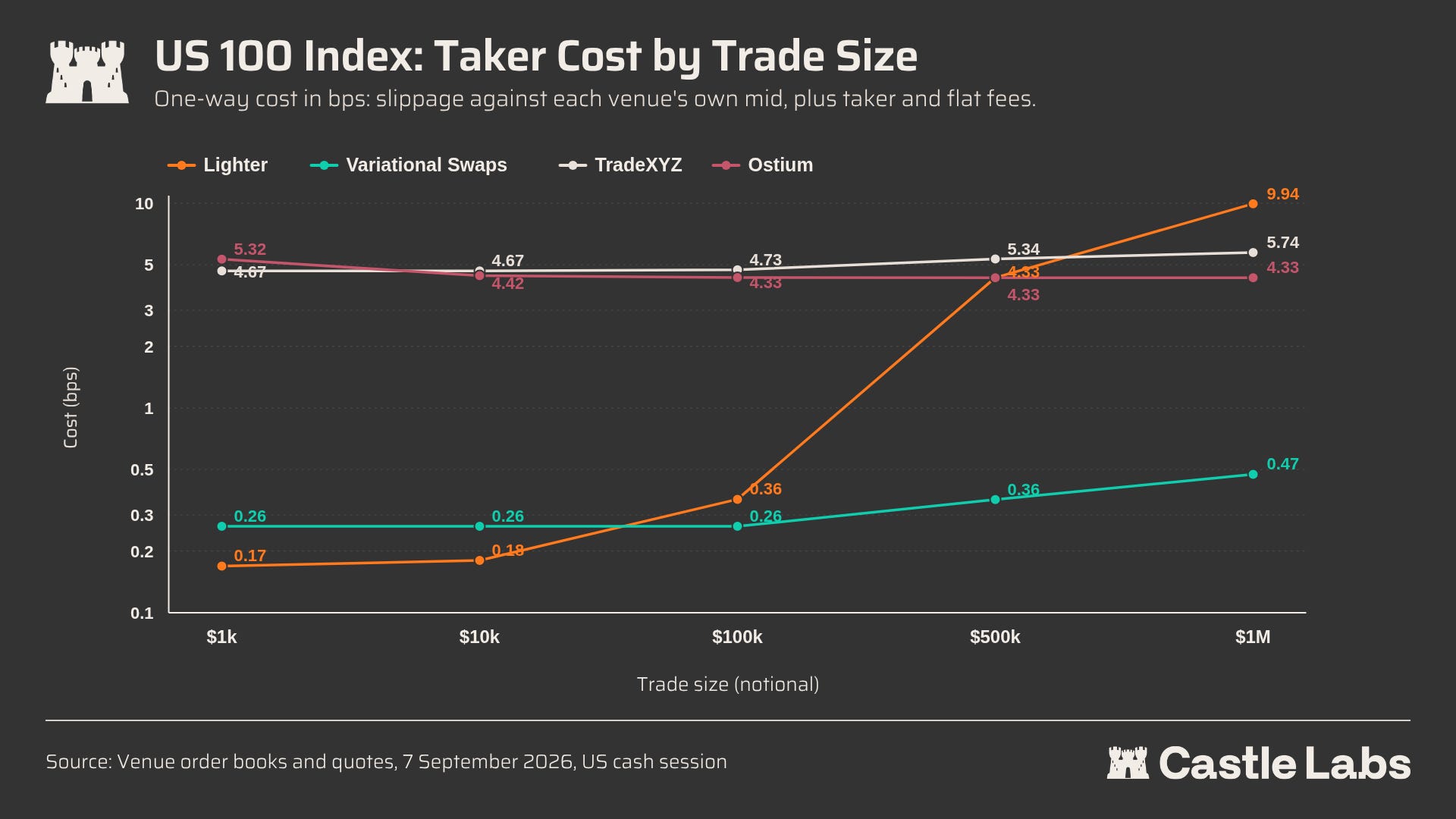
Lighter is the cheapest venue for smaller sizes at $1k and $10k, charging 0.18 bps, but its execution cost scales quickly, rising from 0.36 bps for 100k to over 9.94 bps for a $1 million trade. Ostium and TradeXYZ are the most expensive venues for small sizes, with fees of 5.32 bps and 4.67 bps, respectively, due to their fee structure.
In contrast, Variational Swap costs scale slowly, from 0.26 bps for a $1k trade to 0.47 bps for a $1 million trade, making it 12 times cheaper than TradeXYZ (5.74 bps) and almost 21 times cheaper than Lighter (9.94 bps).
A similar trend is observed in other markets, such as US500.
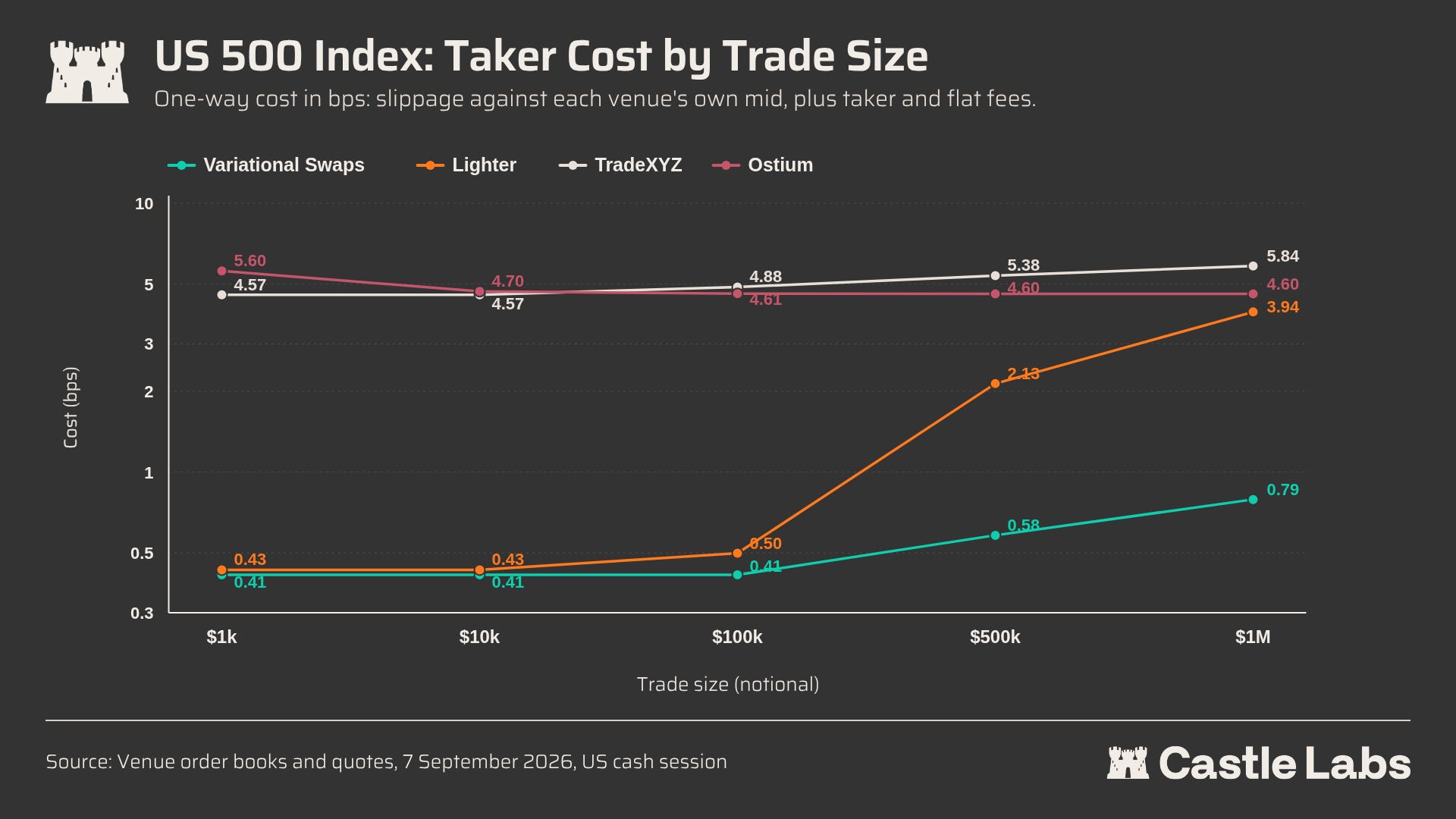
In this specific case, Variational is the cheapest venue at every size, including $1k and $10k (0.415 vs Lighter’s 0.433 bps).
The margin between the two platforms is smaller at the bottom and grows to 5x at $1 million. This represents a significant difference, with $79 vs $395 in execution cost. Tradexyz and Ostium charge 5.84 bps and 4.60 bps, respectively.
Next, we analyse Silver (XAG) across platforms.
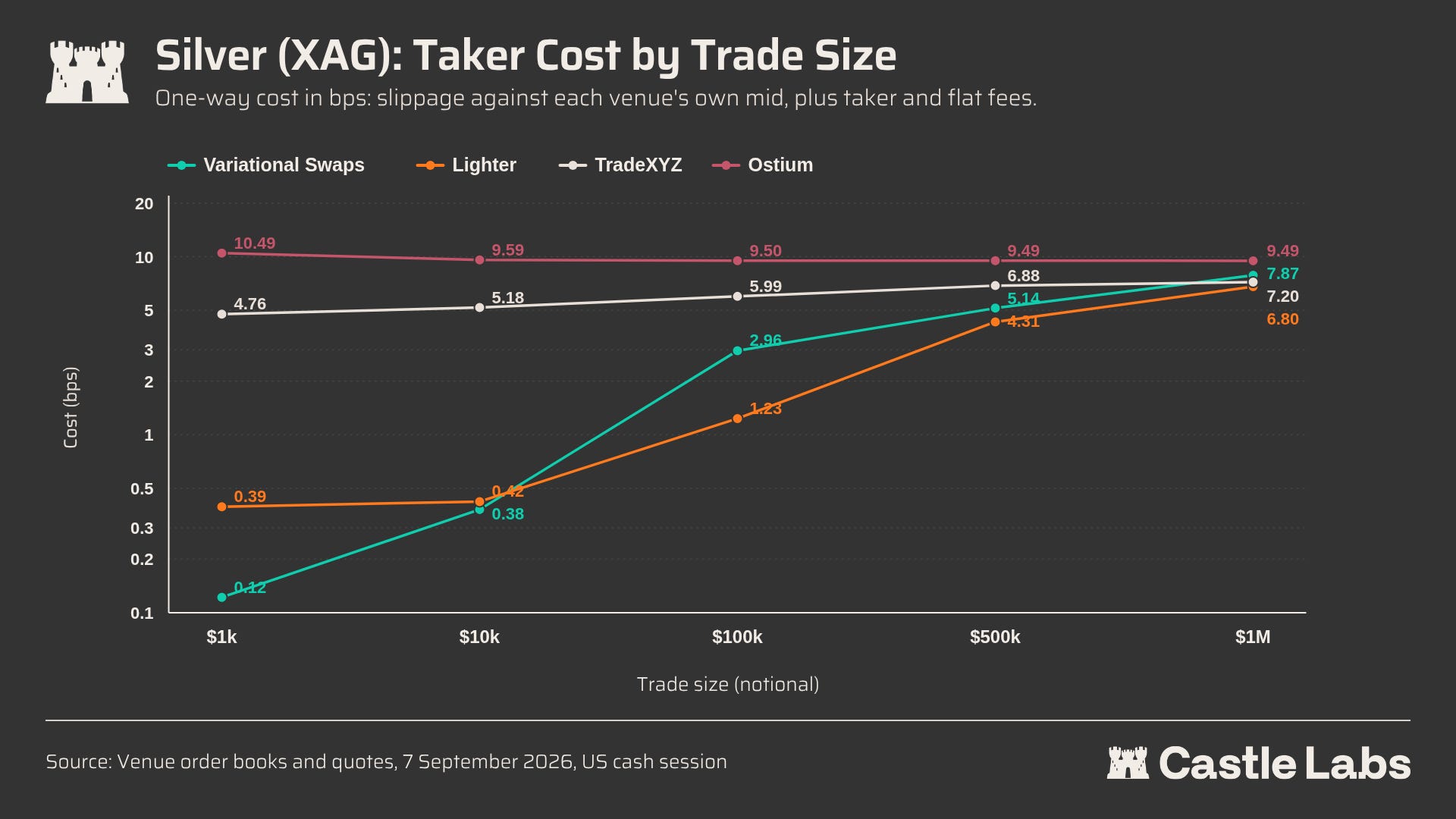
Variational is the cheapest venue at $1k (0.12 bps) and $10k (0.38 bps), but its execution cost scales at $100k, growing past Lighter and then costing more at larger sizes. A $500k order on Variational would cost 5.14 bps, compared to Lighter’s 4.31 bps, a ~20% difference. XAG is currently the thinnest swap market live and lacks the flat-quote profile held in other markets. We expect the results to generalise to other markets as XAG grows.
Next up is the Gold (XAU) market, which behaves similarly to the US100 and US500 indices.
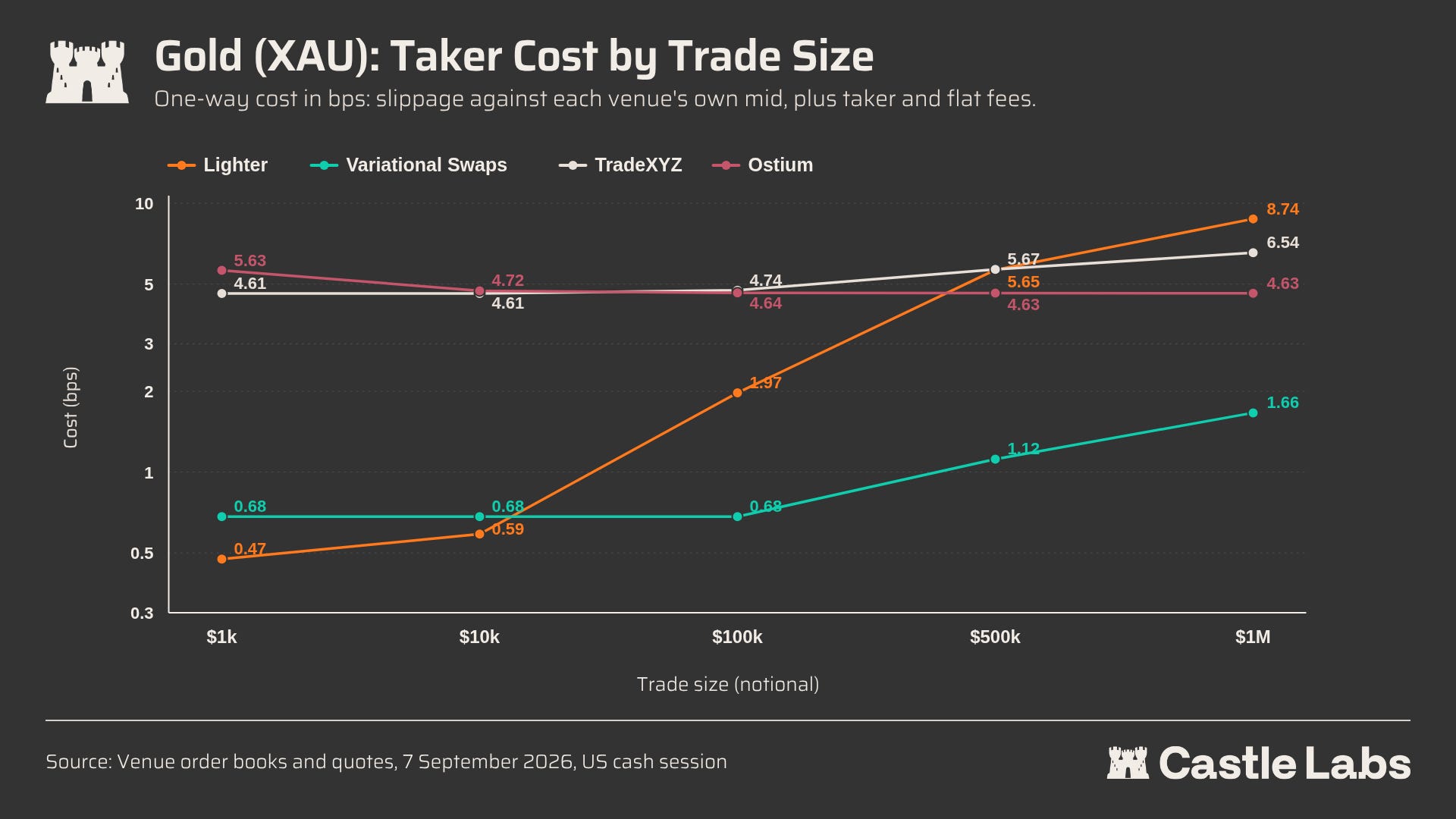
For smaller order sizes of $1k and $10k, Lighter is the cheapest alternative, with opening costs of 5 and 60 cents, respectively. Instead, Variational takes the lead at larger sizes of over $100k, where it costs only 0.68 bps, costing 65% lower than Lighter. Variational also maintains its lead for orders up to $1 million, with 1.66 bps in fees, well below its competitors: Ostium is the closest at 4.63 bps, while Tradexyz charges 6.54 bps and Lighter skyrockets to 8.74 bps.
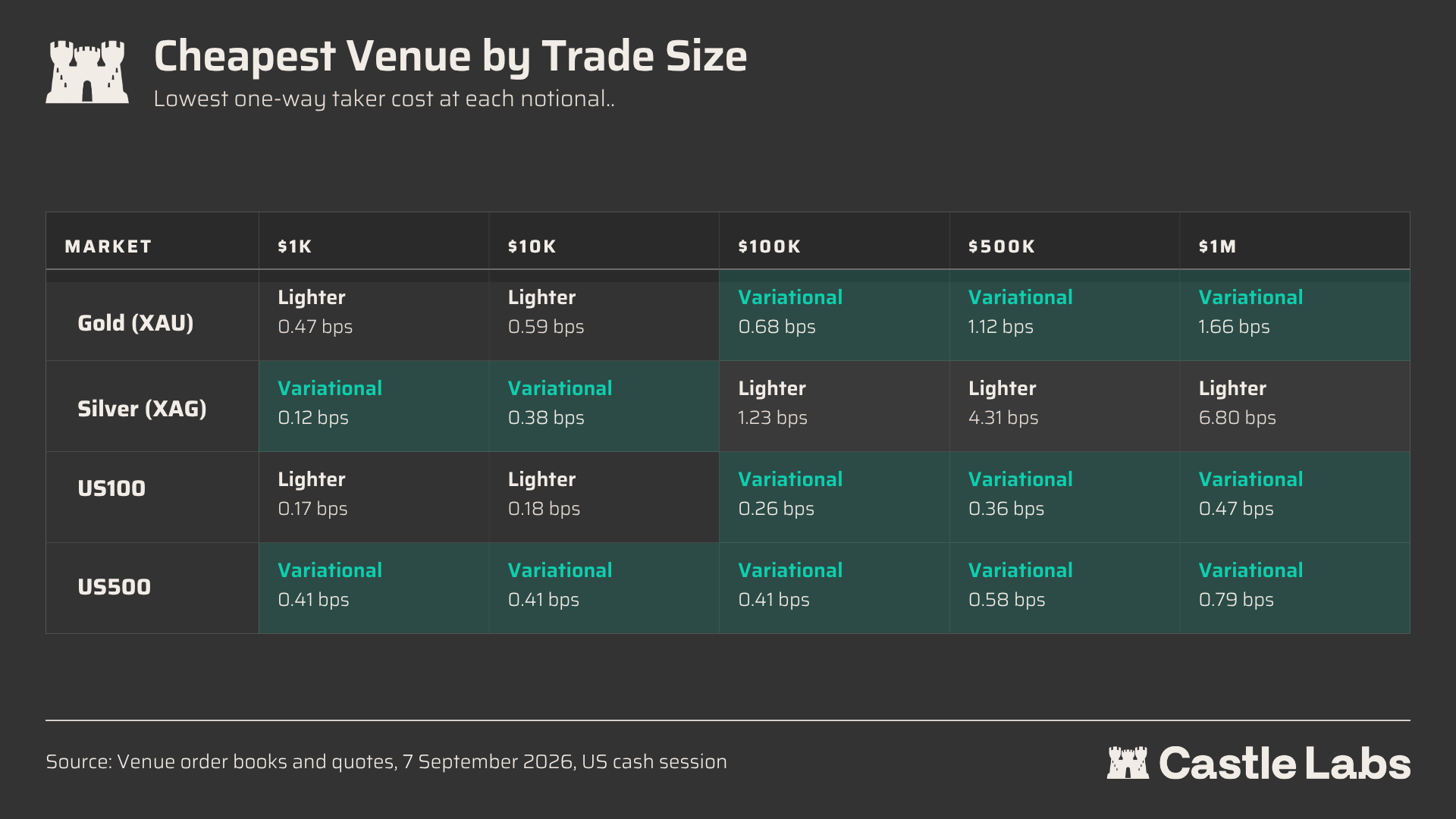
In most markets, Variational was the cheapest venue for larger sizes, while Lighter led for smaller sizes like $1k and $10k for assets like Gold and US100.
Conclusion
The onchain trading landscape continues to evolve.
RWAs and TradFi assets now have an increasing share of perp volume
While there is strong appetite from onchain natives, the novelty of these assets and the accessibility benefits of being onchain mean the market is far from efficient enough to attract institutional traders with size.
Perp protocols have to continuously strike a careful balance between listing new, attractive assets and ensuring enough liquidity to execute efficiently. Furthermore, perps aren’t attractive to RWA traders because funding rates are unpredictable and can affect a trade’s bottom line.
Variational swaps are an interesting way to address both problems and benefit retail traders and institutions alike.
The former can benefit from predictable funding and a clear understanding of the real cost of holding exposure through a swap position. The latter can rely on low execution costs, predictable funding rates, and a close link to the underlying market.
This is proven by how fast swaps are growing: they already drive over 50% of Variational daily volume and over $220 million in OI.
This is mostly driven by the US100 market, which, as of the 7th of September, comprised over 50% of all swap volume and 30% of OI.
For the first markets listed, funding rates show longs paying between 4.6% and 5.7%, while shorts are getting around 2.4% annually

Until now, trading most RWA markets at scale and getting good execution was hard. Swaps bypass the need to bootstrap liquidity and offer TradFi depth for any market, redefining the perp trading venue as an onchain derivatives protocol that can aggregate liquidity wherever it already exists and settle that exposure transparently.
This model has clear advantages. It can support more markets, avoid the slow liquidity-bootstrapping problem, and offer users exposure to assets that are difficult to list through onchain orderbooks, with predictable costs.
By doing so, swaps also create a cleaner structure for RWAs, where funding costs and trading hours reflect the underlying market rather than a perp template driven by demand and supply.
The trade-off is that the model places more importance on OLP. Users don’t rely on a broad public orderbook but on Variational’s pricing, hedging, risk management and ability to maintain competitive quotes across hundreds of markets through its RFQ. All of this makes execution quality the core thing to prove.
Our analysis confirms that for most sizes, Variational is the cheapest venue for the current listed assets, costing as low as $47 for a $1 million trade in the case of US100. Though, in some cases, like Silver, it also costs more in execution due to a lack of volume, resulting in $787 to execute a $1 million trade, 20% higher than Lighter.
As the platform doesn’t charge any fees, it further reduces execution costs, making it one of the most cost-effective venues across the board to trade TradFi markets onchain.
written by @francescoweb3 and @Noveleader
Every week for the last 3 years, we have shared our research for free, directly in your email. Not a subscriber yet? Let’s fix it:
https://research.castlelabs.io/subscribe
PLUS, don’t forget to join our Telegram channel for the latest updates from Castle and all our research: Link here
Disclaimer: This article was produced in collaboration with Variational. Castle Labs applies the same standard to sponsored content as in our independent research. We strive to be accurate, unbiased, and educational. Commissioned partnerships provide resourcing and distribution, not editorial control.
Great read!!