


“Give me a knife, and I will win a fight. Give me a sword, and I will win a war.”
DeFi offers plenty of opportunities to earn yield on your deposits, whether from lending protocols, yield-bearing assets, arbitrage strategies, looping strategies, liquidity provisioning, and more.
However, these strategies are far from accessible to everyone, due to:
Strategic Complexity: The specialised knowledge required to build complex strategies is a strong barrier to entry. Only a small number of DeFi users know how to build an optimal strategy across multiple platforms to maximise APY.
Execution Barrier: Even if users know which platforms to target, these strategies require active management and impeccable execution across all their steps.
These problems haunt every yield market. In TradFi, strategies like these are strictly reserved for HNWIs. In DeFi, an unlikely ally is making them more accessible.
AI has been a great help in easing out the tasks we perform daily, whether it is writing code, emailing someone, or booking your next vacation; it understands human intent and translates it into automated execution.
AI and crypto fully converged in late 2024, when the Decentralised Finance and AI (DeFAI) was booming, and we saw multiple products focused on using AI agents to find and manage optimal yield opportunities in DeFi.
DeFAI sought to ask questions such as:
Can AI agents curate DeFi strategies and streamline yield generation?
Can they automate yield management once and for all?
Can AI agents find the best possible yield for users?
Some of these questions remain unanswered, but overall, we are making steady progress toward answers. As it’s been a while since our last deep dive into AI agents, we tune back in with an update on how these agents have progressed, using INFINIT as a case study to reflect on its offerings, how it works, and what might bring the ultimate turning point in how we use agents in DeFi today.
Prompt to Yield
The way users operate in DeFi is set to change significantly, shifting from first-hand position management to interacting with specialised agents via natural language prompts.
On INFINIT, this is possible through their “Prompt-to-DeFi”, where their agents execute strategies across DeFi protocols.
For many, technical capabilities have been a limit to their onchain adventures.
Now, they have no excuses: as long as you can ideate a strategy, AI agents can execute it for you.
This is exactly the type of user base these projects are targeting. While many knowledgeable users have clear ideas for the strategies they want to bring to life, INFINIT also targets users without deep DeFi knowledge and expertise, who can simply leverage one of the many strategy templates. These can take the form of a leveraged looping strategy or a liquidity provisioning strategy to farm an airdrop. To start, users simply mention the starting token, then type the strategy: “Swap token A to token B, deposit in Protocol A.”
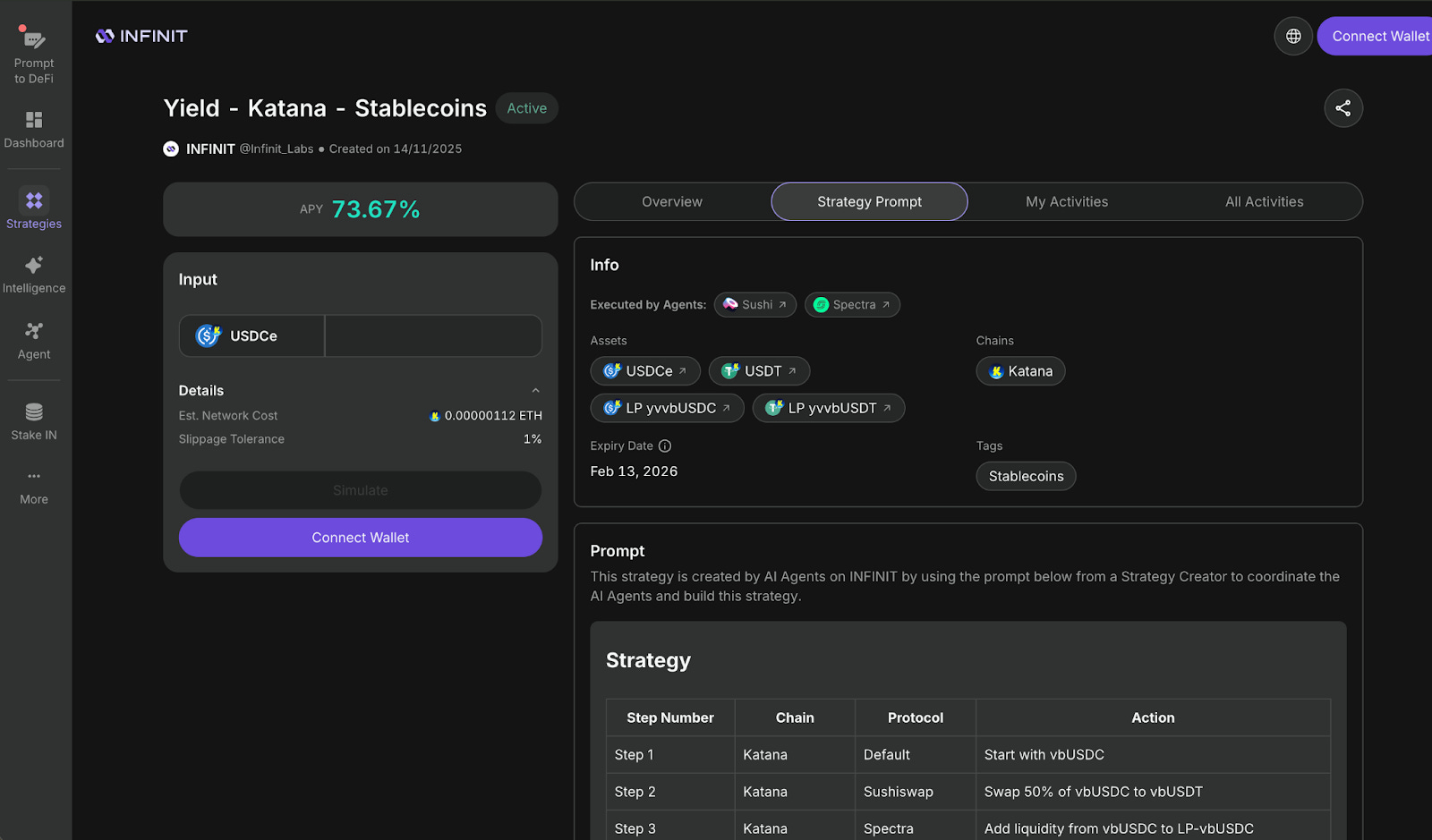
Each template supports multiple agents and smart actions. While typing out swap token A to token B, users can specify which platform to do it on. “Supported agents” refers to the group of agents on the platform that currently support “Prompt-to-DeFi.”
As part of best security practices, all prompts are simulated before execution or public sharing, and all published strategies are currently vetted and backtested.
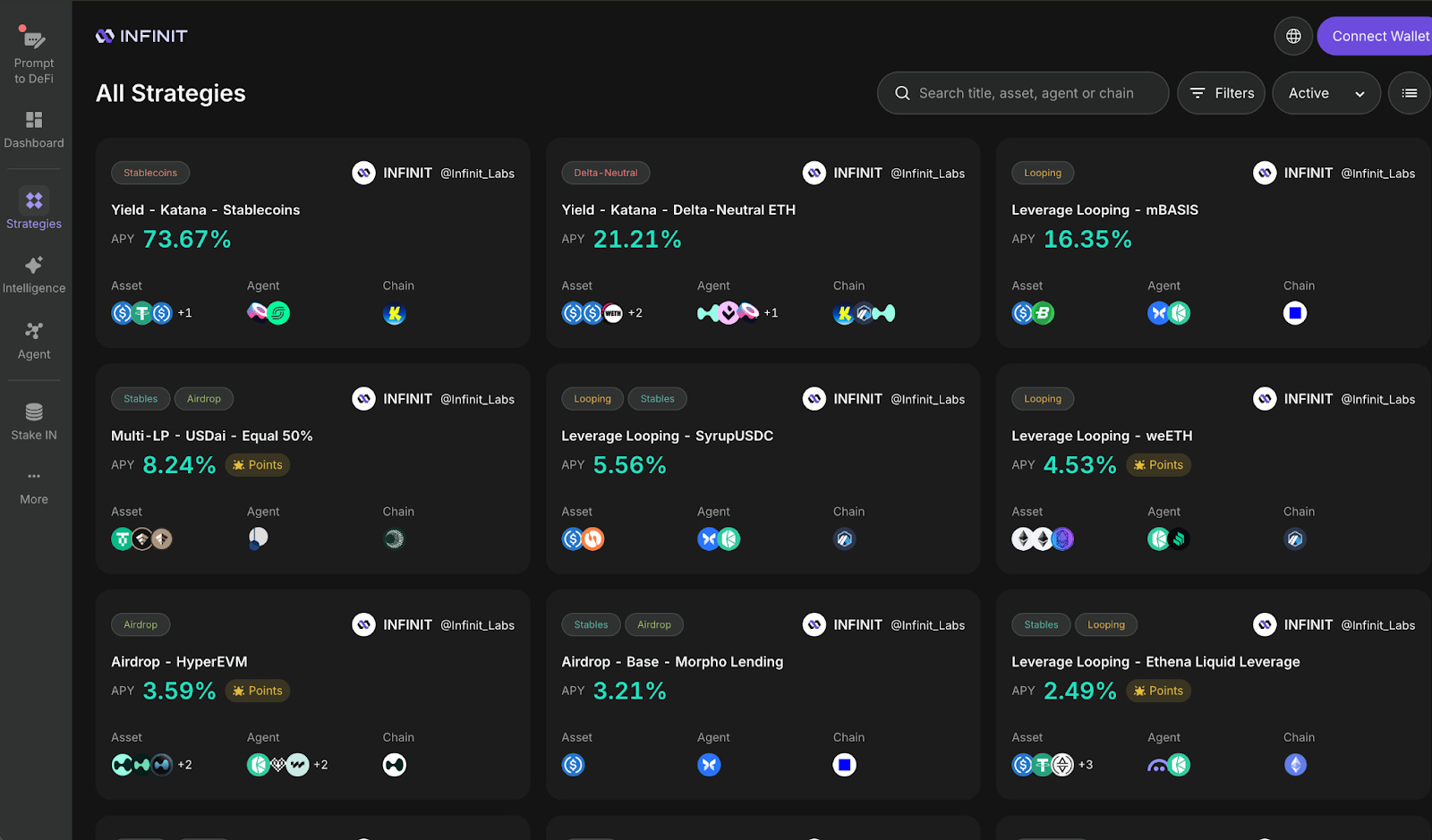
Whenever AI assists users, they maintain full control of their assets, and the process is fully non-custodial, removing any trust-related dependencies. Additionally, the code construction is deterministic, with no scope for hallucination.
The protocol aims to go one step further by making the strategy deployment layer permissionless, with the expectation that, as the protocol grows, users will develop more strategies, creating a virtuous cycle in which they seek better yields and even create their own strategies that can be monetised.
We asked the team how the revenue-making process would work for strategy creators, and they mentioned that it will have two major components: “First is management fees, or can be referred to as the transaction fees, which are paid by end users for every execution. These fees scale based on the transaction’s complexity and the number of agents involved in completing it. The second is the performance fees, which will follow the management fee as part of a phased rollout of the fee-collection and fee-sharing mechanism. Additionally, from time to time, we will run campaigns for creators to earn an additional bonus tied to strategy usage.”
Users on the platform have two options: Either they create their own strategy or use someone else’s.
A user who might use a similar looping strategy to farm incentives across chains can reuse the same prompt and easily switch protocols, reducing execution time. Users who aren’t familiar with this strategy can utilise it with a single click, reducing strategic complexity.
The Stack behind making DeFi cool
The “Prompt-to-DeFi” initiative is a strong step toward making DeFi more accessible.
As part of its stack, INFINIT utilise agent swarms, Large Language Models (LLMs), and a comprehensive data stream of onchain and offchain data to turn the dream of abstracting DeFi complexity into reality.
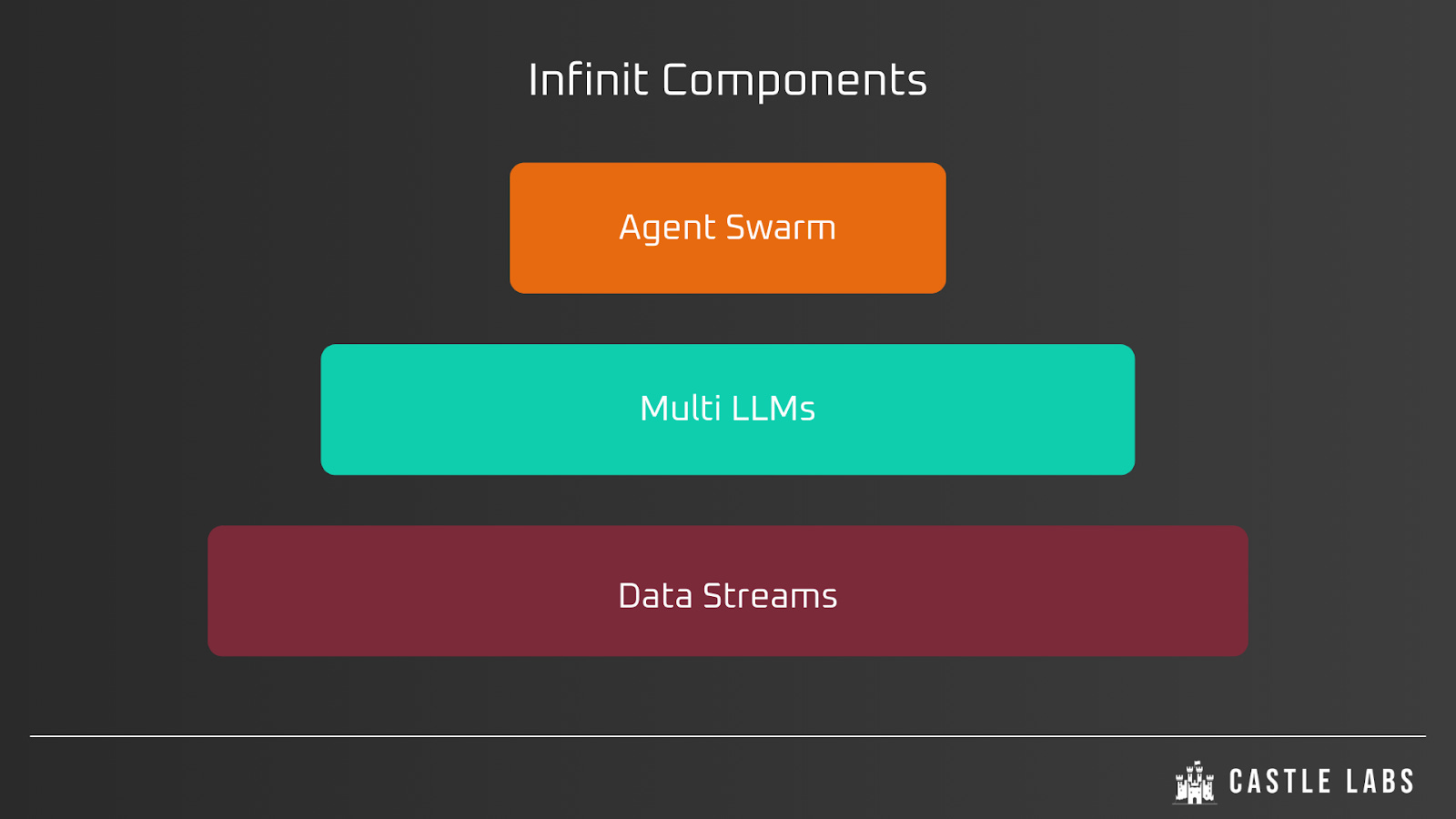
Agent Swarm: The agent swarms sit at the top of the stack and are the point of contact for users. Whatever strategy a user builds is executed by these specialised agents. Each working in a particular direction, such as token swapping, lending and borrowing, bridging funds, finding the best onchain yields, and more. On INFINIT, there are over 35 such agents to support any strategy-building exercise.
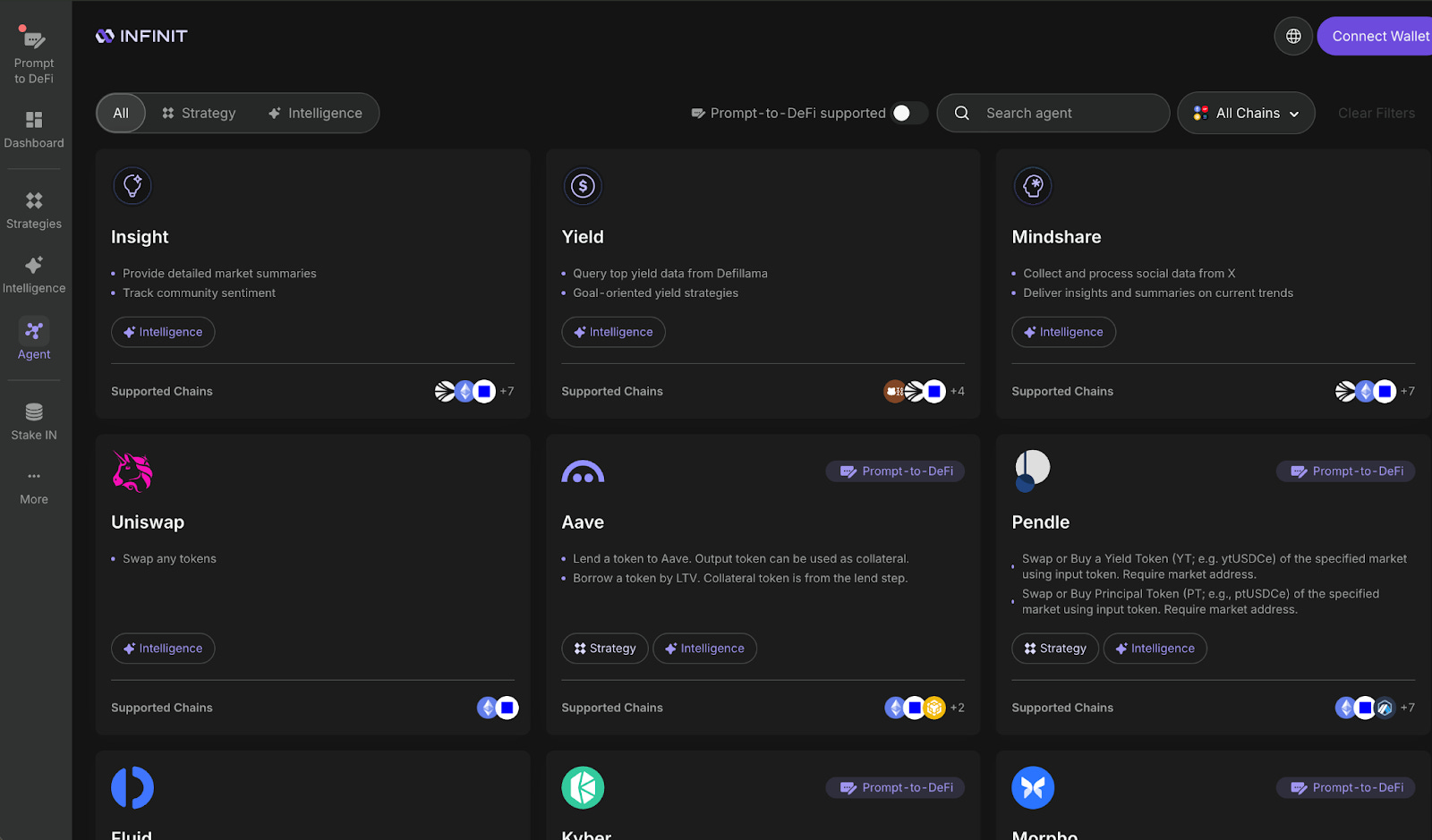
Coordination Layer: Communication is essential among swarm agents, as they are interdependent. For instance, an agentresponsible for swapping token or lending on Aave cannot simply “swap USDT to sUSDe, deposit it on Pendle, and then deposit PT assets from Pendle on Aave as collateral to borrow stables against them and repeat the process for maximum possible yield,” as it would need to communicate with the others through:
Feedback Loops: Review performance and utilise user feedback to improve accuracy.
Agentic Retrieval-Augmented Generation (RAG): Enables agents to pull data from INFINIT Data Streams and make them context-aware about cross-chain liquidity profiles, user-specific analysis, and opportunities.
ReAct Agent: Helps agents to provide a suitable execution flow based on user requirements. Actions are processed sequentially, and users are made aware of them.
Utilising multiple LLMs: Improve execution, interactions with users, and help analyse the user’s financial goals and risk tolerance.
Data Streams: Data streams ensure agents are always aware of the latest onchain and offchain data, including yield rates, liquidity, news, governance, and other key information. They are the intelligence layer for the product.
While this setup is fairly complex, it helps make the DeFi experience smoother and keeps everything just “one prompt away.”
Food For Thought
As DeFi grows, there will be richer sources of yield all waiting to be explored by potential depositors. On the other side of the equation, there will be a large audience unaware of these different yield opportunities. This disconnect is addressed by yield and strategy abstraction protocols like INFINIT, which make accessing these yields easier.
This is also an easy win for all supported DeFi protocols, as it provides a new source of liquidity from users who may not be aware of their products, making DeFi more accessible. Additionally, the strategies in the application are not limited to DeFi yield; they also include delta-neutral strategies, aidrop farming, an important part of how crypto functions, and others.
While serving this important role in the next phase of DeFi, products like INFINIT also offer DeFi neobanks an opportunity to offer exotic onchain yield options to their users and to make the DeFi ecosystem easier for the retail audience to access.
Another opportunity INFINIT is exploring is to act as a backend for neobanks, CEXs, and more, routing and handling higher-risk, higher-yield opportunities for end users, rather than competing with them on distribution. They have already integrated with the wallets from Binance, Gate, and Bitget to work in a similar direction.
As AI and LLMs continue to advance, projects like INFINIT are expected to benefit. As an application-level building on top of these fundamental models, INFINIT agents will become smarter, faster, and more efficient as these LLMs progress.
Last but not least, they are exploring to grow beyond crypto-native users to reach the broader crypto and FinTech audience.
This expansion will be supported by enabling and scaling new use cases and user bases for AI agents operating across tokenised stocks and commodities.
Make DeFi more accessible.
written by Noveleader ✍️
Every week for the last 3 years, we have shared our research for free, directly in your email. Not a subscriber yet? Let’s fix it:

If you are more of a Telegram guy, you can read all of our research without the noise on our TG channel:
Disclaimer: This article was produced in collaboration with INFINIT. Castle Labs applies the same standard to sponsored content as in our independent research. We strive to be accurate, unbiased and educational. Commissioned partnerships provide resourcing and distribution, not editorial control.
