

The Layer Zero for all Chains
LayerZero is a fundamental product for crypto as a whole, but few people understand its structural importance.
Although it is not a lending protocol or an exchange per se, LayerZero’s magnitude can be rapidly grasped: it is an invisible giant connecting DeFi’s labyrinthine infrastructure.
LayerZero has transcended its origins as a crypto bridge to become the TCP/IP of blockchains, the fundamental protocol that allows disparate networks to communicate in a single, common language. Just as SWIFT sends secure instructions between global banks without actually holding their cash, LayerZero moves data packets between blockchains to trigger specific actions, such as burning a token on one chain and minting it on another. This architecture has become the definitive standard for moving real-world assets.
By serving as this universal layer, LayerZero turns the entire crypto ecosystem into a single, interoperable network where assets move without the risk of catastrophic losses.
The traditional bridge model has been responsible for billions in losses (Ronin ($625M), Wormhole ($320M), Nomad($190M)). Centralised custody creates centralised failure points.
LayerZero’s architecture eliminates this, using immutable onchain endpoints, a configurable security stack, and a permissionless set of executors. When an application sends a message from Chain A to Chain B, the endpoint on Chain A emits the message, a Decentralised Verifier Network (DVN) independently validates it, and the Executor on Chain B delivers it. The verification and execution are separated by design, so compromising one component doesn’t compromise the system.
As Packy McCormick wrote: “You can think of the LayerZero protocol as a series of pipes that deliver messages between blockchains, transport layer infrastructure that runs below the cities…”
Every time a user moves a stablecoin cross-chain, swaps a token on a DEX aggregator pulling liquidity from another network, or bridges an asset from Ethereum to Solana, there’s an 85% chance LayerZero handled that message, and he has no idea.
In particular, LayerZero developed the OFT (Omnichain Fungible Token), a standard that allows a token to exist natively on multiple chains. When a user bridges, it burns the token on Chain A and mints a native token on Chain B to avoid the risk of token wrapping. Its importance cannot be understated, this year they processed $133 billion across 150+ connected blockchains, with 173% year-over-year OFT growth, over 61% of all the available stablecoins operate on LayerZero.
Today, LayerZero announced Zero the next steps into their vision of connecting well, everything.
Clues leading us to LayerZero becoming the heart of finance 2.0:
PayPal using LayerZero for its stablecoin PYUSD.
The state of Wyoming issued its own stablecoin.
Ondo Finance distributes tokenised US equities through it.
And so did Fireblocks, embedding it directly into its institutional tokenisation platform to deploy assets across 150+ chains.
Ethena’s USDe, the synthetic dollar backed by delta-hedged staked Ethereum, runs as an OFT across multiple chains through LayerZero.
EtherFi’s weETH, the liquid restaking token, uses the same standard.
Zero: The Last Chain
The reasons behind this novel chain are presented in a lengthy article published on X, which identifies flaws in the current chain, crippled by what they call “homogeneity.”
The announcement argues quite openly against Ethereum: “If an L2 is locked and decentralised, it becomes a dead end. It cannot innovate or adapt, making it irrelevant compared to every other evolving network. If an L2 can be upgraded, it is centralised and controlled by a small group of people with the power to change the rules.”
The exposé continues, in a surprisingly hostile tone: “They abandoned their principles to stay competitive. They stopped building the world computer. Instead, they pushed users away from a decentralised, permissionless, and censorship-resistant blockchain and into centralised, censorable blockchains and called it scaling.”
This scathing statement led LayerZero to build its own chain, running in parallel with the existing business.
Besides the noted contradiction within Ethereum, the announcement highlights three problems with any blockchain:
Compute: Running code to turn inputs into outputs.
Storage: Saving and retrieving the outputs.
Network: Communicating with other computers and the internet.
ZK solved this: Every blockchain forces validators to download and rerun every transaction, thousands of computers duplicating the same work to verify the same data. ZK proofs eliminate this by allowing validators to mathematically verify outputs without re-executing the code, just by checking a tiny cryptographic proof. Validators verify proofs in milliseconds and move on; the breakthrough is manifold.
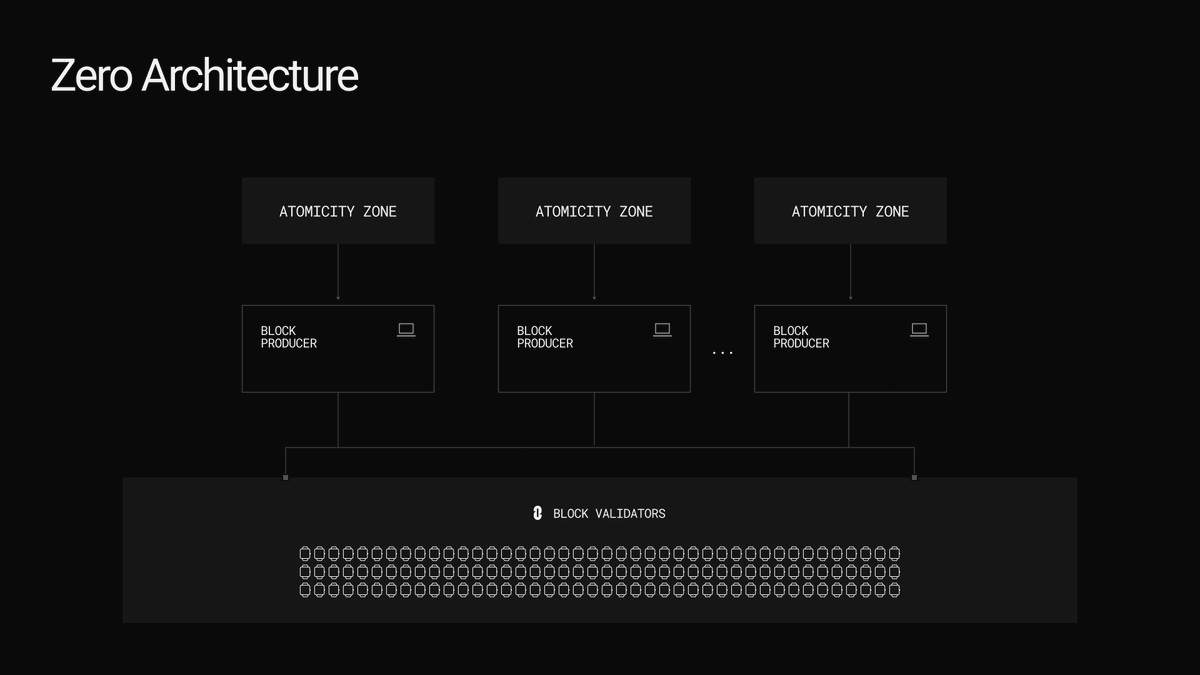
The term heterogeneous architecture is the most important clue: Block pìProducers execute transactions and generate proofs while Block Validators verify those proofs on consumer hardware. This separation eliminates the replication problem that clogs every other blockchain: for instance, on Ethereum, every validator downloads and reruns every transaction. Thousands of computers duplicate the same work to verify the user’s account balance. This redundancy forces Ethereum to maintain moderate hardware requirements to remain decentralised.
Instead, Zero uses ZK proofs to decouple execution from verification.
Block validators “don’t replay history,” so they verify cryptographic proofs in milliseconds. Ethereum currently costs roughly $50 million per year to maintain at its current scale. Zero aims to deliver the same throughput and decentralisation for under $1 million.
Four compounding breakthroughs make this possible:
QMDB, a database delivering 6x performance improvements, processes 3 million updates per second, 100x faster than existing blockchain databases, by replacing legacy trie structures with log-based, append-only architecture optimised for modern SSDs.
FAFO, achieving over 1.2 million transactions per second at 91% lower cost than newer generation sharding. This is achieved on a single node through automatic parallel execution, which identifies non-conflicting transactions without manual intervention.
Jolt Pro demonstrates RISC-V 100x faster than existing zkVMs at 1.61 GHz per cell, with a roadmap to 4 GHz by 2027, making real-time, verifiable computation practical.
SVID ensures that validators download less than 0.5% of block data, delivering 1000x the throughput of PeerDAS.
Finally, Zero introduced the concept of Zones, “applications running on different cores of the same blockchain”. Most blockchains are single-threaded (Ethereum runs one EVM, and every transaction competes for the same execution environment).
Zero runs multiple applications simultaneously in parallel:
Each “Atomicity Zone” is functionally equivalent to Ethereum’s single EVM, but Zero executes them across multiple cores at 2 million TPS per Zone. One Zone handles high-frequency trading, another handles privacy payments, and another executes general EVM contracts, with no resources shared.
Every Zone is owned by Zero and governed by a unified protocol, determined through on-chain votes by ZRO stakers. Developers don’t create their own Zones; they build applications on top of the Zones Zero provides.
Zero assigns each application its own execution core while maintaining a single decentralised validator set, a single consensus mechanism, and a single blockchain, at a cost 50x lower to maintain, according to the release.
These upgrades are TradFi-tier architectural replacements for every hurdle that has prevented blockchains from breaking through, to accommodate Wall Street.
The announcement concludes: “(Zero) provides a credible alternative to centralised cloud providers like AWS”.
Nothing less!
So, Zero won?
The metamorphosis brought about by institutional influence is such that the lines between crypto and the NYSE are blurring.
Today, Citadel, ICE, and Ark announced a joint investment in Zero; none of those firms are involved in DeFi. Ardoino’s Tether also joined the cap table, sharing how: “LayerZero has built interoperability technology that allows digital assets to be transferred in real-time across any transport layer and distributed ledger, enabling a fundamental utility within the financial industry.” USDT0 is devised using LayerZero’s OFT standard.
The importance of these investors cannot be understated:
Citadel accounts for 40% of U.S. retail equity volume.
The DTCC processes $2.5 quadrillion in transactions annually.
ICE operates the world’s largest stock exchange.
Tether just became one of the most profitable financial institutions on earth. LayerZero didn’t partner with crypto companies, VCs or corporations, but with the giants that run Wall Street.
Although the exact figure has yet to be disclosed, LayerZero has raised hundreds of millions of dollars while largely operating as a crypto-native protocol.
To put it into perspective, Citadel Securities is one of the largest market makers in the world. The firm executes roughly 47% of all US retail equity volume and 26% of total US equity volume. We are witnessing one of the most structurally important Wall Street titans directly investing in “crypto,” if it is still the correct denomination.
Fortune argued that “The upshot, if Zero proves out, is that institutions like the DTCC handling trillions of dollars worth of assets might be more likely to turn to blockchain infrastructure”.
This may be, to date, the most brazen example of TradFi eating up crypto like there’s no tomorrow. The very heart of Wall Street, namely ICE and Citadel, decided to invest in an L1 specifically spun to accommodate their structural needs.
Ondo, xStocks, Tether, Canton, and now Zero, it is easy to determine where this is going.
Zero is supposed to launch in Fall 2026. If it can handle institutional-grade trading infrastructure before regulations are rolled out, existing L1s become feeder networks. The advantage isn’t just technological (QMDB, FAFO, Jolt Pro, SVID) but mostly structural, if not political: Zero is funded by Citadel and Tether, advised by ICE and the DTCC, built by the team that already controls 85% of cross-chain volume.
Ethereum spent years promising institutional adoption through L2s with the outcomes that we know. Zero is the manifestation of Ethereum’s hopes, except that it comes from above, and not from below, from crypto.
It is an unforeseen turn of events that, ultimately, Wall Street gave us what we needed, rather than waiting for a lengthy maturation on our part.
If another L1 may seem redundant, it’s the first blockchain Wall Street built for itself.
The result of years of practical and theoretical research, LayerZero’s vision for an entirely digital Wall Street has been termed the multi-core world computer.
It has become difficult to distinguish between crypto and traditional finance, as the ecosystem we learned to master is now entirely remodelled by entities the power of which we cannot fathom.
As the lines between DeFi and TradFi are more blurred than ever, one wonders if there still exists a chasm between our world and theirs.
Is unification the path toward reconciliation?