All climbers know how hard it is to climb a mountain - especially if it’s uncharted ground.
Even the more vigorous climber will have to do it in steps: no one can do it in a single sprint. Even after a new checkpoint, it’s essential to rest, regain our strength, and then resume climbing. Why would you do that - climb - if it’s so hard, you might ask? In the words of George Mallory, “because it’s there”.
There’s no greater feeling than pioneering something, to take the courage to do something no one has ever attempted before. Almanak has been developing its products for months and has successfully built audiences for both Almanak Vaults and its Strategy Builder.
To fit our metaphor, it seems Almanak has reached one of these checkpoints. Now they are moving to the next phase of their growth, which involves their token generation event (TGE). However, this is no launch like any other, with a strong focus on community-incentivised participation that could help it sustain in the long run and grow alongside the product.
Enter the Almanak Games.
This article provides a brief context for Almanak and sheds light on its TGE, native token, and a novel distribution mechanism via Almanak Games.

From LLMs to Structured Multi-Agent Strategies
Almanak worked on a core problem: AI agents currently do not meet security and risk benchmarks that make them appealing for managing funds.
Still, most agentic interactions have AI agents or LLMs managing funds directly. However, while they are optimised for data gathering and analysis, they pose several issues when it comes to handling funds.
Among them, the fact that the final execution is neither verifiable nor deterministic, as well as the fact that LLMs are generalised and lack the specific precision needed for fund management and investment.
Given this, Almanak takes a different approach: It still leverages AI agents for what they are good at, which is coding and reasoning, discovering and creating strategies. However, the strategies themselves are hard-coded rather than executed by the AI agents or an LLM.
For more details, see our article.
Furthermore, Almanak recognises that not all users are looking to run their own strategies. Some might just want to take advantage of existing ones to generate yields across DeFi.
With this in mind, Almanak divided its product suite across two core offerings:
Vaults
Strategy Builder
Let’s dive into each of them.
Vaults
Vaults are designed for passive users who want to leverage existing strategies. They can simply deposit their funds to earn yields, which are boosted by Almanak points. This product serves a risk-averse audience looking for the best yield opportunities in a risk-adjusted manner.
The platform provides two different vaults, each running its own strategy. The first vault (alUSD) earns this yield by providing liquidity across various DeFi platforms, such as Aave, Euler, Fluid, Morpho, and others, while keeping risk to a minimum. The second vault (alpUSD) sources its yield from similar sources, takes a risk-aggressive approach, and seeks the highest possible APY.
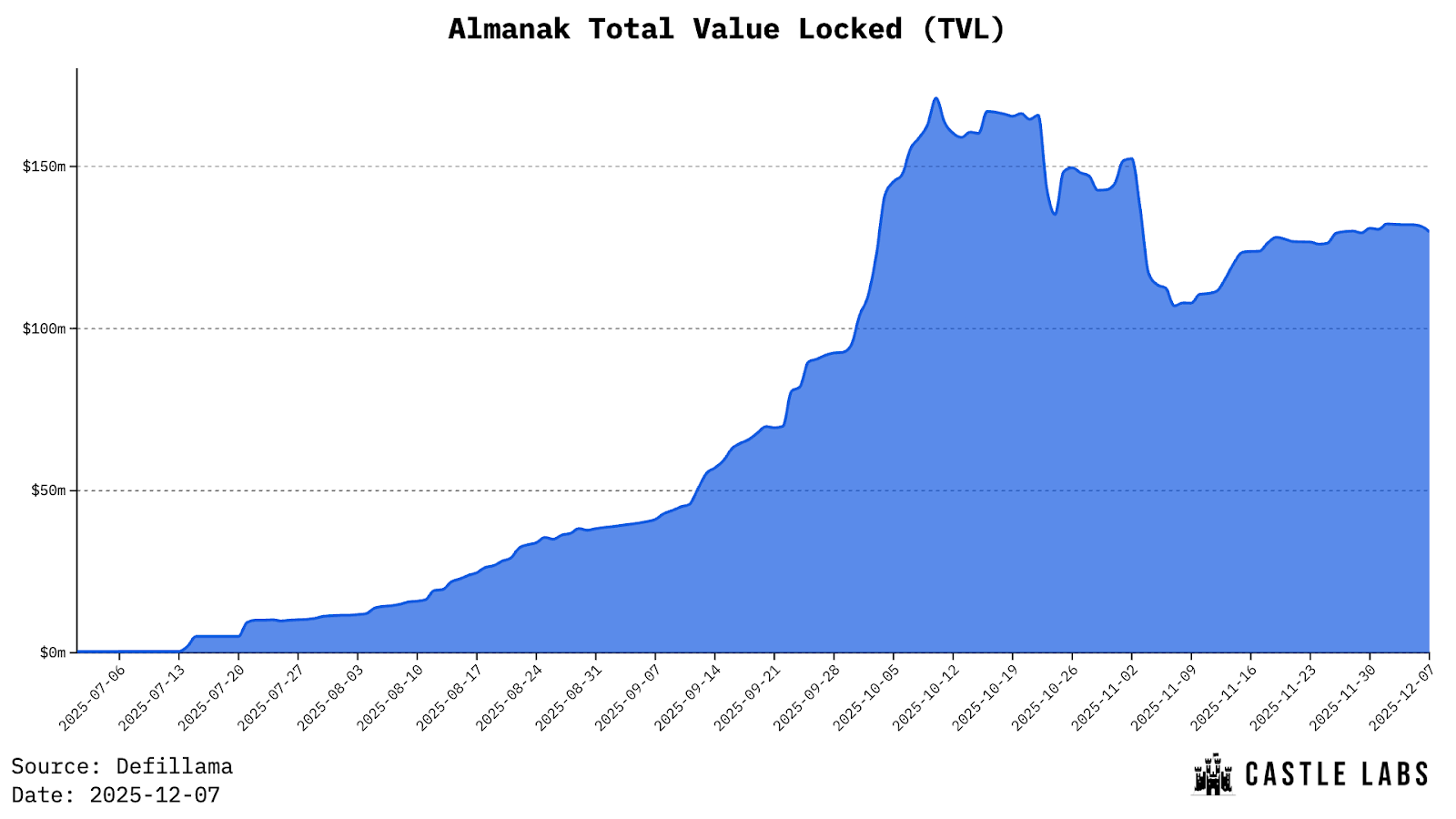
The accrued yield and the token deposited into the vault are represented through a vault share, which can be deposited into vaults on Pendle and Curve to earn even more points. At the time of writing, Almanak TVL is over $130 million and has experienced significant growth since its launch.
Strategy Builder
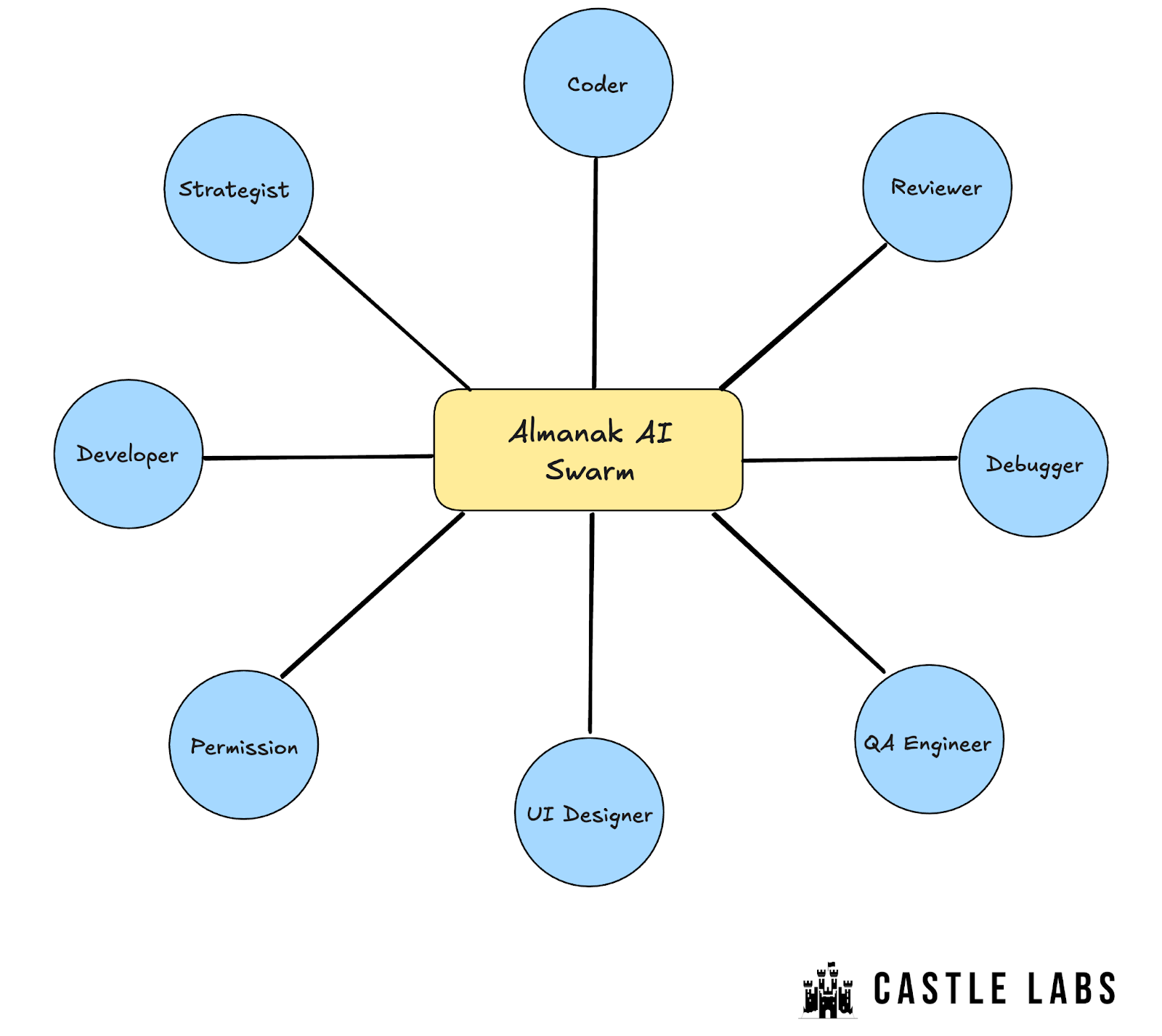
This is probably the most interesting aspect of the platform. On Almanak, you get a swarm of AI agents that can help you build your trading strategies from scratch.
Currently, users can create trading strategies (buying and selling a token) based on specific technical indicators, with custom strategies coming soon.
For more details, we recommend reading our last report, where we created a Pendle RSI strategy as a case study of how the Strategy Builder works.
Users can also build strategies around liquidity provisioning on Uniswap, including automated looping, arbitrage, trading options, perps, and yield tokens, coming soon.
With the Almanak builder, users can receive significant agentic support in turning their trading strategies into real-time execution models.
We’re patiently waiting for the opportunity to create custom strategies, as this will represent the most significant value unlock for users.
All of this will be powered by Almanak’s native token $ALMANAK, which is expected to TGE on December 11. To strengthen its token distribution, Almanak has developed an interesting mechanism they call Almanak Games.
Rewriting the script with Almanak Games
In the typical TGE design, there is significant insider play and manipulation that harm token holders and the project’s community.
Eventually, all distribution choices skewed toward short-term gains over long-term sustainability come at a cost. To mitigate the impact of mercenary capital, Almanak is increasing community participation during the initial period of the token launch by distributing algorithmic rewards through Almanak Games, which will run from December 11th to January 31st.
How will the Almanak Games work?
There will be two different types of rewards:
Token Rewards
Stablecoin Rewards
Token rewards will be accrued dynamically as points for end users (claimable after the campaign ends, tentatively during the first week of February), ranging from 1.5% to 3% of the total token supply, depending on the number of tokens pledged in the campaign.
The activities for which these rewards will be distributed include buying, holding, providing liquidity for the Almanak token, and deploying strategies that utilise the Almanak token, giving users enough flexibility to use the incentivisation most effectively.
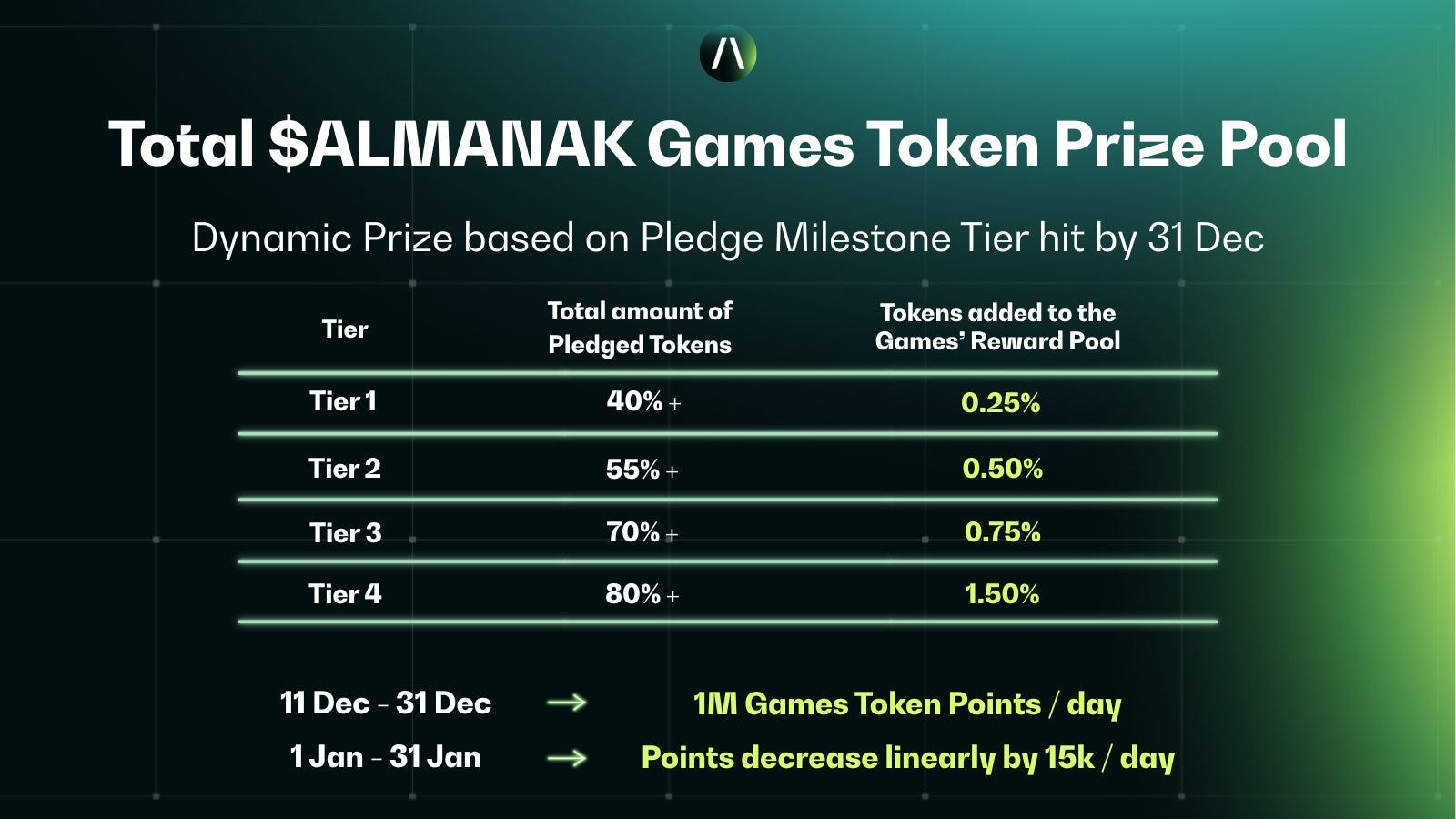
Pledging means a user commits to holding the tokens distributed in the airdrop until the end of 2025, in exchange for a boost in rewards. It’s important to note that this is not a binding pledge, as users hold self-custody of the tokens and can revoke it at any time.
Stablecoin rewards are also accrued dynamically across tiers based on the total tokens bought during the Games. To earn these rewards, the activities are similar to those above, including buying, holding, and generating trading activity on $ALMANAK.
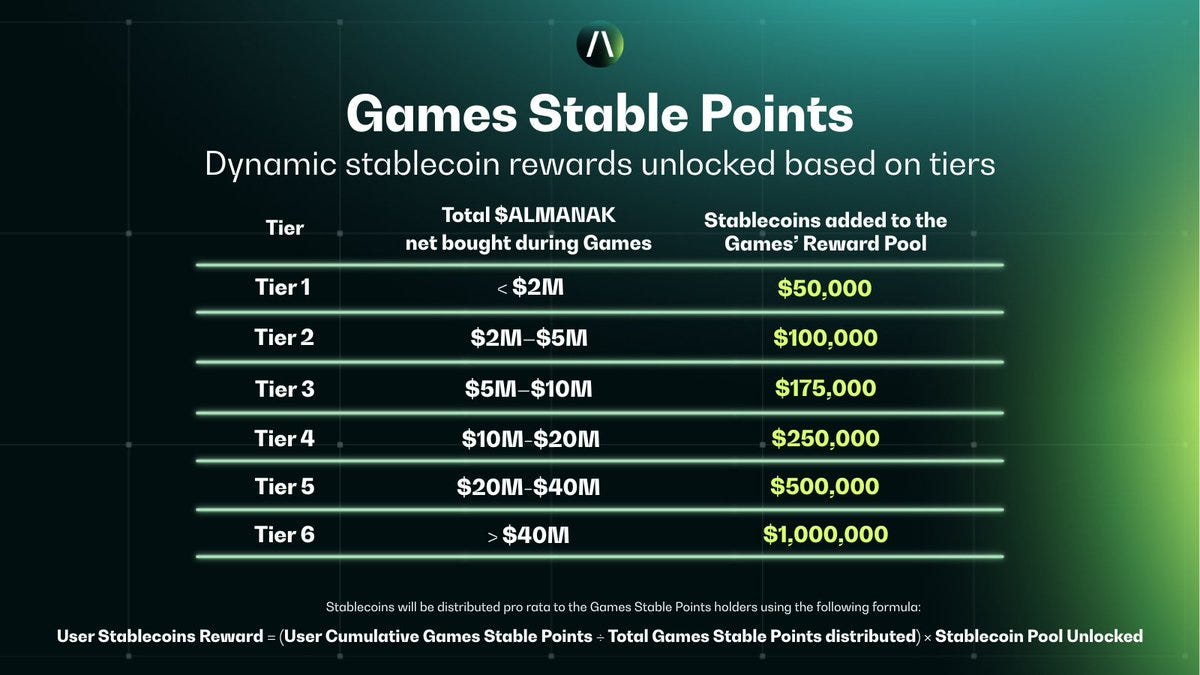
Both tokens and stable rewards are dynamic and depend on the net activity generated and pledging that occurred during the Almanak Games.
Their specific distribution formulas can be found in Almanak’s article.
Looking Forward
AI is growing and increasingly becoming part of our daily workflows. Whether for research or to automate a task, we can expect to rely on an AI agent to perform these tasks.
While the sector may become a giant bubble, there is a lot of reality in this tech that could change our mental models for how we perform tasks.
Within this context, Almanak does not aim to remove humans from the equation; instead, they have a key place within their product. Humans control the strategies, can edit them, and can create their own. The AI is just there to speed up the data gathering and analysis, coding, and everything that would otherwise take a long time. Traders can focus on what matters, doing the research and curating a strategy they wanna execute. At the same time, Almanak AI agents can handle the rest, turning their ideas into real-world implementations.
The Almanak TGE reinforces this builder autonomy and contributes more to the platform, community, and token growth.
The Almanak Games are an interesting implementation that complements the token distribution mechanisms by aligning incentives with users who have skin in the game and are active on the Almanak platform.
Through this design, Almanak hopes to direct a greater share of tokens to its core community of users, thereby indirectly benefiting long-term sustainability, fostering loyalty, reducing selling pressure and increasing value accrual within the ecosystem.
Will you take part in the Almanak Games?
May the odds be ever in your favour.