

Recently, yield has taken on many forms in DeFi, as evidenced by the growth of platforms like Ethena and Pendle, which offer various yield opportunities to every DeFi user. With their growth, onchain money markets and LP models have adopted and built a more mature stance around onchain yield generation.
As part of it, institutions are waking up to the fact that these onchain native solutions can be more effective and rewarding than their traditional counterparts.
Strategies like the basis trade, which is by itself a $800B market in TradFi, have found their onchain application through Ethena and USDe, the first yield-bearing stablecoin.
Even more so, new ecosystems are leveraging primitives like Ethena and collaborating with them to launch stablecoins in their ecosystem, all because they want to direct the most value into their ecosystem and generate the maximum yield without leaking any value to other ecosystems or products.
The focus on yield is intensifying now with institutions deploying capital and bringing Real-World Assets (RWA) onchain, now worth over $33 billion. Different avenues are being explored to utilise these assets and make them more composable across DeFi. Aave has recently made an attempt through its Aave Horizon launch.
But if we zoom out, all that sits in the middle is the chase for the maximum yield out there. It is also important to understand that this chase is attested with the growing need for asset management onchain, or more accurately put, risk managers.
Morpho and Euler, two major lending platforms, have adopted this model, where users deploy capital to their platforms, which are then managed by different risk curators who aim to provide the best risk-adjusted yield to end-users.
Can a similar model be applied to yield by combining multiple strategies, beyond lending?
While TradFi companies have access to fund managers and quants for their strategies, this model is being replicated onchain, supported by increasing institutional demand to deploy capital.
In particular, this report focuses on @Upshift_fi, which has been working on connecting these dots for some time and bringing the best yield generation tools onchain, bridging traditional fund management with DeFi-native protocols.

Leading the Up-shift
The RWA market is expanding and is expected to be a $2 trillion market by 2030.
Bringing this value onchain will also mean being able to solve some of the previous issues in the yield markets of TradFi, as DeFi has proven itself to be an exceptional infrastructure for yield products.
Finding professionals in the sector is incredibly difficult and competitive, both for TradFi and DeFi companies. Talented fund managers and quantitative analysts are highly sought after.
These strategies are also opaque and proprietary, as they represent a hedge that each company carefully crafts and is wary of sharing publicly.
This is completely opposite to the transparency and composability offered by DeFi primitives.
Among those working to democratise the core component of yield markets is Upshift, which replicates the same experience of onchain curated lending vaults through various institutional allocators and managers, but across all DeFi and CeFi yield sources.
At its core, Upshift offers a series of vault-based strategies that ensure institutions and users never miss an opportunity, onchain or offchain, to generate high quality yield.
Instead of having to find and run sophisticated strategies themselves, both retail and institutional users can deposit funds in Upshift vaults.
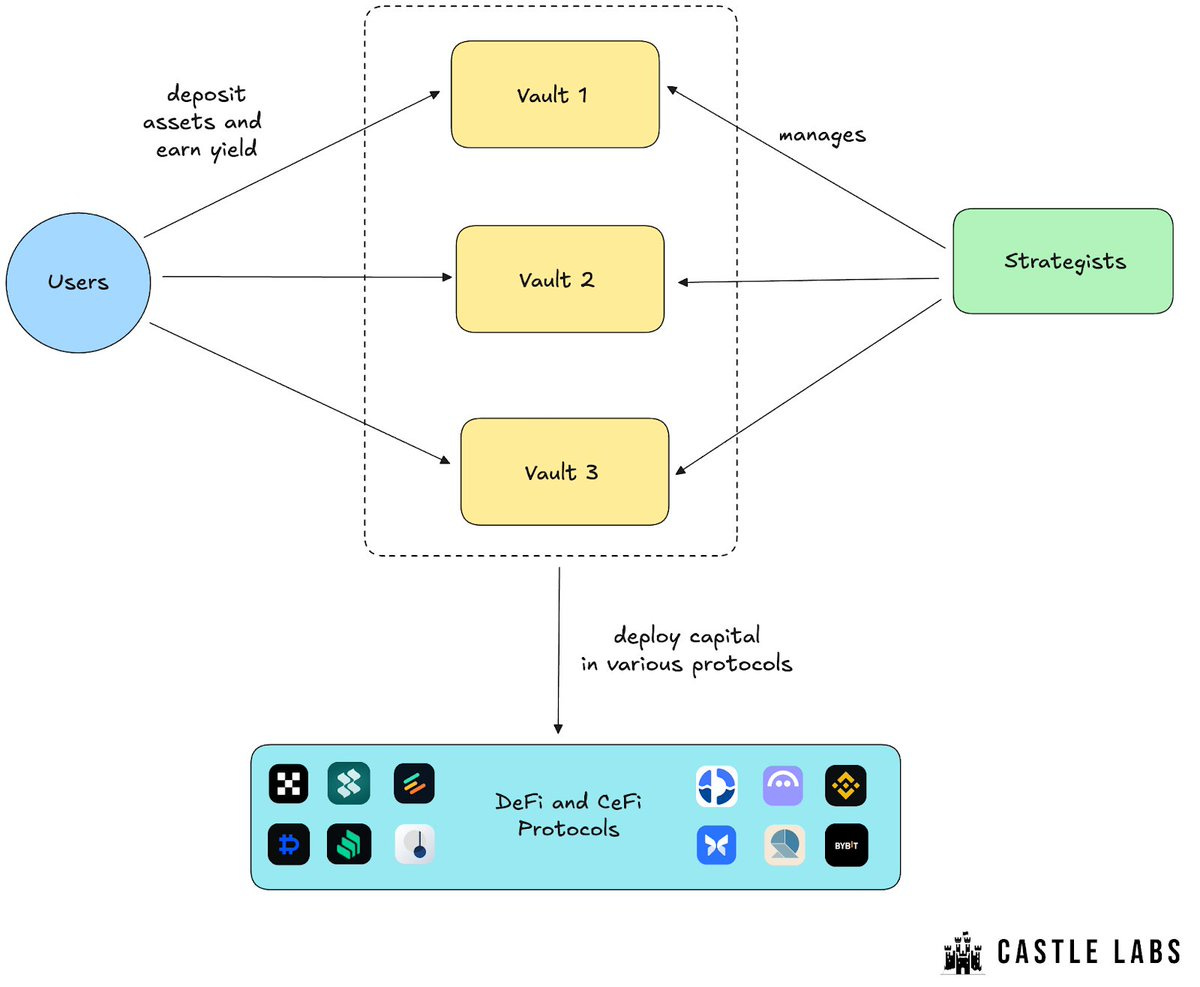
These vaults are actively run by top DeFi funds, including MEV Capital, K3 Capital, and others, and encompass various strategies, including, but not limited to, basis trades, a combination of DeFi (concentrated LPs…) and CeFi (...hedged using Deribit options), lending strategies, and more. As a result, each vault has specific fees, including withdrawal, platform, and performance fees, as well as different withdrawal periods.
One of the key features which sets Upshift apart from other vault platforms: all strategies leverage August in the backend, the largest DeFi prime brokerage, with over $7b of monthly trading volume.
Why is this important?
Ensures institutional-grade risk architecture in the background
Makes it easier to onboard other risk managers, since they already using August
August integrations can be leveraged to craft vault strategies, and the architectures enables cross-margining of DeFi and CeFi positions
This means that Upshift vaults can simultaneously execute multiple yield strategies across DeFi and CeFi, while benefiting users with institutional-grade risk management.
Currently, the protocol has over $500m in TVL, with its biggest vaults in terms of TVL being:
High Growth ETH: With $77m in TVL, this is an rsETH strategy, focused on blue-chip liquidity provision, combining multiple strategies across several protocols.
AAVE: Leveraged tETH, wstETH, weETH and rsETH loop; supplying stETH to borrow stETH
Compound: Supplying ETH to borrow WETH
Euler: Supplying ETH to borrow WETH
Kelp: Staked rsETH
Pendle: a small % of stETH is supplied on Pendle
2. The K3 Neutrl Pre-deposit Vault: With $75m in TVL, this vault focuses on maximising USDT yield by providing liquidity to blue chips, and boosting yield with airdrop potential (for the commitment to Neutrl).
3. Kelp Gain: With over $61m in TVL, this strategy leverages rsETH to deposit into protocols and farm airdrops, among other benefits. Within these strategies, rsETH is supplied on various protocols (shifting according to the opportunities at hand).
AAVE: Supplying rsETH, wrsETH and ETH to borrow wstETH, WETH and stETH
ZeroLend: Supplying rsETH
Compound: Supplying ETH to borrow WETH
Silo: Supplying rsETH to borrow WETH
Morpho: Supplying rsETH to borrow WETH
Fluid: Supplying ETH to borrow stETH
These are just a few examples of the leading vaults currently live on Upshift in terms of TVL, showcasing the potential to combine multiple strategies within a single vault.
However, for more risk-averse users, the platform also offers a broad range of returns.
One such example is the institutional lending vault, Upshift USDC, curated by August (with a 7% APY), where users deposit USDC, to lend to overcollateralized institutional borrowers on the August platform. All unutilised capital is also lent on blue-chip vaults on Morpho, Euler, and Pendle for more yield.
Every vault on Upshift is transparent, providing a breakdown of the fund allocation and, whenever possible (for onchain strategies), a direct link to Debank to observe the strategy directly:
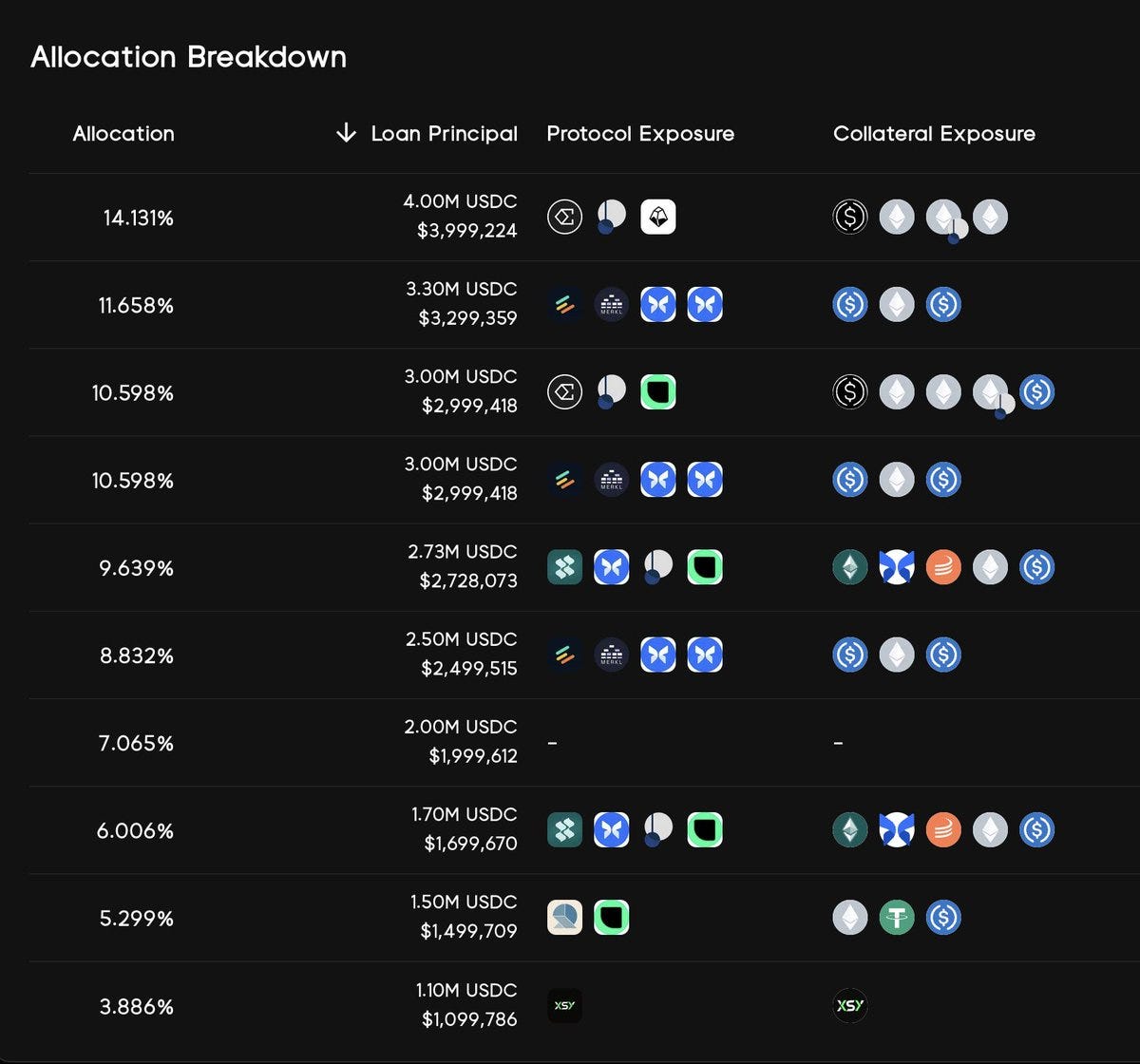
The advantages of the Upshift vault model are multi-fold. For one, institutional allocators can track each position onchain and carry out the necessary due diligence before depositing. Upshift curators are sophisticated entities with a track record of DeFi execution onchain. Transparency is a core feature of the vaults.
Furthermore, Upshifts employs an “allowlist first” model where chains, protocols and contract calls must first be allowlisted before vault curators can use them in strategies. This ensures the vault remains non-custodial for depositors and eliminates the hidden leverage or bad debt disasters which plagued more opaque models (e.g. BlockFi or Celsius).
Moreover, all strategies leverage August in the background, the largest prime brokerage in TradFi. August’s risk engine handles all liquidations on Upshift automatically, and maintains the NAV of each vault using a multi-oracle pricing system. With the ERC4626 standard, depositors can query the smart contracts directly to check share prices and accrued yield.
On top of superior risk management, a modular vault structure enables Upshift to rapidly list and support an ecosystem, ensuring timely launches that align with market mindshare. Examples include DeFi vaults on HyperEVM and SUI.
All of the vaults are developed as ERC-4626, meaning they are natively composable across blue-chip DeFi protocols, such as Morpho, Pendle, and Euler, to unlock more yield.
With their focus on identifying, communicating and mitigating risk, Upshift is poised to become a go-to option for institutions looking to move activities onchain, either as a curator or as a depositor.
Future Outlook - “Core” vaults
Currently, the platform hosts over 21 vaults, working as primary infrastructure to cover most of the available opportunities in the market.
Among those, Upshift stablecoin vaults have been growing rapidly, ranging from pre-deposit vaults on Neutrl, to Binance basis trade vaults. To simplify the decision process for depositors, Upshift has recently launched Core USDC, a “vault of vaults” managed by August, that diversifies deposits across multiple stablecoin vaults.
Core USDC has already accrued over $14m in TVL with a historical performance of 7.51%.
The funds of Core USDC are currently looping USDC on Morpho and deposited across several Upshift stablecoin vaults.
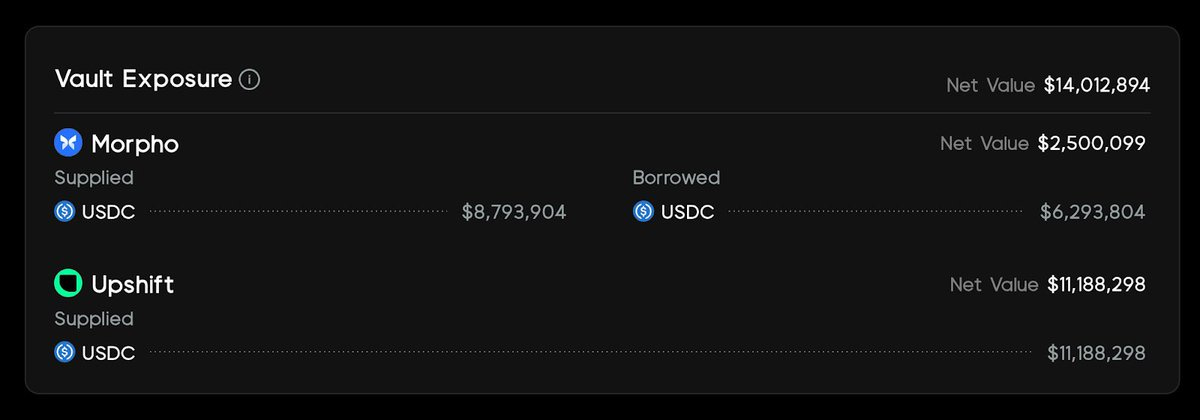
Instead of manually researching the best strategies and managing their position, Core USDC enables users to gain exposure to yield opportunities for stablecoins by combining different strategies across CeFi and DeFi.
As the DeFi landscape becomes increasingly complex for non-sophisticated users, Upshift vaults abstract the management and allocation process: simply deposit in one of the vaults according to your risk profile, and let it do the work for you.
This is valuable for both retail and institutional investors, as it provides a very transparent and automated way to simplify the user experience to generate yields onchain.
Another area where we expect Upshift to expand is lending. As Upshift is built on August, institutional allocators have access to additional benefits, such as increasing their capital efficiency by borrowing against their positions in August (note, this is available only with KYC and loanbook capacity).
The number of strategies available will continue to grow as more protocols are supported and more vaults are listed.
While the “curated yield-vault” model brings several benefits, it’s important to add a small caveat on the role of vault curators and third-party risks. While risk managers work to optimise the risk-adjusted yield for users, it comes with the need to trust these curators to act fairly.
Nonetheless, this remains a good trade-off for institutions that replace third-party risk with credible DeFi funds managing the strategies, and for retail investors who want to diversify their exposure onchain, without the overhead of running multiple strategies themselves.
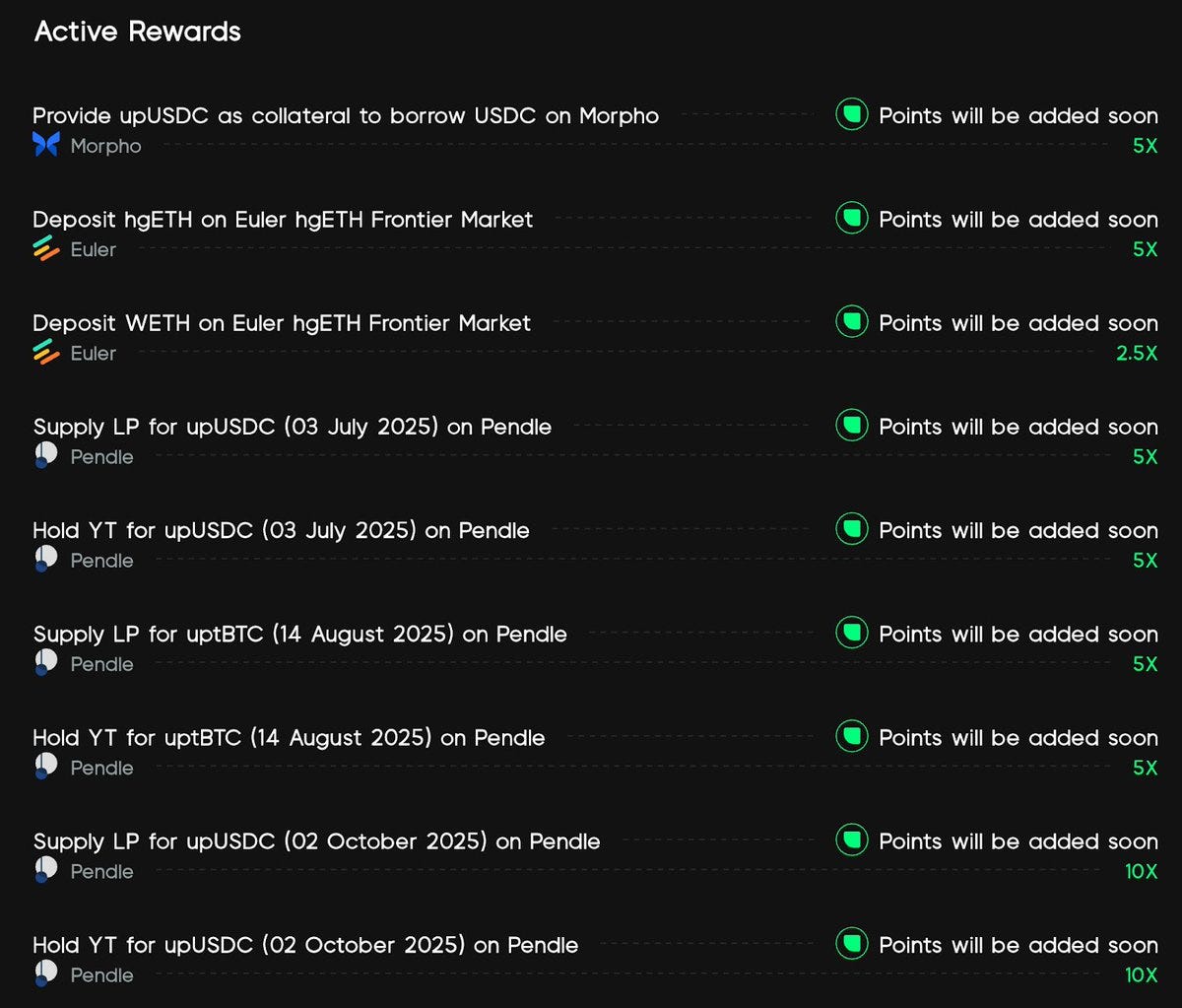
For those looking to jump in, Upshift is currently conducting Season 2 of its point campaign, where users earn points for depositing liquidity in any vault, in addition to the APY.
Rewards are targeted towards specific actions and vaults, with a bonus up to 10x:
Upshift provides a way to tap into onchain yields in an abstract form:
By simply depositing funds in a vault, users are getting exposure to all the different protocols utilised by the underlying strategies.
By introducing the role of vault curators and integrating with prime brokerages such as August, Upshift delivers a credible framework for risk-adjusted onchain yield generation that aligns with institutional standards.
On the other hand, retail investors can unlock yield on both stablecoins and other assets without having to actively manage complex strategies.
The implications of this model suggest the emergence of a new asset management layer for DeFi, accessible to everyone and with transparent performance.
With the rise of neobanks and increasing demand from institutional investors, Upshift is well-positioned to capture this growth, focusing on building products that meet institutional standards through August. Many institutional actors have already deposited funds in the vaults, helping Upshift reach over $500m in TVL. Stablecoins and RWAs are booming. Perhaps, this time, the only way really is Up?