

Surveillance grid, intelligence agencies, spaceships, US government, bunkers in New Zealand, crypto perps: rings a bell? Don’t you see the connection?
One man, the enemy of the Antichrist, does.
Peter Thiel sees tech everywhere, and he has little interest in anything else.
His style is quite monomaniacal: Thiel’s ventures are governed by a single obsession articulated in Zero to One, which seeks vertical progress by creating entirely new technologies rather than merely brooding on existing ones.
He explicitly rejects competition, favouring companies that dominate a specific niche to achieve a durable, near-complete monopoly. This philosophy explains how Palantir came to sit at the intersection of intelligence agencies, law enforcement, and the White House. The merits of such a formidable machine are debatable, but one cannot argue against its efficiency.
Ultimately, Thiel employs what he named the Power Law strategy, backing only those rare startups with the potential to “return the value of the entire fund“ while ignoring safer bets. Mr. Thiel doesn’t know the meaning of risk aversion and how it works.
In his book, he said that “[Diversification] is just a hedge against ignorance.“ Yet he now shepherds a consortium of companies spanning stablecoins to biotech in space.
However, one dogma unites all his projects: unfettered progress and aggressive activism (and a solid dose of Middle-earth’s lexicon).
Welcome to crypto, Mr. Thiel.
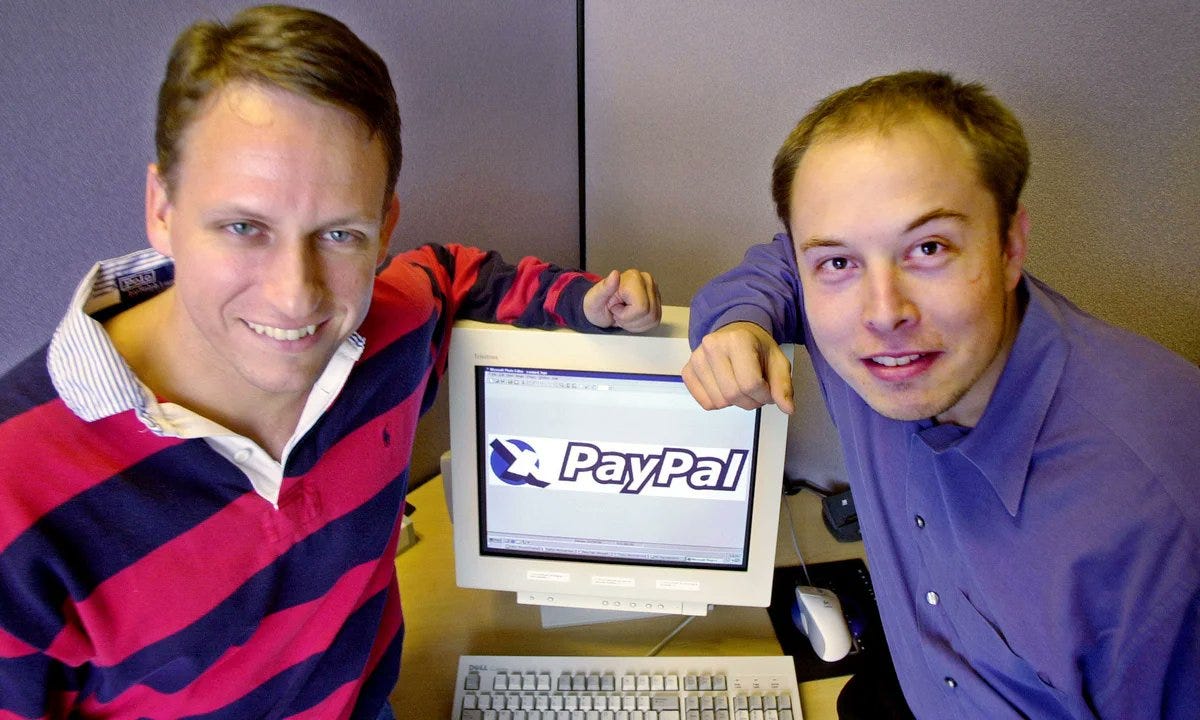

From Payment Apps to Palantíri
Peter Thiel was born in Frankfurt in 1967. Though the son of a German family, he spent his childhood traversing South Africa before settling in the U.S. to study at Stanford.
You know him through PayPal, Palantir, Facebook, Anduril, and recently, the ‘Antichrist’ meta. Thiel’s vision is eschatological. His stance on democracy, war, and politics is plain: “Without new technology to relieve [scarcity], the world will not just stagnate; it will collapse.” It is an emphatic affirmation, yet entirely adequate for a world where technological growth sustains the financial markets, the backbone of our hyper-consumerism. The masses need new toys, no matter how fried their brains become. Panem et circenses, the show must go on, whether the audience is coked up or merely bored to death. The new gods are influencers, devoid of superpowers other than nihilism, and yet they are the oligarchy we get.
Thiel might be irritating to the Right (as an LGBT supporter) and the Left (as a Trump ally), but he remains a Musk-like antihero: horrifically realistic and pragmatic. In 2009, in his essay The Education Of A Libertarian, he wrote, “I no longer believe that freedom and democracy are compatible.“
Despite his epic Lord of the Rings references, his magic is entirely earthly: drones, banks, and rockets. It is only recently that he moved on to web3, bringing with him an obscene amount of cash.
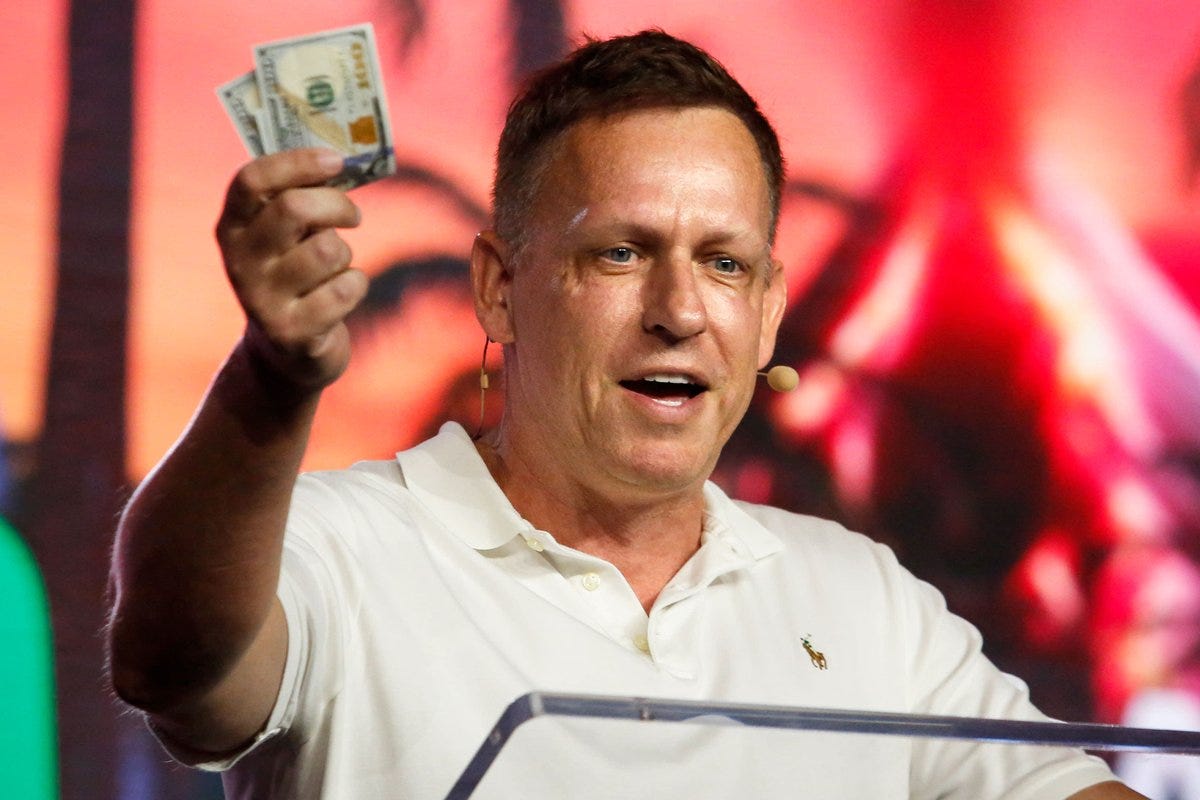
The Silmaril Of Crypto
Since the collapse of FTX, crypto has migrated from cypherpunk forums to earnings calls. It has become mainstream in a way that Satoshi might not have envisioned at all. In just 15 years, Bitcoin turned from a plain computer into a trillion-dollar asset.
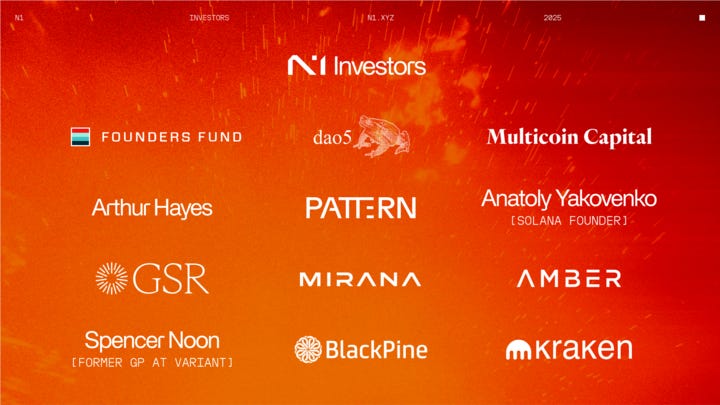
Naturally, capital started flowing in. Founders Fund, Thiel’s One Ring, has endeavoured to enter DeFi alongside crypto-native VCs such as Dragonfly and Coinbase. So far, Founders Fund has backed protocols like Polymarket, Plasma, Lighter, and N1. The tickets are always large, the protocol S-tier, and the vision exuberant. It matches Thiel’s epic disposition.
Thiel wants the shiniest toys in his portfolio. His penchant for technocracy, quite frankly brazen (”We are in a deadly race between politics and technology... The fate of our world may depend on the effort of a single person who builds or propagates the machinery of freedom“) led him to explore frontier sectors.
This is why Founders Fund invested in N1, the Frankfurter’s latest bet.
In a few sentences: “N1 is building the future of onchain finance. A trading-first L1 that delivers ultra-high throughput, sub-ms latency, and congestion-free transactions.”
A spartan yet evocative description of the first blockchain dedicated to finance onchain. One can sense the German approach to efficiency, almost academic. Even the name is sharp, a title resembling some computational process one utters awkwardly. While Ethereum, Solana or Aptos offer a standard infrastructure based on ease of use, N1 bet on hyperspecialisation.
Are you obsessed enough?
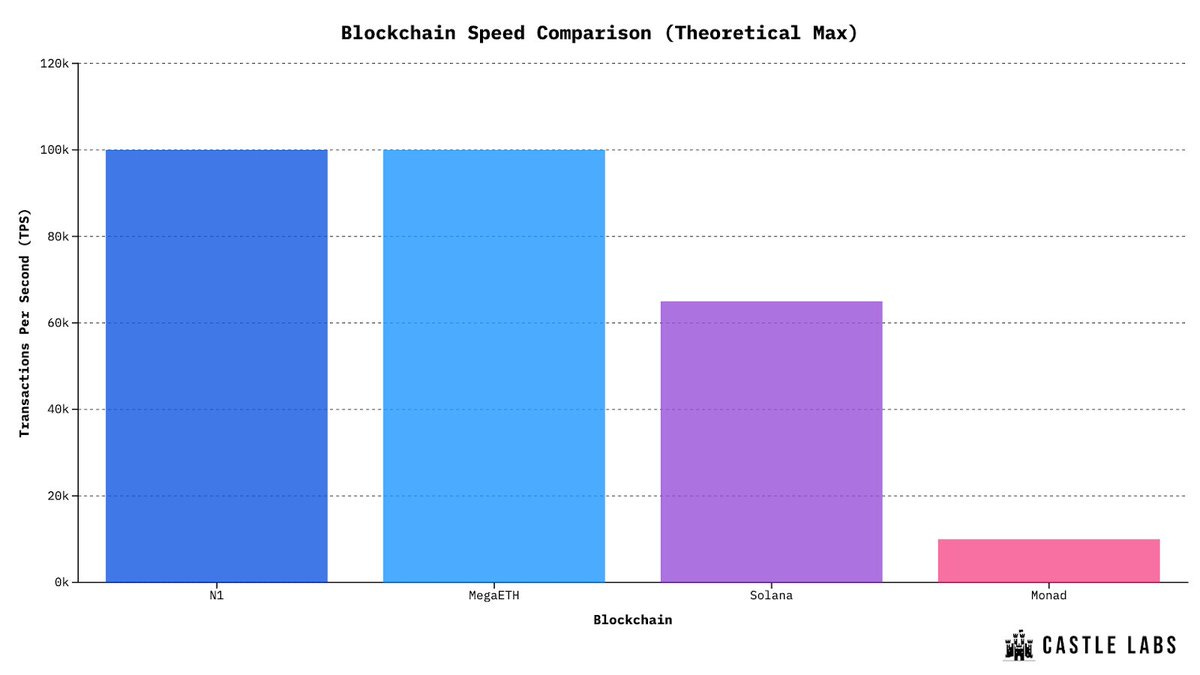
The L1 rotation trade has exhausted its potential. We have seen the same infrastructure being repackaged with slightly higher TPS and slightly different consensus mechanisms, all fighting for a fragmenting share of developer mindshare: more users, more apps, and somehow less revenue. It is the same asset, with different marketing ploys. Speed is not a vector of profit.
To understand how N1 is breaking away from a saturated marketplace, Dima, the founder, shared his secret recipe with us.
Dima’s provenance is essential to understanding the N1 thesis. A college dropout in 2021, he started building on Solana in early 2022. He launched, he saw the ecosystem collapse, and he survived.
While Solana is now a functional chain (which, thankfully, has evolved since FTX), Dima realised it wasn’t designed for the specific, high-frequency demands of a truly high-performance exchange. One cannot build a CEX-killer on a general-purpose chain.
This realisation led to N1, which was not devised as a chain for everyone but as a highly specialised environment for high-performance perps.
The market is obsessed with ‘chains.’ Dima is obsessed with ‘products.’ He expects the same level of obsession from both his team members and the builders N1 incubates.
We often talk about community or tech, but the real differentiator in crypto is the psychological profile of the founder. When Dima was asked what traits he favours when builders apply to N1, the bar was simple: Obsession.
“It’s not enough to be a good coder. You need to be immersed. You need to understand the user because you are the user.”
The challenges in building a vertically integrated superapp chain are endless. Without a near-pathological obsession with the product, you won’t survive the job.
“To build on N1, there is a minimum bar, but you need to realise there will be endless challenges. You need to understand users and be immersed. Obsessed with the crypto space.”
Total domination
The N1 philosophy is that launching another L1 is uninteresting. The alpha lies in superapps, built in-house, capturing the user from end to end.
The first manifestation of this is 01, N1’s flagship perp DEX. The vision expands to Terminal, a superapp designed to accept liquidity and logic from everything on N1 and beyond, bridging external chains into a singular, unified experience.
By keeping development in-house, N1 ensures that the application and consensus layers are perfectly synchronised. They aren’t waiting for third-party developers to figure out how to use the chain; they are building the chain to serve their own killer apps. The strategy is total domination: every user, every flow, including the massive potential of onchain FX, under one umbrella. It obviously echoes the Thiel approach in his other ventures, the absolutist need to dominate a sector by offering one, and only one pristine product.
While others are fighting for ‘mindshare’ and hoping L1 tokens retain high valuations based on speculative infrastructure promises, N1 is laser-focused on one vision: the product. They don’t spend time looking at what others are doing. They focus solely on the vertical integration of their own stack.
This alignment with Founders Fund wasn’t accidental. Dima noted that the cap table needed to be balanced, no black and white thinking:
“We wanted partners who could support us in the later stages. Not just investors; the goal was to be able to rely on them in the future too.”
Before scaling features, N1 aims to achieve absolute domination in a specific category. They aren’t trying to be everything to everyone. They are trying to be the only thing that matters for high-performance trading: a monopoly.
German efficiency
If democracy is the “deadly race” Thiel warns against, then most blockchains are losing. They are trapped in a digital parliament resembling the French Assemblée Nationale: a noisy, global room where every transaction, from a billion-dollar arbitrage to a degenerate memecoin mint, must be heard, verified, and voted on by everyone. This is the Global State problem. Solana is the ultimate monolith: a singular, shared timeline. MegaETH presents a different approach to onchain politics: their solution is to take that same parliament and pump it full of crack. They optimise the hardware to its absolute physical limit, vertically scaling the EVM. It is a faster horse, undeniably, but it is still championing global consensus. This paradigm is still deeply entrenched in the libertarian blockchain ideology that emerged in 2010.
N1 is the Zero to One shift Thiel mentioned in his essays. It abandons the democratic dogma entirely.
Technically, N1 is an asynchronous, sharded Layer 1. It rejects the idea that all applications must share a single execution environment. Instead, it offers horizontal scalability.
Here is how the machinery works and its unique design and value proposition:
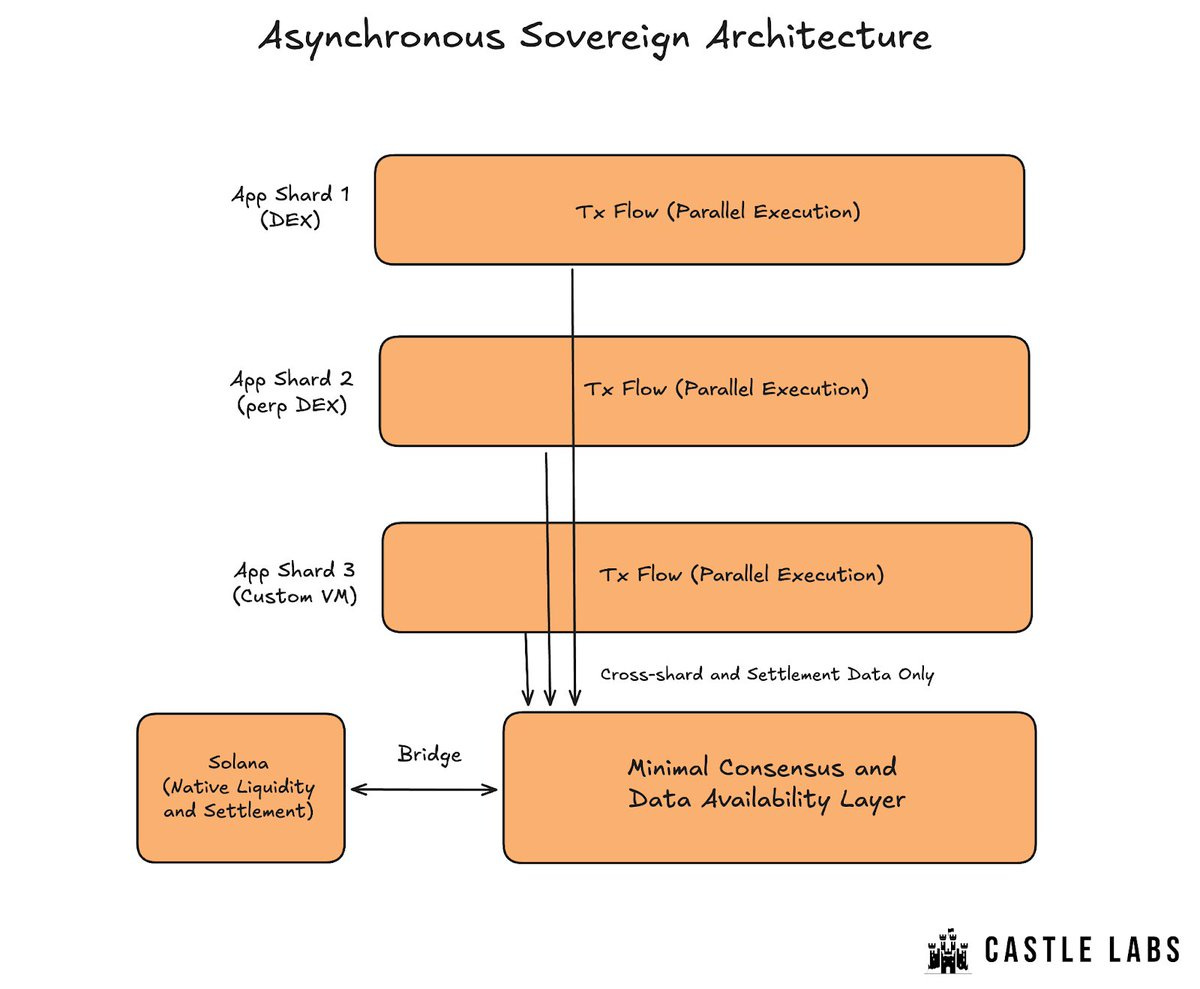
Asynchronous Execution: In Solana or Ethereum, transactions form a single-file line. In N1, there is no global ordering for local events, and applications act as sovereign islands. A transaction on a DEX does not need to be aware of a transaction on a perp exchange; as such, they run in parallel, asynchronously. There is no global ordering for local events.
Consensus as a last resort: The network only ‘votes’ when absolutely necessary, specifically, when assets need to cross borders.
Native Liquidity: N1 does not build an island in the middle of nowhere. It anchors itself to Solana for settlement and liquidity.
VM Agnostic: Because execution is isolated, N1 doesn’t care what language is employed. It can run any verification procedure (SNARKs, etc.).
Through these technical choices, N1 is the architectural embodiment of Thiel’s 2009 essay: a collection of sovereign startup-technomonarchies, unbothered by the plebs’ whimpers. While Solana and MegaETH fight to build a faster playground for the masses, N1 has built a silent, congestion-free Autobahn for the elite. Deutsche Qualität.
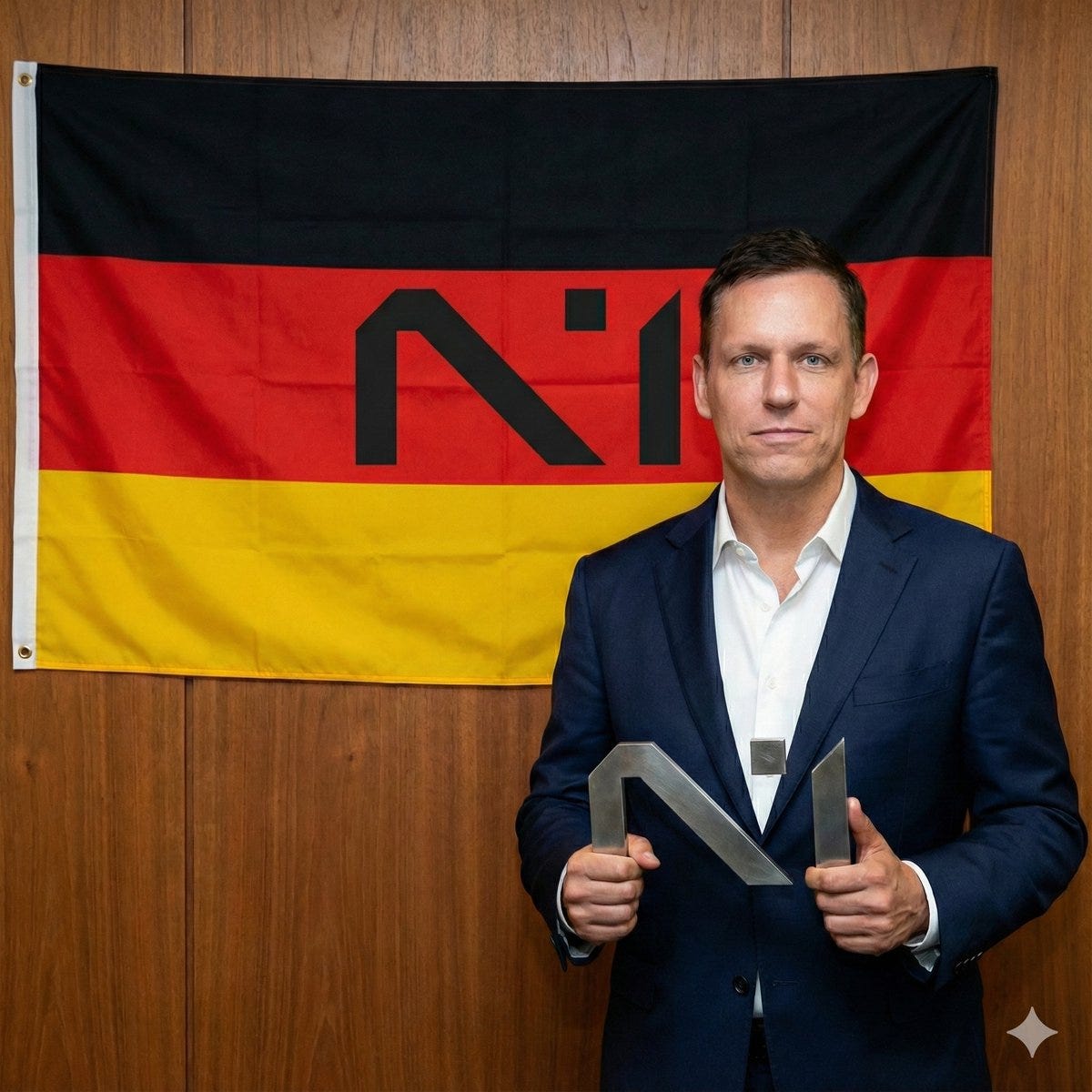
The N1 Cartel
Thiel’s baby belongs to a new elitist class of chains defined by the superapps built on top of them.
According to Delphi Digital, “the Next Big Thing for Crypto could be SuperApps. Fintech superapps like Nubank, Revolut, and Cash App generate billions in revenue by bundling financial services into one interface. But they’re constrained by permissioned banking systems built on traditional rails.”
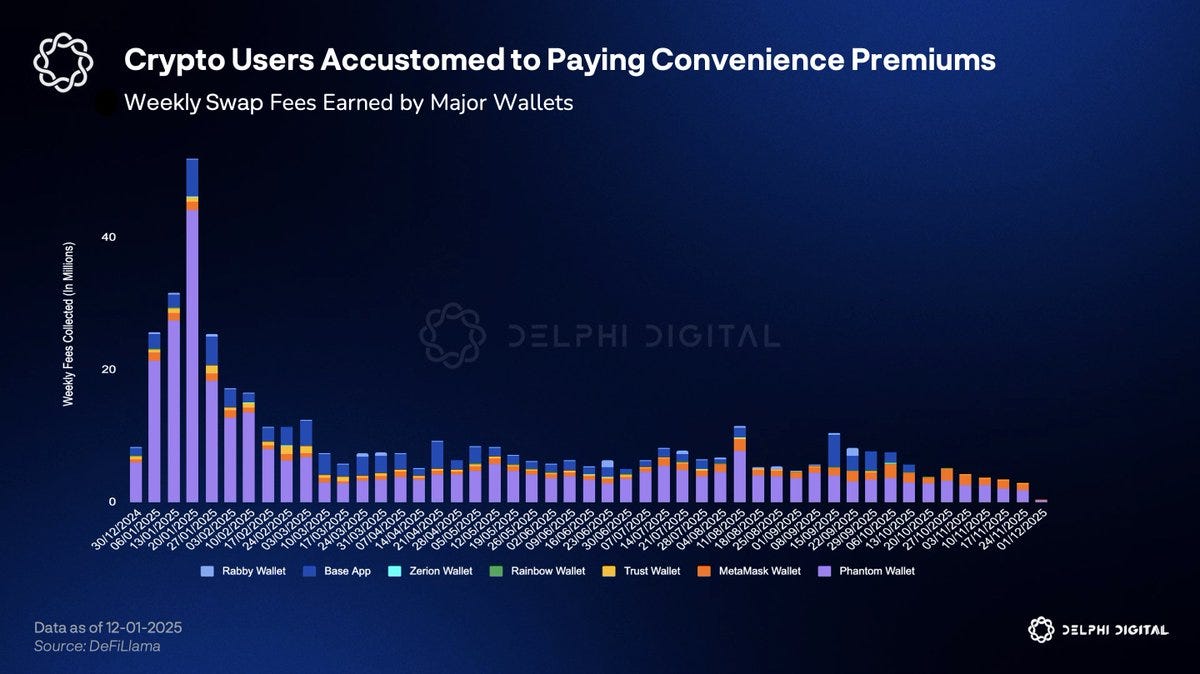
Like MegaETH, N1 onboarded flagship protocols aimed at transforming crypto entirely. So far, the most widely adopted crypto applications are perps, lending, stablecoins, memecoins, launchpads, and other retail-friendly venues with a sleek UI. N1 has few apps, but, like Palantir, Nubank, or SpaceX in their respective fields, it aims to entirely remodel the crypto experience. This aggressive approach mimics Thiel’s TradFi products, with one company for one sector, one monopoly for one target audience. Drones for the White House, rockets for Musk, lightning-speed apps for traders.
N1 is not a chaotic bazaar like Ethereum, where any developer can deploy a mediocre smart contract. The ecosystem is structured more like a theocracy or a sovereign corporation. They don’t want a thousand average apps; rather, a few lethal ones. These are not just dApps, they are the state-owned enterprises of the N1 cartel:
The current lineup consists of three flagship implementations, futuristic machines designed to demonstrate the full power of the infrastructure.
01
01 is the crown jewel. 01 is the reference implementation of N1’s power. It is a fully onchain CLOB running on its own dedicated shard. It pulls liquidity from Solana but executes in a private vacuum.
01’s founder, Cited, shared his take on N1’s engine. A former operator at a crypto unicorn turned trader, he connected with the N1 team over a shared frustration: current DEXs were simply too weak.
They wanted a venue capable of running complex, one-click trading strategies without hitting the invisible wall of ‘compute limits.’
He finally took over in early 2024 with his own team and savoir-faire.
For Cited, the choice to build on N1 wasn’t about tribal loyalty to a new chain but about pure pragmatism. As he put it:
“For me, I think it’s more about the application and the product than what chain you’re building on.”
He needed an environment where the product could run sovereign execution without worrying about neighbours clogging the network, and N1 was the only architecture offering that distinct infrastructure.
Despite his pragmatic, hands-on approach to crypto, Cited shares the same obsession with power and efficiency as Mr. Thiel. If a blockchain is an emergent technology, N1 has to perfect it and turn it into not only a reliable tool, but the best of its category. Like the iPhone, Porsche, or the M-16, one distinct product rules, and its competitors must fight tooth and nail to survive.
To power the exchange, 01 relies on S-tier liquidity providers. 01 isn’t just courting the usual crypto-native prop shops; they are deep in talks with traditional family offices and TradFi outfits. The green light has already been signalled by several major players.
The symbiosis between 01 and N1 allows both teams to focus on their own expertise:
“I like that our team can focus on the DEX and the N1 team can separately focus on the chain and ecosystem, kind of like if Hypercore and HyperEVM is separated.”
While N1 builds the rails for institutional-grade finance, 01 onboards the fat cats:
“01 is my vision of a perp dex I can see both institutions using, as well as retail. I think retail will seek more advanced trading strategies and styles when it comes to trading, and 01 is going to be able to deliver.”
01 is currently being tested by the public on an invitation-only basis and should be ready to launch soon, along with a vault.
Terminal
If 01 is the engine, Terminal is the cockpit. This is the hub for the N1 ecosystem, a unified, latency-free interface that aggregates positions, cross-chain assets, and performance analytics into a single view. It strips away the fragmented UX of modern DeFi (switching chains, signing endless approvals that take ages to execute, if at all) and replaces it with raw, Bloomberg-style efficiency.
TradeRush
While 01 handles the heavy institutional flow, TradeRush is the high-velocity fun app. This is the gamified layer, weaponising N1’s speed for competitions and retail engagement. On N1, TradeRush runs on its own shard, allowing for millions of fast interactions (leaderboards, achievements, high-frequency volume) without slowing down the serious money on 01.
This trinity (Terminal, 01, TradeRush) proves the Zero to One thesis.
One Bloomberg-like app with a universalist approach to crypto, one flagship trading app built specifically for N1, and finally the apex of the consumer app, designed to be fast, entertaining and simplistic.
By controlling the entire arsenal, N1 creates a user experience that feels less like crypto and more like a sovereign fintech state.
Crypto for the Few and the Many
High-end products are destined for a wealthy clientele, but crypto has always been an egalitarian asset. If N1 aims to embody the iPhone of chains, it costs the user exactly $0 to use it.
The original premise of crypto was to pull fiat out of the heavily regulated financial system to keep it away from the State’s prying claws; times have changed, for better or worse, but it is still within anyone’s grasp to set up a wallet, connect to a dApp, and start trading, staking, or lending.
The inherent risks of such a libertarian tool (total freedom for the user, be it to triple their assets or lose it all) vary; it is child’s play for the initiated, while new entrants often pay a heavy price. Crypto is still the only industry where one can become a millionaire overnight; aside from very risky options trading, the stock market is a game solely for patient investors (which we are not).
Ray Kurzweil’s Law of Accelerating Returns dictates that technological progress is exponential, not linear.
The exponential view recognises N1 as a paradigm shift: a hyper-performant execution layer that decouples compute from consensus. It is yet another iteration of the same monopolistic strategy Thiel employs with his investments, this time freely available to the masses. Ironically, N1 democratises speed and an elegant trading experience, putting the final product of a long cycle encompassing computer science, investment banking, engineering, finance, marketing, and PR in anyone’s hands.
Citadel’s quants, State Street’s algos, BlackRock’s models, and Goldman Sachs’ soft power were thus far reserved for the elite. Crypto opens direct access to Wall Street-tier finance.
Treaddfi is even offering algo trading to the masses, paving the way for even more advanced financial tools in the hands of the average Joe; even if you don’t understand how it works, you can use it.
Zero to One, onchain
It is expected that the ecosystem we obsessively spend hours every day using will be unrecognisable in a few years. Due to its nature, inherently fluctuating, ever-changing and dependent on external technological progress, crypto is bound to blow your mind. Improvements are not always measurable in terms of metrics, performance, or throughput, but N1 is a good example of how far we have come when gauging advancement through hard data.
It is not particularly surprising that Peter Thiel chose to build his own chain: his autocratic approach to ownership dictates that blockchain technology be perfected, another highly valuable sector that echoes his early investments in financial software.
N1 follows the long line of highly successful companies under the patronage of Founders Fund.
Led by a team of laser-focused crypto natives, the synergy between traditional US capitalistic imperium and frontier finance is bound to birth a unique product.
One chain to trade it all, right, Mr. Thiel?