

The next leg of the RWA cycle will go beyond simplifying access to assets and into hardening their infrastructure and utility.
Putting assets onchain was the easy part.
Here’s what we’ll cover in this edition:
We sit down with Redstone to discuss what’s next for tokenisation after TokenizeThis in NYC
Spark and Uniswap go after the next generation of liquidity infrastructure for the swathes of new stablecoins coming on chain
Cboe revives S&P 500 binary options as prediction-market fever spreads into TradFi
We recap our privacy stream with builders from across the stack in Railgun, Arcium, and Ambire

On The Record with Redstone for TokenizeThis

Last week, we published a flagship report, Real-World Assets: Bringing TradFi Onchain, in partnership with Redstone for TokenizeThis.
Real-world assets (RWAs) have become the fastest-growing category in crypto since the beginning of 2025, with the tokenised RWA market now at $28.2 billion, a 500% expansion since January 2025. This growth is correlated with rising institutional interest from the likes of BlackRock, Franklin Templeton, and Apollo, which have themselves launched tokenised products.
However, even with strong growth metrics, RWAs struggle with limited representation in DeFi, with a current market cap of $3 billion (~10% of the total RWA market cap). This is due to factors such as regulatory & KYC concerns, as certain assets need to be restricted by region or to qualified investors, and a lack of instant redemption, which DeFi protocols require to perform liquidations instantly.
We sat down with Bella from Redstone after the conference to discuss their focus on tokenisation and what they hoped to achieve through their hosting. She told us that “hosting our own event gives us the flexibility to curate the right room more effectively while making sure the agenda is hyperfocused on RWA tokenisation and institutional use cases.”
Institutions are moving beyond exploration and proof of concepts and into real pilots and in-product applications. This can be seen not only onchain but also in the attendees at TokenizeThis, including C-suite speakers from Securitize, Fidelity, Citi, Bloomberg, DTCC, Invesco, and many other traditional players: “No one is asking if tokenisation will happen anymore; the conversation has now shifted to focusing on the infrastructure that will support it, distribution, and increased utility of these onchain assets.”
Bella’s point is that tokenisation is no longer the end product. It is a new base layer that can be built upon, but one that requires many more supporting parts than onchain-native assets. Before RWAs can be fully integrated into vaults, lending markets, or derivative products, the plumbing needs to be correctly configured beneath them: pricing via oracles, asset custody, jurisdictional compliance, and regulatory reporting.
This week’s headlines follow similar lines.
Allium, the blockchain data firm, raised $40m, showing firsthand how institutional tokenisation needs the data, reporting, and reconciliation side of the equation to move past simple token issuance.
Framework Ventures, on the other hand, has been looking further into the future, raising a new $400m fund aimed at using tokenisation to solve financing problems outside of crypto.
Tokenisation is a huge opportunity for the world economy, but it needs to be usable inside existing institutional workflows and business operations.
One of the most important things to watch this year is which companies are actually making this happen behind the scenes.
Read our full report on the entire sector here:

Stablecoins Everywhere
The adoption and acceleration of tokenisation have largely resulted from stablecoins finding product-market fit and growing from strength to strength in line with regulatory clarity, such as the GENIUS Act.
This success and the clear business case for stablecoins are beginning to spur banks, exchanges, and fintechs to launch their own stablecoins, using them not only as revenue generators but also to retain customers within their ecosystems. If this continues to play out, we will see not only a large increase in stablecoin market cap and payment volume, but also an increase in the number of discrete stablecoins, leading to a further fragmentation of the liquidity landscape.
So what happens when there are hundreds of in-demand stablecoins?
To facilitate the movement of this many stablecoins, liquidity and exchange infrastructure needs to evolve away from inefficient, isolated pools. To overcome this new challenge, Spark has introduced the Stablecoin FX Layer, built on Uniswap v4.
Hooks in v4 allow custom logic to be embedded into a pool’s behaviour. In this instance, Spark uses them to hold its assets in a vault, earning yield, while making that capital available to users swapping from the pool. The whole design operates atomically: when a swapper wants to use the pool’s capital, it pulls the assets in at the exact right moment and then returns the funds in the same block.
The initial deployment migrates over $150m of PYUSD and USDT paired with USDS, with Spark acting as the pool’s LP. The aim is to allow anyone to seamlessly swap stablecoins at market rates, moving between ecosystems without friction.
The world is already moving in this direction. Revolut and Robinhood are exploring stablecoin initiatives. A consortium of major European banks is working towards a regulated euro stablecoin, and we are also hearing of similar movements from Japanese institutions.
The next question is how they will coordinate their liquidity infrastructure once onchain, and whether they will rely on decentralised technology stacks like Sky, Uniswap, and Spark.
Binary Options are Back in Fashion
A separate sector making the world take notice is prediction markets, with monthly volume across Polymarket and Kalshi rising from under $5bn to nearly $24bn in the last year, not to mention them each raising at multi-billion-dollar valuations from traditional institutions.
In fact, Kalshi’s crypto prediction markets’ monthly volume grew from $120M in November to $2B in May.
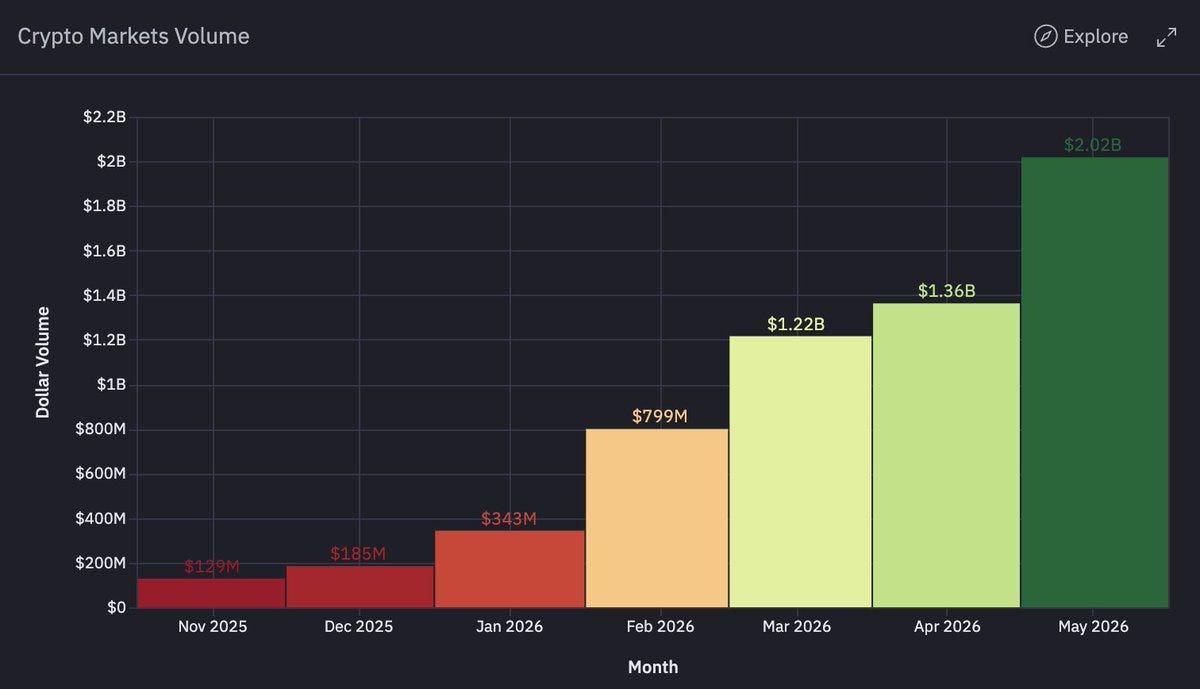
Their success is now spilling back into traditional markets, with CBOE reviving its S&P 500 binary options in response to the demand popularised on these prediction-market platforms.
This is something we have been looking at closely. Tomorrow, we publish our flagship report on volatility markets and their expression through options and prediction markets.
This overlap might seem out of place at first glance, but prediction markets closely resemble traditional binary options. These markets have a fixed expiration time and a binary payout structure that settles at either $0 or $1. What Polymarket and Kalshi have done is make the conditional payoffs feel retail-native by simplifying the interface and allowing users to express their views on an outcome without needing to understand greeks or manage margin and liquidations.
In tomorrow’s report, we’ll look at the evolution of options, both off-chain, where they are widely utilised and heavily integrated into the economy, and onchain, where they have had a mixed past but are experiencing a new revival alongside the growth of prediction markets, which in themselves are a type of volatility-driven outcome product.
Privacy for user protection and institutional adoption
Last week, we hosted Arcium, Railgun, and Ambire Wallet on a stream to discuss the privacy landscape, its evolution, and how privacy is becoming infrastructure for user protection and institutional adoption.
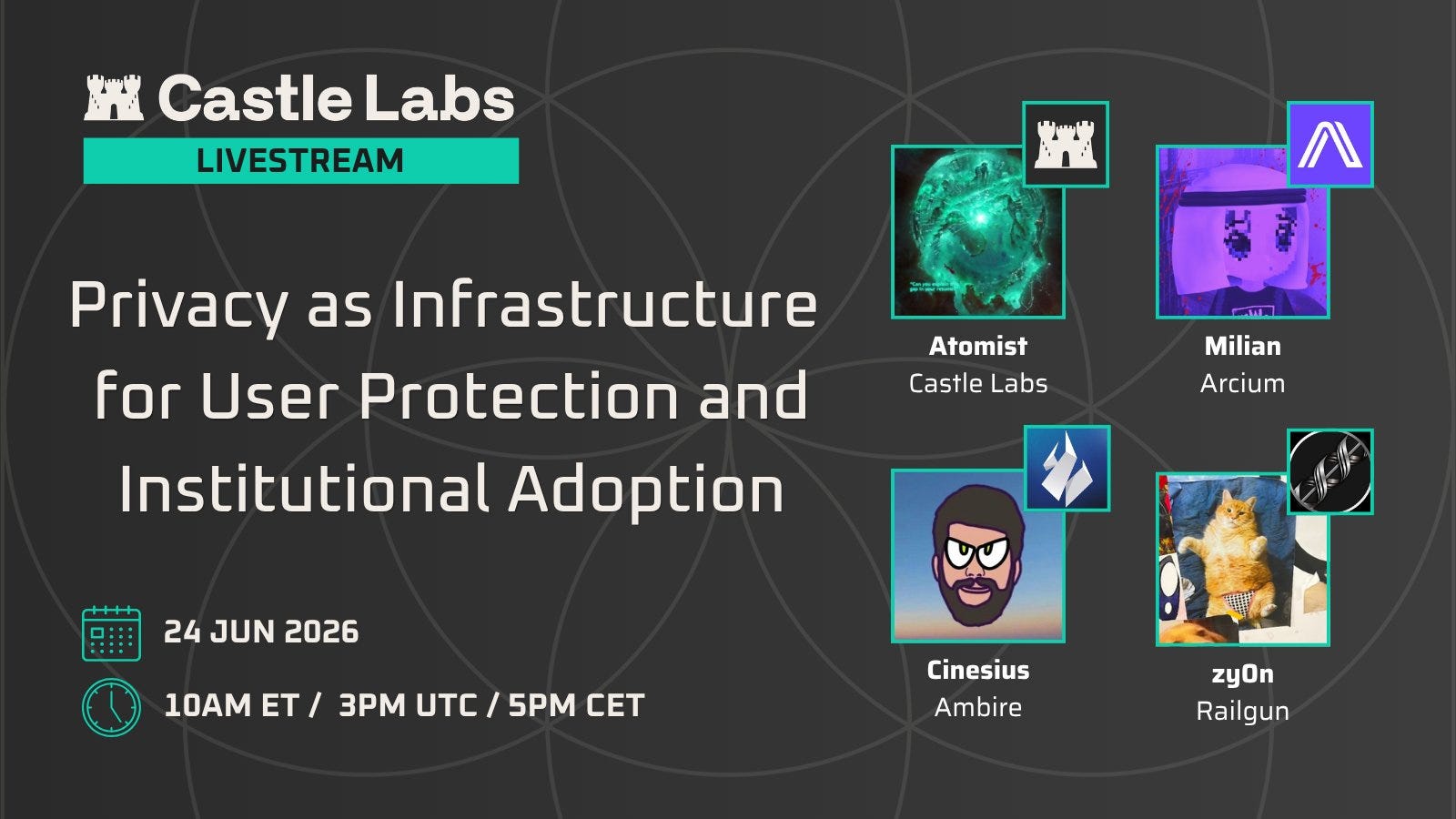
Privacy as a concept is well developed, but in practice it has been quite hard to implement and, when implemented, feels fragmented, making it easy for the user to get lost along the way. But things are slowly changing, and privacy, or more often referred to as compliance, is coming to the forefront of the industry’s focus.
Each guest sat on a different part of the stack, targeting a different problem for a different type of user:
Railgun is a set of tools for user privacy. It combines onchain contracts, SDKs, and wallets, and allows users to prove that their funds originate from innocent sets of actors. It can also prove their shielded funds without revealing their entire trading history, allowing someone to be both private and compliant at the same time
Ambire is the wallet the Ethereum Foundation chose to fork to create its Kohaku SDK, a wallet system with privacy built into the base layer. The wallet layer is extremely important, as it is an infrastructure layer we all interact with. If we are going to make privacy a default, one of the best ways is at this user level.
Arcium, on the other hand, is building encrypted compute to support a range of applications, from private AI to prediction markets and dark pools. Ambire focuses on encrypting data and ensuring that information flows remain private and compliant.
In the last month, we have published a number of flagship reports, but a recent piece of news touched on two of them specifically: both on the rise of vaults and the importance of privacy. Last week, Zama unveiled its Confidential Prime USDC on Morpho, curated by Steakhouse. This is a big step for the industry and one we have definitely been excited to see coming. Expect more applications like this, and a future world where confidential transactions, investments, and yield-earning opportunities are private by default.

Hyperliquid was added to the Monetary Authority of Singapore’s (MAS) Investor Alert List: Hyperliquid stressed that the listing is not a ban, enforcement action or finding of wrongdoing, but it has led to a number of rumblings across the industry about the future of Hyperliquid as a non-KYC venue, just as Binance and Bybit have been forced to exit the EU due to new restrictions. We have not seen any regulatory action against decentralised protocols in a while; could that be about to change?
DAO declines: ENS is the latest DAO to come into the spotlight for its struggles with capital management and operations. Katherine Wu, ENS COO, attempted to clear up some of the misinformation circulating about the proposal to tighten capital and resourcing controls.
Yield compression: Rami’s thread on looping captures why 2024-to-2025 DeFi yields were so profitable and why the trade is now harder amid higher borrowing rates, fragmented liquidity, and fewer lenders willing to hold exotic collateral. This compression in yields has led participants to look outside of lending markets for yield, particularly options venues, as a source of volatility income.
EthLabs hiring: EthLabs put out another announcement today clarifying who they are, what they’re about, and what they aim to achieve. They now have funding for 2-3 years of runway and are hiring many positions, including senior leadership roles. Who they hire and in what positions will be a great sign of what we can expect from them over the next year.
That’s all for this week!
Don’t forget to join our Telegram channel for the latest updates from Castle and all our research: Link here

In our newsletter, we may discuss projects or tokens in which we hold positions. While we aim to provide informative content, our views are not financial advice. Please conduct your research and consult professionals before making investment decisions. Crypto markets are volatile, and past performance doesn’t guarantee future results. Invest responsibly, and be aware of the risks. Your capital is at risk, and we do not accept liability for any losses.