

In this week’s Chronicle:
Vault curators come under the microscope after Hester Peirce warned that some crypto vault strategies may raise questions usually reserved for portfolio managers or investment advisers.
Robinhood Chain by the data after a month of being live, with memecoin launchpads taking more of the pie vs. RWAs than initially thought.
Fake World Assets brings NFTs back into the conversation, with various forms of ponzinomics.
BitMEX and BitMart shutdowns show how hard the exchange business has become, while DEX/CEX volume ratios keep moving in favour of onchain venues.
Mantle turns three, with the network pushing deeper into DeFi, tokenised equities, active strategies and RWA-specific trading infrastructure.
On our radar: Securitize Capital’s RIA approval, Marc Zeller / ACI’s stealth project, and HIP-3 Stars on Hyperliquid.

Are Vault Curators the same as Portfolio Managers?
The AUM of vault curators has grown massively over the past year. This is clearly demonstrated by the chart below, which shows AUM by Curator of Morpho V2.
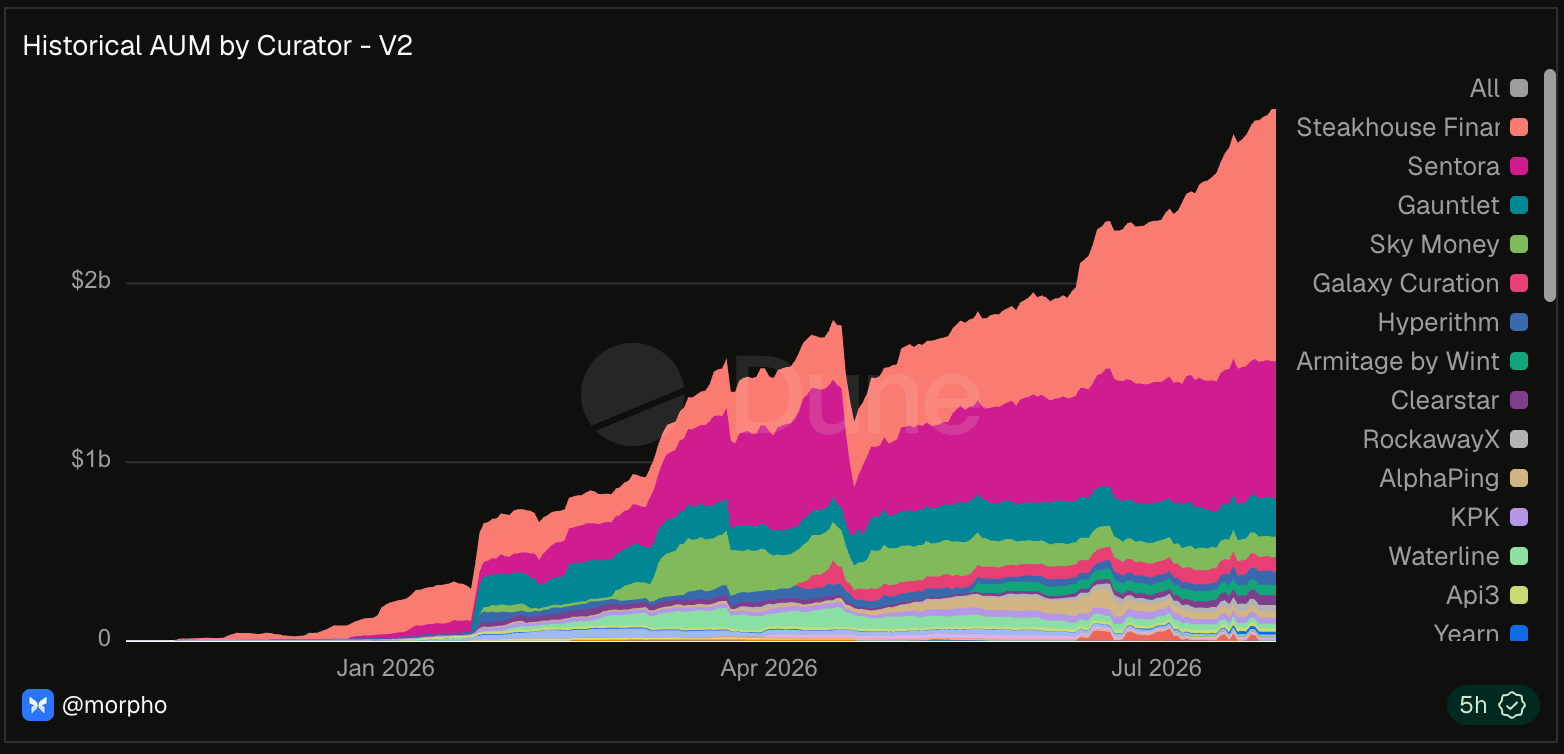
Among the factors that have contributed to it is that vault curation, at its core, resembles a dynamic similar to that of fund managers in traditional finance. At a time when institutions are increasingly looking at onchain finance and how to put their RWA to use, vault curation is the perfect vehicle for it.
Nonetheless, vault curators have operated without regulatory clarity on the topic. That is, until now. This is somewhat typical of any primitive coming from crypto, and it’s quite unavoidable, especially when it comes to asset management: a new primitive is born, it grows so much until regulators take notice, and eventually the new primitive has to comply with the law.
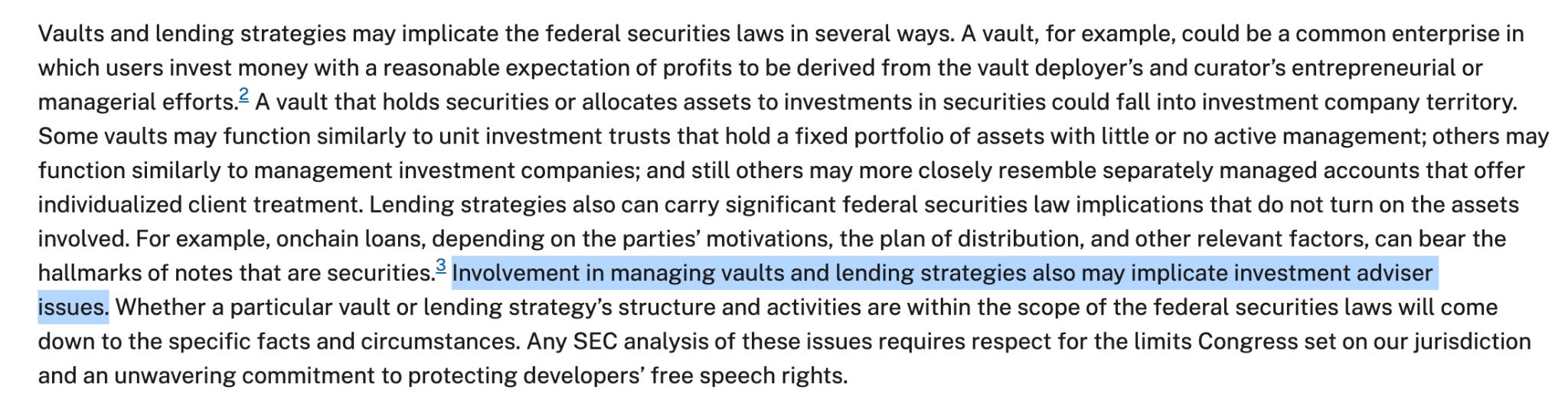
This happened just recently, when Hester Peirce warned that some crypto vault strategies may raise questions typically reserved for portfolio managers or investment advisors, depending on how yield activities are selected and assets are reallocated.
Participants across the sector understandably have different takes:
Togbe, previously of ACI, argues some curator policies and reallocation bots remain too opaque, especially where users cannot easily understand who is making decisions and when.
adcv of Steakhouse argues that vaults do not unilaterally set rates, and that the mechanics are not as simple as “curator selects yield, user follows”.
KPK highlights their transparency on the topic, publishing target weights for each market and detailing the underlying infrastructure (but not giving everything away).
Tesseract agrees with the SEC. Its position is that vaults are not a single thing: “At one end, fixed rules run by immutable code. At the other, a person is choosing strategies, moving capital and setting risk. The more discretion the curator exercises, the more the vault starts to look like portfolio management.”
Matthew Graham of TokenLogic has a similar view: if a curator is selecting allocation and managing risk on behalf of users, the comparison to investment management is hard to avoid.
Whoever you agree with, regulation comes as a positive, meaning that vault curators will continuously be embedded as an alternative to traditional investment vehicles.
Regulation can bring increasing transparency on vault curators, which at times have been accused of being too opaque.
Curators can do a much better job at explaining and documenting:
their allocation policy, and who is able to change it
what happens under certain stress conditions
who is ultimately accountable for the vault’s allocations
what underlying offchain infrastructure is running
where the offchain dependencies and permissions sit
On the other hand, the hurdles of obtaining a license might prove hefty for smaller curators, thus stifling grassroots vault curation.
We can, however, expect many more regulated traditional finance managers coming onchain to run compliant vault positions.
Nonetheless, it’s still early to express what the SEC regulatory action on the matter will be.
We have seen the Morpho team and other representatives of the vault sector meeting with the SEC just after this memo was published.
We expect more concrete documents from the SEC in the coming months.
Robinhood Chain by the Data
Robinhood Chain was unveiled at the start of this month and has already captured a decent chunk of crypto mindshare.
The launch was initially framed around tokenised stocks, but over the month they have leaned more and more into memecoins, with Vlad posting repeatedly about these, several launchpads battling for attention, and a surprising approach to pairing memecoins with stock tokens inside AMMs.
This means users who want to trade the memes are effectively moving from ETH or USD, through tokenised stocks, and into the memecoin trade.
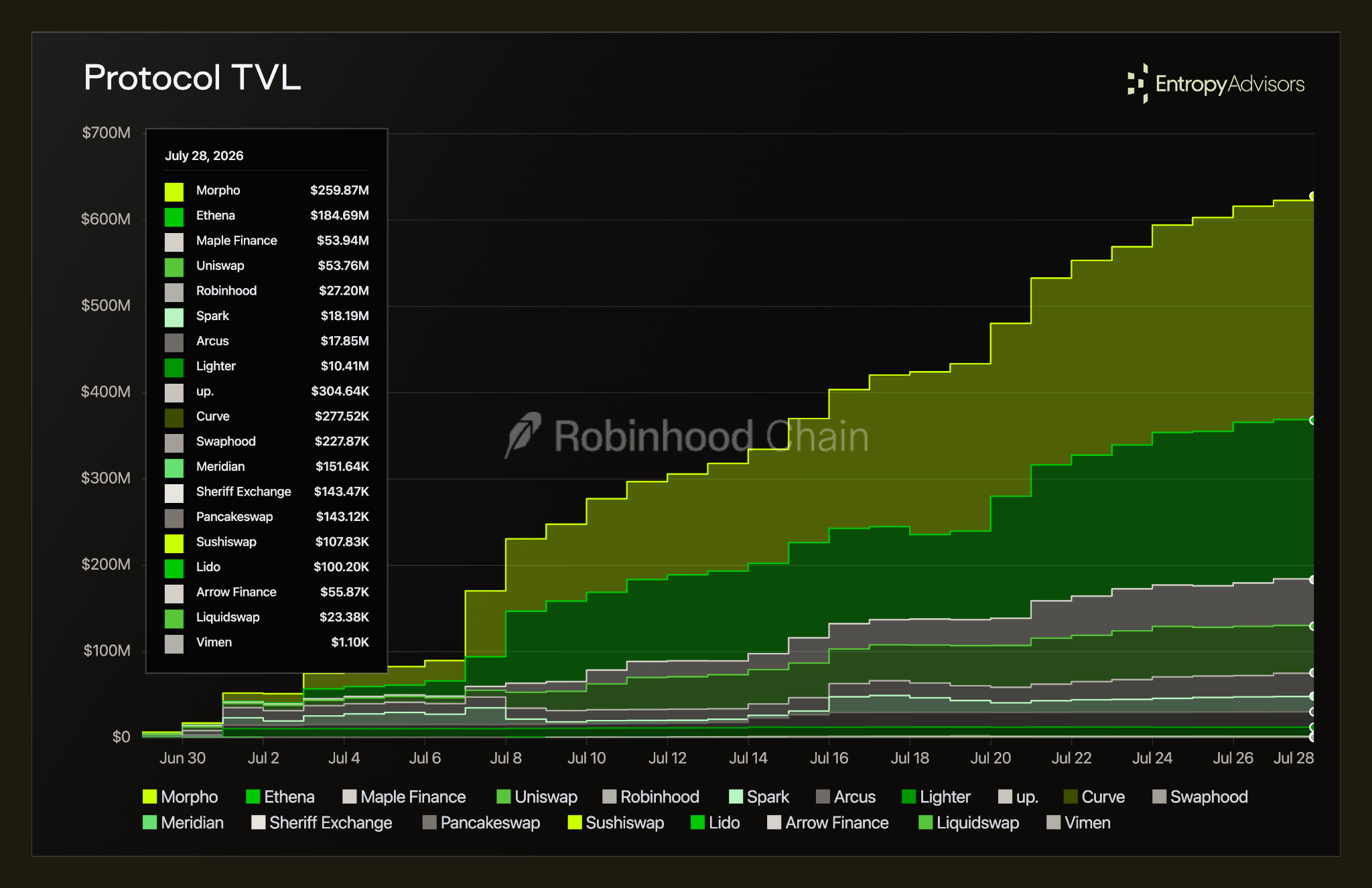
The chain has seen impressive growth and stability, with Entropy’s data showing over $800m in assets on the chain, with stablecoin market cap approaching $500m. In terms of TVL, Morpho accounts for roughly $259.9M, Ethena another $184.7M, with Maple, Uniswap and Spark behind them.
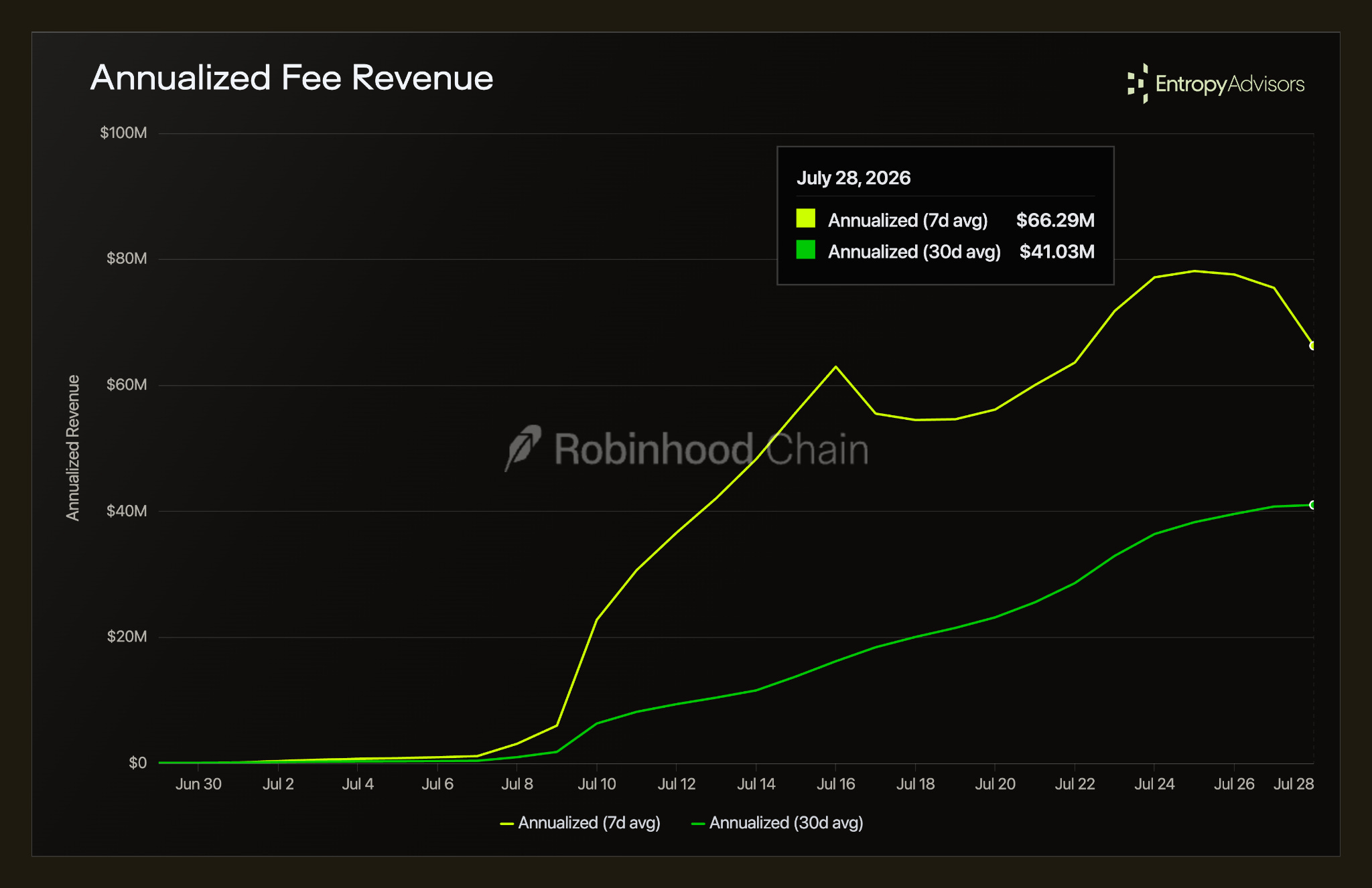
Daily fee revenue has been running between roughly $150K and $350K, with gross margin around 88-89%. The 7-day annualised revenue line is near $66M, ahead of the 30-day line at roughly $41M, suggesting that activity is still accelerating rather than rolling over just yet.
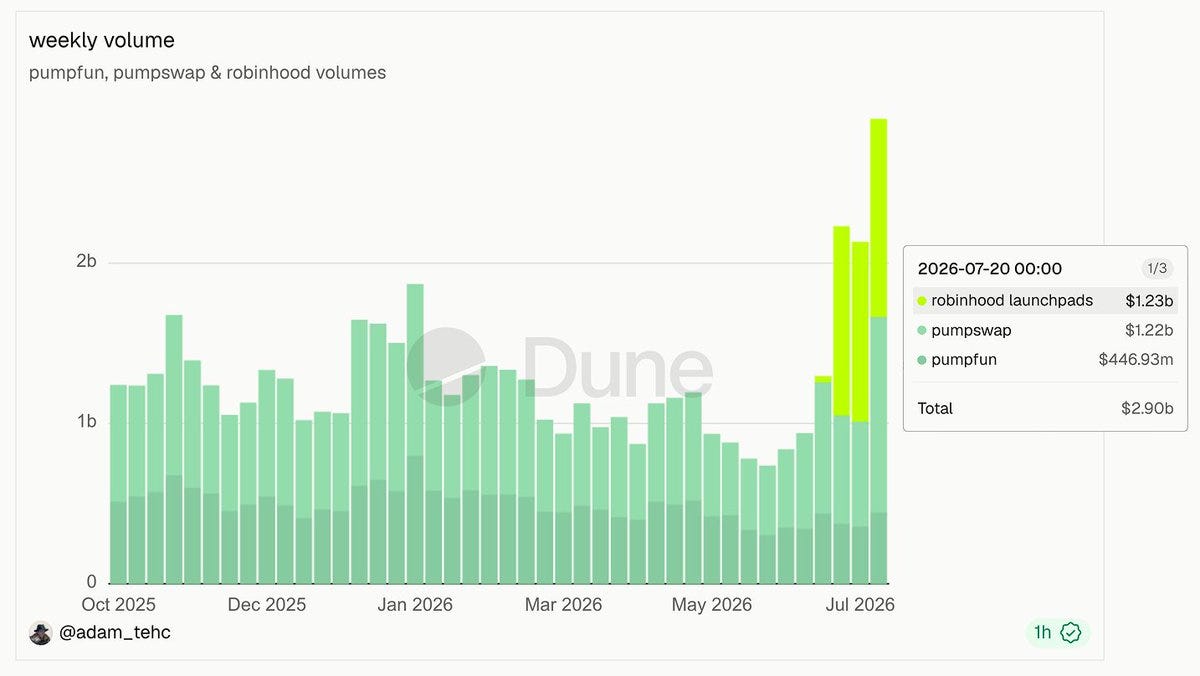
As mentioned, memecoins are dominating daily activity on the chain, with memecoin pairs at 65.9% of spot DEX volumes, versus ETH-USD at 24.1%, and Robinhood stock tokens at just 8.2%. This is happening at such a rate that Robinhood launchpads have now overtaken both pumpfun and pumpswap (pumpfun’s DEX) by volume.
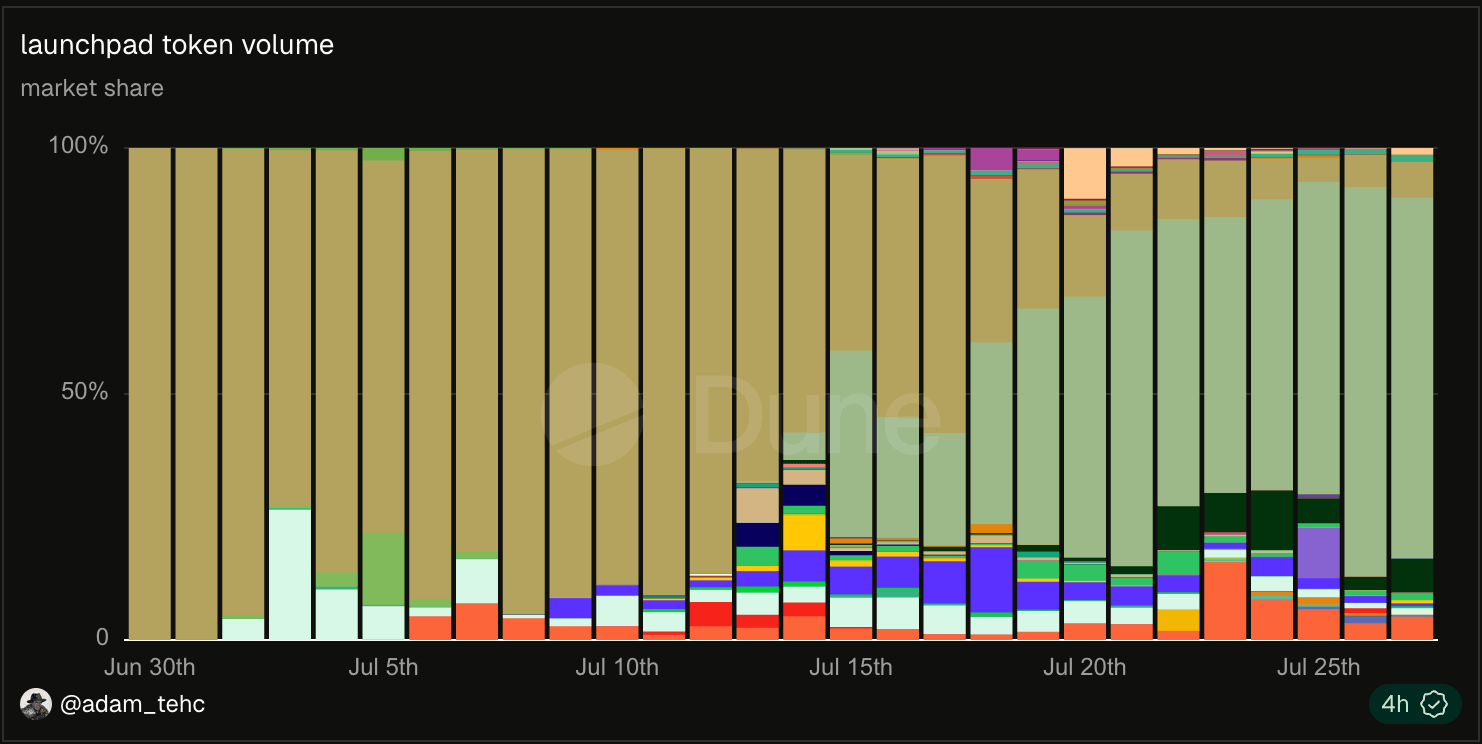
Of these Robinhood launchpads, pons now represents around 75% of the total launchpad token volume on the chain, generating over $2 million in total revenue so far.
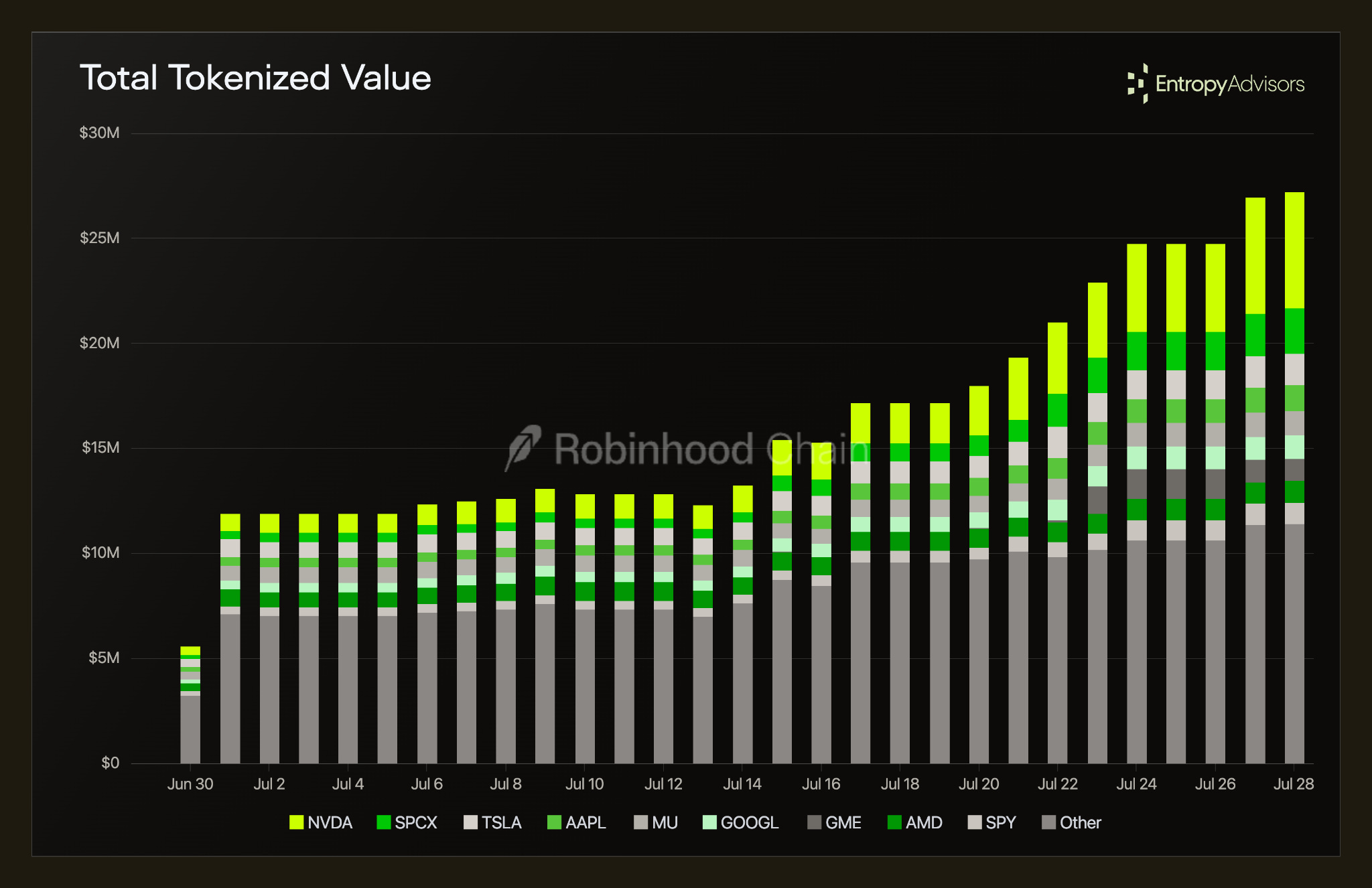
The stock side is still growing too, breaking $25 million in total tokenised value yesterday, and rwa.xyz reporting nearly 330,000 RWA holders across 97 assets.
Across the board, Robinhood is experiencing strong early traction and can be seen as more of a consumer trading venue than a pure RWA play.
Whilst the stock tokens and their underlying representations give the chain legitimacy, it’s currently meme coins and launchpads giving it velocity amongst users, and by pairing meme coins with stock tokens inside AMMs, they have cleverly found a way to embed a role for stock tokens inside of the high-volume meme coin trading category.
But can Robinhood Chain secure this meme coin trading and launchpad volume, and take a meaningful share from chains like Solana? Can tokenised stock deployment keep growing beyond the first wave of tickers? And how far will Robinhood go in integrating the chain and its assets into the main mobile trading app?
h/t Entropy Advisors for the data.
Are NFTs Back?
You meet someone on the street, and the guy goes like: “NFTs are not dead”!!!
You look at him with a pity look, throw $5 at him, and go home.
Then you open X and find out there is a new NFT gacha protocol on mainnet Ethereum.
WTH.
TokenWorks launched Fake World Assets, a protocol that at its core resembles some gacha dynamics:
NFT owners deposit NFTs in a pool with a corresponding ETH backing
Purchasers pay a price specific to each NFT pool and have randomised chances to win the NFT in question with each try

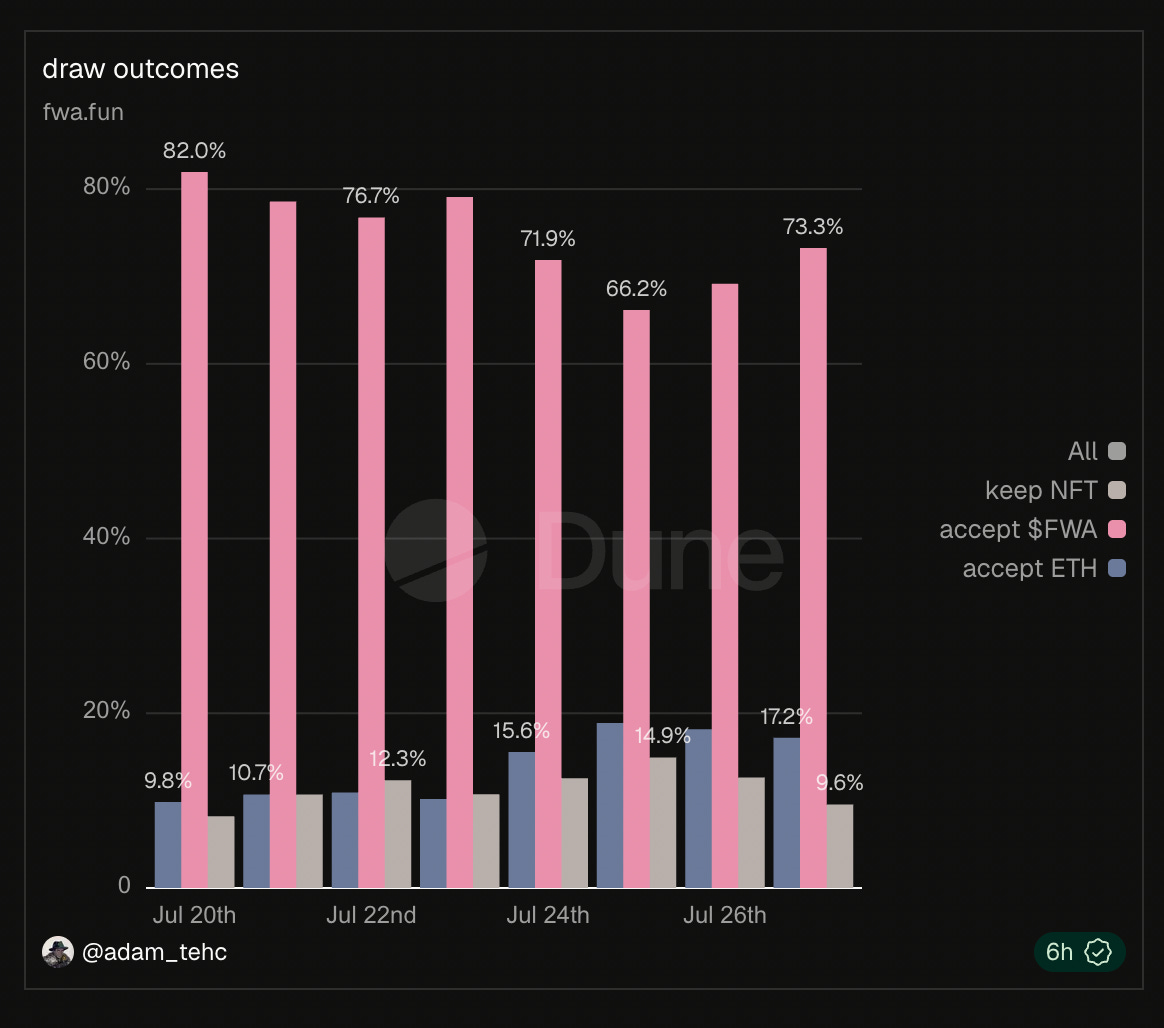
Users who win the NFTs have a chance to choose how to get paid. Here is some interesting data on the outcomes, partially biased because of the extreme and early stage of the FWA token during this week, which justifies why users opted for FWA payments in most cases..For a deep dive into how the protocol works, you can check:
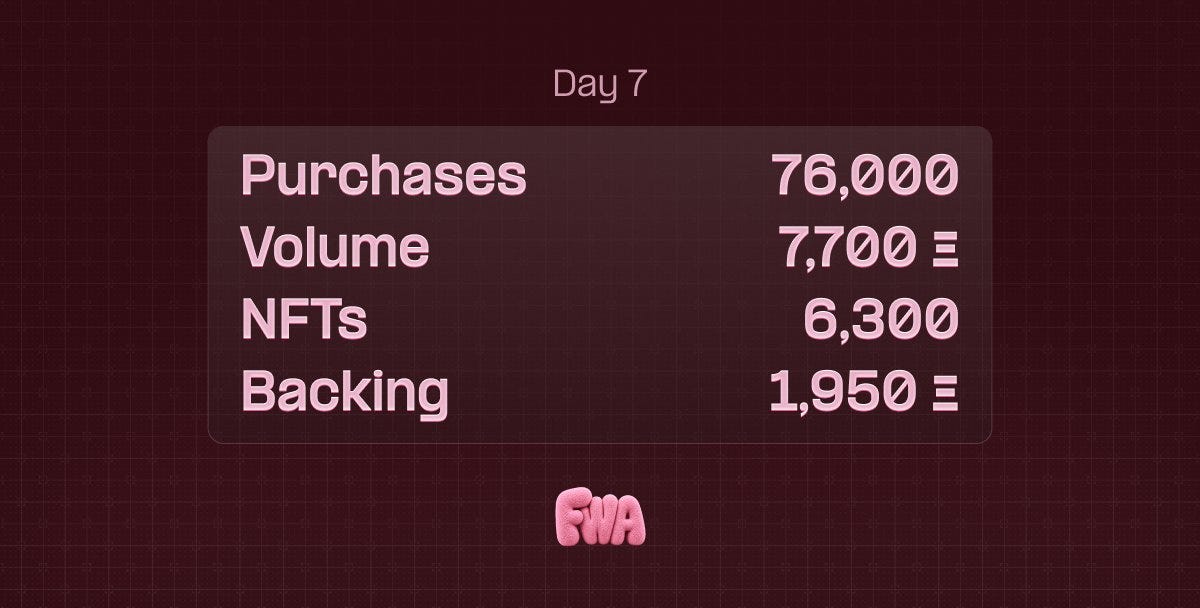
In just 7 days, the protocol is now responsible for 10% of gas consumption on the Ethereum mainnet. These are some stats that give a better idea of the activity:
It is still extremely early to say whether this is a short term burst or a dynamic which can last.
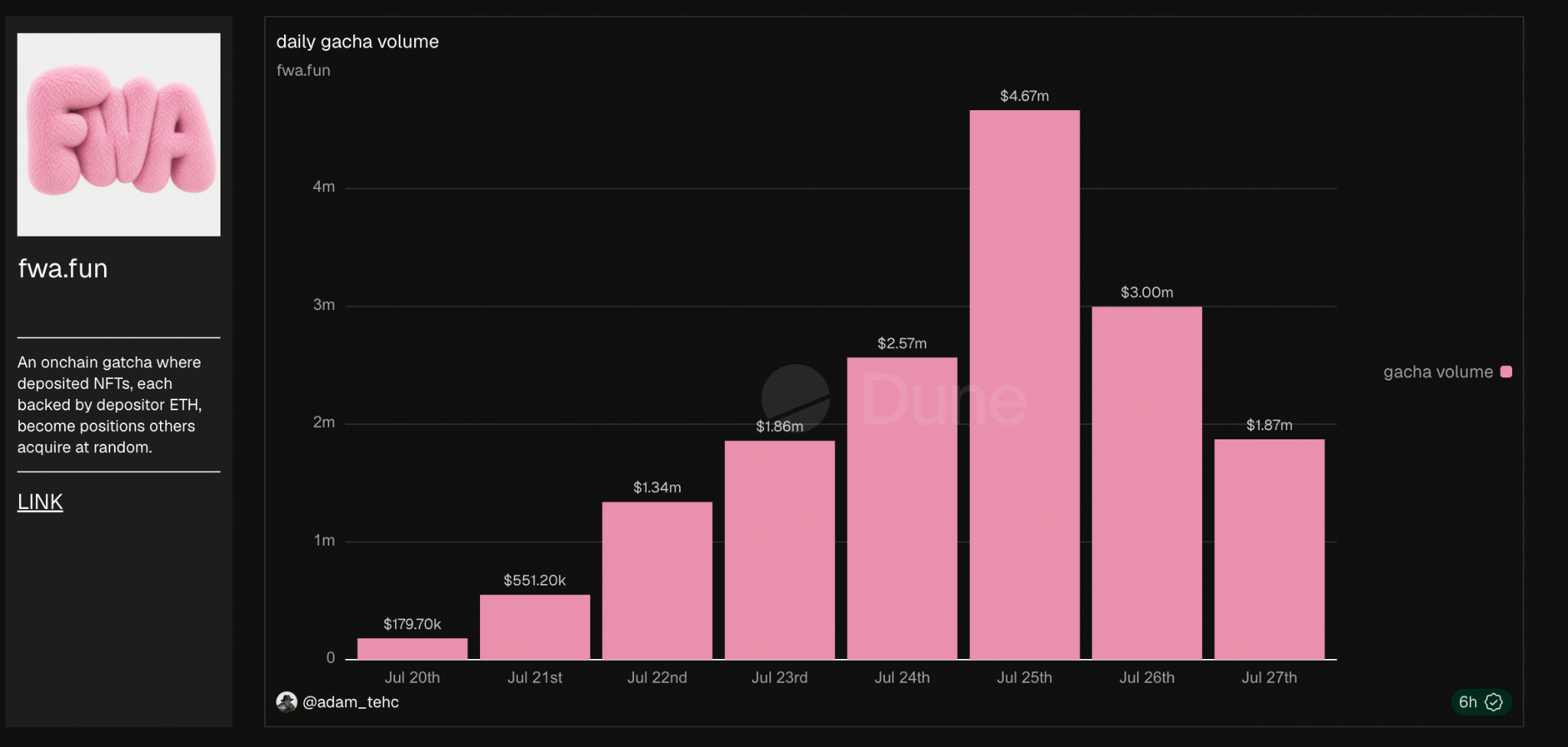
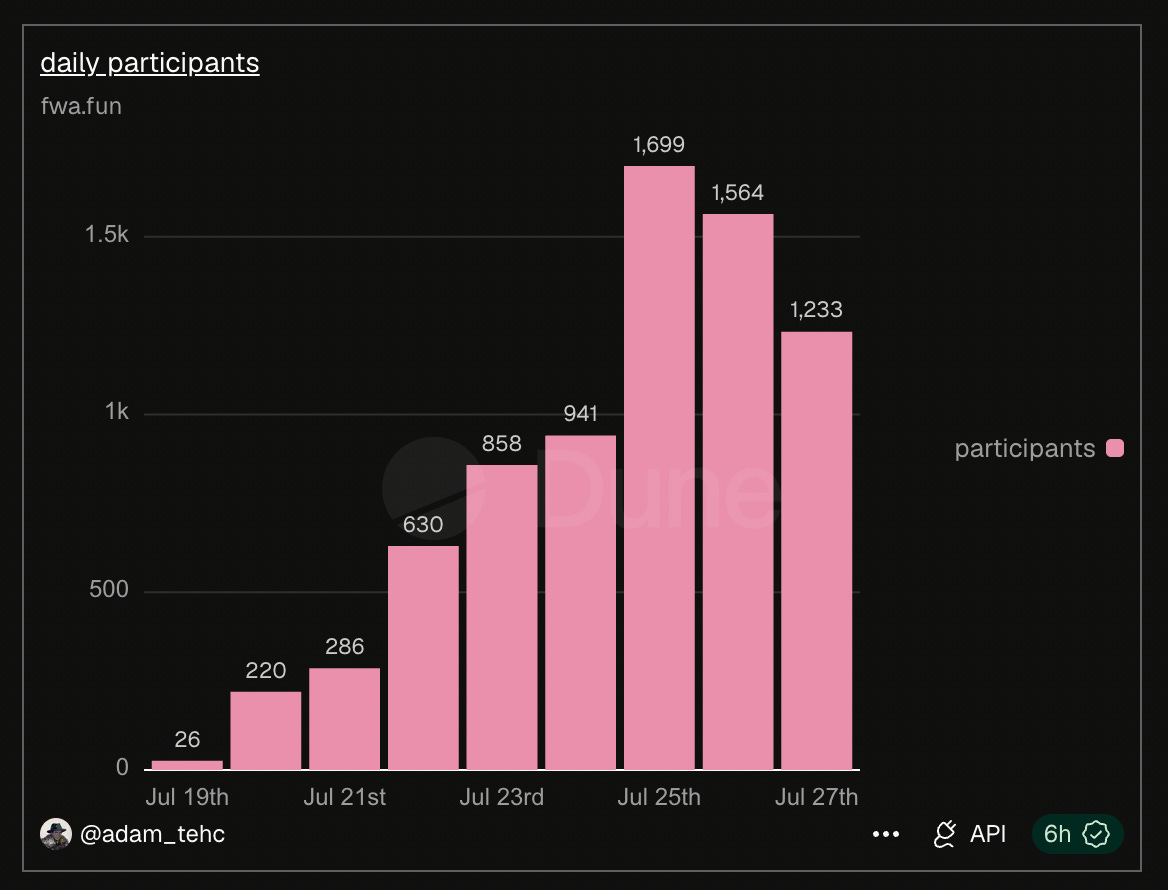
The daily participants trend is still very good, showing less inflation than those of volume, meaning fewer hardcore users doing lots of spins and more chill users doing a lesser number of spins.
While gambling should not necessarily be the only silver lining to make new things nowadays, in this case it shows how a simple consumer-focused protocol with a gacha dynamic can revive and attract interest.
More builders should take this as an inspirational example and an opportunity to build things that people use.
Not another L1, L2, or even prediction market app.
Crypto Trading is Moving Onchain
Just this week 2 CEX representatives of the old guard have shut down: both BitMEX, one of the OG CEX and BitMart.
What does this tell us? For once, the CEX business is brutally competitive and dominated by a few incumbents. This is often a duopoly or monopoly depending on which geographic region.
In addition, both regulation (for instance, MiCa in Europe) and competition from the likes of Hyperliquid, Lighter, Variational, and other onchain trading venues have led to a loss of users and volumes across the board.
The DEX/CEX spot-volume ratio hit 24.3% in July, a series high, up from 17.9% in June and around 18 to 21% for most of 2026.
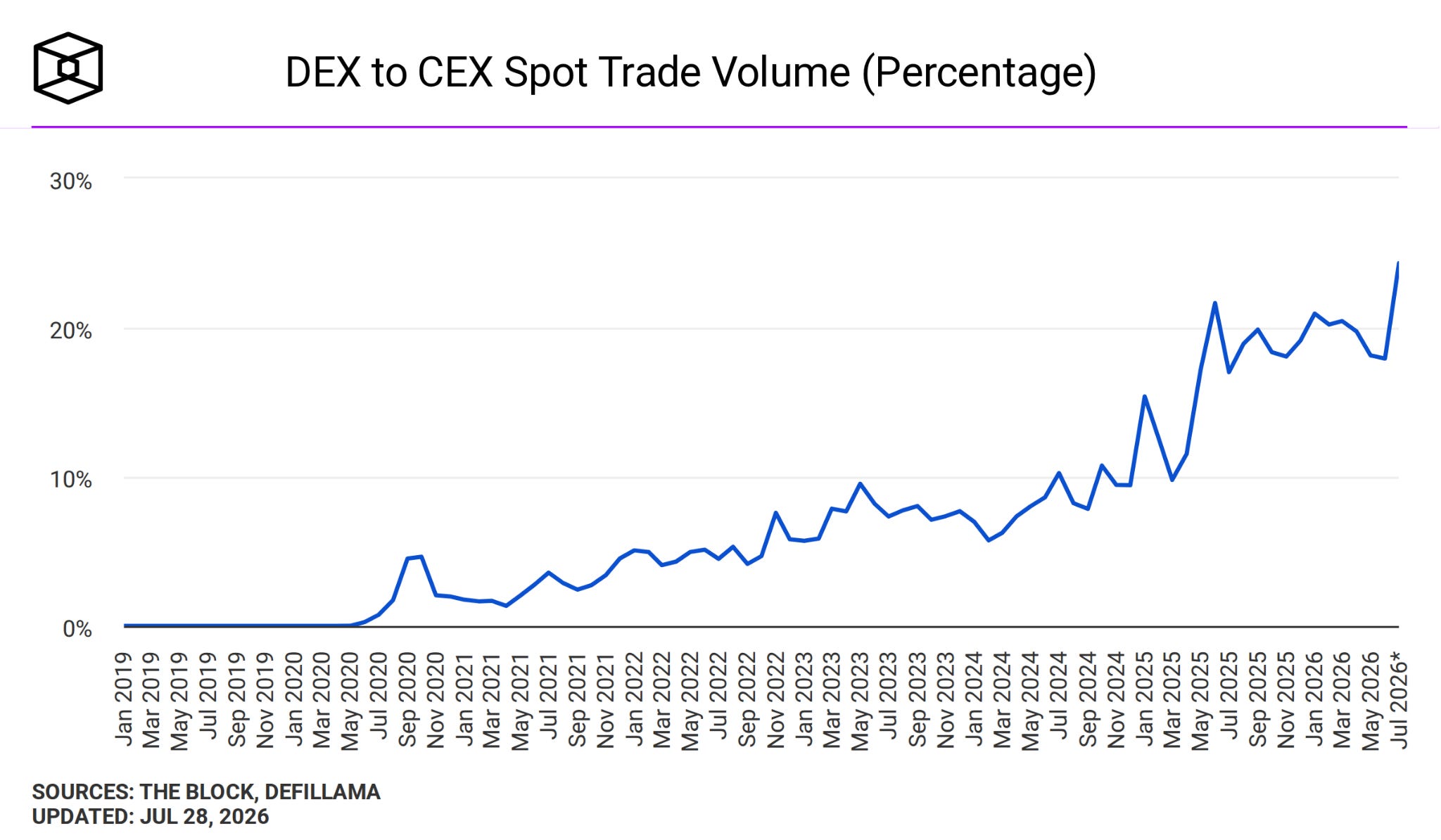
Exchange power is consolidating at the top, while the next growth or innovative layer is moving onchain. DEXs may end up the same way, with Robinhood/Uniswap on spot, Hyperliquid on perps, and a few app-layer distributors deciding where flow lands.
For the next cycle, we can expect fewer CEXs consolidating themselves, and more flow controlled by the venues and front ends that own distribution
Nonetheless, something important to keep in mind about the recent shutdowns is that they have happened in an orderly way and without affecting users’ funds, a sign that the industry as a whole is maturing and perhaps healing.
Mantle’s Birthday and Q2 Reflection
Mantle turned three last week.

The network started as a DAO to support the growth of open finance and develop decentralised, tokenised economies; its focus of late has been on DeFi, yield products and institutional-facing RWA infrastructure.
Nansen recently framed the Q2 thesis for Mantle as a full-stack distribution layer for tokenised real-world assets. By quarter-end, it counted 155 tokenised equities, $1B+ in DeFi TVL, and $955m in stablecoin market cap.
Live RWA.xyz data now shows around $120m in tokenised active strategies on Mantle. We are highlighting active strategies because they give a cleaner read on real capital being put to work through managers, products and platforms, rather than passive tokenised exposure sitting onchain.
The application stack has been moving in this direction too, with trading infrastructure in particular being built around RWAs:
Fluxion is Mantle’s native spot liquidity for RWA-linked assets, with AMM pools and concentrated liquidity designed around xStock/USDC markets and other asset-backed pairs.
xChange is xStocks’ Atomic RFQ route, giving onboarded participants issuer-direct quotes for minting and redeeming xStocks, with both sides settling in one onchain transaction or not at all.
It’s becoming clear that Mantle is not just trying to host tokenised assets on its chain, but is building the required liquidity and execution stack around them too, just as Nansen highlighted: a full-stack distribution layer for tokenised real-world assets
We’ll have more to cover on the Mantle ecosystem soon.
On Our Radar

Securitize Capital gets SEC RIA approval as an SEC-registered investment adviser, which will allow it to operate tokenised funds above $100m, with a full compliance programme and fiduciary duties to investors. In light of Peirce’s comments, they also positioned the approval as regulatory coverage for RWA-based vaults that interact with DeFi lending protocols.
ACI / Marc Zeller’s new project appears to be in stealth under @acier, with the account verified, followed by ~9.5k people and currently saying only “Building”. Given ACI’s role around Aave, any new project from them is worth tracking, especially in a week where vault curation, permissions and onchain capital management are central themes.
HIP-3 Stars on Hyperliquid: Rajiv flagged Stars on Hyperliquid’s HIP-3 testnet, which lets deployers create controlled markets for custom perp DEXs, including address-allowlisted venues: HIP-3 already gives builders a way to launch their own perp markets, and Stars adds more control over who can trade them, bringing more speculation around whether Hyperliquid wants to move beyond purely open, crypto-native flow.
Every week for the last 3 years, we have shared our research for free, directly in your email. Not a subscriber yet? Let’s fix it:
PLUS, don’t forget to join our Telegram channel for the latest updates from Castle and all our research: Link here

In our newsletter, we may discuss projects or tokens in which we hold positions. While we aim to provide informative content, our views are not financial advice. Please conduct your research and consult professionals before making investment decisions. Crypto markets are volatile, and past performance doesn’t guarantee future results. Invest responsibly, and be aware of the risks. Your capital is at risk, and we do not accept liability for any losses.