

Robotics is currently one of the top narrative and tech sectors worldwide.
Just a month ago, AI robotics company Figure raised over $1 billion at a $39 billion post-money valuation.
However, for most users, unless they are seasoned investors, it’s hard to get exposure.
In fact, most of these companies are raising private rounds, which are gated off for most normal users.
As AI redefines the labour market, it will also impact how capital is created. With robots becoming the new workforce, how will this change the role of humans?
Within this context, exposure to robotics opportunities can indirectly make us more resilient.
Also, we believe that robotics will open a new area of opportunity. As the famous quote goes, during a gold rush, sell shovels.
This article introduces @xMAQUINA, a decentralised autonomous organisation (DAO) which focuses on offering access to investment opportunities in physical AI.

DePAI
The focus of xMAQUINA is exclusively on Physical AI, with a strong belief in the importance of decentralised, open-source applications.
The majority of the companies that are building this incoming wave of autonomous machines are doing so privately. Nearly all aspects of their existence, including raises, decisions, and more, are completely centralised, with essentially no benefit to the wider public.
DePAI (Decentralised Physical AI) is meant to flip that notion on its head, built on a foundation of open access, shared control, and broader participation. Through the decentralisation of the ownership and decision-making of these machines, we can achieve:
Collective community ownership of machines, instead of corporations, allows anyone to benefit from this new revolution.
A more transparent and inclusive governance process, done by token holders.
The data gathered by machines could be either kept private or granularly shared amongst builders, instead of being stashed away by private companies.
For machines to function in a real-life setting, they need actionable data that can also flow in real-time. If a delivery robot relies on outdated navigational data, it may not be able to deliver packages accurately or on time.
Robots need to be able to survey their environment and make decisions based on the signals they’re receiving. This means that data needs to be decentralised and open, allowing for knowledge to be distributed openly.
Between open-sourced data, software, their onchain identities, and even the physical machines themselves, there are plenty of moving parts to be aware of.
That’s why governance is so important, allowing users to decide how these machines are used in this new labour economy and even how the value they create is distributed. That’s where xMAQUINA really comes into play.
The Robotics Treasury Company
xMAQUINA’s foundation is the belief that robotics and AI should not be centralised and controlled by a few big companies. Rather, a future based on open-source technology, privacy-first principles, and permissionless access to these technologies is the only way to ensure their promises of wealth trickle down across the broader society.
This is referred to as an “Open-Source Humanoid Robot Core (OHRC)”, and will be fundamental to ensure that robotics operates across:
Collaborative Ecosystem: an open, auditable system where developers can build robots leveraging open source code without having to deploy it from scratch.
Clear Standards: Interoperability, safety, and performance must be maintained in line with industry standards. This will be achieved through partnerships with companies, the government and research institutions.
Specialised Tasks: A flexible core will enable adaptability to several new use cases.
xMAQUINA wishes to invest and support the development of companies operating in physical AI.
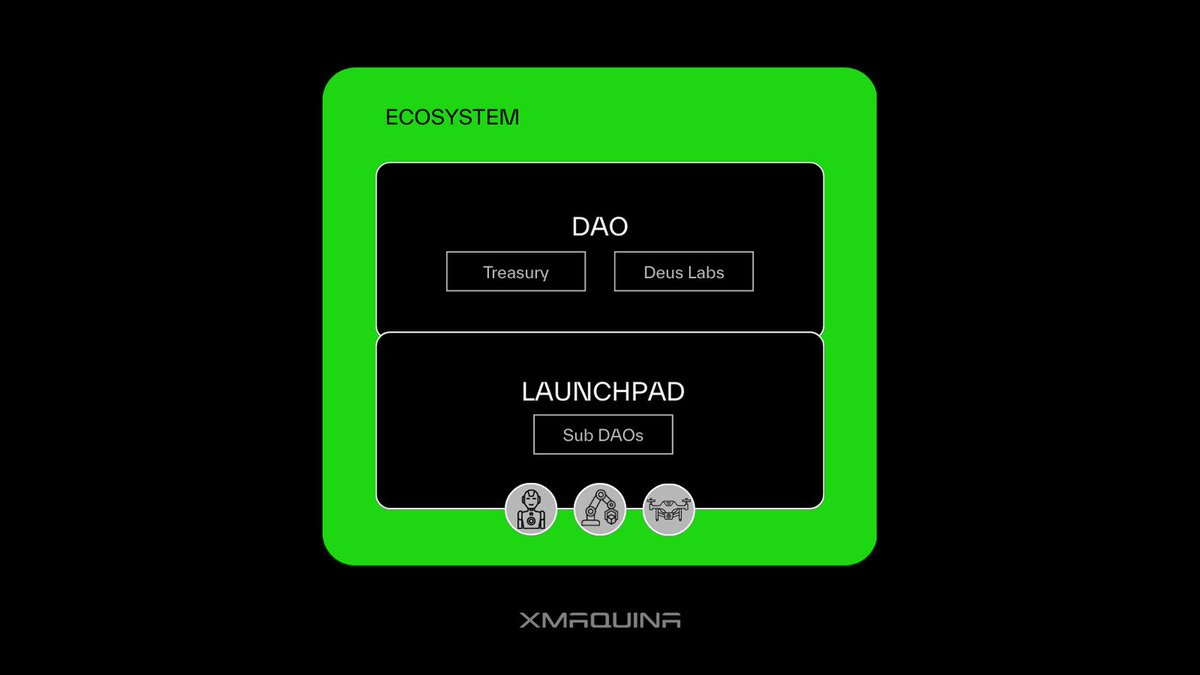
At the centre of its ecosystem are its two key pillars:
The DAO
The Launchpad
The DAO
The xMAQUINA DAO governs the treasury’s capital allocation, the DAO’s resource allocation, and how revenues are distributed.
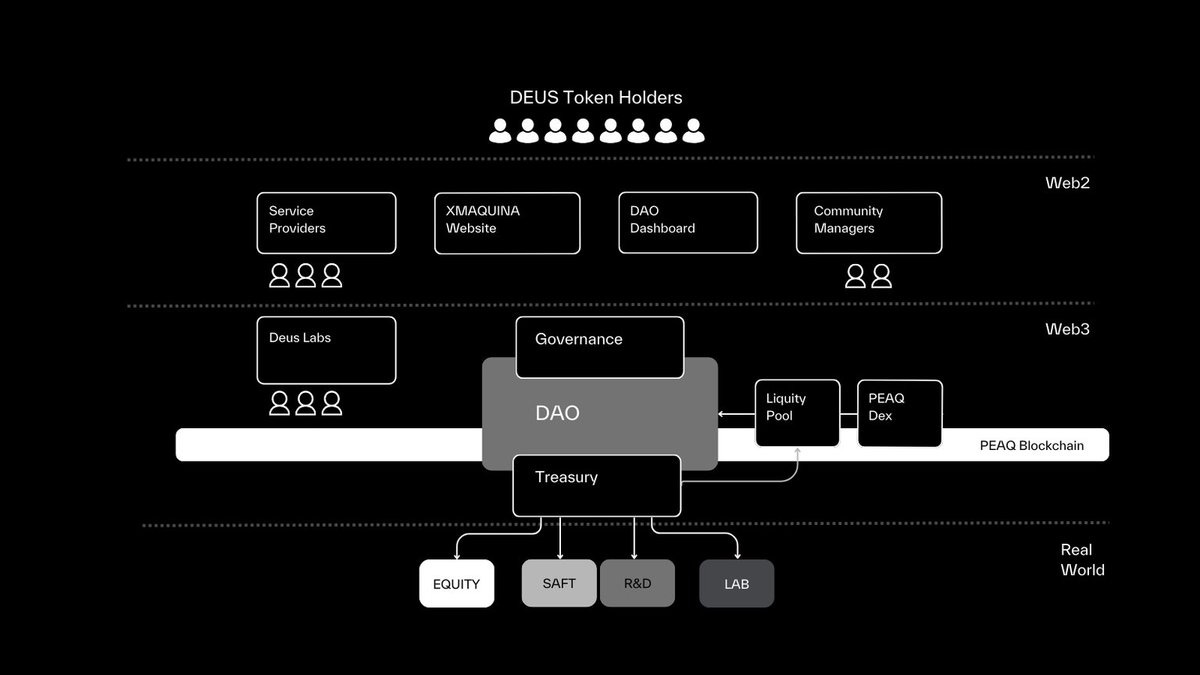
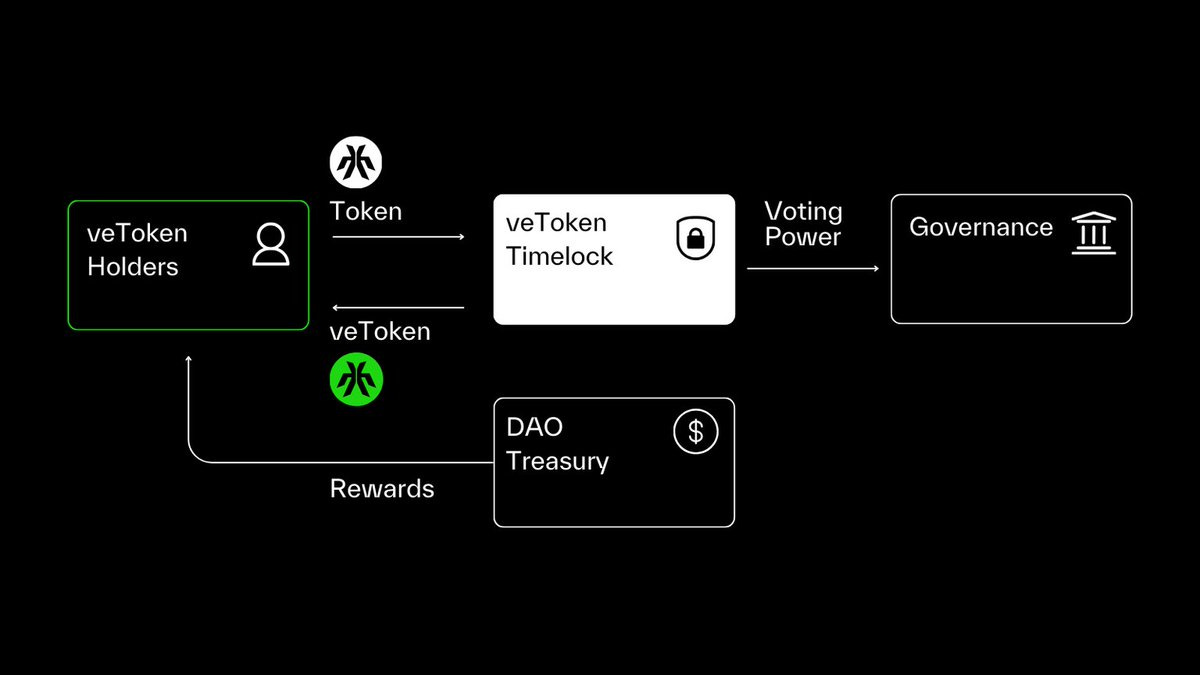
To become part of the DAO, users have to hold and stake DEUS, xMAQUINA’s native token.
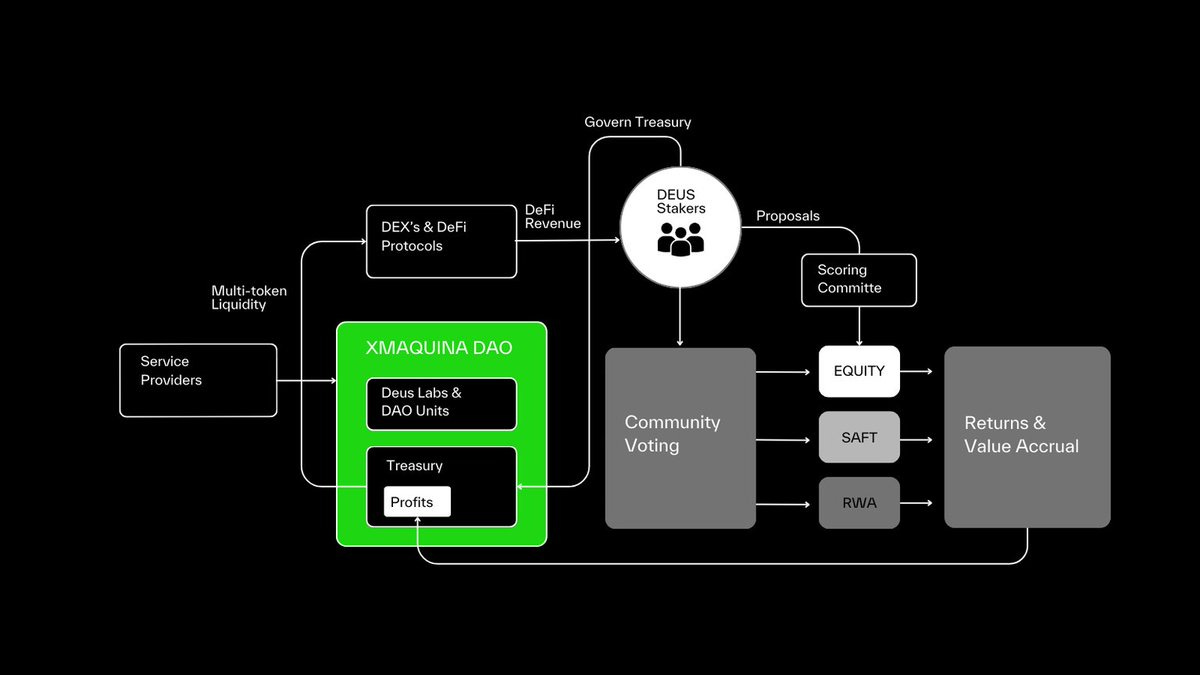
DEUS is the utility token of xMAQUINA, designed to align incentives through its utility, especially when staked, users can:
Decide where value is distributed across the ecosystem, involving revenues from machine operations, SubDAOs, and successful investments.
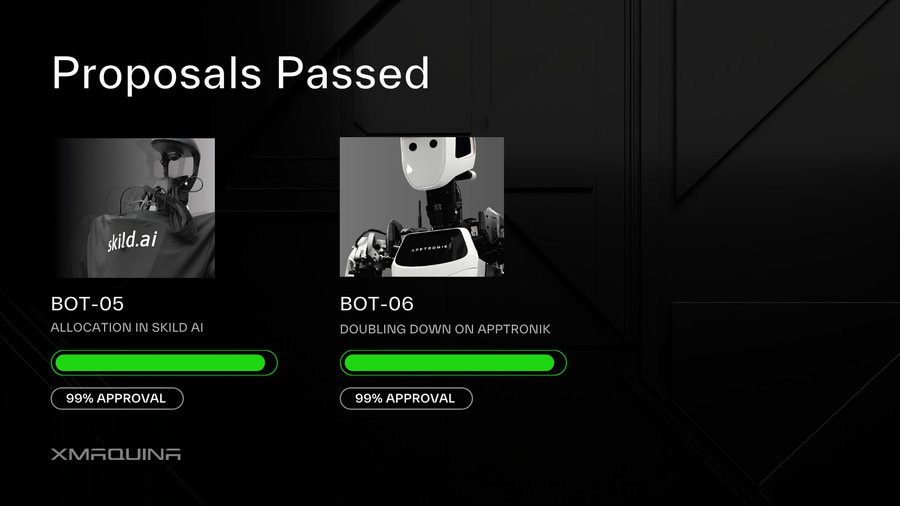
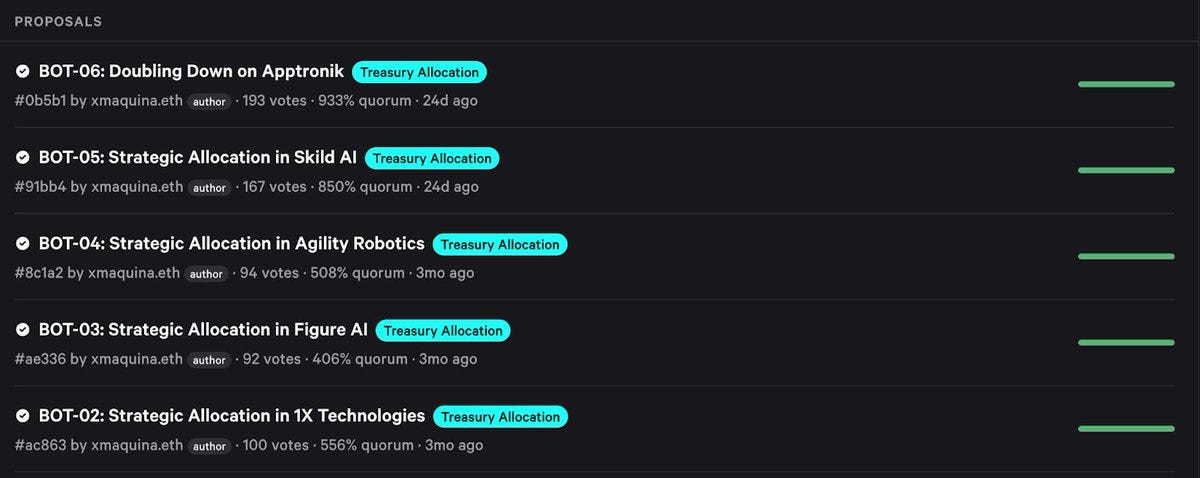
Get exposure to the xMAQUINA treasury, holding multiple assets previously unavailable, and vote on its allocation. Through BOT-5 and BOT-6 the DAO recently approved investments in Apptronik and Skild AI:
Impact the DEUS tokenomics: Adjust supply, propose burns, buy-backs, etc.
Vote and propose new programs through governance
Be involved in the launch of SubDAOs through the launchpad.
Earn token rewards by completing bounties or contributing
The staking model converts DEUS into xDEUS, a vote-escrow (ve) token with a timelock and governance rights.
The Launchpad
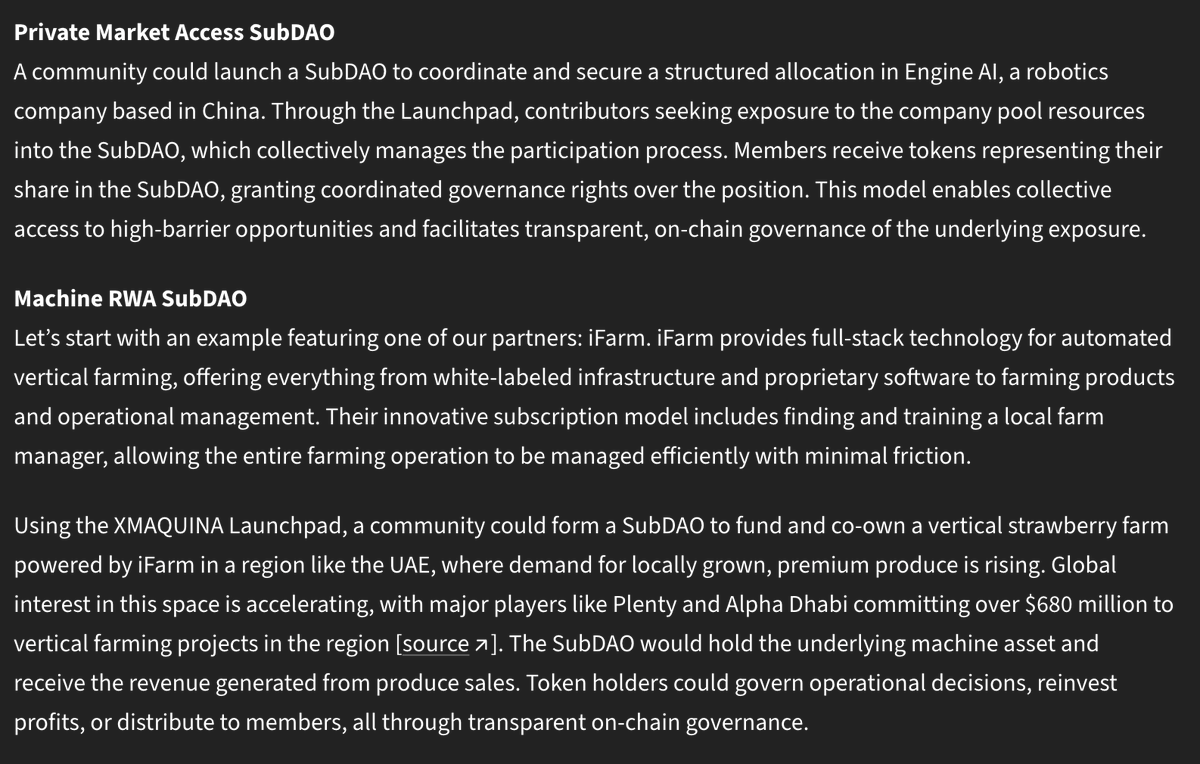
The second key aspect of the ecosystem is the “Machine Economy Launchpad”, which will allow the creation of SubDAOs - provided governance approves. Each SubDAO includes a legal and governance framework, and technical infrastructure, making the creation of robotics-focused treasury companies much easier.
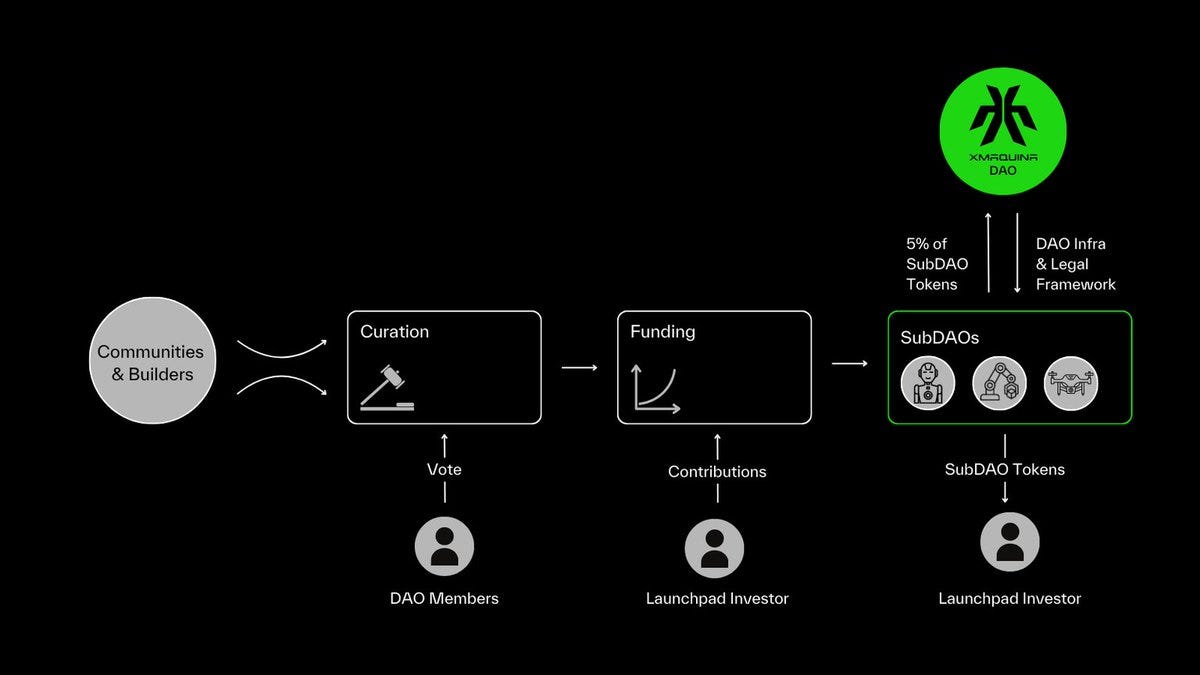
Through these SubDAOs new builders will be able to raise capital and create new treasury companies to invest into “robotics and machine-based assets”.
To make this more clear, here are a couple of practical examples of what kind of opportunities SubDAOs could be after:
Every SubDAO launching incurs two types of fees:
5% of SubDAO Tokens Issued are to be allocated to the xMAQUINA DAO treasury.
5% of Capital Raised During SubDAO Auctions is collected as a service fee.
The relationship between the DAO and the launchpad is symbiotic:
The DAO votes on new SubDAOs and could even decide to fund some of them with capital
The Launchpad grows the ecosystem and generates fees for the DAO.
A Treasury Company for Robotics
In their docs, the team compares their approach to MicroStrategy, as both are treasury companies that give access to assets which most users would otherwise not be able to invest in. Strategy does so for Bitcoins, xMAQUINA for physical AI.
This is indeed an interesting comparison, which makes xMAQUINA a different beast than other robotics companies, especially when it comes to its valuation.
Being a treasury company means xMAQUINA’s value could be calculated similarly to other DATs by taking into account its NAV.
This is actually pretty important, as it allows them to operate similarly to DATs, which use strategic offerings to secure funding by allocating equity or taking on debt to buy more underlying assets.
In practice, xMAQUINA could benefit from allocating its DEUS resources (trading at a premium) to “acquire additional robotics equity, mission-aligned tokens or Machine assets”.
30% of the DEUS supply has been distributed through a Genesis auction on Base conducted across three different waves. The last wave had a fixed price of 0.05, implying a fully diluted valuation of $50m.

Compared to their treasury NAV of $32m this implies DEUS trades at a premium of 1.56x.
Of these $32m in the treasury, the majority is in DEUS, with $2m in cash to be allocated to investment opportunities, while the rest is split across investments in Apptronik, 1X, Figure, Agility, and peaq, with a future investment in Skild AI.
Here’s a quick glance at each of the investments and the terms of the deals:
Apptronik - $450,000 USDC used to acquire 24,666 shares at a price point between $17.20 - $17.50 per share.
These are preferred shares, which offer more downside protection and favourable conditions compared to common shares.
Apptronik - $1,200,000 USDC used to acquire 31,135 common shares at a price of around $37 per share.
An SPV (Special Purpose Vehicle) was used to acquire these shares and will be managed through a regulated third party that will sit on the company’s cap table.
1X Technologies - $350,000 USDC used to acquire 253.29 common shares at a price point of $1,250 per share.
These shares were acquired using a single-layer SPV, facilitated through a licensed broker.
Figure AI -$350,000 USDC used to acquire 1,935 common shares at a price point of $180.88 per share.
These shares were acquired using a single-layer SPV, faciliated by a licensed broker through shares acquired from an existing shareholder.
This offer gave the DAO a lower entry cost than the previous round, giving them immediate profit on their position.
Agility Robotics - $350,000 USDC used to acquire 4,799 preferred shares at a price point of $66.145 per share.
Skild AI - $500,000 USDC used to secure access to Skild’s Series B-1 financing through a SAFE (Simple Access to Future Equity) at a 10% discount to the B-1 valuation.
This SAFE converts to the same class of equity listed in the financing upon closure of the B-1.
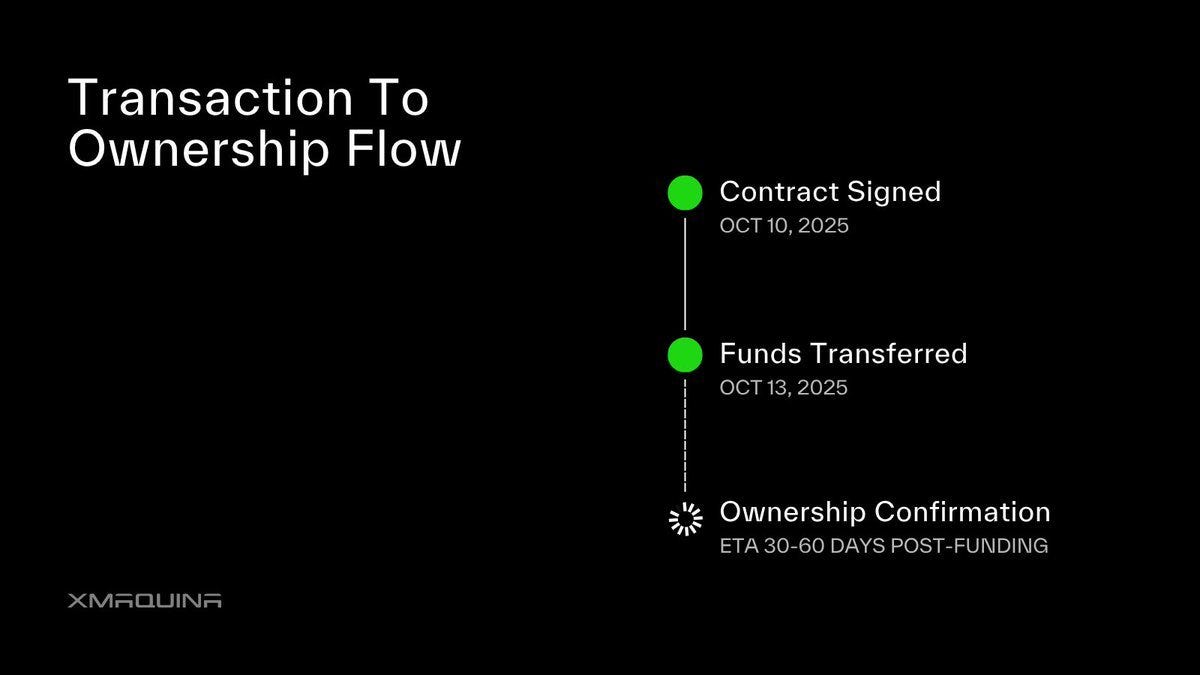
For those interested in learning more about the deals themselves and how the DAO has access to them, these usually take place through licensed intermediaries and escrow.
This is an example of how long it can take and what the flow looks like:
Food for Thought and Conclusion
xMAQUINA is a very interesting protocol as it works differently than others, resembling closely a DAT, or treasury company, which also allows us to have a benchmark to approximate its “fair valuation”.
Its main value proposition is to democratize access to previously unavailable deals for most users (unless they are accredited investors). Through a clever system of incentives, they align DAO and launchpad participants, ensuring a close feedback loop between the two.
Instead of betting on the success of a protocol, xMAQUINA allows users to bet on the success of the broader narrative, powered by a DAO model which emphasises collection action and participation.
With Physical AI heating up and growing in mindshare, we’re already seeing examples of robots launched in production, such as Neo recently, highlighting the potential of the opportunity.
For those looking to invest in private robotics companies, xMAQUINA is probably the only place to do so currently.