


We have a bunch of good news this week… it feels like a while.
It’s IPOP time… with the biggest IPO calendar in a generation.
CBRS rang the bell as the first IPOP traded on Tradexyz. Now, SpaceX promises to be the biggest IPO yet.
DC is also busy: the Senate also cleared the CLARITY Act, and incumbents noticed Hyperliquid.
Last but not least, trenches seem to be alive again.
Solana and Base are both back, promoting their ecosystem.
This time, it seems they have switched their GTMs.
Solana is pushing Phoenix, an onchain perp which burns SOL from fees, while Base is now trying to position itself as the meme chain.
We start with the deep cut on pre-IPO perpetuals, then turn to the Clarity clearing committee, the unfreezing of rsETH and the saga’s resulting $4B LayerZero exodus, and Hyperliquid on Wall Street’s mind.
Let’s dive into another Castle Chronicle!
State of Pre-IPO Perpetuals in Charts
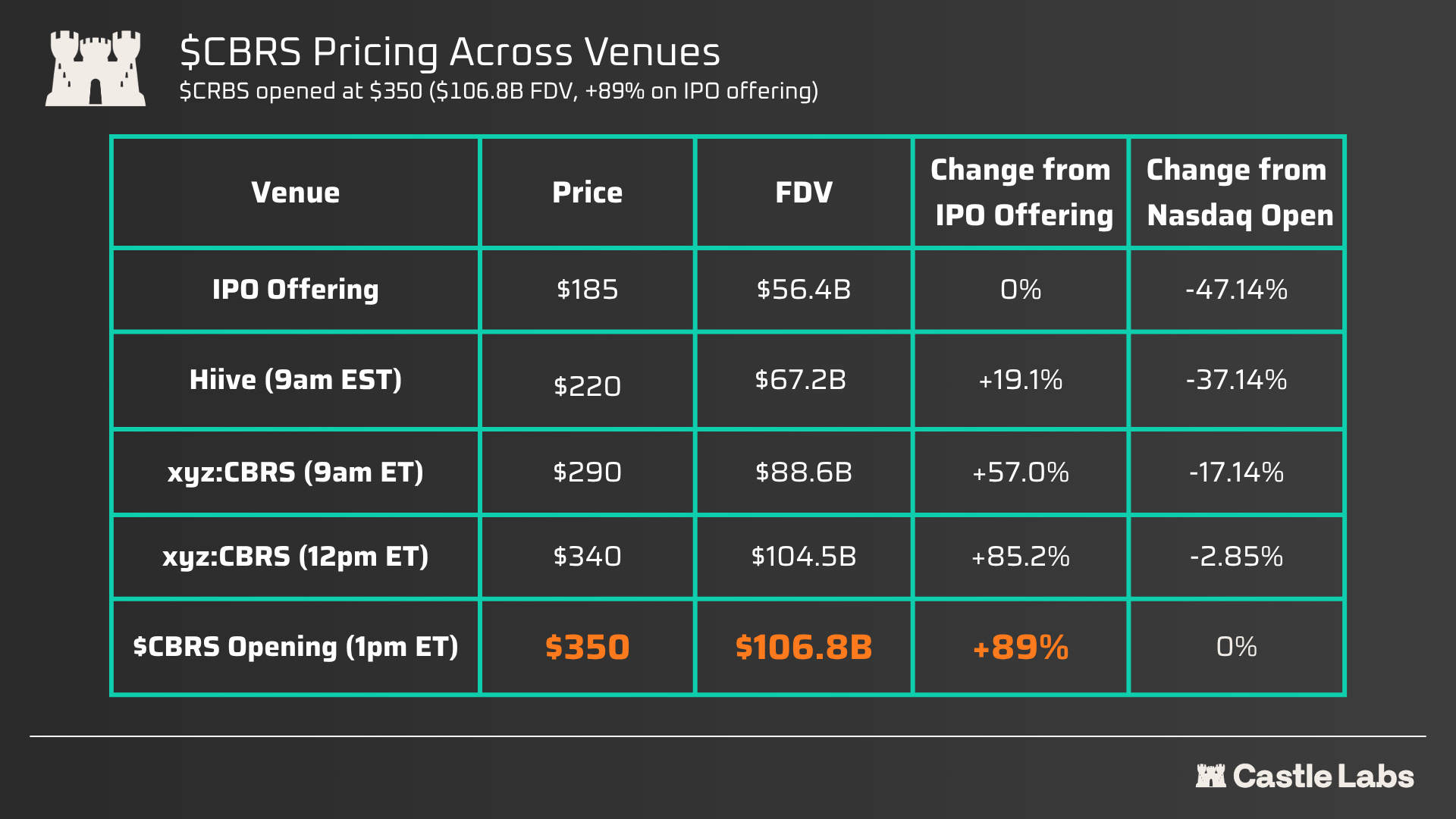
On Thursday of last week, Cerebras ($CBRS), the first Pre-IPO Perpetual Market (IPOP) from TradeXYZ, opened on Nasdaq at $350, following a repriced IPO offering of $185.
An IPOP is a synthetic perpetual that reflects the implied value of a private company before it goes public.
Compared to traditional IPOs, which often both accredited and retail investors unable to secure exposure, IPOPs have no accessibility constraints, guaranteeing broader accessibility to these assets.
In addition, they provide an additional venue for price discovery, as they trade 24/7.
On the morning of the IPO, Hiive, the primary offchain platform for accredited investors, was valuing the stock at $220. In contrast, TradeXYZ was the only venue providing real-time pricing for the asset, with ~$290 in the morning and ~$340 one hour before the Nasdaq opening.
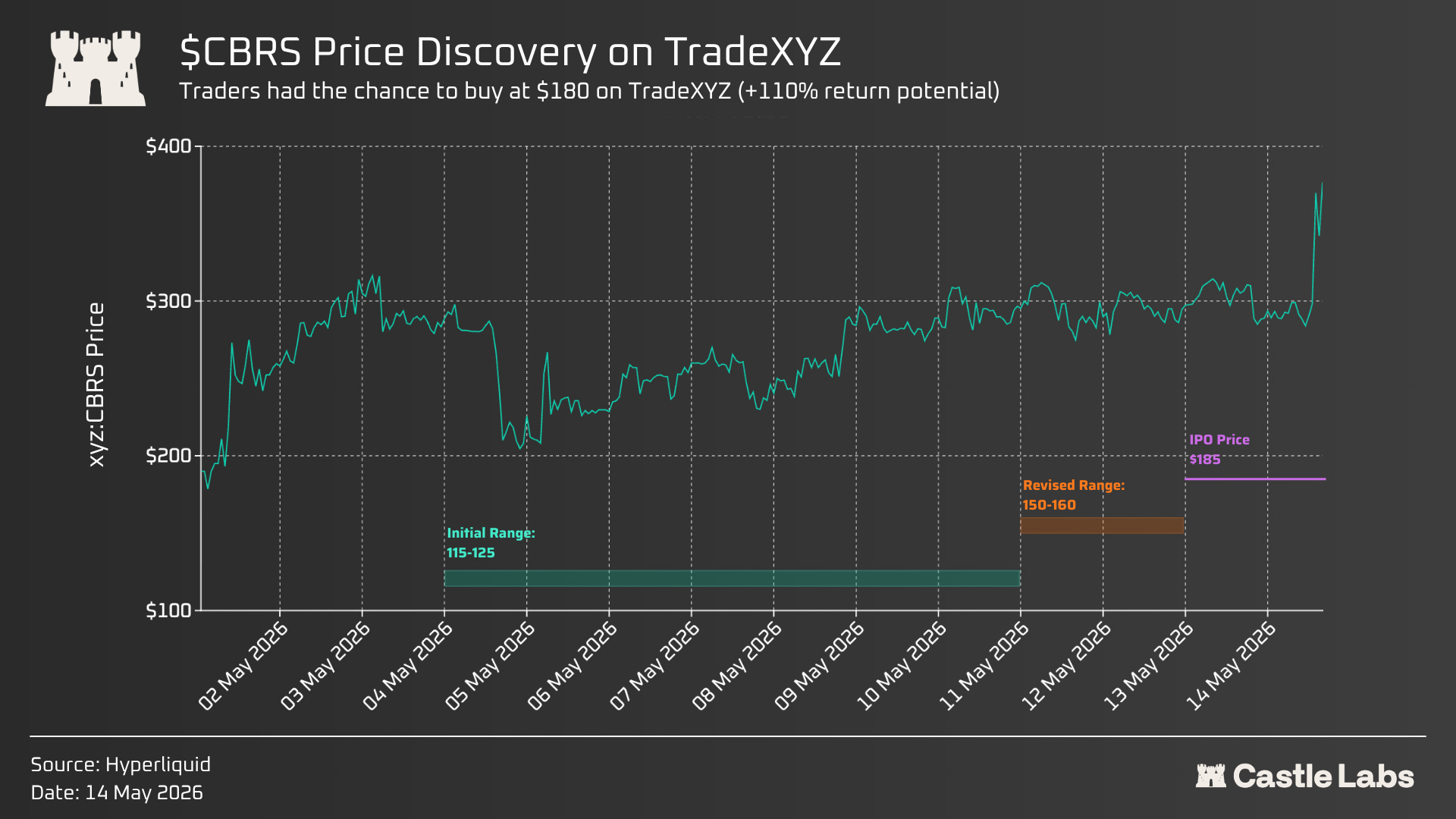
On May 1, TradeXYZ launched xyz:CBRS at a reference price of $175, at an implied valuation of $48.9 billion. Traders on the platform consistently valued the stock well above the initial IPO range of $115-125, both as it was revised to $150-160 and as it was finally priced at $185.
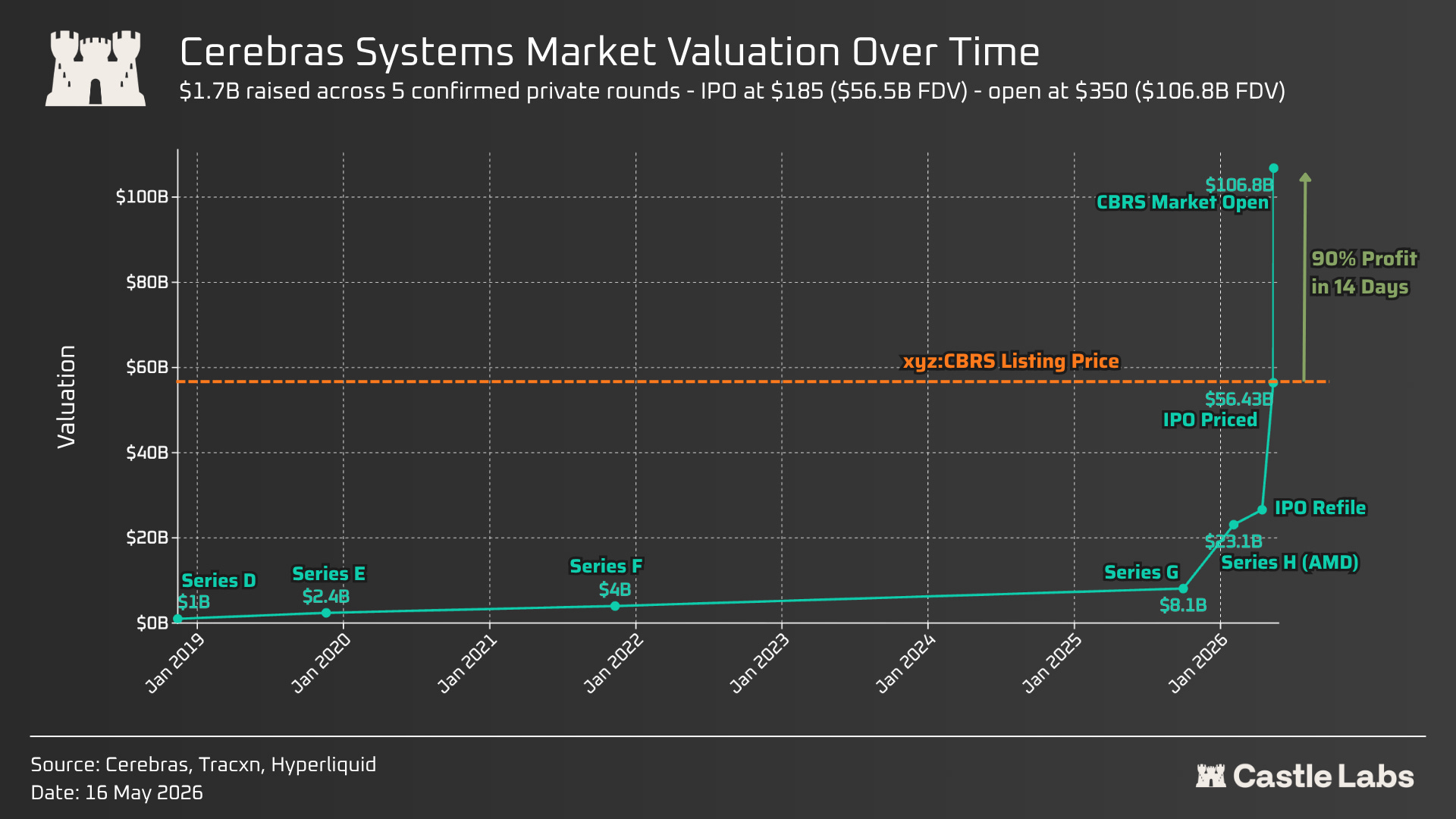
TradeXYZ allowed anyone to gain exposure, potentially yielding over 90% profit if held until the Nasdaq opened at $350, just 14 days later.
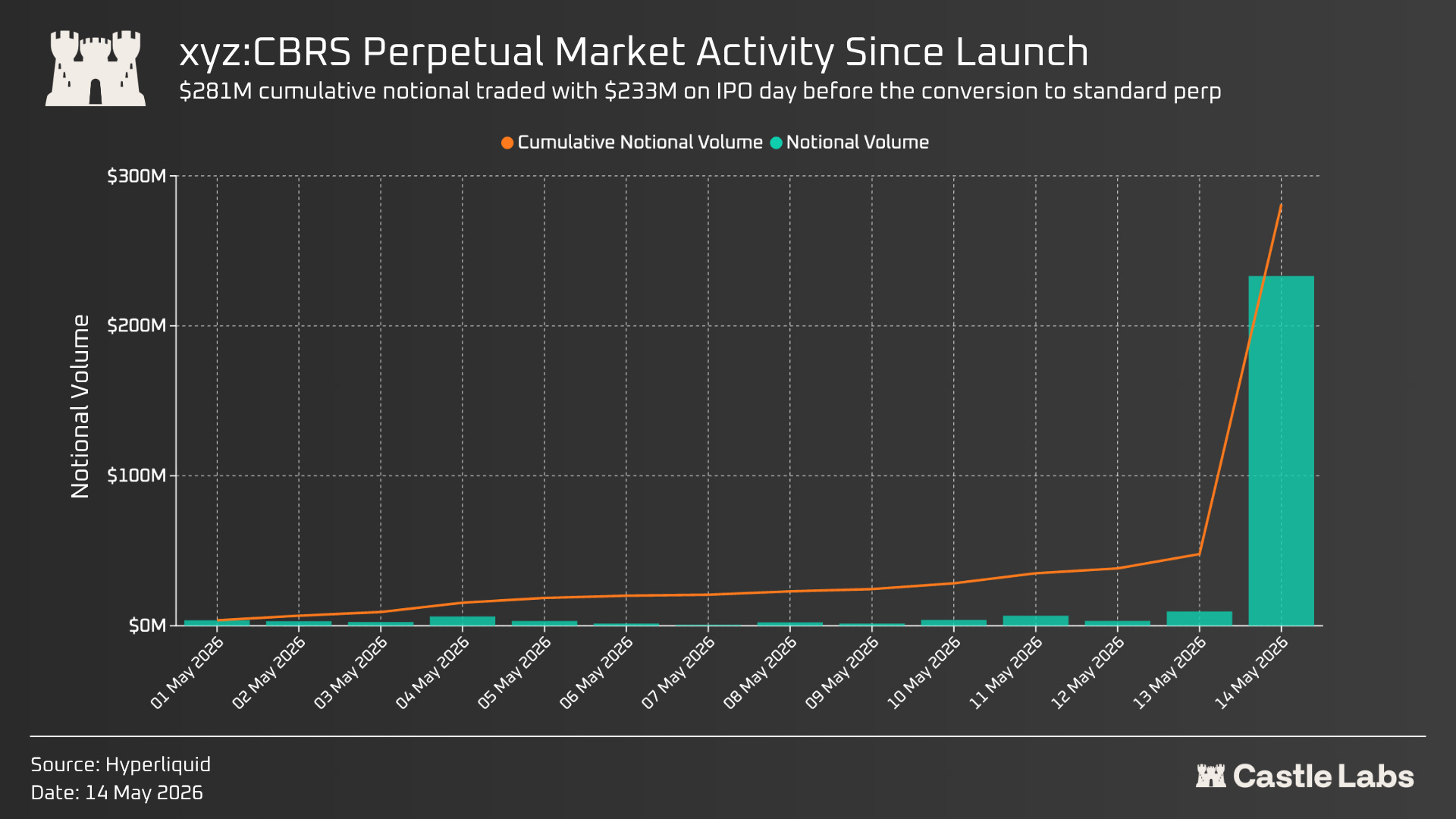
Daily volume sat between $1.5 million and $9.5 million over the first 13 days, before 14 May printed over $207 million, 80% of the market’s lifetime volume.
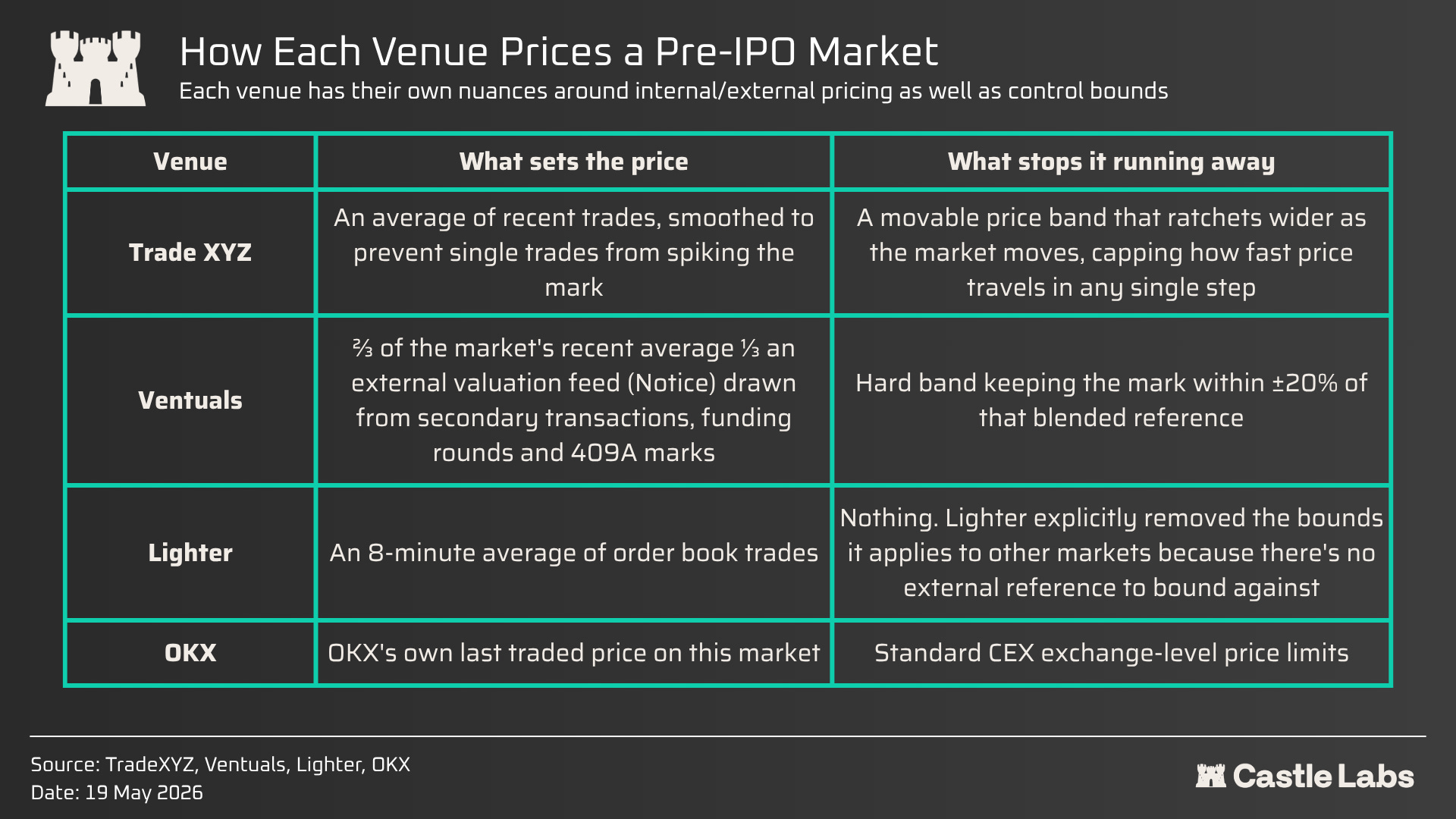
Now there are over 4 venues where users can trade IPOPs: TradeXYZ, Ventuals, Lighter, and OKX, each with different models for pricing pre-IPO markets.
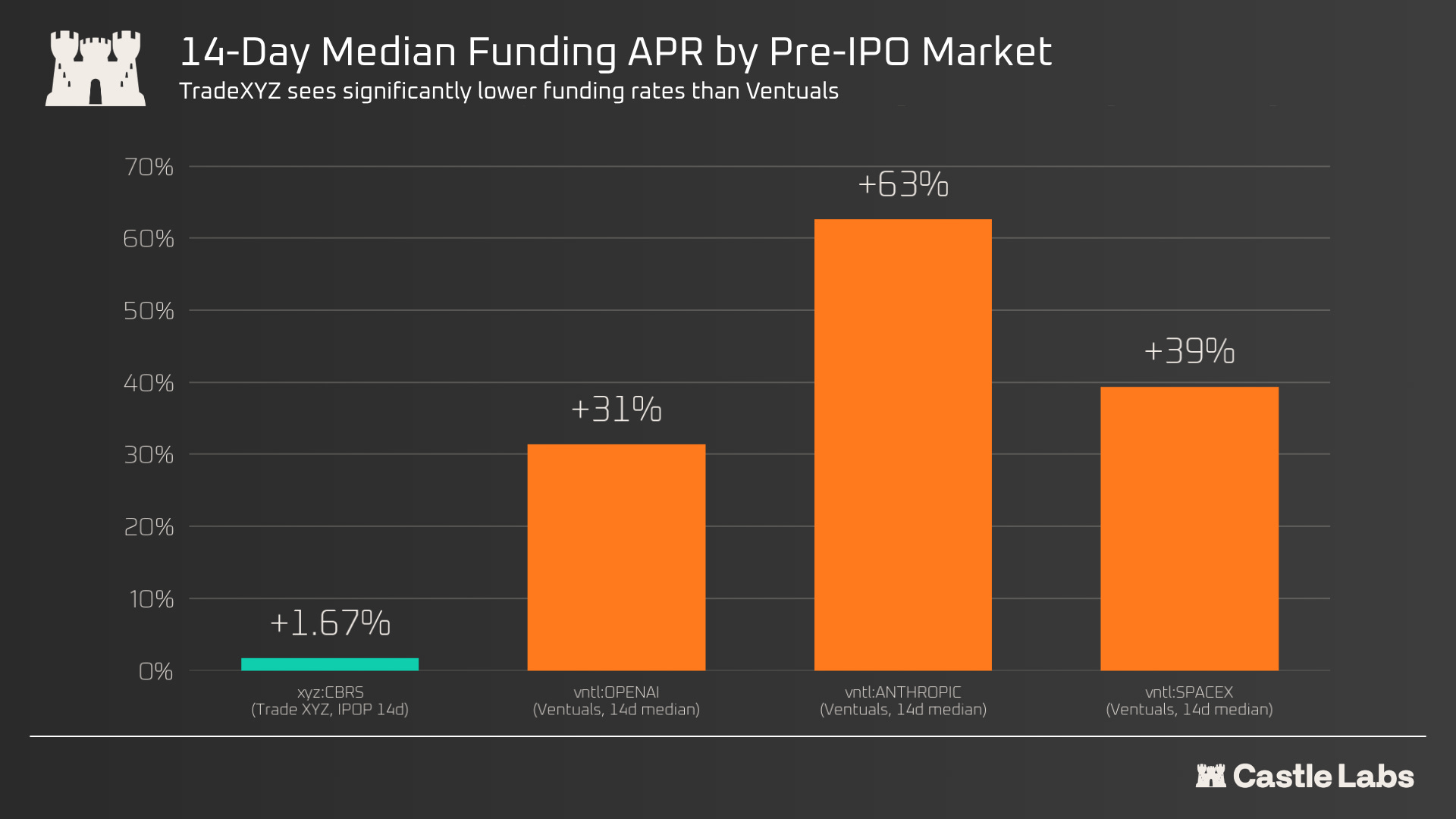
If pricing mechanics are one half of the equation, funding rates are the other half. For a trader holding a position during a volatile period, such as an IPO, the cost of carry is extremely important. TradeXYZ applies a 0.005 funding multiplier to IPOP markets, which is 1% of their standard perp rate. As a result, xyz:CBRS averaged +1.67% APR across its 14-day pre-IPO window.
In contrast, Ventuals, Lighter, and OKX use their standard funding in a market with one-way directional demand, producing significantly higher APRs: +31% for vntl:OPENAI, +64% for vntl:ANTHROPIC, and +39% for vntl:SPACEX, all 14-day medians.
What’s next?
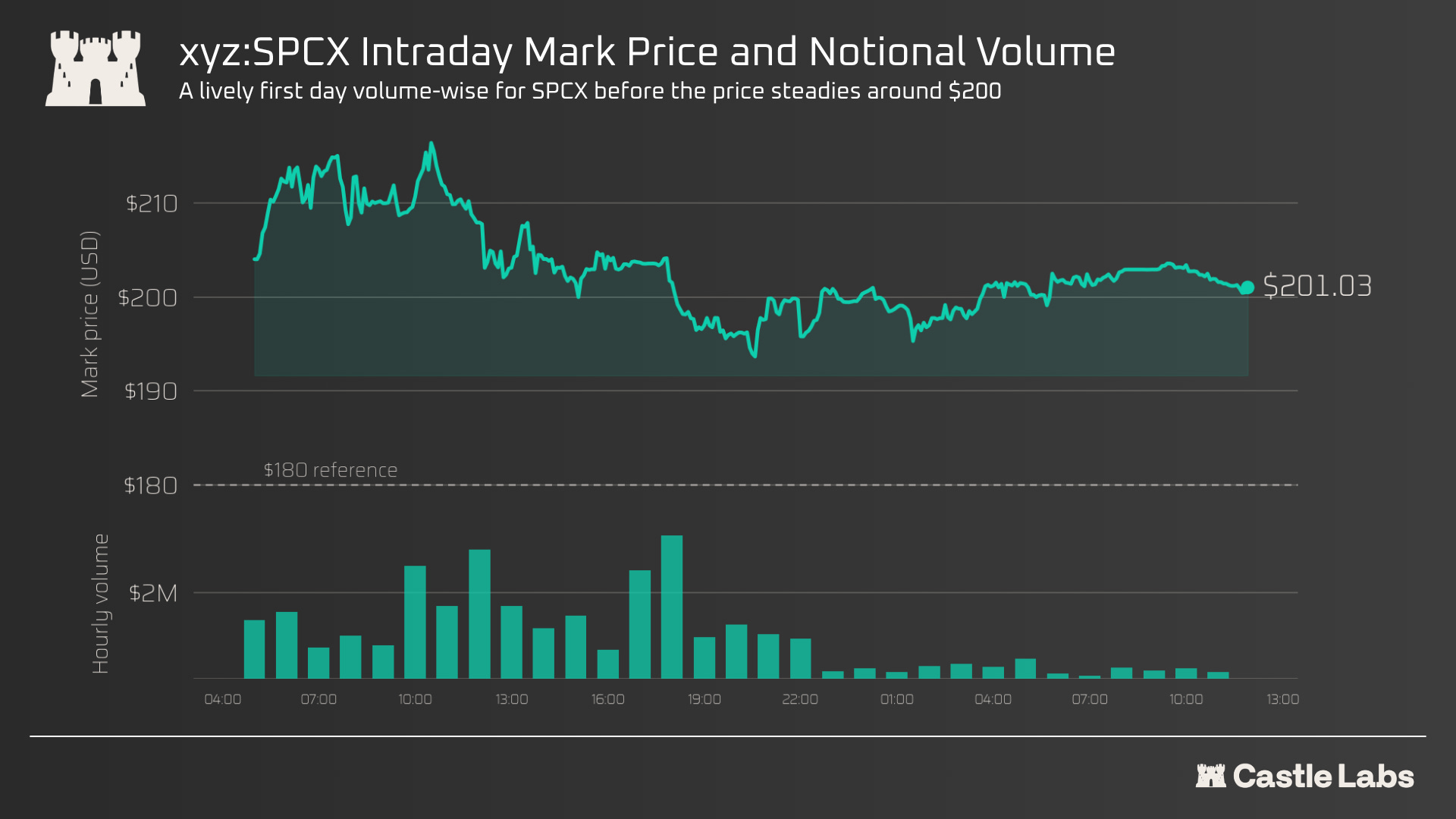
On May 18th, 2026, TradeXYZ listed xyz:SPCX with a reference price of $180. Within the first minute, it printed $204. By the end of the first hour, it had ranged from $204 to $218, settling at $211.75. As of this writing: mark $203.14, cumulative session notional $50.67 million, open interest $25.49 million, roughly 42k trades.
SpaceX is queued to list on 12 June 2026 at a $1.75 trillion target valuation. Behind it: Anthropic in October 2026 at $850-900 billion and OpenAI by Q4 2026 or 2027 at $1 trillion+. A total of $3.5 trillion.
To put that in context, between 2015 and 2024, the US IPO market raised an average of roughly $50 billion per year.
IPOP season is just starting.
Read our full article on IPOPs:
Pre-IPO Markets are Moving Onchain

2026 is one of the most eventful years for IPOs, with the biggest IPO calendar in a generation.
Clarity for stablecoin intermediaries?
We’ve been flagging the Clarity Act for a few weeks now, but that’s just because of how important it is. The successful GENIUS Act last year set rules around what stablecoin issuers could or couldn’t do. The importance was because they let issuers do a lot of things they might have wanted (they didn’t), but the regulatory clarity was there in the first place. The same is now happening with stablecoin intermediaries through the Clarity Act, bringing them under a clear regulated landscape, allowing them to put down roots and expand in the US.
Since January, there have been deadlocks in the text, and there were strong fears the legislation would not make it into law this year, or worse, be delayed until a new President. However, on 14 May, the Digital Asset Market Clarity Act passed the Senate Banking Committee 15-9, with two Democrats voting in support.
The main friction point was around yield from stablecoins, with the committee settling on payment stablecoin issuers not being able to pay interest economically equivalent to a bank deposit, but allowing activity-based rewards tied to usage. Crypto-linked equities surged on the news, with Coinbase, MicroStrategy, and Robinhood up 9%, 8%, and 6%, respectively. The bill still has to be merged with the Agriculture Committee version and survive a floor vote, estimated at about a month out.
rsETH markets are unpaused, unlocking millions of frozen funds
After nearly a month, Aave’s rsETH markets were finally unpaused last week, with Kelp restarting withdrawals, bridging and EigenLayer claims. DeFi United raised over $300M in ETH commitments, enough to avoid socialising losses amongst Aave users after rsETH was falsely minted due to a vulnerability in LayerZero’s Distributed Verifier Network (DVN), causing roughly $200M of bad debt on Aave.
It cannot be overstated how much coordination must have been required to ensure such a result, which could have shaken DeFi to the core if left to resolve through liquidations or losses. Whilst many drew parallels of this initiative to bank bailouts in 2008, those were led by governments propping up a too-big-to-fail industry with taxpayers’ money, in this instance, DeFi United was led and funded by the industry itself from within.
Kudos to Aave for leading such a charge despite being somewhat of a victim in this case.
$4B exits LayerZero for Chainlink CCIP post Kelp hack
The rsETH hack has led to a redefinition of the landscape.
On 15 May, Lombard migrated $1B+ in BTC-backed assets (LBTC and BTC.b) off LayerZero and onto Chainlink CCIP. The total asset migration since the Kelp exploit now stands at $4B+ across KelpDAO ($1.5B), Lombard ($1B), Solv ($700M), Re ($475M), and Kraken ($330M).
LayerZero removed 1-of-1 DVN support entirely and is pushing routes toward 5-of-5 verifier setups, but this has not managed to stop the outflows.
How will this trend continue to evolve?
Will this migration concentrate risks into CCIP?
And moreover, will our industry come out of it more secure?
One thing is for sure: this event is making everyone revisit their security practices from top to bottom.
Is Hyperliquid going to be regulated?
Great power comes with great responsibility, and scrutiny.
As the main representative of onchain and 24/7 trading of commodities, Hyperliquid has increasingly attracted attention from regulators, as we highlighted in our previous report.
Just recently, the CME and ICE urged US regulators to scrutinise Hyperliquid over oil benchmark manipulation and possible risks around international sanctions evasion.
This comes a week after 21Shares launched Hyperliquid ETF (THYP) on 12 May: the first regulated HYPE exposure for US investors.
The oil market on Tradexyz has averaged $700M daily turnover in April during the Iran conflict, after just a couple of months of being operational.
Issues revolve around the fact that Hyperliquid “could end up influencing the spot market price or the futures market price on our registered platform“, said CFTC Chairman Michael Selig.
The Hyperliquid Policy Centre is engaging the CFTC directly, arguing that onchain transparency is a deterrent to manipulation rather than a risk, and supporting regulators in their legislative process. Interestingly enough, the ICE recently invested in OKX with the objective of pushing 24/7 trading equities on the platform.
To support the Hyperliquid Policy Center, Jeff spent a few days in Washington D.C. last week, meeting with policymakers and discussing the benefits that Hyperliquid offers to American consumers, and the regulatory path to bring onchain derivatives markets into the United States.
Hyperliquid Policy Center’s efforts in the US are definitely one to keep an eye on!
Ambire Wallet Upgrades Safe Experience
This week, we have a small section presented by our friends at Ambire Wallet.
If you’ve been using Safe but wished the experience felt smoother, Ambire has you covered.
Ambire now supports importing Safe accounts directly in the app, unlocking operational efficiency and new ways for users to leverage these accounts:
Connect to any app: Just like connecting accounts in any wallet’s browser extension, you can connect your Safe to apps in exactly the same way with no additional steps.
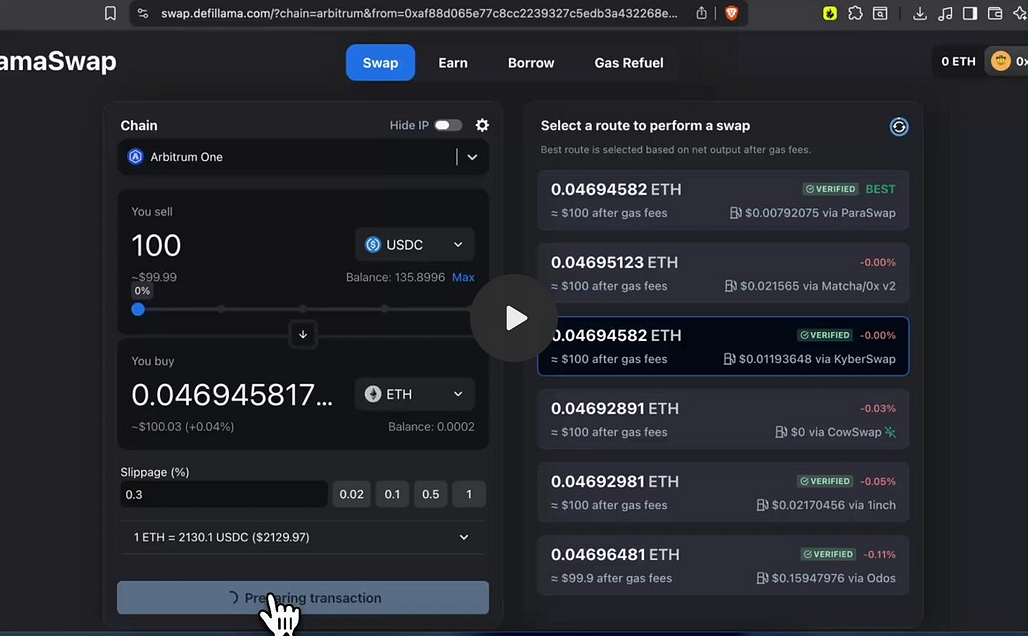
Approve & Swap: On your favourite apps like LlamaSwap or Jumper, users can approve and swap in a single flow, reducing the friction of Safe transactions with multiple signers. This is compounded further when executing even more complex multi-step transactions.
Onchain transaction simulation & clear signing: The Transaction Builder in Ambire performs security checks and uses clear signing to always display what is being signed in the transaction.
Transaction batching: Executing complex transactions becomes much easier. Multi-send, multi-swap, batch revoke, or any combination of transactions can be signed all in one go.
Flexible signing: Users can choose their signing path, with Ambire supporting complete transactions within Ambire or broadcasting to Safe Global to finish signing there.
See it in action here, with an example of connecting and swapping on Defillama:

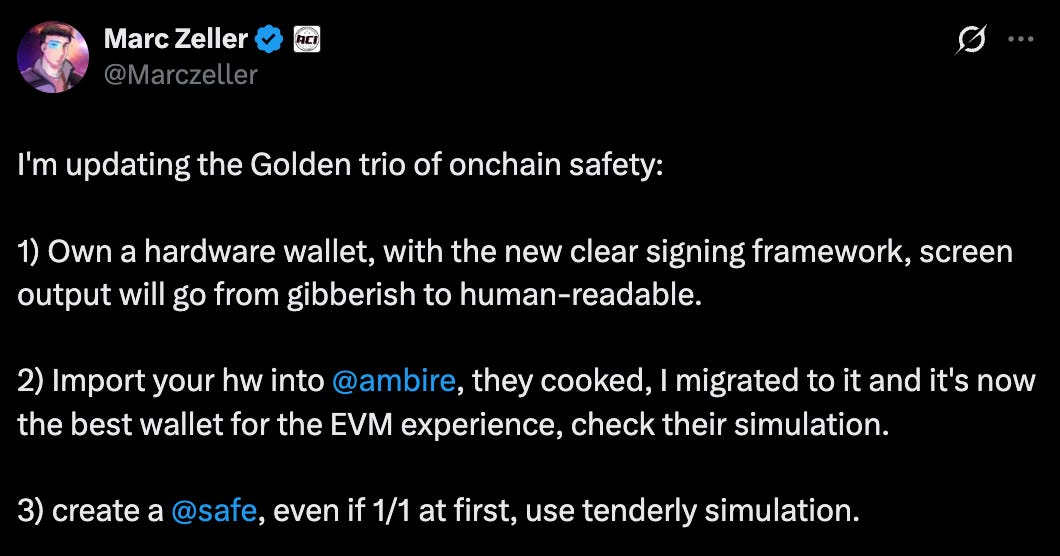
We know that switching wallets is a huge deal, and not something to be taken lightly. But if we can’t convince you, maybe Marc Zeller can, as he named Ambire as his wallet of choice in the Golden trio of onchain safety.
Try out the wallet here: https://www.ambire.com/get-extension
What else to expect this week
It’s a big week in the Castle, with a new flagship report shipping tomorrow on the Vaultification of DeFi. Everything you need to know about vaults, their history and evolution, the current landscape, and what is coming next as DeFi and TradFi continue to merge.
Then on Thursday and Friday, you’ll find our founders at EthMilan, so if you are there, go and hunt them down! We are media partners for the event and you’ll be able to hear Atomist give you the rundown on the State of Onchain Neobanks.
Ciao!
Don’t forget to join our Telegram channel for the latest updates from Castle and all our research: Link here

In our newsletter, we may discuss projects or tokens in which we hold positions. While we aim to provide informative content, our views are not financial advice. Please conduct your research and consult professionals before making investment decisions. Crypto markets are volatile, and past performance doesn’t guarantee future results. Invest responsibly, and be aware of the risks. Your capital is at risk, and we do not accept liability for any losses.