

The market has been a little quieter this past week.
However, if you are ready to allocate, there are opportunities we highlight in today’s newsletter that you might find interesting.
While we explore these opportunities, we also cover:
Metric, a capital-efficient DEX which charges no fees to traders, launched on Ethereum, BNB Chain, and Robinhood.
HPC commented on the SEC Crypto Asset Regulation, pushing for airdrop rules in the U.S. and arguing that automated buybacks shouldn’t be scrutinised, increasing S3 airdrop expectations.
$PAPER announced non-transferability of the token, meaning it can’t be sold to preserve platform design.
Lighter EVM devnet is live, the first step to create an ecosystem around the product.
And more

The DeFi Watchlist: Most Interesting Bets
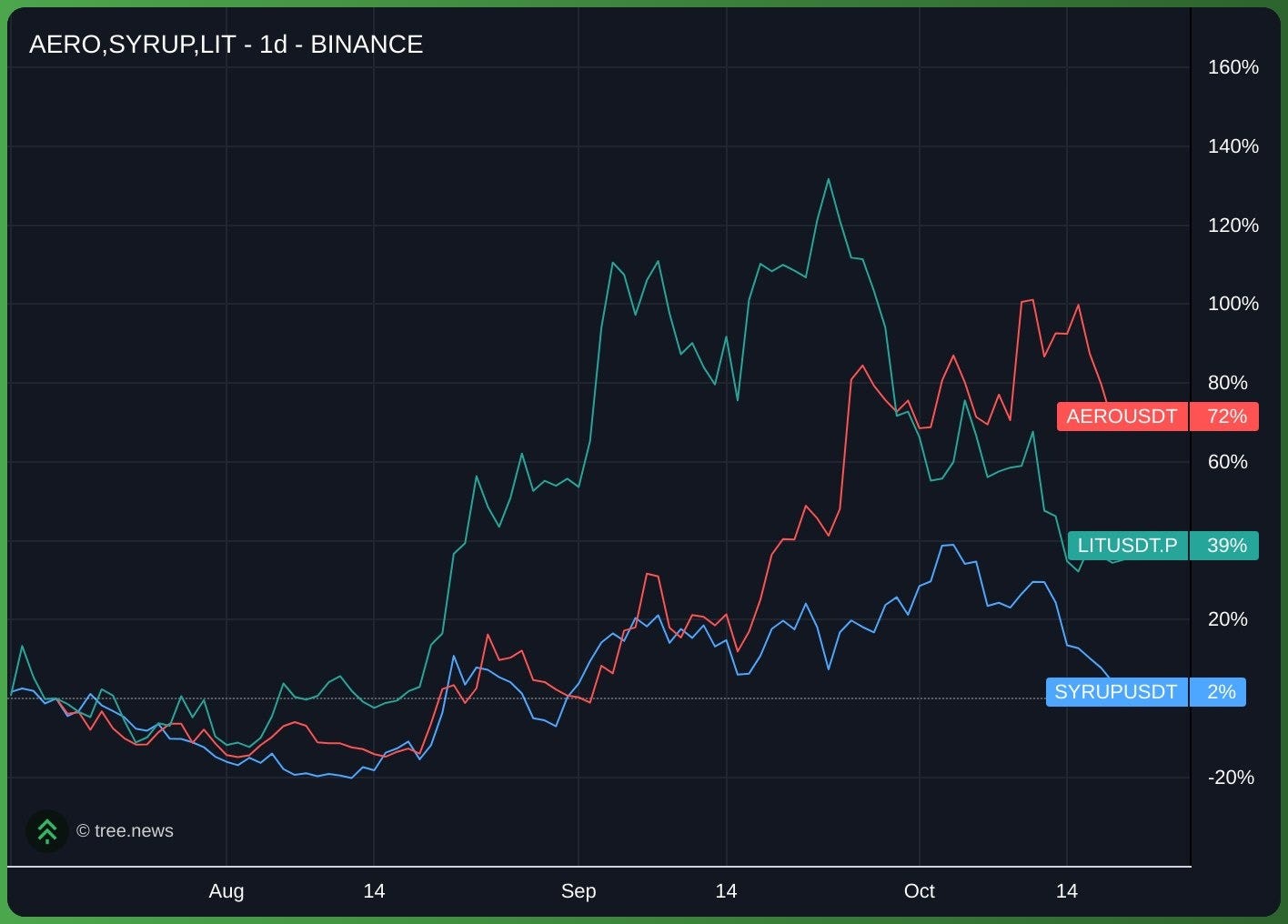
In this part of the newsletter, we highlight some of the protocols which are tapping into newer growth streams, have a decent revenue multiplier, and are token-aligned.
First on my list is $LIT.
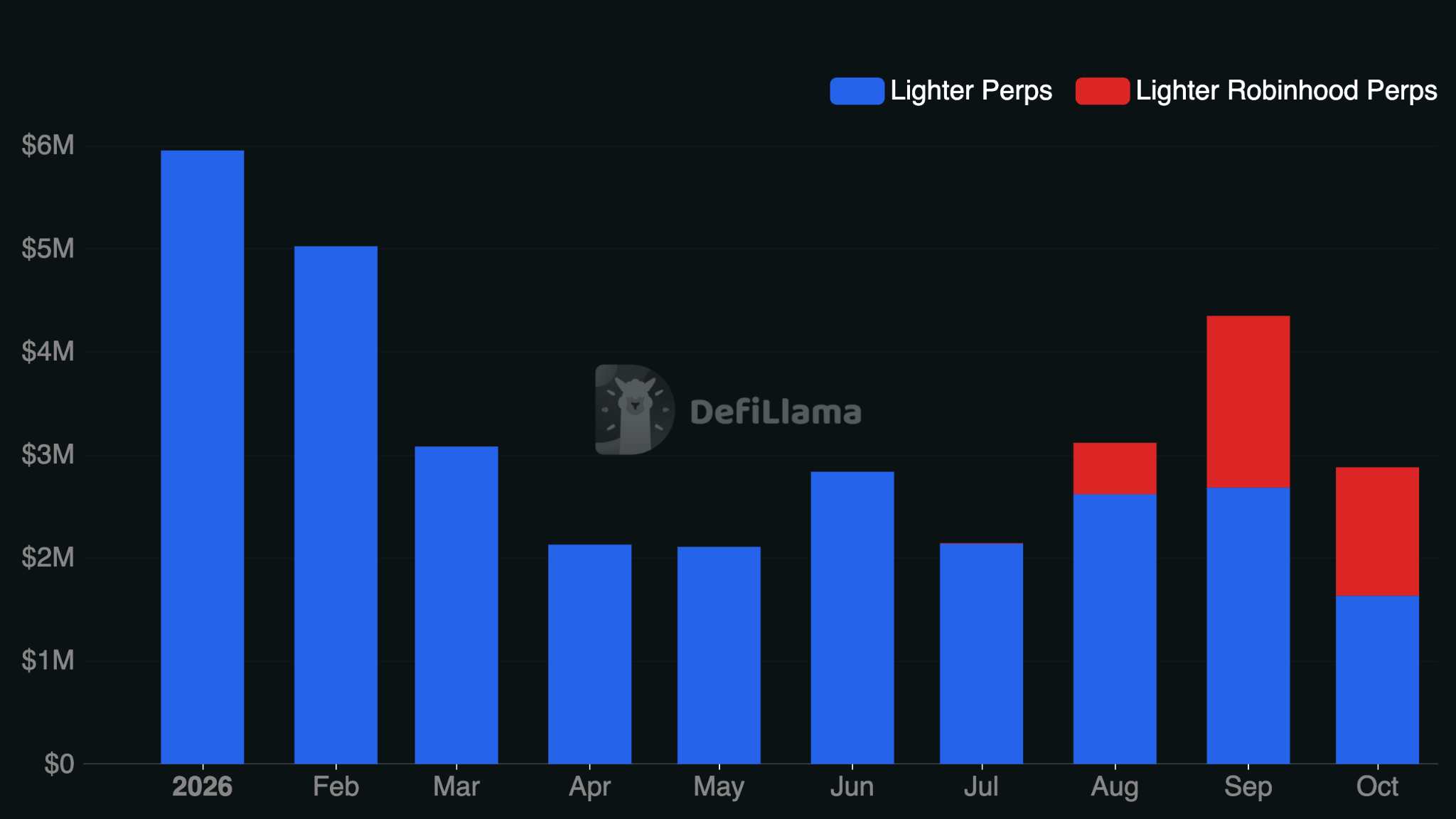
Last month, Lighter revenue reached $4.65 million or ~$50m annualised (highest since the beginning of Q2), pushing their P/S to ~15 at a current market capitalisation of $800 million.
They have recently expanded to binary options and will soon open vanilla options, so through $LIT we get access to three primary narratives: options, perps, and prediction markets.
In our latest perp report, the team also commented on some of their ongoing distribution efforts: “You can build the fastest exchange with the lowest fees, but users still need a reason and a path to find it. Our approach now is increasingly B2B2C. We want wallets, fintechs, brokers, trading terminals, agents, and other consumer applications to offer Lighter directly to their users.”
One such effort is Lighter Robinhood Perps, which added 35% to the protocol’s net revenue last month, an external growth lever the team has tapped that has driven real revenue growth. I believe more growth levers will come into play, helping Lighter expand its distribution.
Next in my list is $SYRUP
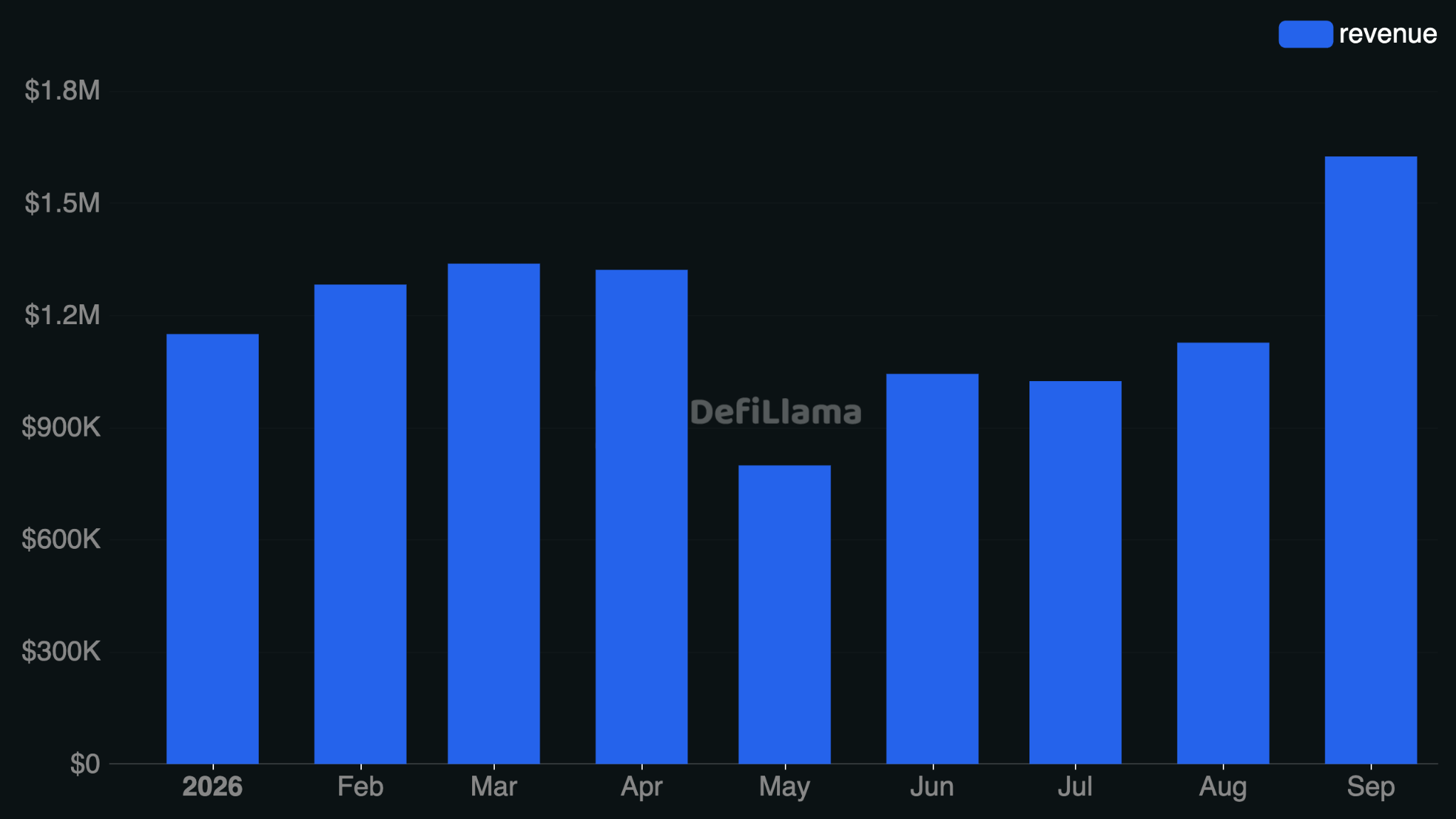
Maple made $1.63 million in revenue last month and, under its rule-based buyback (MIP-021), redirected 20% of that value to buybacks, reflecting token alignment. Additionally, the team is expanding into additional strategies that could boost yield and, therefore, demand for their assets, further boosting revenue.
Annualising September revenue, we get a P/S of 11.4, one of the lowest among lending protocols, including Aave, Fluid, and Kamino, suggesting repricing is also underway.
The last token in today’s list is $AERO
Aerodrome and Velodrome are merging into Aero on 21st October, 2026.
With this launch, they will expand to new chains like Ethereum, Arbitrum, Robinhood, and a few others. This launch will likely expand the addressable market by 3-4x, boosting market size and overall revenue.
On top of this, last month Aerodrome represented about 57% of tokenised equities spot trading, a primitive that is constantly growing, and with expansion to Robinhood, they can double down on it.
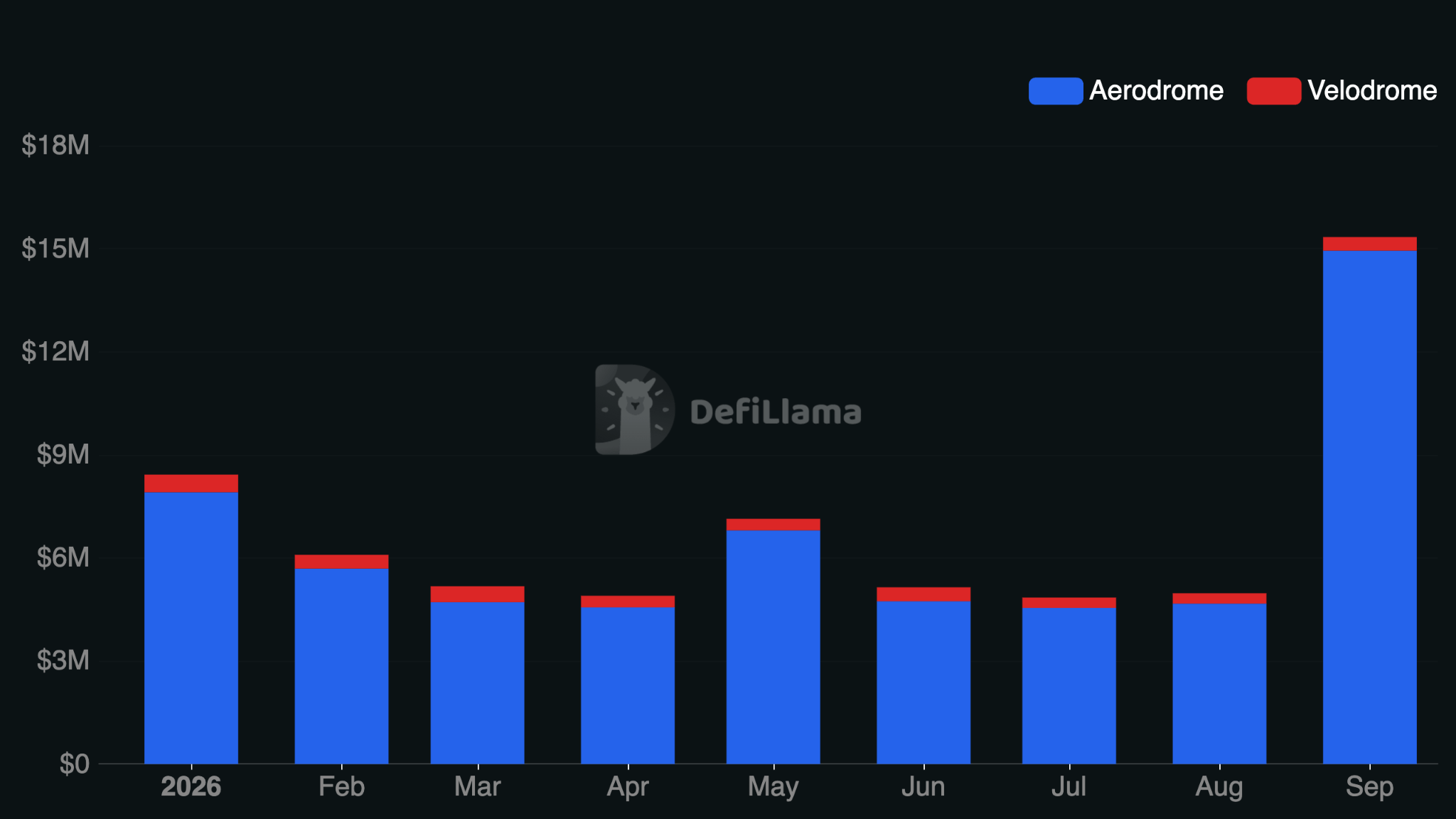
Aerodrome and Velodrome did ~$15 million in revenue and averaged ~$7 million this year, which puts their annualised revenue at $84 million even if we reject the last-month spike as one-time activity, pushing their P/S to 9.62, which, when compared to other DEXs like Uniswap, is pretty low, which trades at over 40.
As more protocols mature into revenue generators, I see them as a +EV play for the space because they show that revenue and positive token alignment get rewarded.
NFA, DYOR.
Metric: The Next-Gen DEX
Metric launched on Ethereum, BNB Chain, and Robinhood on October 15th, 2026, after a 7-month stealth phase where it provided liquidity for different aggregators.
It’s an oracle-based AMM that sources prices from external sources like Chainlink rather than discovering them within the pool, helping LPs avoid losses from arbitrageurs swapping in during periods of volatility when the AMM price drifts from the global price of the asset.
Arbitrage essentially returns the pool to the real market value, but LPs incur a loss because their liquidity is swapped at an older market price, known as Loss-Versus-Rebalancing (LVR).
Another benefit of Metric is that it doesn’t require users to actively shift liquidity, as in concentrated pools, because it deploys liquidity in bins at a percentage range of the current market price (+1% to +2% deviation), and these bins move as the market moves, improving capital efficiency.
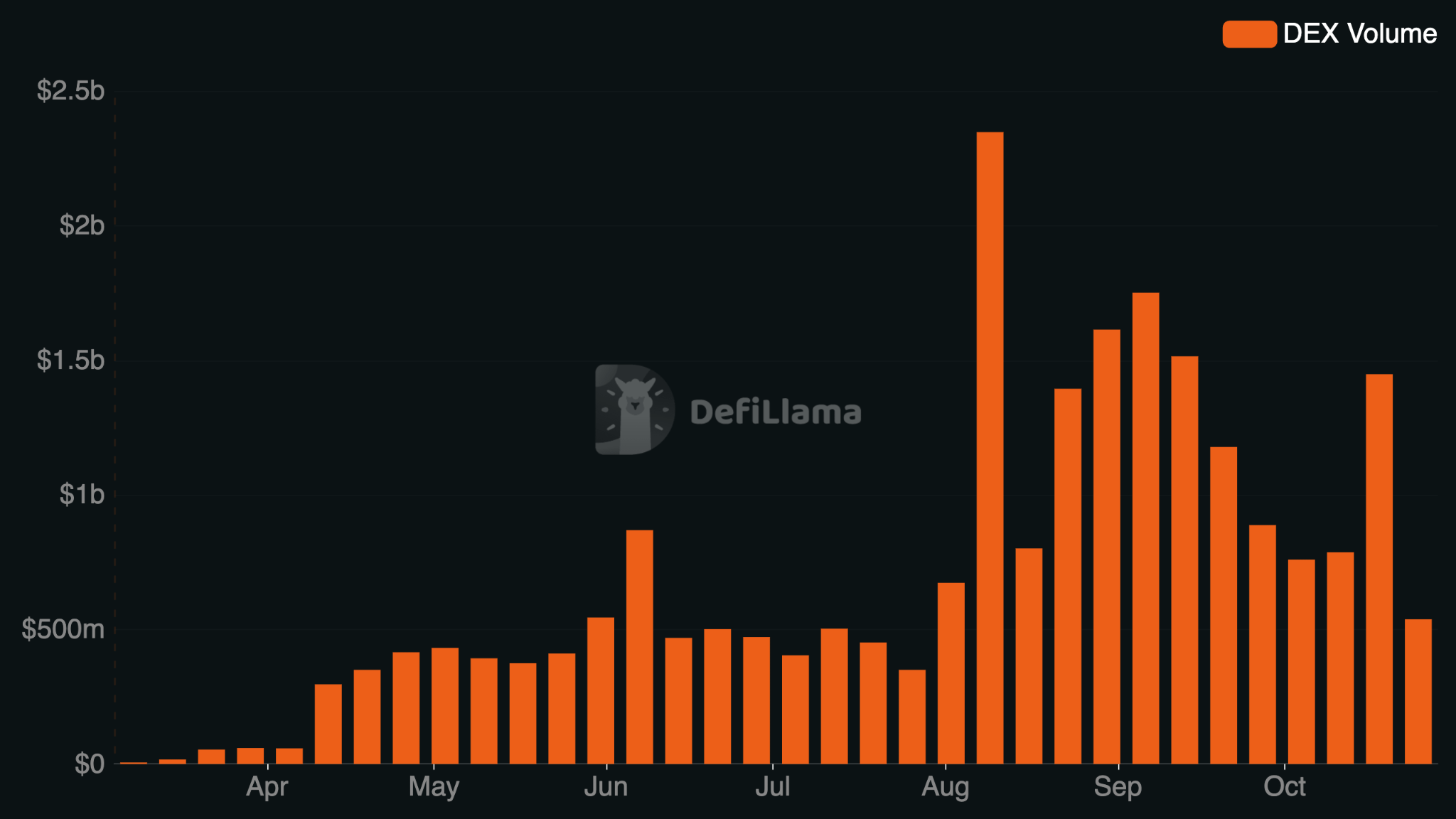
They have so far generated over $20 billion in volume.
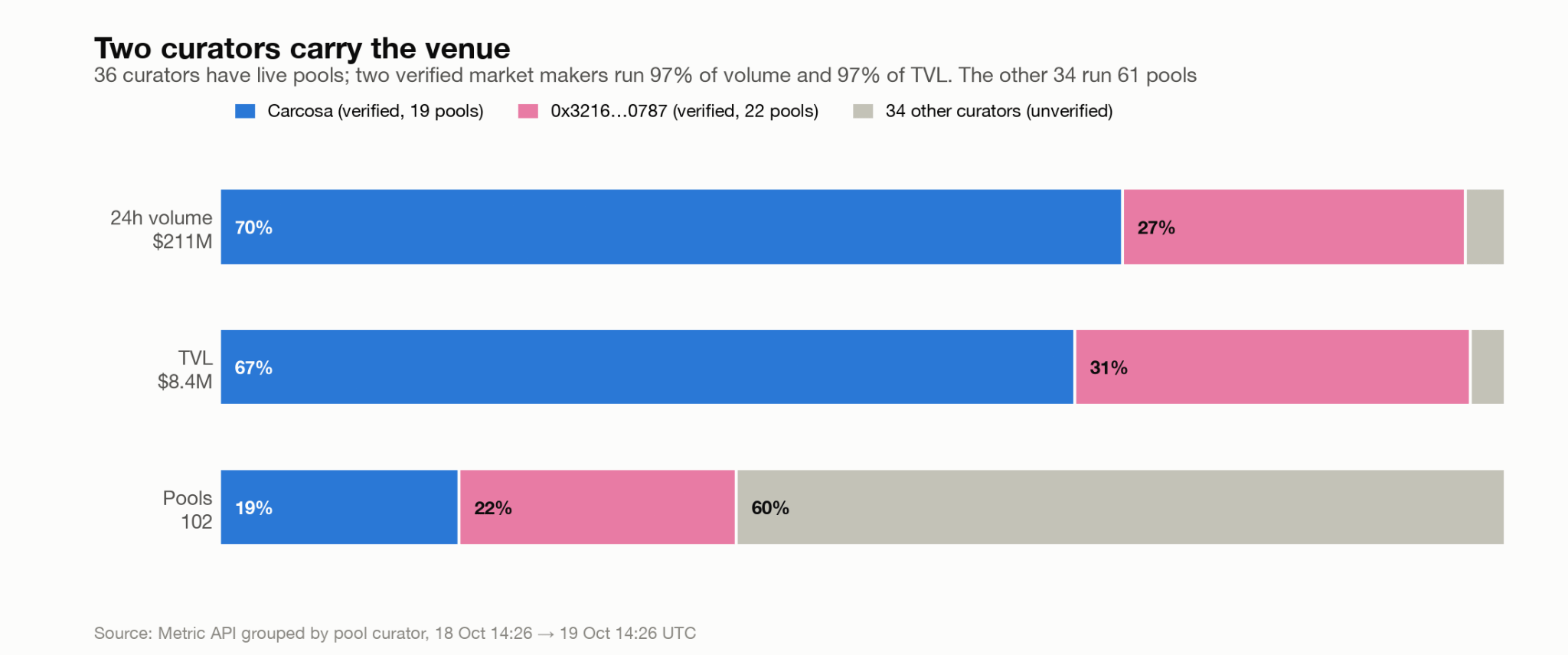
Pool deployment and liquidity provision are permissionless, and curators deploy these pools; two of them currently account for 97% of the platform’s volume, reflecting high curator and, more importantly, risk concentration.
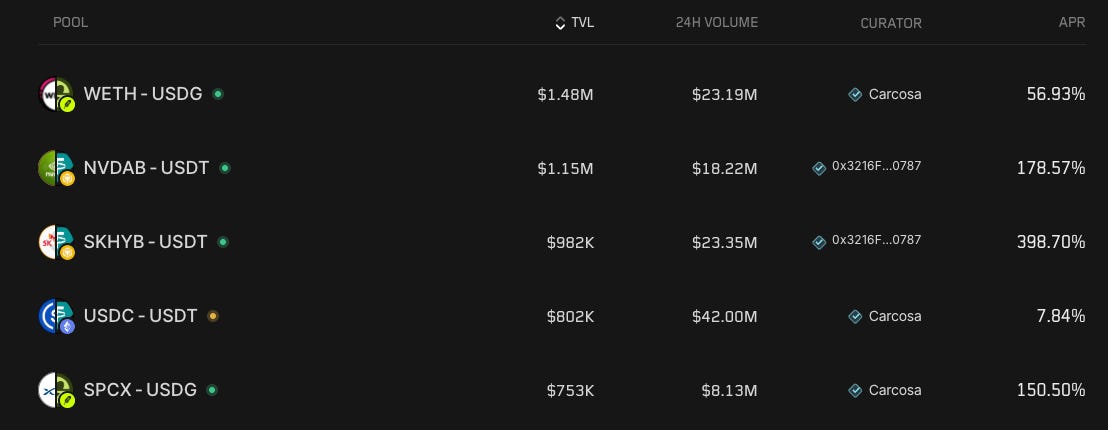
The platform charges no direct fees to traders, and LPs earn from quote spreads, which is beneficial but can encourage volume farms that indirectly suggest they wouldn’t be rewarded.
Most of the platform’s current volume comes from tokenised stocks, and these pools have a high APY because they’re highly capital-efficient, with a small amount of capital powering huge volume.
$HYPE S3 coded?
Hyperliquid Policy Centre (HPC) recently gave five recommendations to the SEC on their proposed Regulation Crypto Assets, with airdrops as the main focus:
Airdrops: Airdrops shouldn’t count as selling securities if the network is live, rewards go to the users who used the protocol, and the airdrop itself isn’t a way to raise money. Also, connecting a wallet, paying gas, or doing KYC shouldn’t count as paying for the airdrop.
Trading: Make it clear that reselling these tokens isn’t a securities trade.
Safe Harbour: Let teams use the SEC’s safe harbour (the token is no longer a security) without admitting their token was ever a security, and cover them while they are building.
Buybacks: Codify the SEC staff’s buyback guidance, meaning programmatic, rules-based buybacks and burns are fine and the discretionary buybacks can be scrutinised.
Preemption: Keep state preemption in place after a project qualifies for the safe harbour, through a light annual certification.

If the SEC adopts these, projects could airdrop to U.S. users without geo-blocking, and those users could trade the tokens without it counting as a securities trade.
Are we getting $HYPE S3 soon?
$PAPER can’t be sold?
Paragon launched $PAPER perps as a pre-listing market, but it lasted only 35 hours and $14.3 million in volume. The market was halted after the Paper team announced that these tokens would be non-transferable, meaning the market could never transition into a standard perp.
In last week’s newsletter, we highlighted a core design flaw in Paper: because the platform uses Hyperliquid BBO prices, an attacker could buy on Hyperliquid, manipulate the price, and profit on Paper. To contain this, Paper caps the bankroll so the cost of moving BTC or ETH on Hyperliquid always exceeds what the attacker can win. A $PAPER perp breaks this, as shorting it is effectively shorting bankroll solvency.
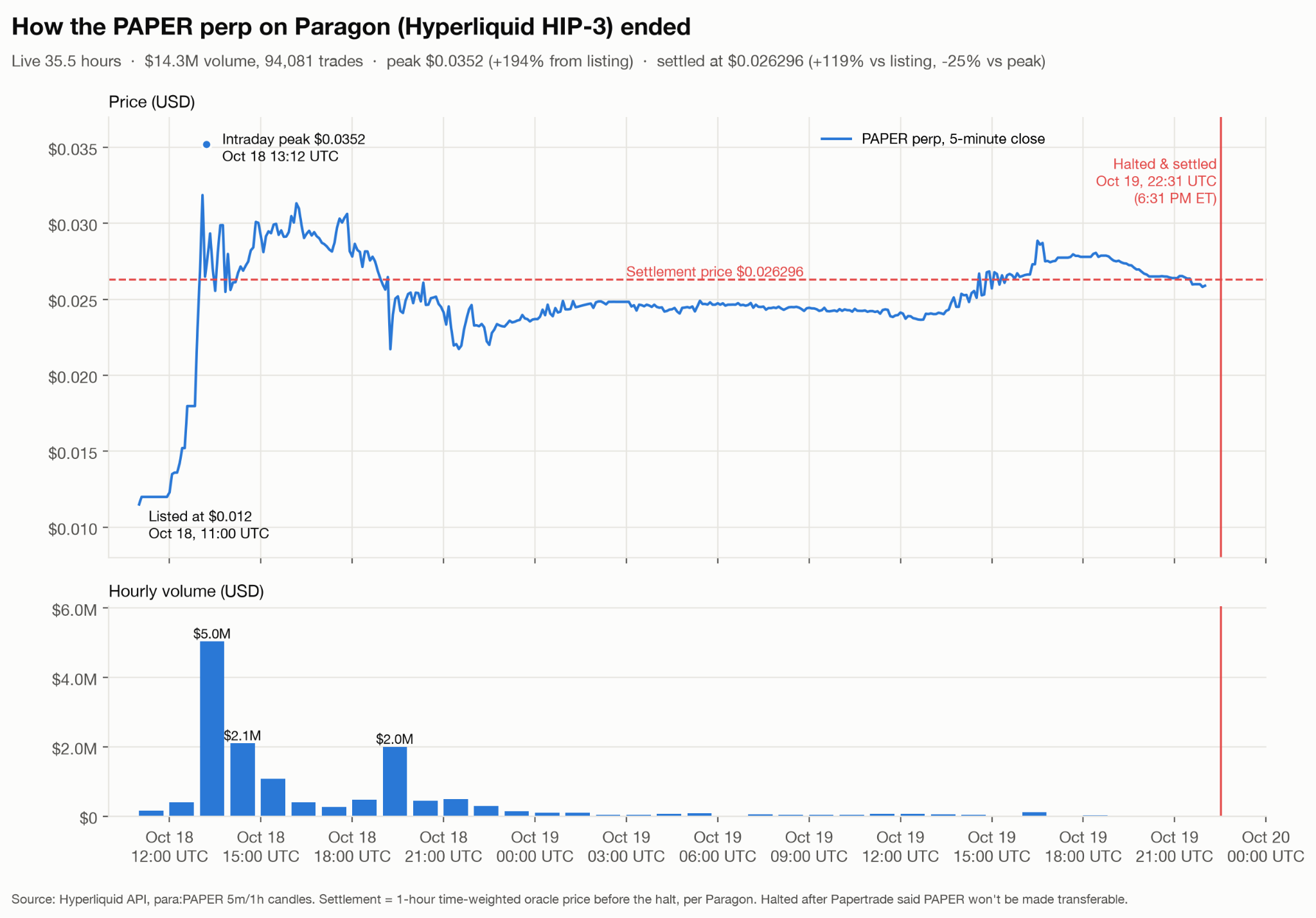
This announcement enraged the community because if the token cannot be sold, the only way to make money is through staking rewards paid in USDC from protocol revenue, which might not be enough to offset the losses they bore to mint $PAPER in the first place, as the only way to mint it is by either getting liquidated or closing the position at a loss.
Additionally, the team is also changing issuance. Every $1 million lost will now mint roughly 0.1% of the supply, so supply compounds as losses accumulate, slowly diluting early holders in favour of newer users.
On our Radar

Silhouette recently went live with RFQ on Hypercore, enabling even larger sizes. They will soon expand to HIP-3 markets (currently BTC and ETH), which need more of this liquidity.
The lighter EVM devnet is live, helping build an ecosystem around the protocol, similar to Hyperliquid HyperEVM.
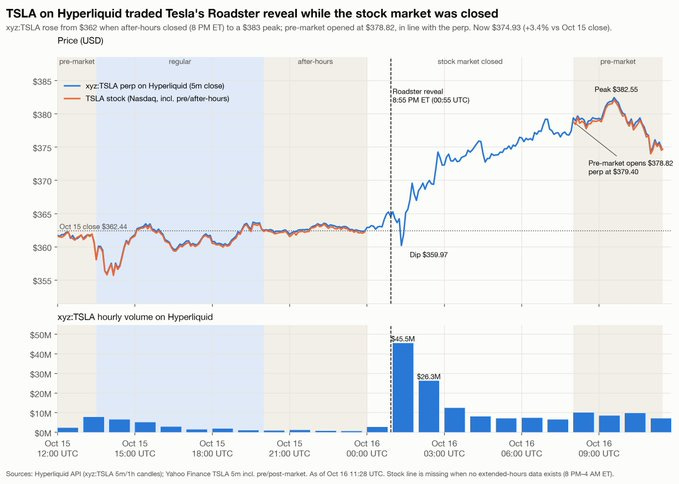
Last week, when Tesla announced its Roadster, the TradeXYZ HIP-3 market on Hyperliquid was one of the most liquid venues for active TSLA price discovery. In the hour after launch, the market processed $45 million in volume and, as you can see below, retraced to the pre-market open.
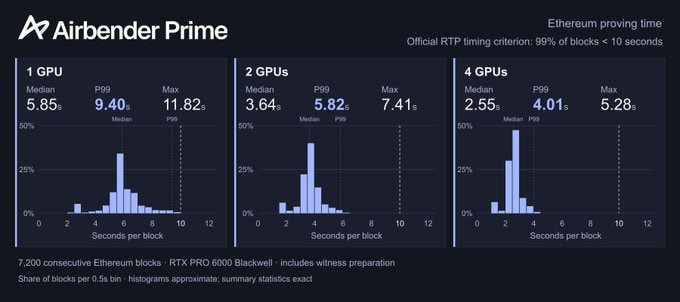
ZKSync launched Airbender Prime, a high-speed ZK prover on Ethereum that demonstrates real-time proving on a single GPU, improving finality times for ZK-based rollups and speeding up cross-chain liquidity and settlement. Additionally, it is quantum-proof.
Is the Robinhood chain dead? Some core metrics, such as stablecoin liquidity, perp volume, and tokenised equities on the chain, look very stable, suggesting the opposite.
Paboxo launched on the Robinhood chain, a lending protocol for tokenised assets that pauses some core operations during closed-market hours.
That’s a wrap!
See you next week.
Every week for the last 3 years, we have shared our research for free, directly in your email. Not a subscriber yet? Let’s fix it:

PLUS, don’t forget to join our Telegram channel for the latest updates from Castle and all our research: Link here

Disclaimer: In our newsletter, we may discuss projects or tokens in which we hold positions. While we aim to provide informative content, our views are not financial advice. Please conduct your research and consult professionals before making investment decisions. Crypto markets are volatile, and past performance doesn’t guarantee future results. Invest responsibly, and be aware of the risks. Your capital is at risk, and we do not accept liability for any losses.