



A new wave of positivity hits the markets, with HYPE at new all-time highs, privacy coins like NEAR, RAIL and ZEC owning the narrative and a growing appetite for onchain tokens despite BTC sweeping the lows of its recent range just above $74k.
All this during one of the longer consolidation periods of our industry, with DeFi protocol wind-downs being announced every month, whilst a handful of success stories are generating revenue and finding product-market fit.
With this consolidation comes a ripple effect of changes in behaviour, from key foundational players like the Ethereum Foundation and Solana rethinking their strategies to the narratives and ideologies the market finds important, such as privacy, compliance, and institutional alignment.
In this 173rd Edition, we recap our time at ETH Milan and sit down with Davide and Mattdotfi to understand what changed this year. Then we’ll look at why HYPE flipped SOL, what Polymarket is cooking with Nasdaq, how DeFi lending is a great fit for institutions, and what Vitalik’s latest statement means for Ethereum.
ETH Milan does it again
We had the pleasure of supporting ETH Milan last week as media partners and speakers, but most importantly, as friends. Castle has been with ETH Milan since the first event back in 2023 and has witnessed firsthand their growth into one of the highest value conferences to date, and they aren’t stopping there.
The attendance, speakers, and sponsorship were all high quality, with MoonPay presenting the conference following its recent acquisition spree and Italy’s largest bank, Intesa Sanpaolo, sponsoring the event.
Topics ranged from:
DeFi trends ahead with Rysk, Bitfinex, LFJ, Keyrock and Enso
The State of derivatives with Pear Protocol, Perps.fun, Raven, and Ostium
The direction of stablecoins with Dune, OpenFX, Kast, and Hercle
How institutions are entering onchain with 21shares, Ledger Enterprise, Lido, and Axis Group
And many more
Not to mention the great attendance from Italian institutions on Day 2. Small but high-value attendee conferences are fantastic. They allow easy access to the connections you want to make, and have a super high signal-to-noise ratio, ensuring great conversations and fewer interruptions.

With the changing market across the industry, all businesses must adapt or die. Conferences are no different. ETH Milan has been at the top of the list because it understands its audience. First and foremost, it has been “an event for the community… that is made for people like them. By conferencoors for conferencoors.” said DavideFi, ETH Milan Co-Founder. “An excuse for all our friends to come to Italy.”
But this year was different. Not only did the event stay true to its community roots, but it also opened the door to institutional appetite. Intesa Sanpaolo, Italy’s largest bank, which holds almost $300m in crypto, sponsored ETH Milan this year, and the Italian-speaking “Institutional Day was so successful that people flooded the stage, and there were dozens of people forced to attend speeches and panels standing,” Mattdotfi told us.
These two worlds are now coexisting, and we see this in our own audience of late, with institutions, banks, hedge funds, and traditional finance media all wanting to learn more and go deeper into what blockchains and onchain finance make possible.
The split was visible on stage across the conference, with speakers from both camps coming to terms with the evolving space we find ourselves in. This was seen particularly across the DeFi Trends panel, and the State of Derivatives Trading panel, where crypto-native builders and institutions coming from different origins were converging on the same technology and use-cases.

We asked both Matt and Davide what they thought might come to pass in 2027, and both landed on the same mark. Davide thought “RWAs will have captured a significant portion of the market, and that the digital Euro will be much more of a reality,” with Matt summing it up perfectly: “an onchain economy that powers TradFi products.” We too believe we’ll see strong growth in euro stablecoins over the next 12 months, with MiCa now fully phased in and more euro stablecoin startups entering the space.
Just last week, in fact, Etherfi added a EURC liquid vault to their Cash product, allowing users to earn yield on their euros with zero-fee FX spending.
Next year, the team is taking it one step further. ETH Milan will become Milan Blockchain Week, and a third vertical focused on enterprises will enter the fray. “This new format will provide corporations and institutions in Europe and beyond with an environment that promotes innovation, education and connections,” Matt told us.
But the suits haven’t taken over yet. ETH Milan, a community and culture-focused track, will get its own day still, “ with all the core crypto community of the conference showing up for a day of OG vibes as a day that they’ll remember as an event not to miss,” said Davide.
We already know we’ll be at MBW next year as we continue to write for and service each side of onchain finance.
Will you?
HYPE flips SOL by FDV as ETF flows heat up
Hyperliquid has been on an absolute burner of late: From HIP-3 breaking records and capturing huge TradFi attention, to the phased HIP-4 deployment set to compete with Polymarket and Kalshi.
Off-chain, HYPE ETFs have been picking up steam, with THYP and BHYP launching earlier in the month and cumulatively recording $74.91M in inflows over just 8 days. That’s around a 5x increase in buy pressure from the Hyperliquid Assistance Fund (AF), which repurchases HYPE with revenue.
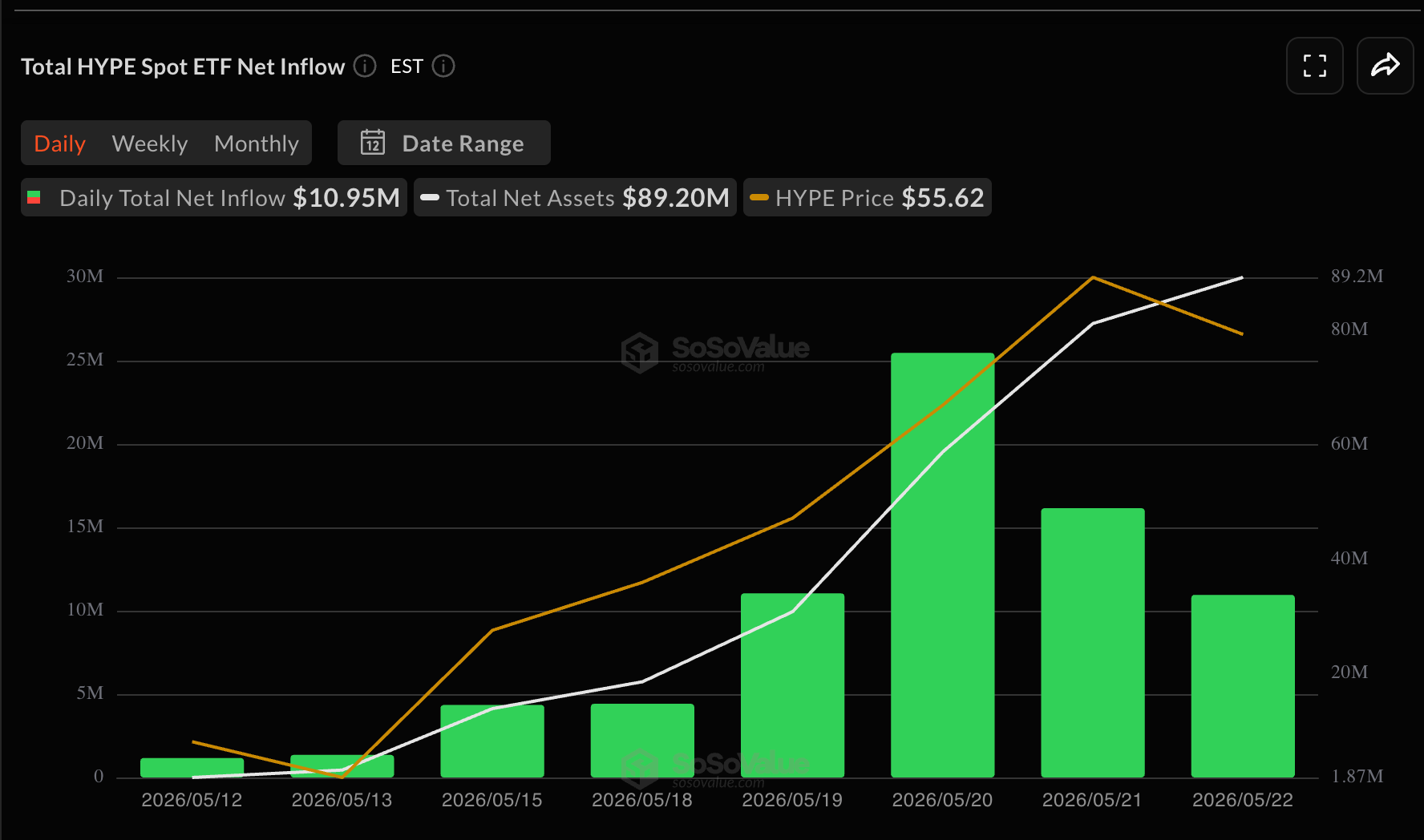
HYPE is now up ~50% this month alone, flipping SOL by FDV as Solana fights a different battle altogether. SOL is down 73% from its one-year high, and despite every onchain ecosystem bleeding perp mindshare to Hyperliquid, it has recently decided to take them on with a marketing campaign. Solana Labs CEO, Toly, has himself been across X, tagging Hyperliquid traders to ‘Try Phoenix Trade’, with pitches for lower fees and greater decentralisation.
Vibnu, now interim CMO at Solana, further drove the campaign, almost losing his entire $10k deposit in a trading competition on Phoenix against a Hyperliquid trader but bringing valuable attention to the platform. This kind of favouritism, however, risks alienating long-term builders on the chain, as they see the ecosystem leadership picking winners and losing its neutrality. It certainly doesn’t help that the chain’s previous perp poster boy was exploited for $285M six weeks ago.
Onchain researcher Tulip King made a sharp critique of the situation: “You need to bridge businesses to Solana, not tokens.” He stresses that Solana’s response to the Hyperliquid growth has been an old marketing playbook, not something fundamentally different. He argues the Foundation’s treasury would be better spent on poaching Polymarket, Rollbit, or the AI projects on Base than promoting a perps DEX that isn’t even the biggest one already running on Solana.
To be honest, when laid out like that, it’s hard to argue with.
The wisdom to zoom out of the weekly timeline came from Bitwise CEO Hunter Horsley, who positioned the two giants as “a new class in crypto: the revenue chains.” Last week, Hyperliquid led with $790M in revenue; Solana sat second at $532M; Tron third at $471M; and Ethereum fourth at $425M. These two have great opportunities to grow and thrive in ways Ethereum cannot, due to their centralised operations and agility (though Solana may be losing some of this).
Vitalik weighs in on the Ethereum Foundation’s purpose
Ethereum is living a crisis of its own.
The Ethereum Foundation (EF) has been losing leaders thick and fast in recent weeks. Eight senior departures in 2026, and five in May alone:
Carl Beek (Beacon Chain, 7 years)
Julian Ma (FOCIL, 4 years)
Protocol Cluster leads Barnabé Monnot and Tim Beiko
Alex Stokes on sabbatical
Co-executive director Tomasz Stańczak, who resigned 11 months in to focus on AI
This crisis at the very top, likely arising from differences in vision and purpose, is coming at a time when the industry is reshaping around institutions coming onchain and the application layer is sorting its winners and losers. That timing is probably not a coincidence.
Last week, Vitalik posted his clearest perspective on the EF in some time. “The EF is not the centre of Ethereum,” he said. It is “one node, with a defined purpose, alongside other nodes.” EF is choosing longevity over breadth, specialising in censorship resistance, capture resistance, open-source, privacy, and security (CROPS). He highlights a number of technical priorities that align with the strive to be deeply impressive in the CROPS domain:
A provably bug-free Ethereum via AI-assisted formal verification - something thought impossible just months ago
Available chain consensus through lean consensus - engineering Ethereum to be safe both when half the nodes are offline AND when up to 49% are actively attacking
Intermediary minimisation via FOCIL, EIP-8141, and the Kohaku wallet stack - Today, smart wallets and privacy protocols route transactions through third-party relays before they hit Ethereum, and these protocols can remove the intermediaries so transactions go straight to the chain.
Moving forward, we will see a smaller, more focused ship leading the protocol, with clear vacuums available to be filled across BD, asset narratives, and application-layer growth. The foundation has already delivered on its mandate, and as always, Ethereum is open to all who wish to drive it forward. Right on cue, Dankrad Feist, a former Ethereum Foundation researcher, has proposed a new ETH-aligned organization seeking at least $1 billion in funding, in order to redirect Ethereum back on a winning trajectory.
Polymarket partners with Nasdaq Private Market
On 19 May, Polymarket and Nasdaq Private Market (NPM) launched a partnership that added IPO-related markets for OpenAI, SpaceX, Anthropic, Stripe, Kraken, Anduril, and Databricks to Polymarket.
Early contracts include OpenAI hitting a $1T IPO valuation before 2027 (currently priced at ~66%), Anthropic IPO valuation over $1.8T (51%), and SpaceX, currently given a 79% chance of being the “largest IPO by market cap in 2026”.
This is the first time a regulated US secondary-market platform has integrated prediction markets as a price-discovery instrument for its own pipeline. The structural shift is that retail traders now gain synthetic exposure to private-company milestones without the accredited-investor requirements imposed by others.
We have been covering Pre-IPO equity speculation at length and believe that synthetic exposure will continue to see strong demand due to its ease of access and lack of legal risks compared with other secondary vehicles. Last week, we focused on the data behind the onchain IPOP markets for CBRS and SpaceX on TradeXYZ, and published a full article covering Pre-IPO Perpetuals here:
Pre-IPO Markets are Moving Onchain

2026 is one of the most eventful years for IPOs, with the biggest IPO calendar in a generation.
Observations after a month: Aave’s Chief Commercial Officer
Speaking of institutional appetite, Luigi D’Onorio DeMeo, Aave’s new Chief Commercial Officer, one month into the role from Ava Labs, published his top observations:
DeFi is more widely welcomed by institutions and fintechs than he even expected: This aligns with what we have been seeing on the ground as well. TradFi is moving past asking if they should engage, but studying how to.
Qualified-custodian-backed lending is the next growth spurt: a huge opportunity, with $100B+ in institutional crypto held by qualified custodians like Anchorage, Coinbase Institutional, Fidelity Digital Assets, and BitGo.
Receivables financing onchain is a tangible institutional use case for DeFi: companies sell their outstanding invoices to financiers at a discount for immediate cash. Whilst it doesn’t set the world alight, this is ripe for disruption, as blockchains unlock verifiability, lower friction, and real-time settlement.
DeFi lending will essentially redefine how prime brokerage works: a function traditionally where banks like Goldman lend cash and assets to hedge funds against their collateral, letting them run leveraged strategies without selling positions. Now think about the funds with billions parked at qualified custodians that can now borrow against their locked collateral onchain through protocols like Aave, lowering costs with programmable rails.
Onchain businesses and protocols are evolving, not just in their architecture but in their business development activities. Aave clearly has a big vision here, but has a lot of work to do to bring it to life. The next 12 months will be incredibly important.
Wind-downs make room for new eras to arrive
Last week saw four DeFi protocols announce wind-downs:
Zero Network: Zerion’s gasless L2 at only 18 months old)
Everclear / Connext: the cross-chain settlement clearing house with $1.5B+ cleared and a ~$500M monthly volume peak
Syndicate Labs: an a16z-backed Ethereum infrastructure team after five years, which has raised >$25M
Fantasy.top: Fantasy sports cards based on CT characters
Unsurprisingly, the Crypto Times’ running tally is now at 40+ DeFi protocols that have shut down in 2026 to date. These are the teams and projects that could not generate meaningful revenue or create a commercial moat, and we will continue to see much more of this in 2026.
But with all things that perish comes new life. Following the rotation of attention and capital brings us to privacy. This week, Barry Silbert posted what could be taken as the institutional starting gun: “the privacy era in crypto has officially begun,” he said.
This follows a sustained rally in May across the privacy stack:
ZEC hit a 2026 high above $585 on 6 May after Multicoin Capital partner Tushar Jain disclosed the firm’s position, with a record ~30% of ZEC supply now sitting in shielded addresses
XMR took out its 2021 ATH earlier in the month before pulling back above $300
The mid-cap rotation of RAIL, ZAMA, and ORE has been moving in unison as well.
We have been tracking a shift from “privacy is ideology” to “privacy is utility”, and that’s now landing with institutions. We wrote about privacy in a recent report, and intend to cover it much more deeply in the coming weeks across the newsletter and with a potential flagship report.


A few things we’re watching closely as the weeks ahead unfold:
CLARITY Act reconciliation: targeting a 4 July signing, conference committee announcement expected
SpaceX’s IPO: Onchain price action evolution for IPO on 12th of June
HYPE ETF flows: whether the $10M+ daily pace sustains or fades back to early-launch levels
Solana’s response: whether the Phoenix push converts to perp volume or the builder backlash hardens
EF Roadmap Execution: Can the Ethereum Foundation continue to deliver with a smaller ship, with Glamsterdam set for next month?
Plus: ICYMI, our flagship on the Vaultification of Finance landed last week!
Don’t forget to join our Telegram channel for the latest updates from Castle and all our research: Link here

In our newsletter, we may discuss projects or tokens in which we hold positions. While we aim to provide informative content, our views are not financial advice. Please conduct your research and consult professionals before making investment decisions. Crypto markets are volatile, and past performance doesn’t guarantee future results. Invest responsibly, and be aware of the risks. Your capital is at risk, and we do not accept liability for any losses.