



Bitcoin is going from strength to strength, breaking $80,000 overnight, closing April +12%, and recording the highest monthly ETF inflows this year ($1.98B). Whilst Ethereum is lagging behind, it did achieve its first net positive inflow month since October 2025, drawing in $365M.
After an April that scarred the industry, with the worst month of exploits since 2022 totalling $651M, May has gotten off to a stronger start. In fact, just yesterday, Haun Ventures announced a new $1B fund focused solely on rethinking finance, and a16z announced a new $2.2B crypto fund. This came after the most anticipated TGE of the year in MegaETH and a week when several new derivative products opened for trading, including the long-awaited HIP-4.
We’ll start this edition with these new derivative markets, then move to Aave’s legal battle for Arbitrum DAO, more details on VCs raising funds, a recap on MegaETH’s launch, and a look at RWAs and DeFi.
Onchain derivatives are eating finance
Haun Ventures’ $1B fund’s thesis focuses on three pillars: new financial infrastructure, new assets and markets, and an agentic economy. The first two are rooted in fewer intermediaries, the removal of legacy constraints, and the creation of borderless, always-on, programmable markets. And that’s exactly what got shipped this week:
Hyperliquid opened HIP-4, its outcome markets in limited form
Trade XYZ launched pre-ipo perpetuals, adding to their dominating product offering
Ostium reinvented its liquidity engine, directly accessing tradfi liquidity with decentralised execution.
Risechain, the gigagas L2 launching their flagship perp DEX, RiseX
Each of these targets the pillars above by removing barriers and enabling access to infrastructure, liquidity, and new markets. Let’s take a deeper look at each.
HIP-4 goes live
Over the weekend, Hyperliquid pushed HIP-4 to mainnet, limited to a single BTC binary event per day.
HIP-4 are Hyperliquid’s outcome markets. They are designed to be a general-purpose primitive, useful for prediction markets and options-like instruments, among others. Outcomes expands the platform, bringing an alternative form of derivatives trading that does not include leverage or liquidation risk, while composing directly with other features, unifying margin across spot and perps accounts, and connecting to the HyperEVM.
Whether this will be seen as a sufficient differentiator from Polymarket and Kalshi, and what kind of user it will attract, remains to be seen. We expect Hyperliquid’s core user base to remain loyal and a portion of Polymarket users to migrate, given that 14% of Polymarket’s top traders are already on Hyperliquid, with those overlapping wallets generating $1.43 billion in Polymarket volume and running $189 million in perp notional on Hyperliquid.
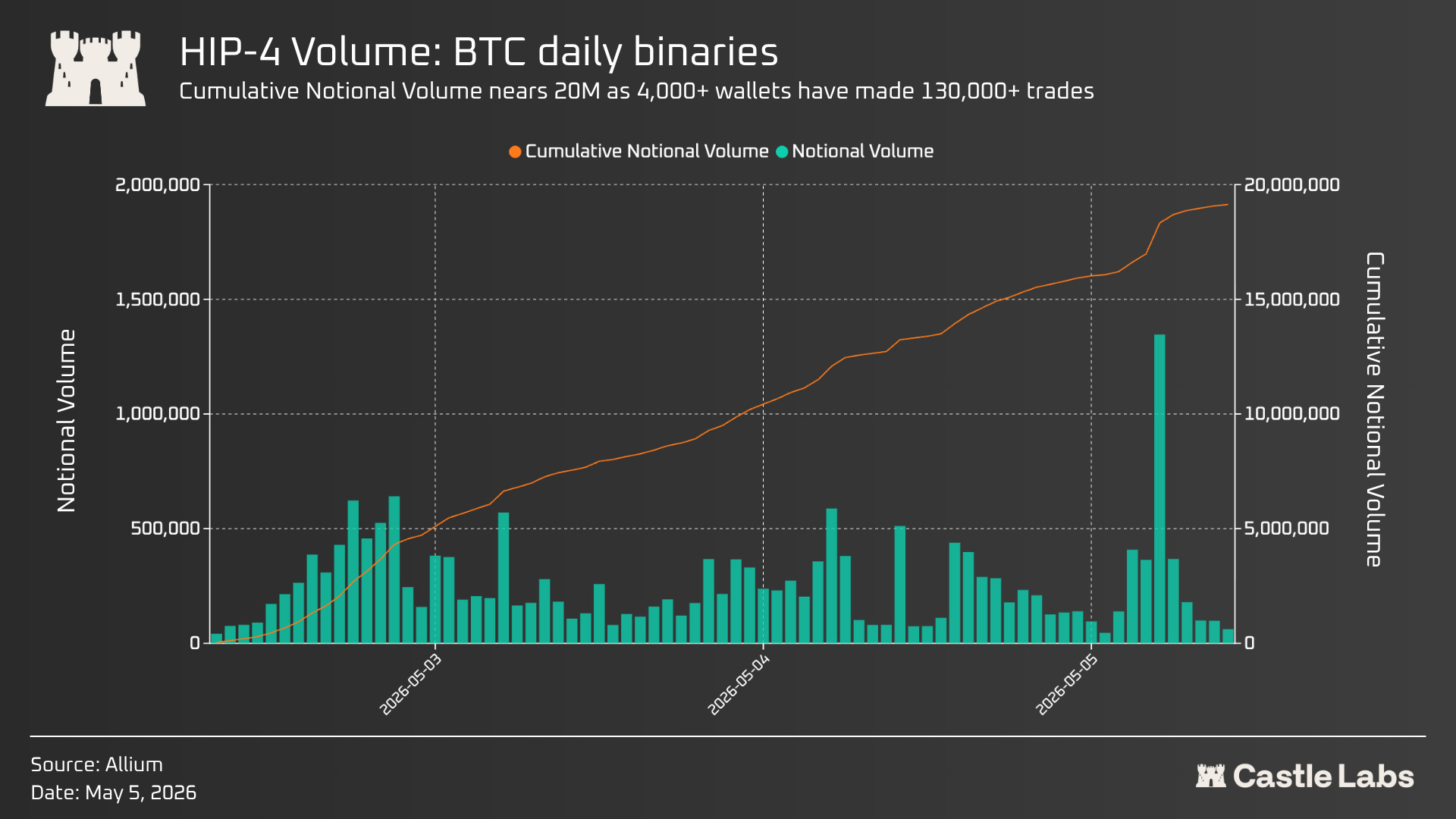
We expect to see more markets listed soon, potentially around the price of hype and later multi-outcome markets, before full permissionless deployment. Potential deployers include TradeXYZ, Kinetiq x MarketsXYZ, OutcomeXYZ, and Nova Markets.
Find all resources surrounding HIP-4 in this thread, along with our previous report.
TradeXYZ launches IPOPs
After dominating perpetual equities and commodities, Trade XYZ are going after pre-IPOs. This time, instead of unlocking 24/7 trading for users, they are opening up a market that was gated, slow and inaccessible on private secondaries. Their first IPOP market is Cerebras (CBRS), the AI chip maker that just filed its S-1 with the SEC, targeting a mid-May IPO.
We’ve seen the first iterations of this onchain from Ventuals and others, but Trade XYZ’s release introduces a new pricing mechanism derived from the internal market itself, enabling price discovery on the platform that is uncorrelated with the stock’s estimated valuation. This is an update on current Pre-IPO perps, which anchor the market price to the underlying using a fair value estimation.
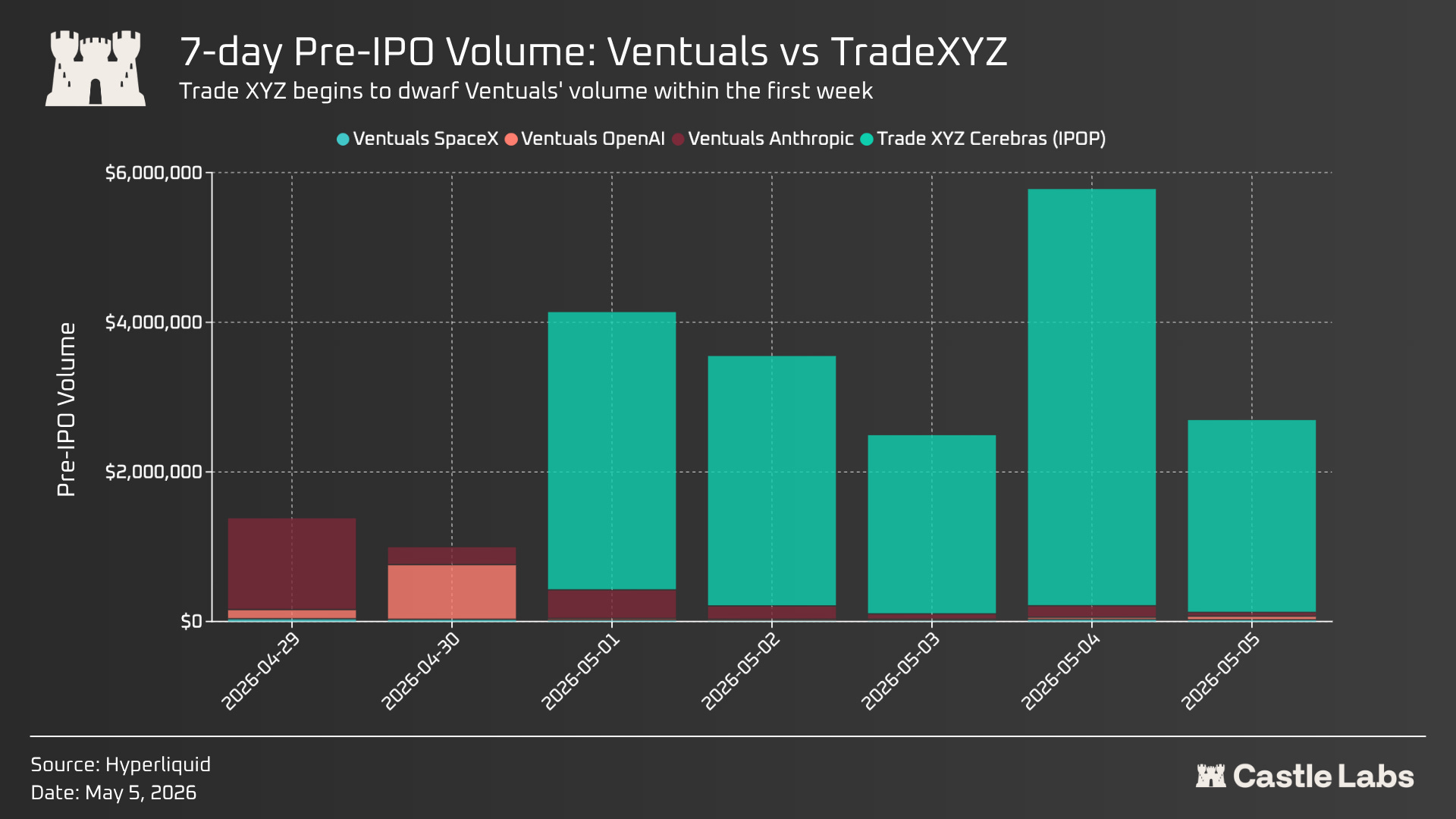
This new market from TradeXYZ is due to make some waves, just like they did with perpetual equities and commodities. We predict this will bring real attention from those outside crypto, as these companies are among the most-watched by investors, allocators, and traders worldwide, and Trade XYZ already has the distribution to target them. In the first week alone, TradeXYZ has been dwarfing the volume at Ventuals. Although Ventuals appears to be in a much steadier state, with lower volumes and a stable OI, suggesting users are sitting on their positions waiting for the IPO.
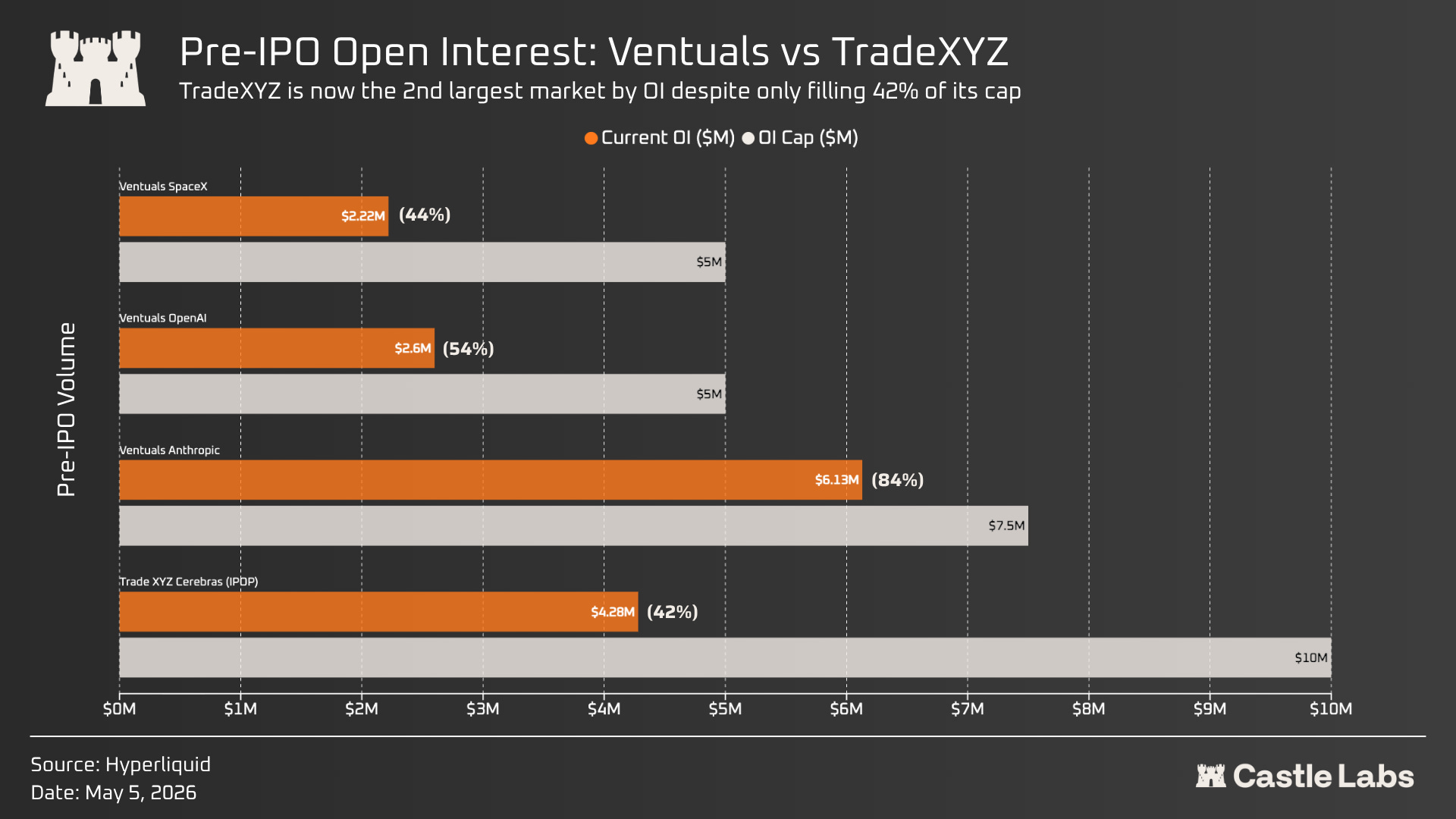
Later this week, we will release a full report on Pre-IPO perps: the evolution, the venues, the mechanisms, the trade-offs, and what this means for the broader offering of onchain derivatives. Be sure to subscribe and follow on X ahead of time, and follow Atomist for teasers.
Ostium as the gateway to liquid markets
Last week, Ostium had its largest protocol upgrade to date and the first of its kind for onchain trading infrastructure. Previously a self-contained system, Ostium now connects to the deepest pricing and liquidity at some of the world’s most liquid traditional markets. They achieved this by working with a hedging network of market makers, prime brokers, and other major institutions.
Traders can expect larger trades, tighter execution, predictable fees that reflect those of these liquid markets, and access to more markets and assets. LPs, on the other hand, are no longer directly exposed to trader PNL. Instead, the directional risk is hedged offchain. Whilst OLP, Ostium’s onchain liquidity provider vault, becomes the senior tranche, with a dedicated junior buffer sitting below, programmatically hedging and absorbing any gains or losses first.
To demonstrate the impact this upgrade is already having, a single $2.2 million trade longing the US100 at 100x leverage had a price impact of 0.0038% last week, and traders are making eight-digit trades with very little slippage.
Instead of creating onchain markets, Ostium has chosen to build a layer that allows access to traditional exchanges worldwide directly onchain. Despite allowing deep liquidity access at competitive pricing and low slippage, it is bound by the restrictions of these traditional markets. As such, Ostium is not open 24/7 for commodities, FX, and equities.
RISEx posts $100M volume in its first week
Despite launching on an invite-only basis, weekly volume at RISEx has hit $100M, with cumulative volume exceeding $150 M since launch and a peak open interest of $2.1M. The order book for the DEX lives entirely onchain, with the same execution environment as every other contract across RISE (more on that below). In pre-launch testing, the team achieved 5 Ggas/s, 50k TPS, and a 1ms order book update. From looking at rollups.wtf, we can see the actual live data with RISE burning more gas than Ethereum and all other L2s combined, all originating from one app.
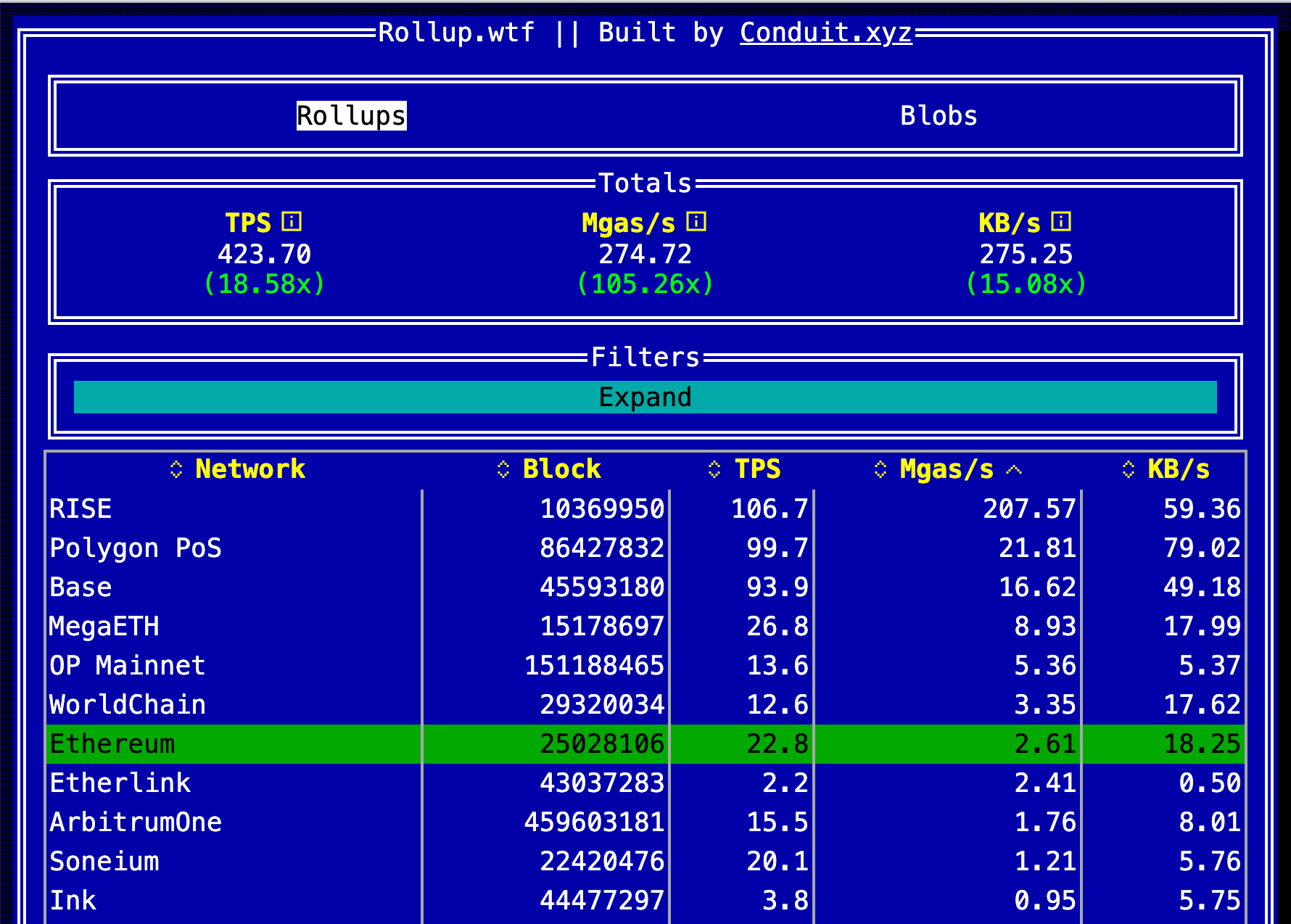
Whilst this speed and gas consumption are astonishing, it’s what the shared state unlocks that can truly be a game-changer here. Through this shared state, AutoYield allows idle margin to earn yield via Yearn-managed vaults, and LP positions and lending deposits can be used as margin.
We’ll be watching to see how RISE grows over the coming weeks as they come out of invite-only, iterate on their product, activate their wider ecosystem, and polish the user experience. See their full launch philosophy here.
Get access now with code: ATOMIST1 at https://rise.trade
Castle’s derivatives thesis
It’s clear that onchain derivatives are becoming critical infrastructure for finance worldwide, removing intermediaries, breaking down borders, and allowing people to access always-on, programmable markets wherever they are.
We’ve been writing about derivatives for years, ever since we published our flagship piece on GMX V2, which at the time was a groundbreaking new architecture for perp DEXs onchain. Much has changed since then with the arrival of Hyperliquid and the emergence of new L2s, opening up the possibilities for what can be achieved completely onchain. You can find some of our derivative pieces throughout the years below:
3 July 2023 — Deciphering GMX v2: The Next Wave of Decentralised Perps: Oracle-priced AMM mechanics, GLP to GM/GLV transition, fee restructure, CLOB versus AMM models.
10 November 2023 — Demystifying Options: A 0 to 1 Guide about DeFi Options: DeFi options primer covering Lyra, Aevo, Panoptic, Synthetix-as-hedge, options AMM landscape.
23 February 2024 – Unlocking Hyperliquid: A Deep Dive into its Future and Fair Valuation: Hyperliquid as dApp-chain, $1.1B FDV thesis, valuation against dYdX and GMX comparables.
19 September 2024 – The Evolution of Prediction Markets: Polymarket and Azuro deep dive, history from Augur onwards, sector growth and PMF.
28 April 2025 – The Ultimate Guide to Farm the Hyperliquid Ecosystem: HyperEVM farming meta, KittenSwap, post-airdrop positioning across the Hyperliquid ecosystem.
10 September 2025 — USDH: A Hyperliquid Aligned Stablecoin: Native Hyperliquid stablecoin design and perp collateral implications.
2 October 2025 — Prediction Markets: A Differentiated Hedging Tool: Prediction markets as hedging instruments, low-risk DeFi framing, Limitless and the broader landscape.
23 December 2025 — Secrecy and Grand Designs: Variational deep dive (RFQ perp DEX with Omni as internal market maker), CLOB versus RFQ structures across Hyperliquid, Lighter, Aster.
12 January 2026 — Prediction Markets Have Never Been This Strong: Sector volume and trajectory thesis.
3 February 2026 — Making All Markets Hyperliquid: HIP-4 binary outcome markets, Hyperliquid as universal market layer.
6 February 2026 — Don’t Trade Cryptos, Trade Rates: Pendle Boros, yield-rate derivatives, funding-rate trading.
19 February 2026 — Hyperliquid is Not a Company: Jeff Yan EthCC interview, protocol-not-company framing.
25 March 2026 — The Evolution of Commodities: Onchain commodities, gold and silver perps, the oil markets thesis.
1 April 2026 — 432 Hours of Hyperliquid Oil Market Data: Empirical analysis of Hyperliquid oil perpetual data.
Aave files emergency motion to vacate restraining notice on Arbitrum DAO
Aave Labs has hit back at a restraining notice issued by Gerstein Harrow (a law firm representing victims of previous DPRK thefts) against the Arbitrum DAO, filing an emergency motion to vacate. The notice has effectively put Arbitrum DAO and its delegates in a tight spot on whether to approve the release of frozen funds back to DeFi United, the contributor coalition working to make rsETH holders whole, bring rsETH back to peg, and remove the risk of bad debt across Aave.
The Arbitrum DAO currently has an offchain temperature check live, which is due to pass. However, we know firsthand that many delegates are wary of voting due to legal concerns around liability. This extends even to abstaining on such a proposal, especially for the onchain execution vote that follows.
Aave Labs’ filing here is a great step towards working with the courts and, hopefully, can lead to clarity before the onchain vote in the coming week.
a16z & Haun Ventures raise billions as crypto VC funding hits a new monthly low
Deployed VC capital in crypto hit its lowest monthly point since July 2024, with $659M in funding across 63 rounds. Despite this, Haun Ventures’ new fund may signal a brighter future. They’re focusing on new financial infrastructure, new assets and markets, and the agentic economy, particularly mentioning prediction markets and perpetual futures. These are all theses we deeply believe in at Castle. To add fuel to the fire, a16z also announced a $2.2B crypto fund today.
Could this signal a bottoming in the market and in the industry? Or do we have longer to wait yet? We expect this transition to continue, as crypto VCs of the past fail, fold, or pivot, and newer, more finance-oriented VCs enter crypto, seeing huge opportunity for disruption, as the financial rails, markets, and assets of tomorrow are built onchain.
MegaETH after the dust has settled
Just five days after TGE, MegaETH has flipped Ink, Monad, OP Mainnet, Plasma, Sui, and Avalanche in terms of TVL surpassing $700M. Despite this, the token fell from an open of $0.18 to $0.12, a 38% drop. MegaETH has been pushing to differentiate itself, both in its architecture with real-time sequencing and in its launch and token unlock strategy, utilising a new approach with KPIs linked to emissions for both users and the team.
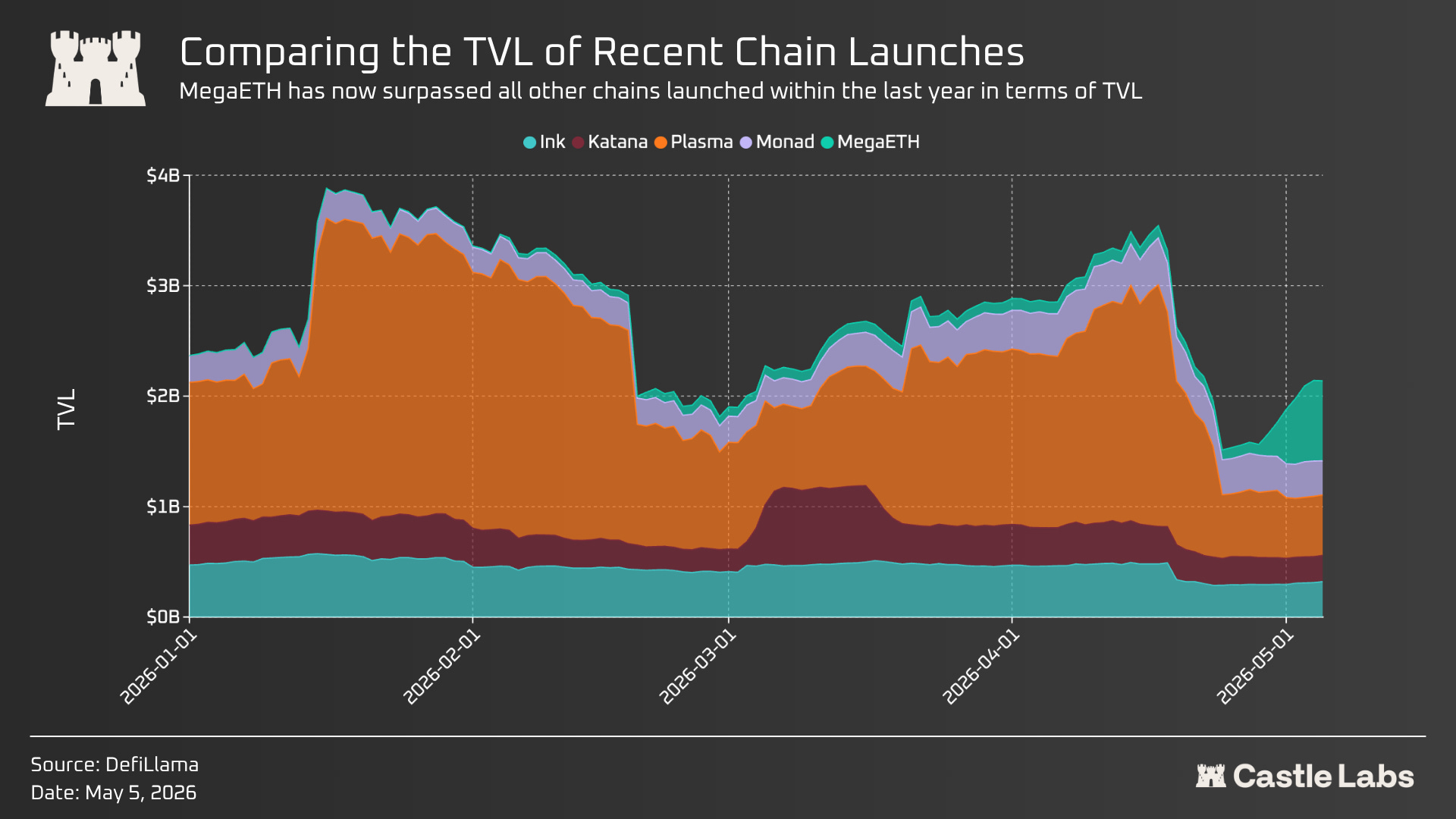
Feedback from the market has been mixed on the quality of the apps, but one thing is for sure: USDM, MegaETH’s native stablecoin, has been growing rapidly, surpassing $500M over the weekend and ticking off one of the first KPIs in Flux. With Flux, users can stake their MEGA tokens in reward contracts that unlock as KPIs are met. There are currently 677 million MEGA committed to this effort from users, with 5.3 billion tokens up for grabs as KPIs get ticked off.
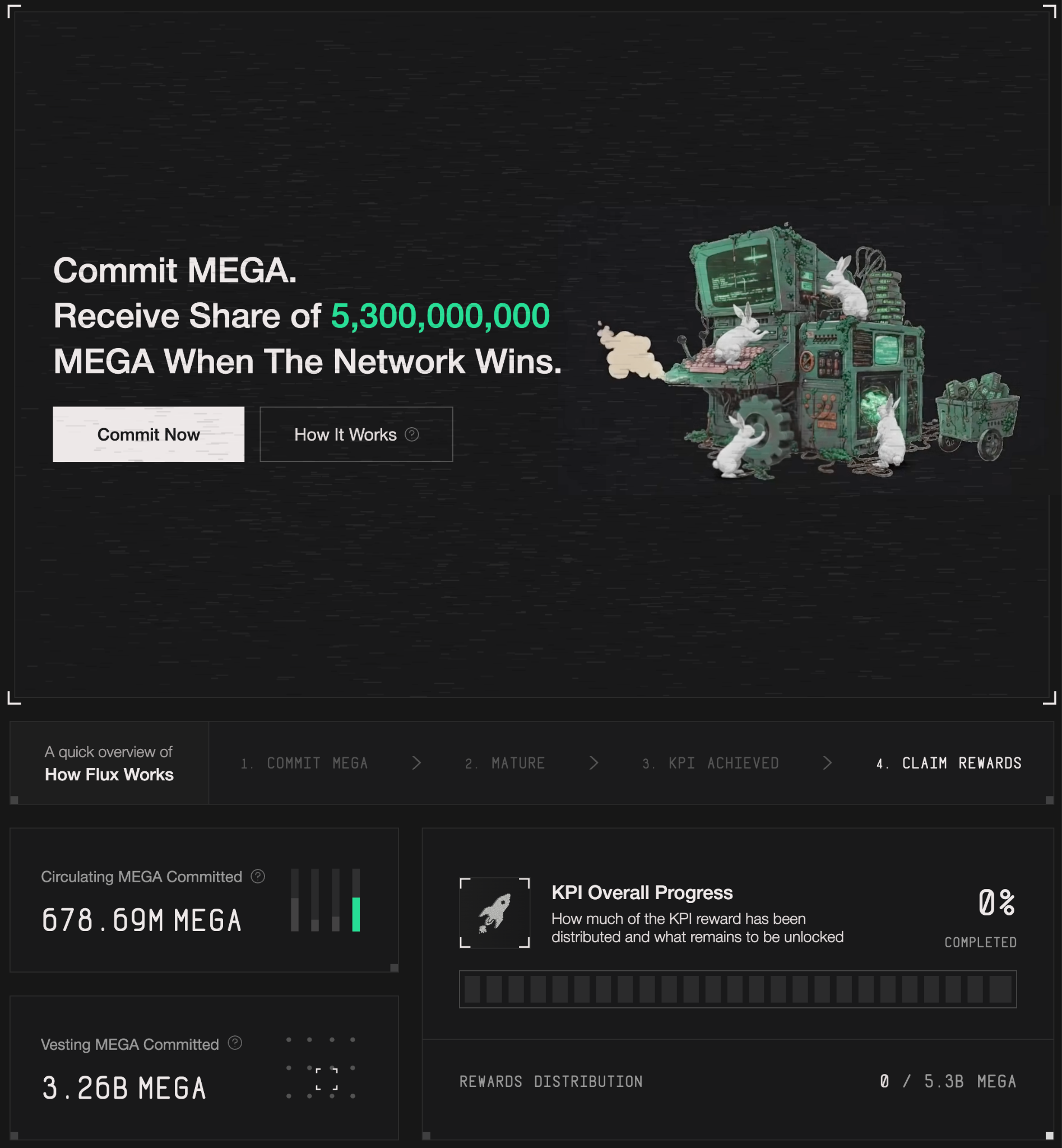
The eight-week incentive campaign across the apps in the terminal has kicked off. Usage across these apps, alongside ecosystem-wide metrics such as USDM supply and collateral in lending markets, is worth tracking. Remember, no incentive campaign tokens are released until the end of the eight-week period, so no fresh supply enters the market during this period. Whether this will lead to an upward price movement back to the opening valuation remains to be seen.

What's happening in RWAs?
Real-World Assets (RWA) currently sits at an onchain value of $30.92 billion and is one of the categories that have seen only an uptick in value over time, unlike other crypto categories. This growth reflects a consistent interest in growing RWA onchain. There are multiple players involved in this significant value, including BlackRock, Franklin Templeton, and many other TradFi institutions.
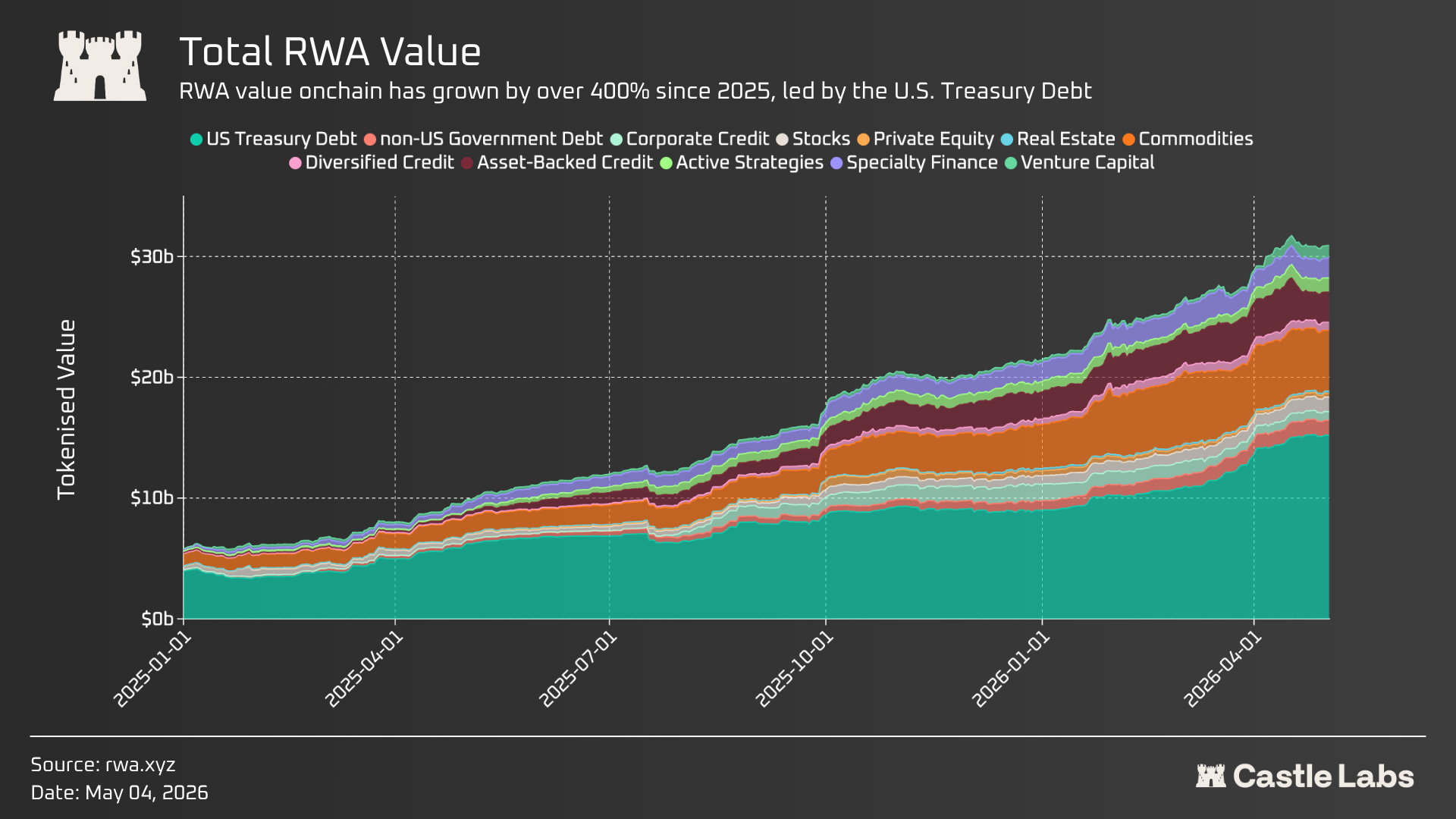
RWAs or tokenised assets are just a way to bring exposure to certain assets onchain like U.S. Treasury Debt, Private Equity, Commodities, Private Credit, Real Estate, and more, basically everything which cannot be produced onchain.
Ultimately, RWAs bring new yield sources onchain. Onchain yield sources are fairly limited, with the core being staking rewards, lending markets, perpetual vaults, and funding rate arbitrage, all of which are net crypto exposure, but RWAs change this.
Offchain yield sources are mature and offer a better risk-to-reward ratio than onchain yield because, with the latter, a user is exposed to hacks, contagion risk, smart contract risk, and many other risk profiles at once, whereas with RWAs, this risk exposure is reduced. Now, RWAs are not risk-free either, but if we consider lower-risk assets like U.S. Treasury Debt, they perform better, especially given that the onchain yields have declined over time and are highly seasonal.
But the real edge is in leveraging RWA yields, which isn’t possible offchain at scale, but DeFi unlocks it through lending protocols.
RWA looping is harder to scale because it can’t be redeemed instantly due to liquidity constraints. To get value out of it, it must go through the full redemption process, which can take a lot of time, making liquidations harder in lending protocols.
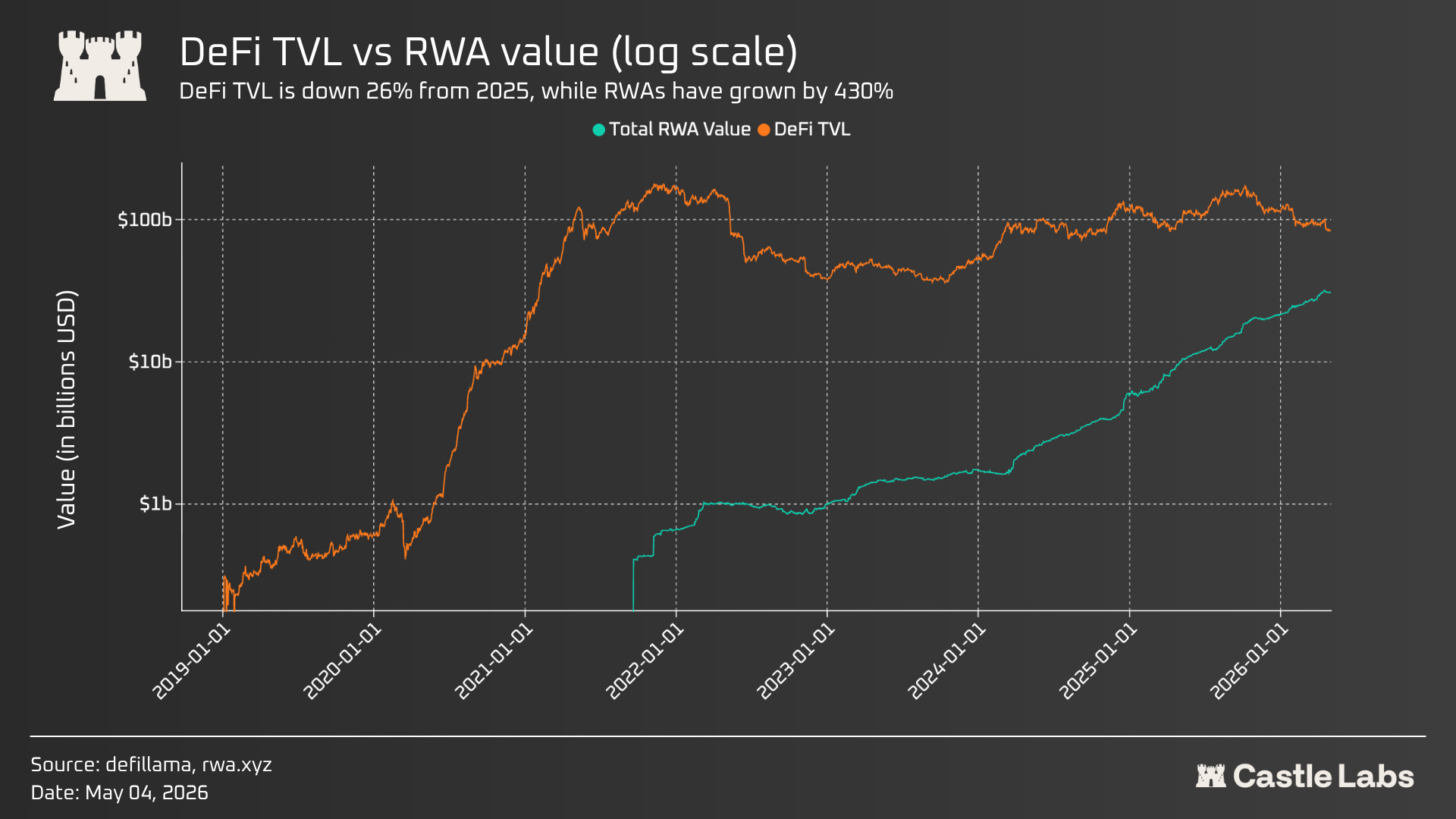
This poses a huge challenge and is also why DeFi TVL didn’t follow the RWA trajectory.
But things are changing as protocols like Redstone have built out a reliable liquidation flow enabling RWA looping at scale. They do this by introducing auction-based liquidations and connecting positions to KYC-verified solvers, who take on the underlying asset offchain and close the position onchain.
RWA growth in DeFi and its scale have been limited, as only $2 billion of tokenised assets are currently used across DeFi, which is ~6-7% of the total RWA value. This equation appears to be evolving as the industry focuses on improving the liquidation flow for these assets.
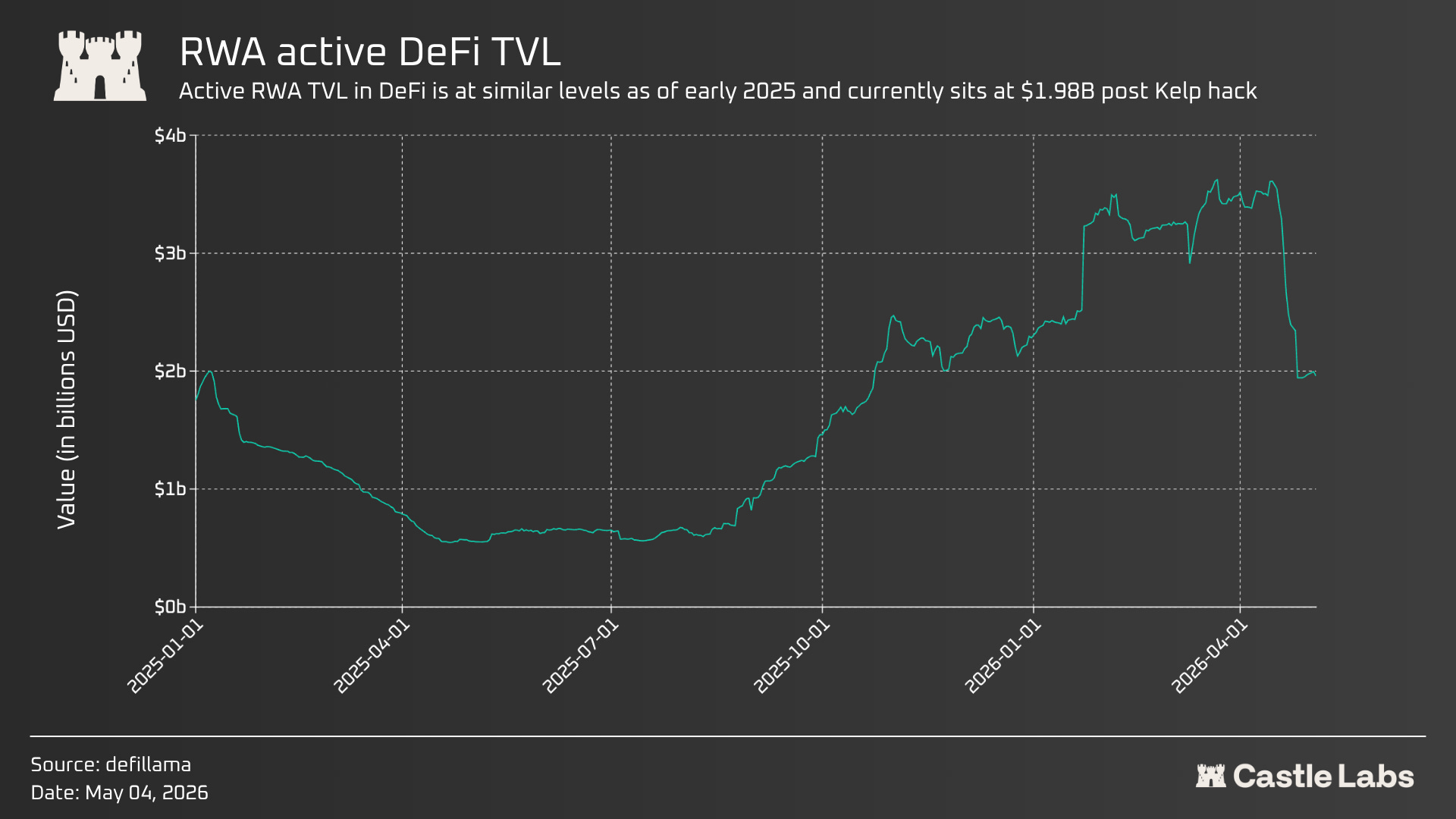
The recent drop in active RWA DeFi TVL, as seen in the chart above, is due to Kelp’s rsETH hack, which prompted users to withdraw assets from lending protocols.

Arbitrum DAO onchain vote on DeFi United disbursement: Snapshot closes May 7, with onchain opening shortly after.
HIP-4 weekly volume and OI: Day 1 cleared ~$6m notional on BTC daily binaries, around 0.7% of daily prediction market activity.
MegaETH’s Growth and KPI targets: First KPI ($500m USDM) ticked. ~677m MEGA committed, 5.3b up for grabs across the eight-week campaign on DefiLlama.
TradeXYZ CBRS-PRE and the second IPOP.Cerebras IPO is set for May 30. We’ll be watching for IPO pricing, CBRS-PRE conversion at listing, and the second IPOP market.
A much stronger close this week, and a positive start to the new month. See you next week.
Don’t forget to join our Telegram channel for the latest updates from Castle and all our research: Link here

In our newsletter, we may discuss projects or tokens in which we hold positions. While we aim to provide informative content, our views are not financial advice. Please conduct your research and consult professionals before making investment decisions. Crypto markets are volatile, and past performance doesn’t guarantee future results. Invest responsibly, and be aware of the risks. Your capital is at risk, and we do not accept liability for any losses.